Financial Reporting
In-Process R&D After an Acquisition: Asset, Expense or Write-Off
For the CFO who bought a company with an unfinished product: when acquired IPR&D is capitalized under ASC 805, when it is expensed, and how it gets valued.
By 409.AI Team - 2026-11-24
# In-Process R&D After an Acquisition: Asset, Expense or Write-Off
If you're the CFO or controller of a company that just bought a business with a product still in development, that unfinished product is about to land in one of three places in your books. It can sit on the balance sheet at fair value as an indefinite-lived intangible. It can hit the income statement on the day you close, in full. Or it can be capitalized now and written off later, when the project slips or stops. Which one happens depends on how the deal is classified, how the project is valued at the close, and what your team does with it afterwards.
This article walks through acquired in-process research and development (IPR&D) under ASC 805: when it is capitalized, how a valuation specialist puts a number on it, what changes when the deal is an asset acquisition instead of a business combination, and what your auditor will test at year end.
What counts as IPR&D
IPR&D is the value of research and development projects the target has started but not finished at the acquisition date: a next-generation device awaiting clearance, a drug candidate in trials, a software platform that works in the lab but has not shipped. It is different from developed technology, the products the target already sells, which is valued and amortized like any other finite-lived intangible.
The AICPA's accounting and valuation guide on assets acquired to be used in research and development activities, finalized in December 2013, is still the reference most valuation specialists and auditors work from. Two practical tests follow from it. The project has to have substance, meaning more than an idea: real work has been done and it can be identified apart from goodwill. And it has to be incomplete, meaning risk remains before it can earn revenue.
Where the line between "in process" and "developed" falls is a judgment. Write it down, project by project, with the milestone that would mark completion. You'll need that same milestone later to decide when amortization starts.
In a business combination, it goes on the balance sheet
Under ASC 805, IPR&D acquired in a business combination is recognized at fair value, whether or not it has an alternative future use. As PwC's comparison of US GAAP and IFRS puts it, these assets are "recognized and measured at fair value and classified as indefinite-lived intangible assets until completion or abandonment." ASC 350-30-35-17A sets that classification.
Indefinite-lived means no amortization while the work continues. It does not mean the number stays put. The asset is tested for impairment at least once a year, and sooner if something suggests it has lost value.
Two points catch acquirers out. First, intent doesn't change the measurement. If you plan to shelve the target's project because it competes with your own, the asset is still measured at what a market participant would pay for it. The AICPA guide treats a project you keep only to protect your own research as a defensive IPR&D asset, still indefinite-lived until the research it defends is completed or abandoned. Second, the private-company alternative doesn't help here. ASU 2014-18 lets a private acquirer fold certain customer-related intangibles and non-competes into goodwill. IPR&D is neither, so it's recognized even when the election is made.
How the number is built
Most IPR&D is valued with the multi-period excess earnings method, the same income method we walked through for customer relationships in a purchase price allocation. Forecast the cash flows the finished product would earn, charge every supporting asset a fair return, and discount what is left. IPR&D adds two inputs most intangibles don't have: the probability that the project reaches the market, and the cost still to be spent to get it there.
Here is an illustrative case. An acquirer pays $50 million for a medical-device software company. Its current product is on the market. Its next-generation product needs about two more years of development and a regulatory clearance before launch. The assumptions:
- If the product launches, its excess earnings from year 3 to year 10, after contributory asset charges for the developed technology it builds on, the workforce and working capital, have a present value of $18 million at a 20% discount rate.
- The chance of reaching launch, based on the project's stage and the clearance history of comparable devices, is 60%.
- The cost to complete is $2.4 million a year for two years, $1.8 million after a 25% tax rate.
The valuation then runs in four steps.
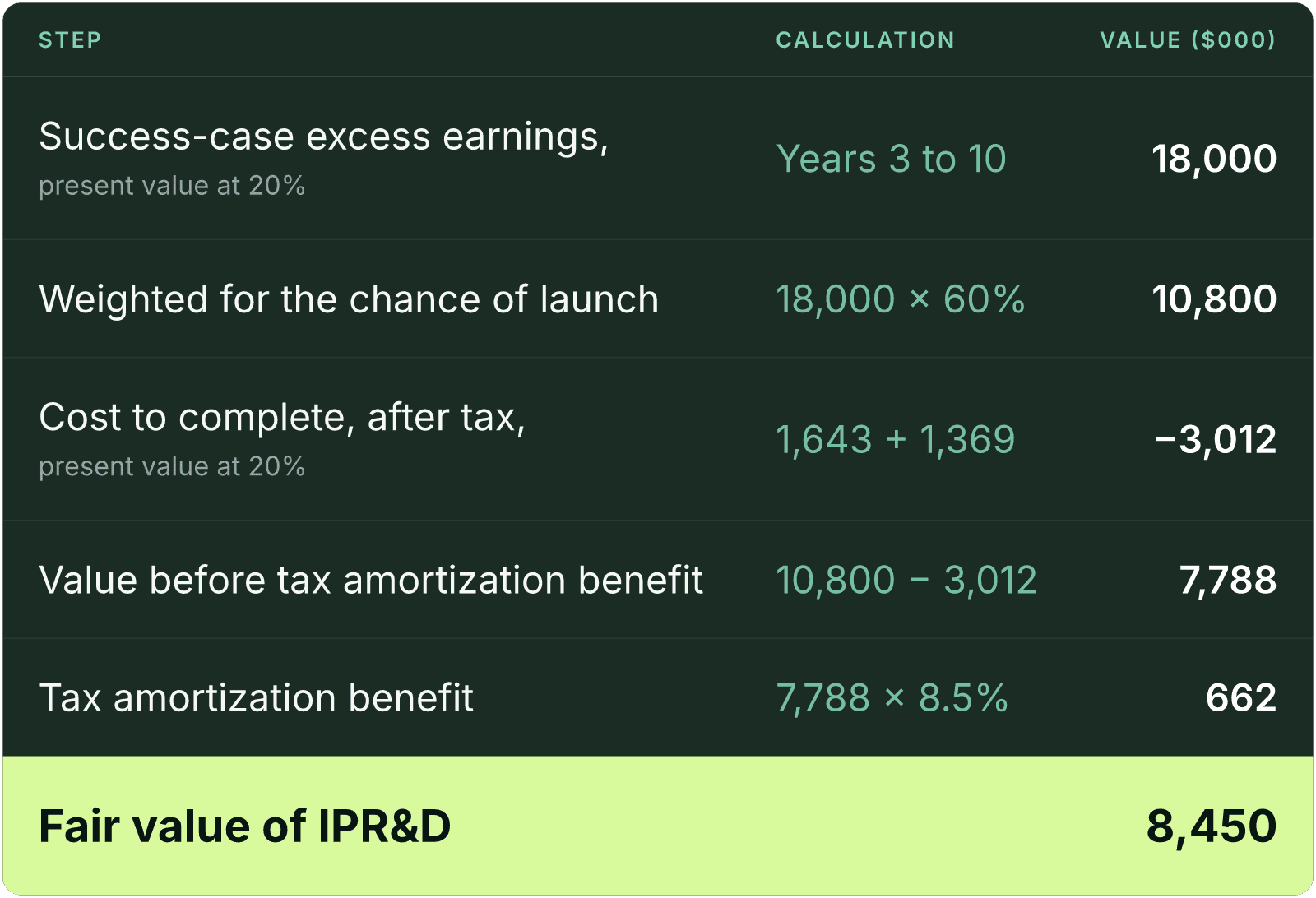

The cost to complete is discounted from mid-year: $1.8 million at a factor of 0.913 in year 1 and 0.761 in year 2. This sketch treats both years of spending as certain. A model built stage by stage would weight the second year's cost by the chance of passing the first milestone, which raises the value slightly. The tax amortization benefit reflects the 15-year amortization under Section 197 that a market participant buying the asset would claim, about 8.5% at these rates.
One input deserves the most scrutiny. If the cash flows are already weighted by a 60% probability of success, the discount rate can't also carry a premium for the same technical risk, or the risk is counted twice. The 20% here prices the commercial risk that remains after a successful launch. Your report should say which risks sit in the probability and which sit in the rate.
Where it lands in the allocation
The full allocation of the $50 million deal, before any measurement-period changes, looks like this.
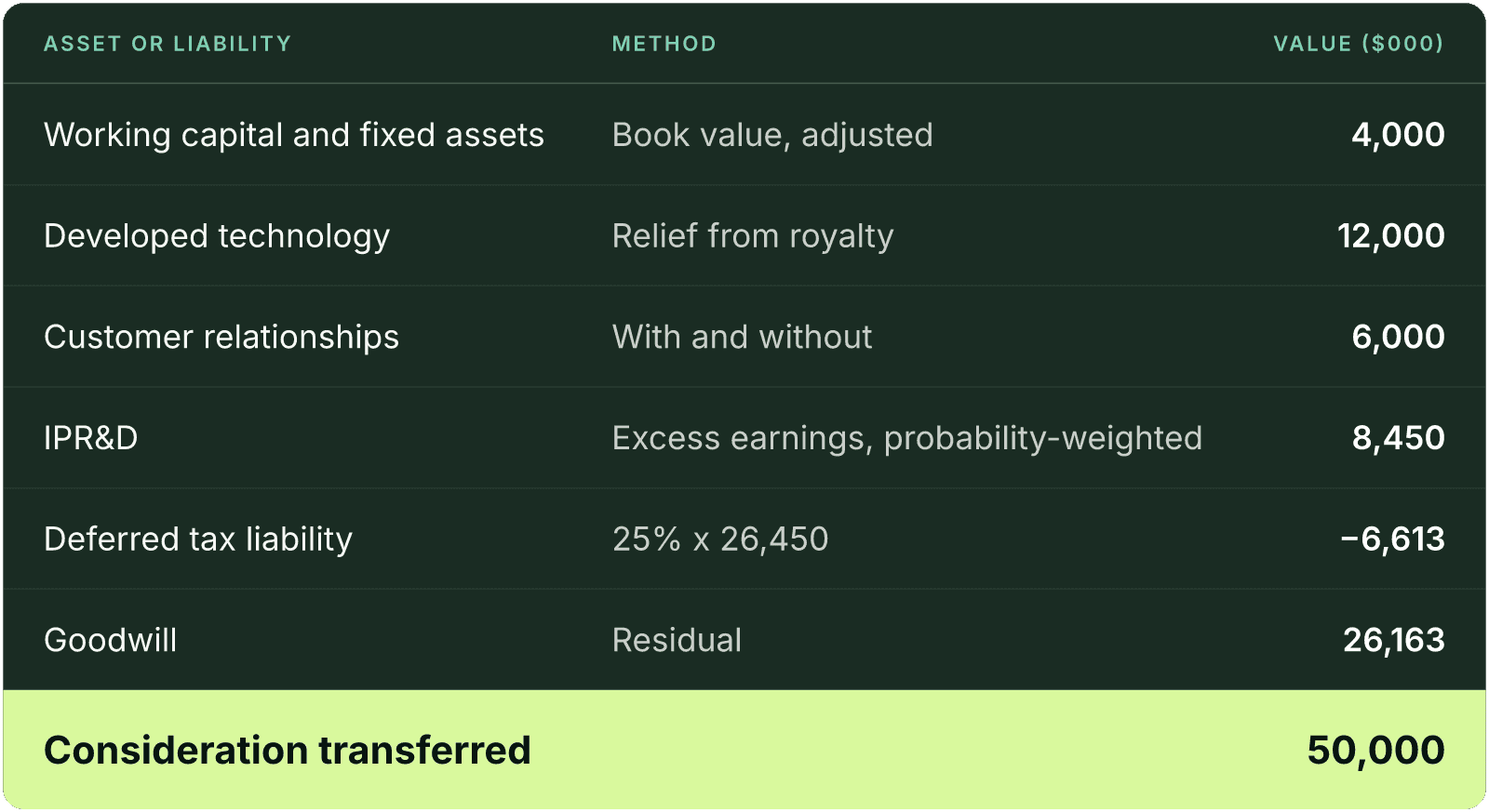

The developed technology and the IPR&D draw on overlapping revenue, so only one of the technology assets should be valued with the excess earnings method on any stream of cash flows. Here the IPR&D carries it, and the current product uses relief from royalty. The deferred tax line assumes a stock deal in which the intangibles have no tax basis, which we explained in deferred taxes in a purchase price allocation. The goodwill residual then has to make sense against the deal's internal rate of return, the test in your purchase price allocation has to reconcile. An IPR&D asset discounted at 20% inside a deal with a 14% IRR is consistent; one discounted at 12% is a question.
In an asset acquisition, it's usually expense on day one
Change the facts. The acquirer pays $12 million for a small company with no product on the market, no customers and two engineers. Nearly all of what it is buying is one unfinished project.
That deal probably isn't a business combination at all. Under the screen test in ASC 805-10-55-5A, when substantially all of the fair value of the gross assets acquired is concentrated in a single identifiable asset or group of similar assets, the set is not a business. We covered the test in detail in asset acquisition or business combination. One IPR&D project is the textbook case.
In an asset acquisition, ASC 730 decides the accounting, and acquired assets to be used in R&D are capitalized only if they have an alternative future use. KPMG's summary of the R&D guidance lays out the decision tree: outside a business combination, no alternative future use means expense. PwC notes that such alternative uses are "expected to be limited." So most of the $12 million becomes R&D expense in the quarter the deal closes.
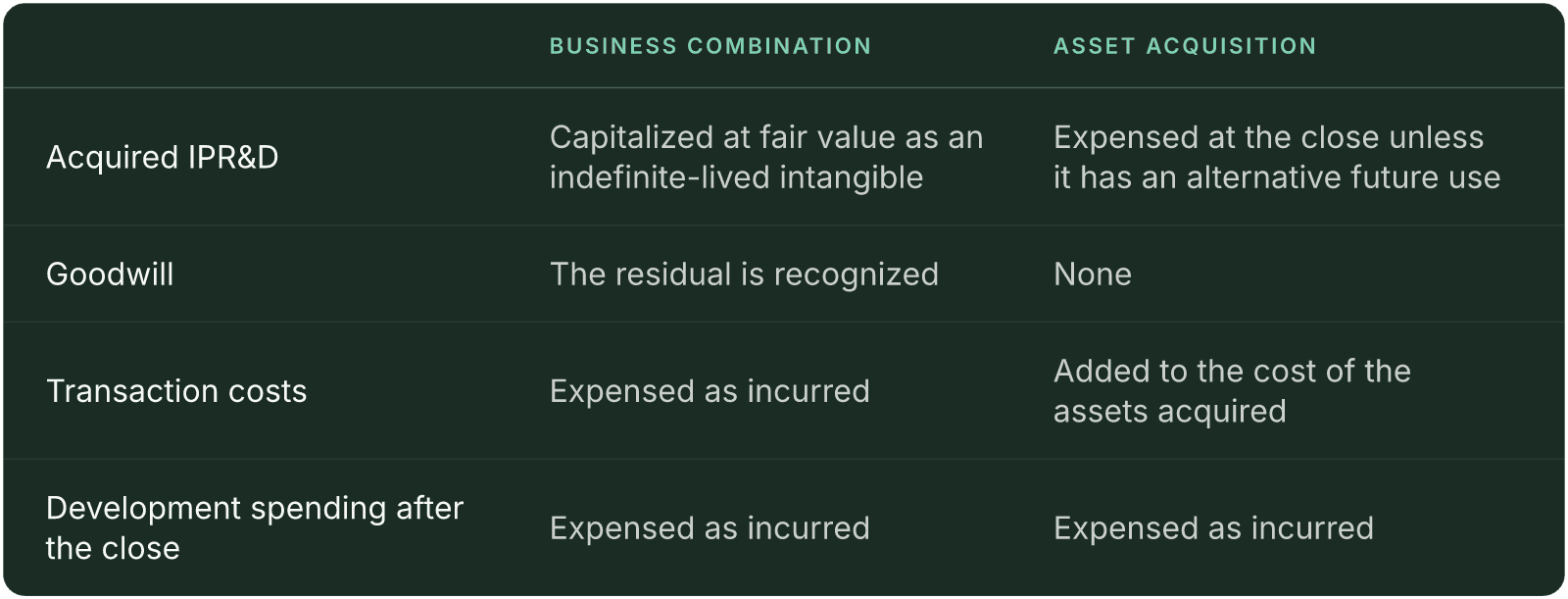

The difference matters beyond the accounting team. A $12 million charge in one quarter changes reported earnings and any covenant tested on them. If the classification is close, settle it before signing, not in the audit.
After the close: three ways the asset moves
An indefinite-lived IPR&D asset changes in one of three ways.
The project is completed. On launch, or at whatever milestone you documented as completion, the asset becomes finite-lived and is amortized over its useful life. That life is a separate estimate, and rarely the patent term, for the reasons in remaining useful life in an IP valuation.
The project is abandoned. The carrying amount is written off. A project that is only paused, with a real intention to restart, is not abandoned, but it's a strong signal for an impairment test.
The project slips or shrinks. A failed trial, a delayed clearance, a competitor launching first or a cut in the budget to finish it can all reduce fair value below the carrying amount, and the difference is an impairment loss. At $8.45 million, our example is sensitive: if the chance of launch drops from 60% to 40%, the same model gives about $4.5 million, and $3.9 million goes through the income statement. Goodwill tied to the same project may need testing too, as we covered in goodwill impairment for private companies.
Development spending after the close is expensed as incurred under ASC 730. It never adds to the IPR&D asset.
What your auditor will ask to see
The valuation specialist on the audit team usually works through the same list:
- The project inventory: every project in process at the close, why each is IPR&D rather than developed technology, and the completion milestone for each.
- The probability of success: its source, the stage it reflects, and why it fits this project rather than an industry table alone.
- The cost to complete: tied to the target's own budget and the acquirer's integration plan.
- The discount rate: set against the WACC and the deal IRR, without double-counting the technical risk.
- The deal classification: the screen test and, if the deal passed it, why the set is a business.
- The plan after the close: board minutes or budgets that support continuing, pausing or stopping each project.
The timeline is the one in what a purchase price allocation costs and what auditors test: the measurement period runs up to a year, but the first audit after a close sets the real deadline.
If your acquisition included a product that hasn't launched yet, the IPR&D line sets your impairment risk for every year until it does. A purchase price allocation that documents the completion milestone, separates the probability from the discount rate and ties the cost to complete to your own plan gives you a number you can defend at the close, and a clear test for the years after it.
About the author
409.AI Team
Startup valuation and equity workflow specialists
The 409.AI team writes practical valuation content for founders and finance teams preparing 409A reports, equity documentation, and related startup finance workflows.
Related valuation reports
- Purchase price allocation report: 409.AI helps acquirers prepare expert-reviewed purchase price allocation reports under ASC 805, with fair value analysis of acquired intangible assets and goodwill.
- 409A valuation report: 409.AI helps private companies prepare expert-reviewed 409A valuation reports for equity compensation and option strike price support.
- Pricing for every report type
- 409A valuation calculator
- Sample 409A report