Financial Reporting
Asset Acquisition or Business Combination? The ASC 805 Screen Test Decides Whether You Book Goodwill
Closing a deal? A controller must first decide: business or asset purchase. The ASC 805 screen test sets goodwill, deal-cost treatment and the auditor file.
By 409.AI Team - 2026-10-31
# Asset Acquisition or Business Combination? The ASC 805 Screen Test Decides Whether You Book Goodwill
You signed the purchase agreement, the wire went out, and now the controller has to book it. Before anyone opens a valuation model, one question sets the whole path: did the company buy a business, or did it buy assets? The answer decides whether the deal produces goodwill, whether the legal fees hit the income statement this quarter, and how much work the auditor expects behind the allocation.
This guide is for the CFO or controller of an acquirer, and for the auditor reviewing the file. It walks through the two-step test in ASC 805, a worked example with the same $10 million price booked both ways, and the evidence worth gathering before the first audit.
Why the label comes first
ASC 805 only applies its full machinery to a business combination. If the thing you bought is not a business, the deal is an asset acquisition and a different, simpler set of rules in ASC 805-50 applies.
The practical differences are large:
- **Goodwill.** A business combination records identifiable assets at fair value and puts the residual in goodwill. An asset acquisition records no goodwill at all.
- **Transaction costs.** In a business combination, the acquirer's deal costs are expensed as incurred. In an asset acquisition they are capitalized into the cost of the assets.
- **How the price is spread.** A business combination allocates fair value. An asset acquisition allocates the total cost, deal costs included, across the assets in proportion to their relative fair values.
- **Contingent consideration.** A business combination records an earnout at its acquisition-date fair value. An asset acquisition generally does not, and the accounting follows other guidance. If an earnout is part of your deal, the [earnout valuation guide](https://www.409.ai/articles/earnout-contingent-consideration-valuation-asc-805) explains how the business-combination treatment works.
Getting the label wrong does not just move a number. It changes which assets exist on the balance sheet and which ones get tested for impairment later.
Step one: the screen test
ASU 2017-01 added a quick screen at the front of the analysis. Look at the gross assets acquired, measured at fair value. If substantially all of that value sits in a single identifiable asset, or in a group of similar identifiable assets, the set is not a business. The analysis stops there and the deal is an asset acquisition.
"Substantially all" is not defined in the standard. Practice generally reads it as roughly 90 percent, borrowing the threshold used elsewhere in US GAAP, and [BDO's discussion of the ASU](https://www.bdo.com/insights/industries/natural-resources/asu-2017-01,-clarifying-the-definition-of-a-busine) notes the same reading. Treat 90 percent as a judgment anchor, not a bright line, and document how you reached the number.
Two details trip people up:
1. Gross assets, not net. The measure uses the consideration transferred (plus any noncontrolling interest and previously held interest, less cash acquired), so liabilities do not shrink the denominator. 2. "Similar" assets. Assets that cannot be separated because the useful life of one depends on the other, or because they have a similar nature and risk profile, can count as one. A building and the in-place leases are the classic pair. A software platform and its source code often work the same way.
A company that buys a patent portfolio, a single codebase, or a drug candidate with nothing around it usually stops at step one. A company that buys a services firm with customers, contracts and a team usually does not, because its value is spread across several different kinds of assets.
Step two: input plus a substantive process
If the screen fails, the set is a business only when it includes at least an input and a substantive process that together significantly contribute to the ability to create outputs. What counts as substantive depends on whether the target is producing revenue yet.
- **Target with outputs (revenue today).** You need an organized workforce that can perform the process, or a process that cannot be replaced without significant cost, effort or delay. Buying customer contracts and a brand without the people who serve them often fails this test.
- **Target without outputs (pre-revenue).** The bar is higher: the set generally needs an organized workforce with the skills and knowledge to perform an acquired process, plus the input it would work on.
An acqui-hire is the common gray area. If the buyer takes the engineers but not the code or the customers, the screen may pass or fail depending on what else came across. Write down what you acquired, what you did not, and why the team does or does not perform a substantive process. [The startup-acquisition walk-through](https://www.409.ai/articles/asc-805-purchase-price-allocation-startup-acquisition) covers how the pieces usually look in a venture-backed target.
The same $10 million, booked both ways
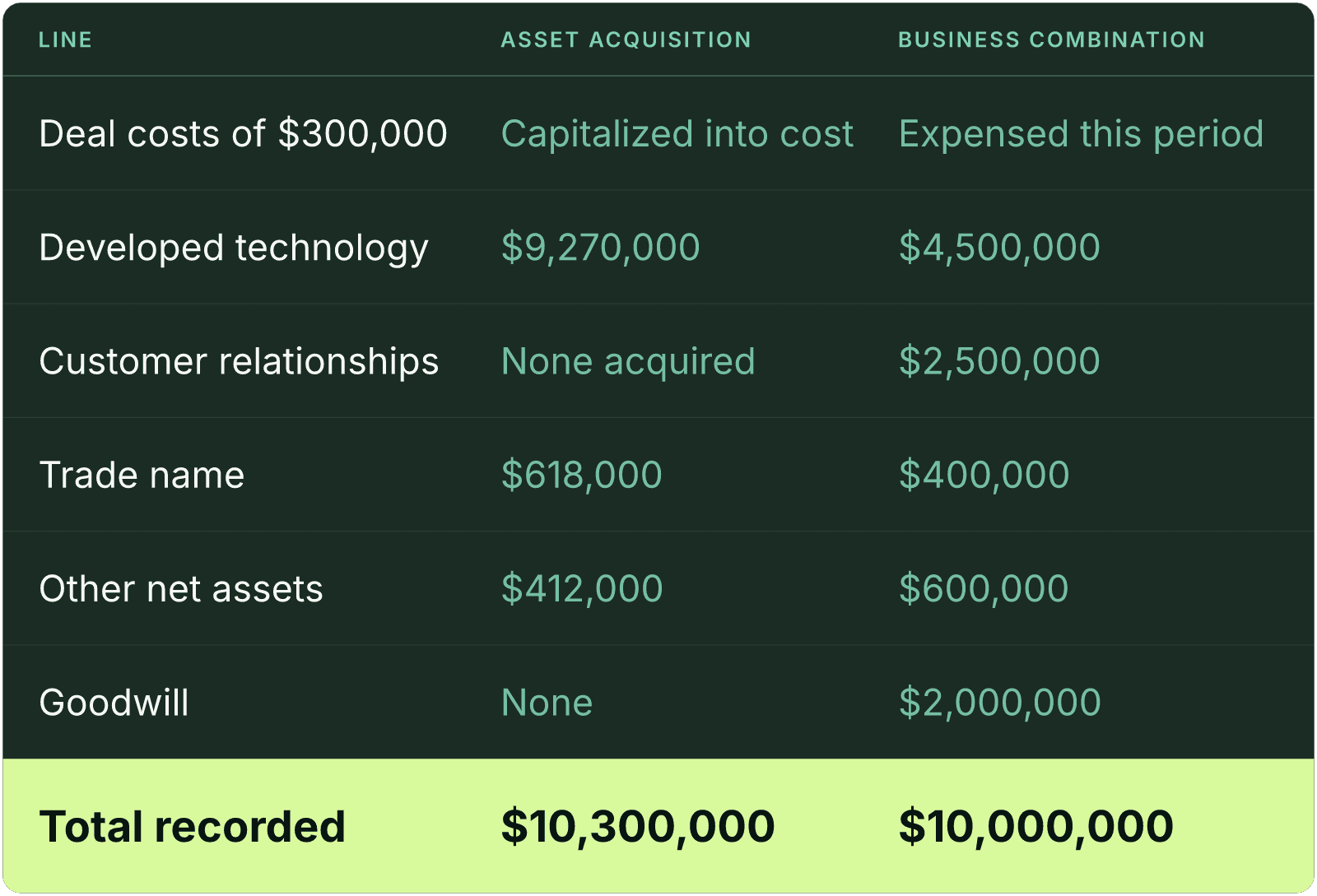
Take a $10 million cash purchase with $300,000 of legal and advisory fees. Suppose the fair values below come out of the valuation work. Scenario one is the purchase of a software codebase and its brand with no customers or team. Scenario two is the purchase of a running software company.
[](https://www.409.ai/uploads/asset_acquisition_vs_business_combination_asc_805_screen_test_goodwill_table_1_dddeab7ecf.png)
In scenario one, the cost of $10,300,000 is spread over the assets by relative fair value. Fair values of $9.0 million (technology), $0.6 million (trade name) and $0.4 million (other) total $10.0 million, so each asset carries 103 percent of its fair value. The technology lands at $9,270,000 and nothing is left over as goodwill.
In scenario two, the identifiable assets total $8,000,000 at fair value. The $10,000,000 price less that amount is $2,000,000 of goodwill, and the $300,000 of fees goes straight to expense.
The point is not that one answer is better. The same cash buys a different balance sheet. Scenario one has no goodwill to test for impairment. Scenario two leaves a goodwill balance that the finance team will carry, and test, for years. The [guide to private-company goodwill impairment](https://www.409.ai/articles/goodwill-impairment-private-company-asc-350) covers what that test involves.
What a private company can simplify
Private companies have two elective alternatives that apply only when the deal is a business combination. ASU 2014-18 lets a private company stop recognizing certain customer-related intangible assets, those that cannot be sold or licensed independently from the business, and noncompetition agreements, folding their value into goodwill. A company that takes it must also adopt ASU 2014-02, which amortizes goodwill, generally over ten years or less.
Both are policy elections, made once, and applied to all future business combinations. They shrink the allocation workload, and the [cost guide](https://www.409.ai/articles/purchase-price-allocation-cost-asc-805-what-auditors-test) explains how that changes what the auditor tests. They also change the shape of the result: more goodwill, less separately identified intangibles, and a goodwill amortization charge in every period. Make the election deliberately and before the first deal closes, not while the allocation is open.
What the auditor asks for
Auditors reviewing an acquisition ask for the conclusion and the reasoning behind it, in that order. A file that holds up usually contains:
- the signed agreement and a list of what transferred (assets, contracts, employees, IP);
- the screen test calculation, with fair values by asset class and the percentage in the largest group;
- if the screen failed, a memo on inputs, processes and the workforce, including which employees stayed;
- the valuation of the identified assets, with the discount rate and cash flow assumptions;
- the treatment of deal costs and any contingent payments that follows from the conclusion.
The auditor reads this file before testing the allocation itself. If the conclusion is thin, the allocation work behind it gets tested harder.
Do this before the wire, not after
Run the screen on the term sheet, not on the closing balance sheet. A rough fair value split by asset class takes a day and tells you which path to plan for. If the answer is close to the 90 percent line, get the valuation done early and let the judgment follow the numbers.
If you are heading toward a business combination, the clock matters too: ASC 805 gives the acquirer up to one year to finalize the allocation, and the first audit rarely waits for it. [Purchase price allocation at 409.AI](https://www.409.ai/products/purchase-price-allocation) is a flat $9,999 engagement reviewed by a valuation expert, scoped to the ASC 805 fair values your auditor will test. Whatever route you take, decide the label first. Every number after it depends on it.