Education
Remaining Useful Life in an IP Valuation: Why the Patent Term Is Rarely the Answer
For founders, CFOs and tax advisors valuing a patent, codebase or brand: how remaining useful life is set, and why it moves value as much as the royalty rate.
By 409.AI Team - 2026-11-18
# Remaining Useful Life in an IP Valuation: Why the Patent Term Is Rarely the Answer
If you are a founder, CFO or tax advisor ordering a valuation of one intangible asset (a patent family you are licensing out, a codebase moving into a holding company, a brand going to a foreign affiliate), the number most people argue about is the royalty rate. The number that quietly moves the value just as much is the asset's remaining useful life: how many more years it will earn money for whoever owns it.
Get the life wrong and a defensible rate still produces an indefensible value. This article explains where a remaining useful life comes from, why the legal term is only a ceiling, and what an appraiser, an auditor or an IRS examiner will want to see behind the figure.
What the life does to the value
Every income-based method for a single asset works the same way. Relief from royalty projects the royalty an owner avoids paying; the excess earnings method projects the profit the asset produces after charges for everything else it relies on. Either way, the cash flows run for a set number of years and stop. The life decides when they stop and how fast they fade before then.
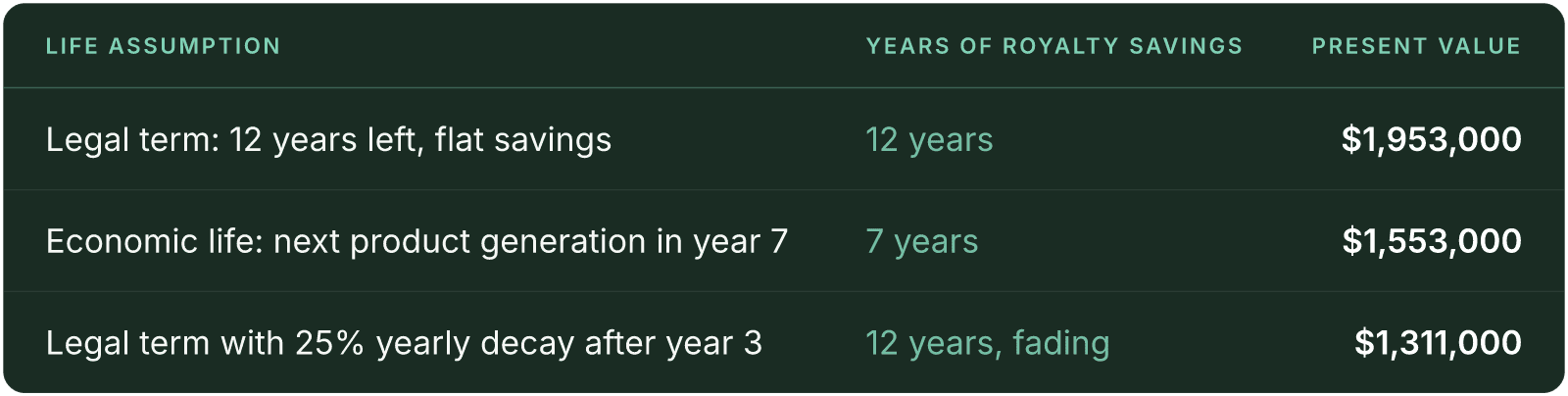
A quick example shows the size of it. Take a patent family covering a product line with $10 million of annual revenue. The comparable licences support a 5% royalty, so the owner avoids $500,000 a year, or $375,000 after a 25% tax rate. Discount at 18%, mid-year, and run the same cash flow under three different lives (illustrative figures):
[](https://www.409.ai/uploads/remaining_useful_life_ip_valuation_patent_software_trademark_table_1_2bac0e32be.png)
Same rate, same discount rate, same revenue. The value ranges from $1.31 million to $1.95 million, a spread of about 49% on the low figure, purely on how long and how evenly the asset earns. That is the kind of gap a buyer, a licensee, an auditor or an examiner notices.
Legal life is a ceiling, not an estimate
Each kind of IP comes with its own legal clock, and that clock tells you the latest date the asset can earn as a protected right. It rarely tells you when it actually stops earning.
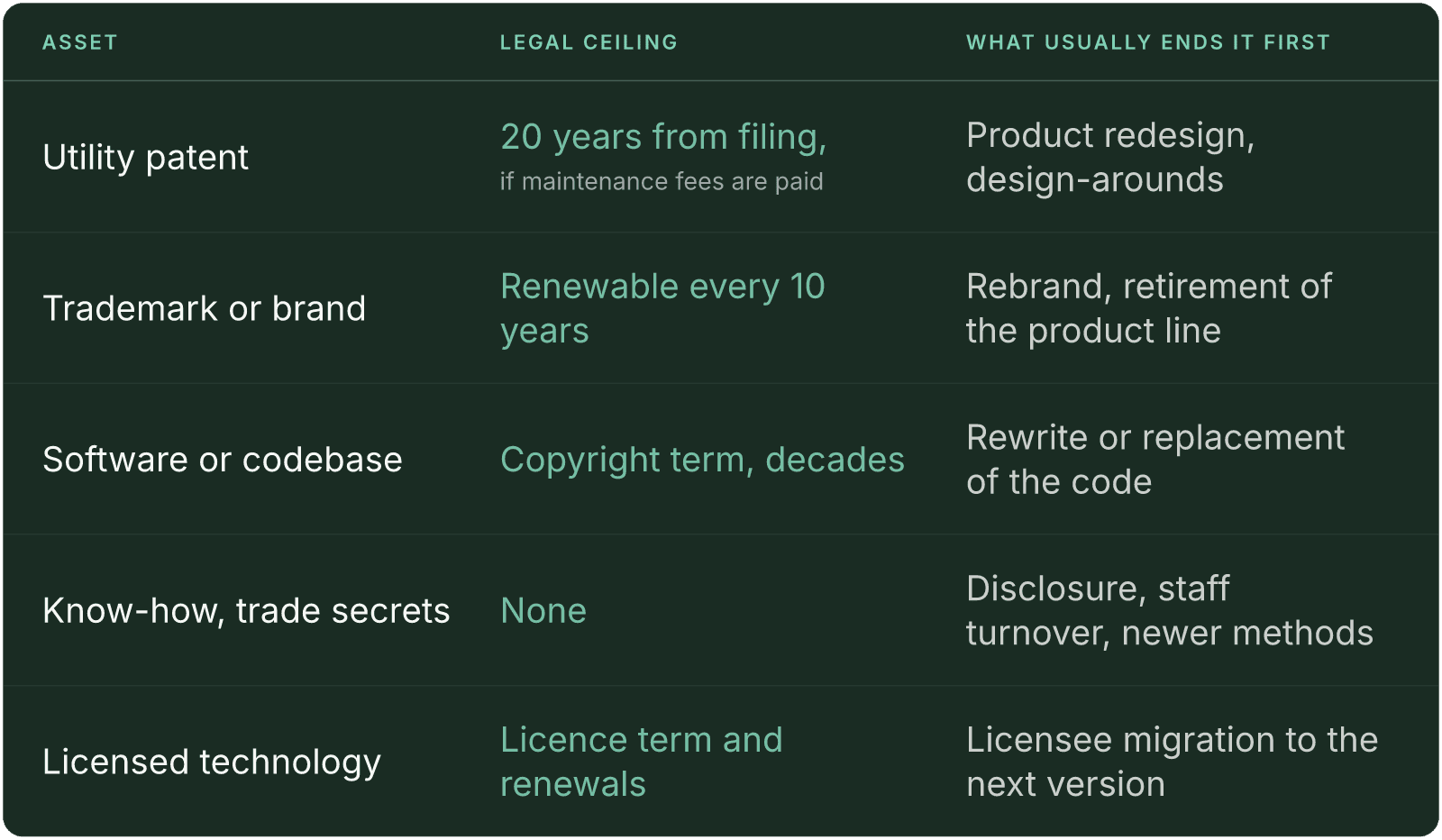
For a US utility patent, the term ends 20 years from the date the application was filed, or from the earliest US or international application it claims priority to ([35 U.S.C. 154](https://www.law.cornell.edu/uscode/text/35/154)). Patent term adjustment can add days for delays at the patent office, so the expiry date is read from the patent record, not counted from memory. The patent also has to be kept alive: maintenance fees fall due at 3 years and 6 months, 7 years and 6 months, and 11 years and 6 months after grant, and if a fee is not paid within the six-month grace period, the patent expires at the end of that grace period ([35 U.S.C. 41(b)](https://www.law.cornell.edu/uscode/text/35/41)). A family where the owner has stopped paying fees on some members has a shorter life than its filing dates suggest.
A federal trademark registration has no fixed end. It can be renewed for 10-year periods for as long as the owner files and pays ([15 U.S.C. 1059](https://www.law.cornell.edu/uscode/text/15/1059)), and a brand in active use may be treated as having an indefinite life. Software is protected by copyright for decades, which makes its legal life meaningless for valuation: code earns until it is rewritten or replaced. Trade secrets and know-how have no term at all; they last as long as they stay secret and useful.
So the legal term answers one question: could the asset earn past this date? Everything else in the life estimate is about why it probably won't.
What actually ends an asset's earning life
The accounting standard sets out the same reasoning an appraiser uses. Under ASC 350-30-35-3, the useful life of an intangible is estimated from an analysis of all pertinent factors, among them the owner's expected use of the asset, legal, regulatory or contractual provisions that limit it, experience renewing or extending similar arrangements, and the effects of obsolescence, demand, competition and other economic factors. None of these factors outranks the others ([Deloitte, Roadmap on goodwill and intangible assets, 4.2](https://dart.deloitte.com/USDART/home/codification/assets/asc350-20/goodwill/chapter-4-subsequent-accounting-for-intangible/4-2-determining-useful-life-an)). The IRS guidelines for valuing intangible property list "expected remaining useful life and legal life" as separate inputs and tie the life to how long the economic benefit continues, which may depend on the product life cycle ([IRM 4.48.5](https://www.irs.gov/irm/part4/irm_04-048-005)).
In practice, four things end an asset's earning life before its legal term does.
The next product generation. A patent on a sensor design earns only while products built on that design sell. When the roadmap shows a redesign in year 6 that relies on different claims, the patent's royalty base shrinks from that year, whatever its expiry date.
Design-arounds and competing technology. A patent with narrow claims that competitors can engineer around earns less each year as they do. This is usually modelled as a decay rather than a cliff.
The rewrite cycle. For software, the useful life is the period until the code is substantially replaced. A codebase that the team rewrites every five to seven years, and that is being rewritten now, cannot carry a ten-year life.
Customer migration. Technology licensed into a customer base fades as customers move to the next version. Historical migration data, when it exists, is the strongest evidence a report can show.
Cliffs and curves
A life is not only a number of years; it is a shape. The simplest model runs full cash flows until a cutoff year and then stops. That fits a patent whose product line has a known replacement date, or a licence that ends on a fixed date.
Most technology does not stop like that. Its share of revenue declines as newer technology replaces it, which is why many reports apply a decay rate or a survivor curve: the portion of revenue still attributable to the existing technology falls each year. In the example above, a 25% yearly decay after year 3 cuts the value by more than a 7-year cutoff does, because the early years carry most of the present value and the decay starts early.
The shape has to come from evidence. Good sources are the company's own release history (how long earlier generations sold), the engineering roadmap, renewal and churn data for licensed technology, and the term and renewal history of comparable licence agreements. A report that picks a decay rate without saying where it came from is the first thing a reviewer will question.
The table below summarises where each common asset's life usually comes from.
[](https://www.409.ai/uploads/remaining_useful_life_ip_valuation_patent_software_trademark_table_2_f0fee27e1a.png)
Tax life is a different number
One more confusion is worth clearing up. For tax, an acquired intangible covered by Section 197 is amortised ratably over 15 years starting with the month it was acquired ([26 U.S.C. 197(a)](https://www.law.cornell.edu/uscode/text/26/197)), whatever its economic life. Self-created intangibles are generally outside Section 197 unless they arise in the acquisition of a business, and off-the-shelf software is excluded entirely.
That 15-year period matters in a valuation, but in a different place. When a value includes a tax amortisation benefit (the value of the deductions a buyer of the asset would take), that benefit is usually calculated over the 15-year tax period. It does not mean the asset earns for 15 years. A report that mixes the two, using 15 years as the economic life because that is the tax life, has a mistake an examiner can point to.
Where the life gets tested
Who challenges the life depends on why the valuation exists.
In a transfer of IP to a foreign affiliate, the life drives the deemed royalty stream and the tax due on it, which is why it gets as much attention as the rate. We covered the mechanics in [moving your IP to a foreign subsidiary under Section 367(d)](https://www.409.ai/articles/section-367d-ip-transfer-foreign-subsidiary-valuation). In a sale or licence of a patent, the buyer's diligence will compare your life to the claim scope and the product roadmap. In financial reporting, the auditor tests the life against the ASC 350-30-35-3 factors, and a life that later proves too long leads to faster amortisation or an impairment, the scenario in [testing a trade name for impairment under ASC 350-30](https://www.409.ai/articles/trade-name-impairment-asc-350-30-indefinite-lived-intangible-relief-from-royalty). Intangibles acquired in a business combination go through the same reasoning inside a purchase price allocation, where customer relationships carry an attrition curve, as in [valuing customer relationships with the MPEEM](https://www.409.ai/articles/customer-relationships-purchase-price-allocation-mpeem-contributory-asset-charges-attrition).
In each case the question is the same: why this many years, and why this shape?
What to have ready before you order the valuation
The life is built from facts the company holds, so the work goes faster when they arrive with the request:
- the patent schedule with filing, priority and grant dates, and the maintenance fee status of each family member;
- the product roadmap, with the expected date each product built on the asset is replaced;
- release history for earlier generations of the product or the code;
- revenue by product, so the royalty base can follow the asset rather than the whole company;
- every licence of the asset, in or out, with its term, renewals and termination rights.
With those in hand, the life is a supported estimate instead of a round number. For the methods that sit on top of it, see [how startup IP actually gets valued](https://www.409.ai/articles/startup-ip-intangible-asset-valuation-methods) and [where the royalty rate comes from](https://www.409.ai/articles/relief-from-royalty-royalty-rate-ip-valuation-comparable-licences). If you need a standalone value for one asset, a 409.AI [IP and intangible asset valuation](https://www.409.ai/products/ip-valuation) documents the life alongside the rate and the discount rate.
The takeaway
Before you argue about a royalty rate, ask the plainer question: how many years will this asset really earn, and does that income stop suddenly or fade? Start from the legal expiry date, then cut it back to the earliest of the product redesign, the code rewrite or the point where customers move on, and put the evidence for that date in writing. On a patent family worth seven figures, that one assumption can move the value by hundreds of thousands of dollars, and it is the part of the report you can document best.