Financial Reporting
Your Purchase Price Allocation Has to Reconcile: IRR, WACC and the Return on Goodwill
After an acquisition closes, your auditor tests whether your intangibles and goodwill earn returns that tie to the deal IRR. How the ASC 805 check works.
By 409.AI Team - 2026-11-03
# Your Purchase Price Allocation Has to Reconcile: IRR, WACC and the Return on Goodwill
If you are the CFO or controller of a company that just closed an acquisition, the number your auditor will question first is rarely the value of one intangible. It is whether the whole allocation hangs together. You paid a price. The valuation split that price across working capital, equipment, a trade name, technology, customer relationships and goodwill. The auditor then asks a simple question: do those pieces, taken together, earn the return the deal was priced to earn?
That question is the reconciliation of the internal rate of return (IRR), the weighted average cost of capital (WACC) and the weighted average return on assets (WARA). It is a reasonableness check, not a line in the Codification, and it catches more bad allocations than any single assumption review. This article shows how it works with one worked example, what moves it, and what to have ready before the year-end audit.
What the standards ask, and what the check adds
Under ASC 805, the acquirer measures the identifiable assets it acquired and the liabilities it assumed at acquisition-date fair value (ASC 805-20-30-1). Goodwill is what is left: the consideration transferred, plus any other amounts the standard requires, less the net identifiable assets (ASC 805-30-30-1). Fair value follows ASC 820, which means the assumptions are those of a market participant, not your own plans for the business (ASC 820-10-35-9).
Nothing in ASC 805 tells you the allocation must tie to a rate of return. The check exists because the pieces are connected by arithmetic. If you pay $50 million for a business, the cash flows you expect from it, discounted at the deal's IRR, are worth $50 million. Each asset inside it carries its own required return. Weight those returns by the fair value of each asset and the result should land close to the IRR. When it does not, one of the inputs is wrong, and the auditor, or a valuation specialist working for the auditor, will go looking for which one.
Practice guidance from the AICPA on valuing acquired assets describes this kind of reconciliation, and auditors apply it under the standards for testing accounting estimates, including [what your first audit actually tests](https://www.409.ai/articles/first-audit-409a-valuation-au-c-540-assumptions) about management's assumptions and data. For the broader picture of what an auditor examines in an allocation, see [how much a purchase price allocation costs and what the auditor tests in it](https://www.409.ai/articles/purchase-price-allocation-cost-asc-805-what-auditors-test).
The three rates, in plain terms
The IRR is the discount rate at which the forecast cash flows of the acquired business equal the price paid. It is derived from the deal, so it is the one rate nobody can argue with: it falls out of your own model and the price on the closing statement. If the forecast includes synergies that only your company can capture, strip them out first. A market participant would not pay for them, and the allocation is not measured on them.
The WACC is the return a market participant would require on the business as a whole, built from the cost of equity and the cost of debt at a market capital structure. In a deal priced at arm's length with no buyer-specific synergies, the IRR and the WACC should sit near each other. A large gap means the price included something beyond what the forecast supports, or the forecast is more cautious or more optimistic than the market would be.
The WARA is the weighted average of the returns required on each asset class, weighted by fair value. Working capital earns something close to a short-term borrowing rate. Fixed assets earn a little more, because a lender will finance them. Intangibles earn more, because they are riskier and cannot be financed against. Goodwill earns the most, because it is the residual and takes the risk of every forecast error above it. The WARA is the number you compare with the IRR.
A worked example
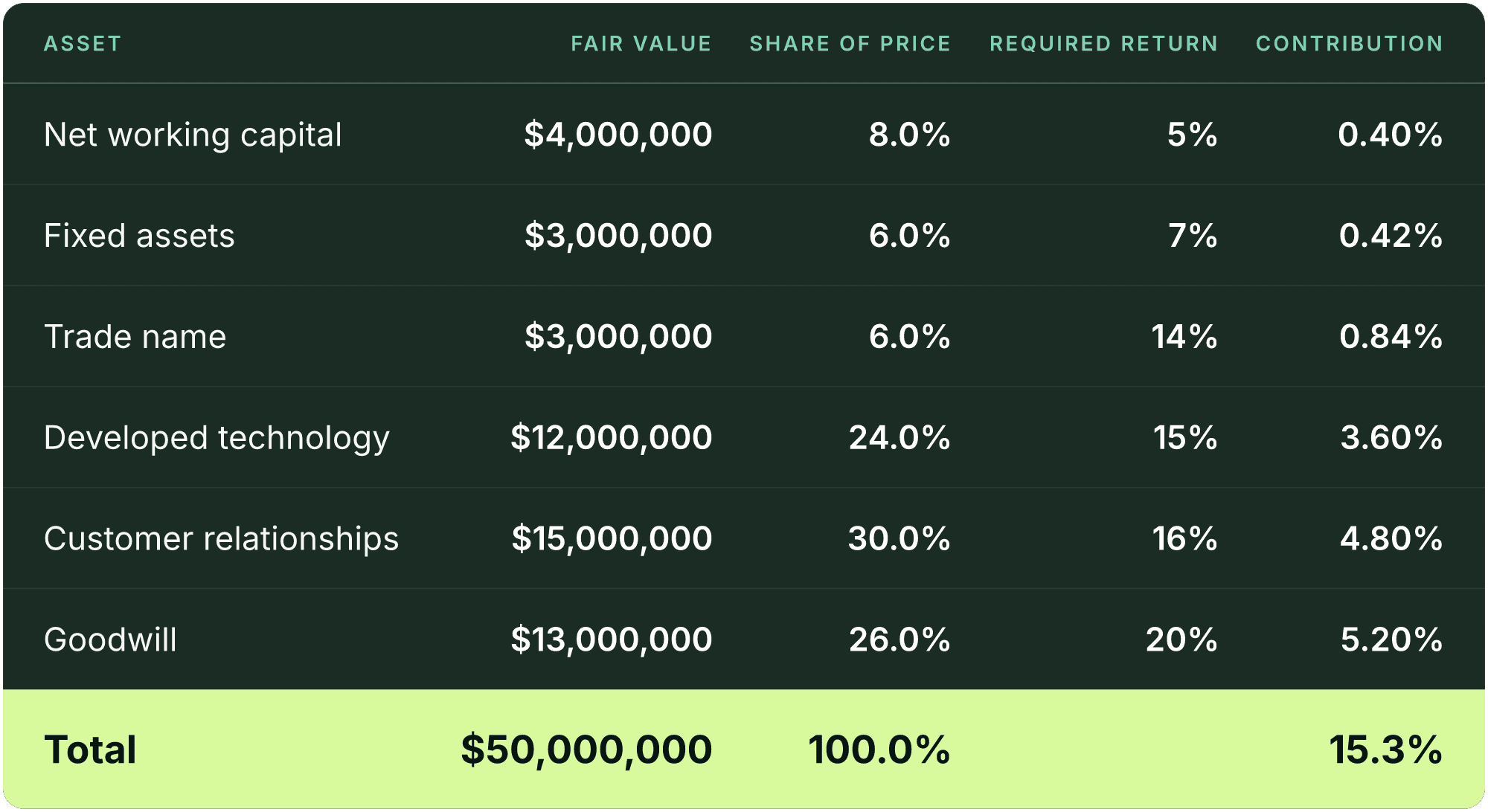
A company buys a software business for $50 million in cash. The deal model gives an IRR of 15.0%, and the valuation specialist's WACC for the business comes out at a similar level. The allocation and the returns assigned to each asset look like this.
[](https://www.409.ai/uploads/purchase_price_allocation_reconcile_irr_wacc_wara_goodwill_return_asc_805_table_1_2ae0e5b20f.png)
The contribution column is the share of price multiplied by the required return, and the total is the WARA: 15.3%, against a deal IRR of 15.0%. A gap of three tenths of a point is small enough to explain, because the rates assigned to each asset are judgments and no model hits the IRR to the decimal.
Now suppose the first draft of the allocation values customer relationships at $26 million, because the revenue forecast used in the excess earnings method assumes a low attrition rate, and leaves goodwill at $2 million. The other assets stay the same. Customer relationships now carry 52% of the price at 16%, and goodwill only 4% at 20%.
The WARA falls to 14.4%, 0.6 points under the IRR. Nothing in that draft looks wrong line by line. The reconciliation shows the problem anyway: too much of the price sits in an asset that earns less than the residual should, so either the customer relationships are overvalued or the goodwill is too thin to carry the risk the deal took. The valuation goes back for a second look at attrition, and the auditor's specialist would have asked the same question.
What moves the reconciliation
Most gaps trace back to one of five inputs.
Attrition and the forecast behind customer relationships
Customer relationships are usually valued with the multi-period excess earnings method: forecast the revenue from existing customers, subtract the costs to serve them and a charge for every other asset that helps produce the cash flows, then discount what is left. A one-point change in the annual attrition rate moves the value of the asset by millions in a business with long-lived customers. The auditor will ask where the attrition rate comes from. Your own customer cohorts, tested against the years before the deal, are the answer they want to see.
Contributory asset charges
The excess earnings method deducts a charge for each contributory asset: working capital, fixed assets, the trade name, the workforce, the technology. If the charges are too low, the intangible looks more valuable than it is. If they double count an asset, it looks less valuable. The charges also have to use the same fair values and returns that appear in the WARA table, which is why the two exhibits should be built from one set of assumptions.
The discount rate on each intangible
The rate for a trade name or a customer list is built on the WACC with a premium for the extra risk of that asset. Developed technology in a fast-moving market gets a higher premium than a trade name with decades of use. A rate chosen without a stated reason is the first thing a reviewer will mark.
Synergies
If the forecast behind the IRR includes cost savings or revenue only your company can capture, the IRR is higher than the one a market participant would use, and the reconciliation will look off in the wrong direction. Separate the buyer-specific synergies before comparing rates. Market-participant synergies can stay in the fair value of the assets, but the file should say which are which.
Contingent consideration
When part of the price depends on future results, the fair value of the earnout is part of the consideration transferred, and it changes the price that the allocation has to fit. If you priced the deal at $50 million of cash plus an earnout, the IRR has to be computed on both. The mechanics are covered in [what "up to $20 million" is actually worth on day one](https://www.409.ai/articles/earnout-contingent-consideration-valuation-asc-805).
What to have ready for the audit
The reconciliation belongs in the file from the start, because ASC 805 gives you a measurement period of up to one year from the acquisition date to finish provisional amounts (ASC 805-10-25-13 through 25-19), and the first audit usually arrives before that year ends. A file that opens with the IRR, the WACC and the WARA exhibit, and then shows each asset behind it, shortens the auditor's questions. It should hold:
- the deal model, with the synergies that only you can capture removed and the forecast tied to what the board approved;
- the build-up of the WACC and of each asset's required return, with the sources of every input;
- the contributory asset charges and the fair values they use;
- the WARA table, built from the same numbers, with the gap to the IRR explained when it is more than a few tenths of a point;
- the attrition, royalty and growth assumptions, each against your own history.
Two related topics sit next to this one. Whether the deal is a business combination at all, and so whether goodwill appears, is decided before any of this by the [ASC 805 screen test](https://www.409.ai/articles/asset-acquisition-vs-business-combination-asc-805-screen-test-goodwill). And the goodwill this exercise produces becomes the carrying amount that [a private company tests for impairment](https://www.409.ai/articles/goodwill-impairment-private-company-asc-350) later, so the cleaner the allocation, the easier those tests are to support. If you want the overall method first, [how an acquisition is split into intangibles and goodwill](https://www.409.ai/articles/asc-805-purchase-price-allocation-startup-acquisition) is the starting point.
The takeaway
Before the valuation is final, ask for one page: the IRR, the WACC and the WARA, side by side, with the gap explained. If the page is missing, or the three numbers are far apart with no reason given, the allocation is not ready for an auditor, whatever each line looks like on its own. [409.AI prepares purchase price allocations](https://www.409.ai/products/purchase-price-allocation) with this reconciliation in the report, at a flat $9,999.