Financial Reporting
Deferred Taxes in a Purchase Price Allocation: Why a Stock Deal Grows Goodwill
A CFO's guide to the deferred tax liability in an ASC 805 allocation: why a stock deal with no election adds $5.75M to goodwill and an asset deal does not.
By 409.AI Team - 2026-11-10
# Deferred Taxes in a Purchase Price Allocation: Why a Stock Deal Grows Goodwill
You closed a stock acquisition for $50 million, your valuation firm sent back an ASC 805 allocation, and goodwill came out about $5.75 million higher than the simple subtraction you ran in the model. Nothing is wrong. A deferred tax liability sits in the allocation, and a controller who has not seen one before usually finds it when the auditor asks about it.
This article is for the CFO or controller of a company that just closed an acquisition, and for the auditor reading the opening balance sheet. It explains where the deferred tax line comes from, why it depends on how the deal was structured for tax, and what it does to goodwill, to the income statement and to the next impairment test.
The allocation has two ledgers, book and tax
An ASC 805 allocation records every identifiable asset and liability at fair value and puts the leftover in goodwill. Your tax return keeps a second ledger. It records each asset at its tax basis, which is what the tax code lets you depreciate or amortize.
When the two ledgers disagree about an asset, ASC 740 says the acquirer records the tax effect of the gap as a deferred tax asset or liability. The business combination guidance, ASC 805-740, applies that rule to acquired assets and liabilities, and the FASB's Codification is the source to cite in your memo.
The disagreement is rarely small. In an acquisition the fair value of customer relationships, developed technology and a trade name is often far above what anyone paid tax on. Whether that gap exists on the tax side depends entirely on one question: did the buyer get a stepped-up tax basis?
Stock deal without an election: carryover basis
In a plain stock purchase the target keeps its own tax history. Its assets carry the same tax basis they had before the close, and the intangibles that the target built itself usually carry a basis of zero or close to it. The buyer pays for them, books them at fair value, and gets no new tax deductions.
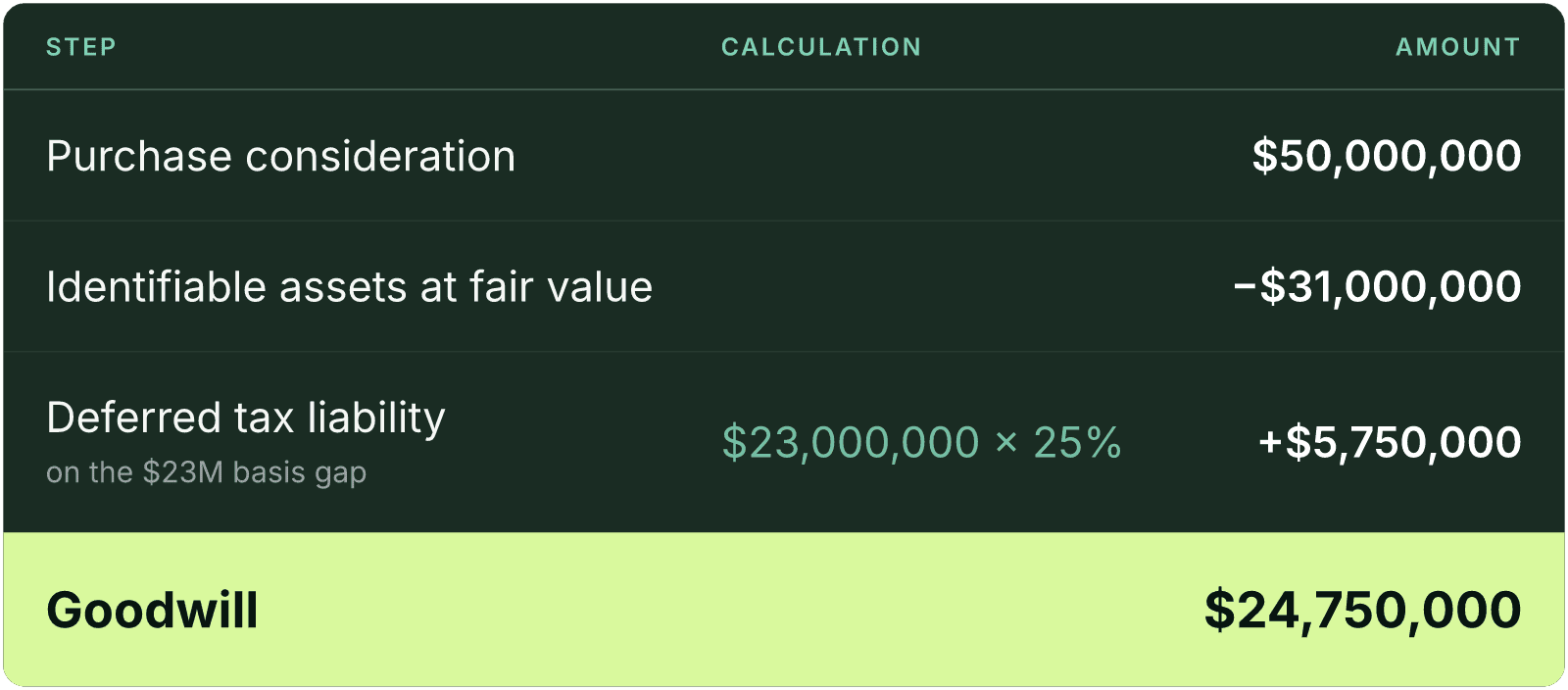
So the book basis of the customer list is, say, $12 million and its tax basis is nothing. Eventually that $12 million of book value will be amortized with no matching tax deduction, which means future taxable income will be higher than future book income. ASC 740 requires you to recognize that future tax cost now, as a deferred tax liability of the gap times the enacted tax rate.
Goodwill is the residual of the allocation, so the liability lands there. A bigger liability means a smaller net identifiable asset total, which means a bigger plug.
A worked example
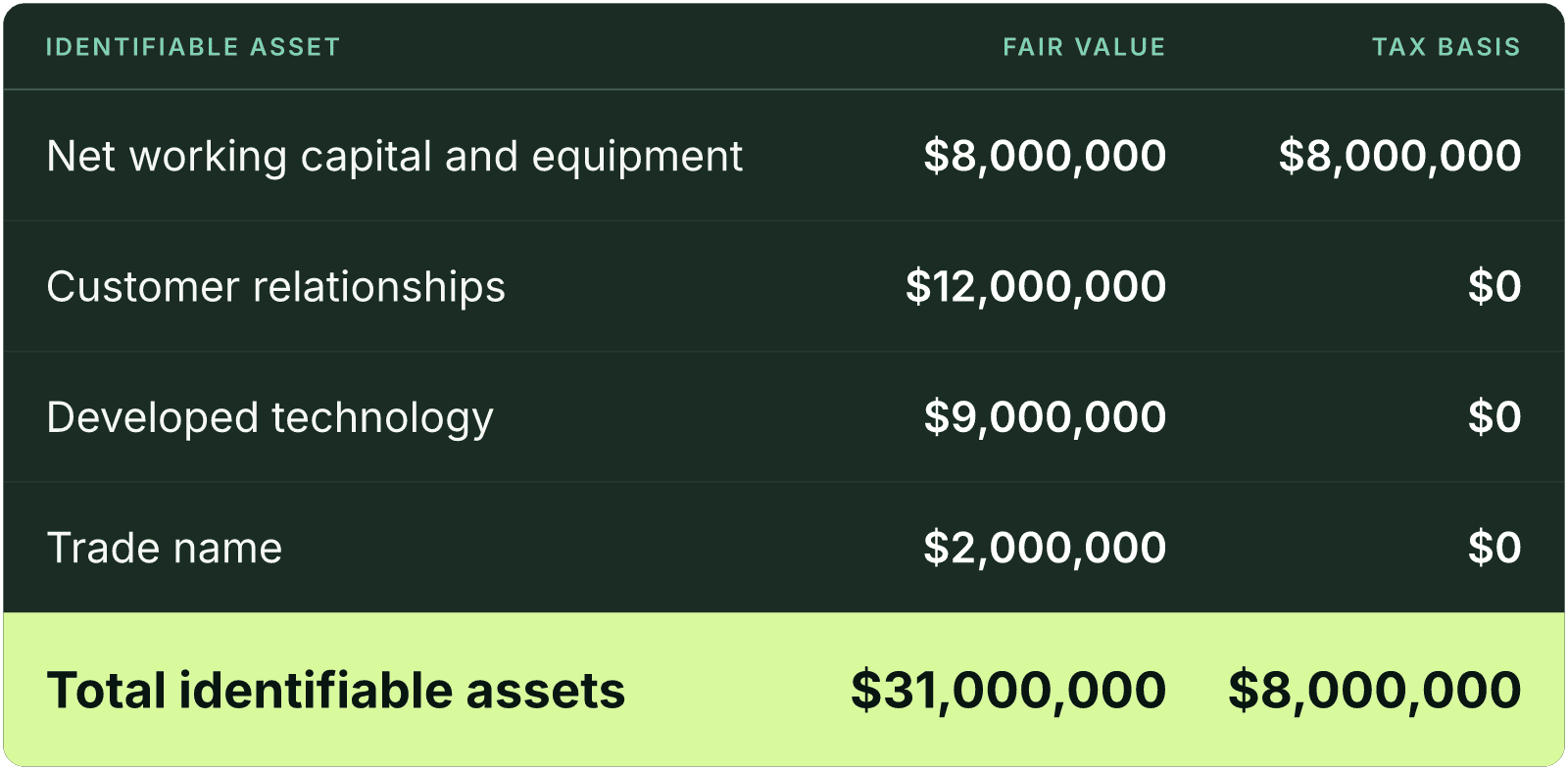
Take a $50 million acquisition of the stock of a software services company, with no tax election. The valuation firm finds these fair values, and the blended federal and state rate is 25%. The rate to use is the enacted rate you expect to apply when the difference reverses, not the top federal rate on its own.
[](https://www.409.ai/uploads/deferred_tax_liability_purchase_price_allocation_stock_deal_goodwill_asc_805_table_1_4f8566b05b.png)
The table lists book and tax values side by side. The working capital lines match, so they create no deferred tax. The three intangibles total $23 million with no tax basis, and that is where the liability comes from.
[](https://www.409.ai/uploads/deferred_tax_liability_purchase_price_allocation_stock_deal_goodwill_asc_805_table_2_ccbd797e02.png)
Without the liability, the same deal shows $19 million of goodwill. With it, goodwill is $24.75 million. The company did not pay more and the target is not worth more. The balance sheet now carries a $5.75 million liability that the cash flow statement will never see, and the other side of that entry is goodwill.
What changes if the buyer gets a step-up
Some deals reset the tax basis. An asset purchase does, because the buyer takes a new cost basis in each asset and recovers it under IRC Section 197, which gives intangibles a 15-year straight-line life ([26 U.S.C. §197](https://www.law.cornell.edu/uscode/text/26/197)). A stock purchase can be treated as an asset purchase for tax with a Section 338(h)(10) or Section 338(g) election ([26 U.S.C. §338](https://www.law.cornell.edu/uscode/text/26/338)), and the old and new target report the allocation on [Form 8883](https://www.irs.gov/forms-pubs/about-form-8883).
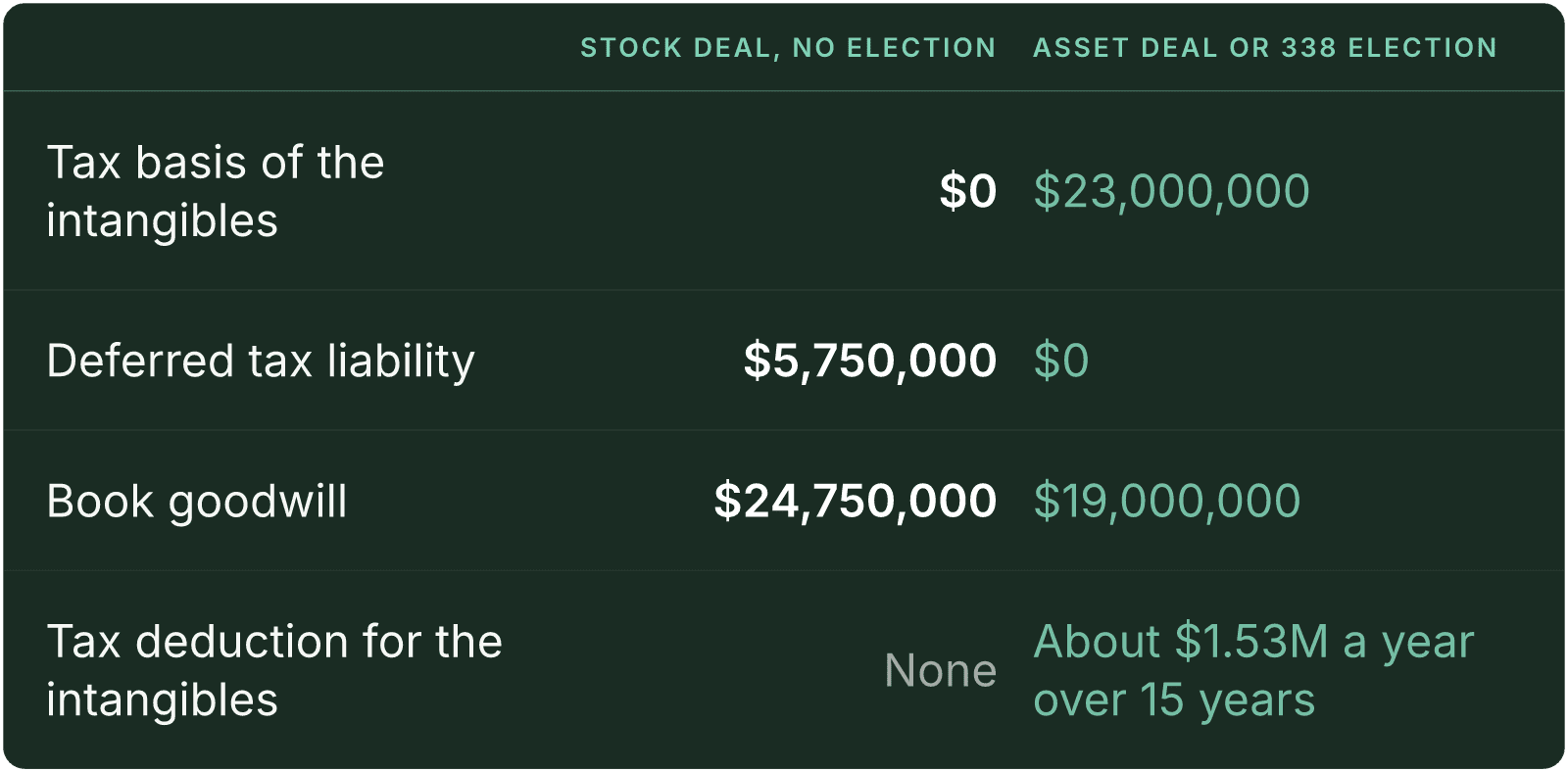
When the tax basis of the intangibles equals their fair value, there is no gap and no deferred tax on them. Goodwill is the residual, $19 million in our example, and a smaller number than the carryover-basis case.
[](https://www.409.ai/uploads/deferred_tax_liability_purchase_price_allocation_stock_deal_goodwill_asc_805_table_3_9521e9d115.png)
The tax column matters for cash, and the book column matters for the audit. The deal team that negotiated a step-up paid for it in the purchase price, often through a gross-up to the seller. The accounting team should see the structure early, because it decides which of the two columns it is building.
Goodwill needs a separate note. Tax-deductible goodwill is compared with book goodwill component by component under ASC 805-740, and the calculation can become circular when a deferred tax amount feeds the goodwill it is measured against. Goodwill that is not deductible for tax creates no deferred tax at acquisition. If your deal has deductible goodwill, ask the valuation firm to show the simultaneous equation, not only the answer.
The ledgers behind these two outcomes are the same ones in the comparison of [ASC 805 and Form 8594](https://www.409.ai/articles/asc-805-vs-form-8594-two-purchase-price-allocations-one-asset-list), and the screening question that comes before all of it is covered in [asset acquisition versus business combination](https://www.409.ai/articles/asset-acquisition-vs-business-combination-asc-805-screen-test-goodwill).
What happens to the liability after the close
The liability does not stay at $5.75 million. It unwinds as the intangibles amortize. If the intangibles have an average life of ten years, book amortization is about $2.3 million a year, and the liability shrinks by 25% of that, about $575,000 a year. Each year's tax provision records a deferred tax benefit of that amount.
Two effects follow. Reported net income looks closer to what a company with no step-up would earn, because the deferred benefit offsets part of the amortization charge. Cash taxes do not move at all, since no deduction exists. Finance leads who forecast cash taxes from the income statement overstate the shield, and a model that nets the amortization against taxable income in a no-election stock deal is wrong from the first year.
Where the deferred tax line goes wrong
The rate is the wrong one. Using the 21% federal rate alone understates the liability when state tax applies. Using the top marginal rate where the company will not pay it overstates the liability. The auditor will ask for the rate build and the state apportionment.
The target's own tax attributes are missed. Acquired net operating losses and credits can create deferred tax assets. Their use may be capped after an ownership change under [IRC Section 382](https://www.law.cornell.edu/uscode/text/26/382), so the asset recorded has to reflect what the buyer can use, and a valuation allowance may be needed. A deferred tax asset that the allocation has to write down reduces the net assets acquired and, like the liability, lands in goodwill.
The measurement period is forgotten. An allocation is provisional at the first reporting date. If new facts about the close-date tax basis emerge within the one-year measurement period, the adjustment runs through goodwill. The same year-end audit that tests the intangibles' fair values tests the tax rate and basis, and [the order in which auditors work through an allocation](https://www.409.ai/articles/purchase-price-allocation-cost-asc-805-what-auditors-test) puts completeness first.
The reconciliation ignores the liability. The IRR, WACC and weighted average return on assets check ties the allocation to the price paid. When goodwill carries a $5.75 million deferred tax gross-up, the implied return on goodwill moves, and a reconciliation built on the pre-tax goodwill figure will not tie. [The WARA reconciliation](https://www.409.ai/articles/purchase-price-allocation-reconcile-irr-wacc-wara-goodwill-return-asc-805) should be rerun with the final balance sheet.
What this does to the next impairment test
A larger goodwill balance has a larger carrying amount to defend. Private companies that elected the alternative under ASU 2014-02 amortize goodwill over a period of ten years or less and test only on a triggering event ([goodwill impairment for private companies](https://www.409.ai/articles/goodwill-impairment-private-company-asc-350)). The extra $5.75 million is amortized with the rest, and the election in [ASU 2014-18](https://www.409.ai/articles/asu-2014-18-private-company-election-first-add-on-goodwill-cost) that folds customer-related intangibles into goodwill reduces the identifiable intangibles, and so the liability, but it does not change the total. A company that does not elect keeps the goodwill and the burden of an annual or triggered test.
Before the next signing
Ask three questions before the close, while the structure can still change. Will the buyer get a tax basis step-up, and what did the price assume about it? What is the target's tax basis in each asset the valuation firm will measure? Which tax attributes come with the stock, and what is limited?
The answers decide whether the allocation carries a liability of a few million dollars or none, and whether goodwill lands near $19 million or near $25 million on the same price. If you are preparing an allocation and want the deferred tax calculation built in from the start, [409.AI's purchase price allocation service](https://www.409.ai/products/purchase-price-allocation) delivers the ASC 805 allocation with the tax effects shown line by line, so your auditor can follow each one.