Financial Reporting
ASU 2014-18 for a First Add-On: What Folds Into Goodwill, and What the Election Costs
A CFO of a private PE-backed platform weighing ASU 2014-18 before a first add-on: which intangibles fold into goodwill, and the goodwill amortization it brings.
By 409.AI Team - 2026-11-08
# ASU 2014-18 for a First Add-On: What Folds Into Goodwill, and What the Election Costs
If you are the CFO or controller of a private, PE-backed platform and your first add-on is about to close, one decision lands on your desk before the purchase price allocation starts: do you elect the private company alternative in ASU 2014-18? The answer sets how many intangibles your valuation specialist has to measure, how much your auditor has to test, and how your income statement looks for the next decade.
The election removes work. It also adds a cost that most summaries skip, and it binds you at the first deal and every deal after it. Here is how it works and what it looks like in numbers.
What the alternative actually removes
Under ASC 805, an acquirer recognizes the identifiable intangible assets of the target at fair value and books what is left as goodwill. ASU 2014-18 lets a private company skip two groups of those assets. According to the [Journal of Accountancy](https://www.journalofaccountancy.com/issues/2015/mar/gaap-intangible-assets-for-private-companies/), a company that elects it does not recognize:
- customer-related intangible assets, unless they are capable of being sold or licensed independently from other assets of the business, and
- noncompetition agreements.
Both are folded into goodwill. The independence test matters. Customer-related assets that can be sold or licensed apart from the business, such as mortgage servicing rights, commodity supply contracts and core deposits, are still recognized on their own. For a typical add-on, say a software, services or industrial business whose customers buy from the company and nobody else, the customer relationships are not separable, so they go into goodwill.
Everything else stays. Developed technology, trade names, favorable leases, in-process research and the rest of the identifiable list are still measured, and so is the fair value of the net tangible assets. The alternative shrinks the allocation. It does not skip it. If you want the baseline mechanics first, our walk-through of the [ASC 805 purchase price allocation](https://www.409.ai/articles/asc-805-purchase-price-allocation-startup-acquisition) covers how the pieces are split.
Who can elect, and when
The election belongs to private companies. Public business entities and not-for-profits cannot use it. If your platform could file with the SEC in the next few years, because of an IPO or a sale to a public buyer, raise that with your auditor before you elect, since you would need a plan for moving back to the standard model.
The timing is the part people miss. The election is made at the first transaction within its scope, which for a platform that has not yet used it is the first deal in scope, often the first add-on. Once made, it applies to the transactions that follow. You do not pick deal by deal whether to use it because this one has a large non-compete. A later reversal is a change in accounting principle that you would have to justify as preferable, so treat the first deal as the decision for the portfolio.
The string attached: goodwill amortization
A company that adopts ASU 2014-18 must also adopt the goodwill alternative from ASU 2014-02. The [Journal of Accountancy's guide to the private company alternatives](https://www.journalofaccountancy.com/issues/2019/mar/private-company-gaap-alternatives.html) states the dependency in one direction: the intangibles alternative requires goodwill amortization, but amortizing goodwill does not require the intangibles alternative.
Under ASU 2014-02, goodwill is amortized on a straight-line basis over ten years, or a shorter period if you can show another useful life fits better. In exchange, you test goodwill for impairment only when a triggering event suggests the fair value of the entity or reporting unit may be below its carrying amount, not every year. Our post on [private company goodwill impairment under ASC 350](https://www.409.ai/articles/goodwill-impairment-private-company-asc-350) shows what that triggering-event test looks like in practice.
That linkage is the cost. Goodwill that would have sat on the balance sheet untouched now runs through the income statement.
A worked example
Take an add-on bought for $60 million. The numbers below are illustrative, not a client case. Assume the valuation finds net tangible assets of $14 million, developed technology of $10 million (eight-year life), a trade name of $3 million (ten years), customer relationships of $17 million (ten years) and a two-year non-compete worth $2 million.
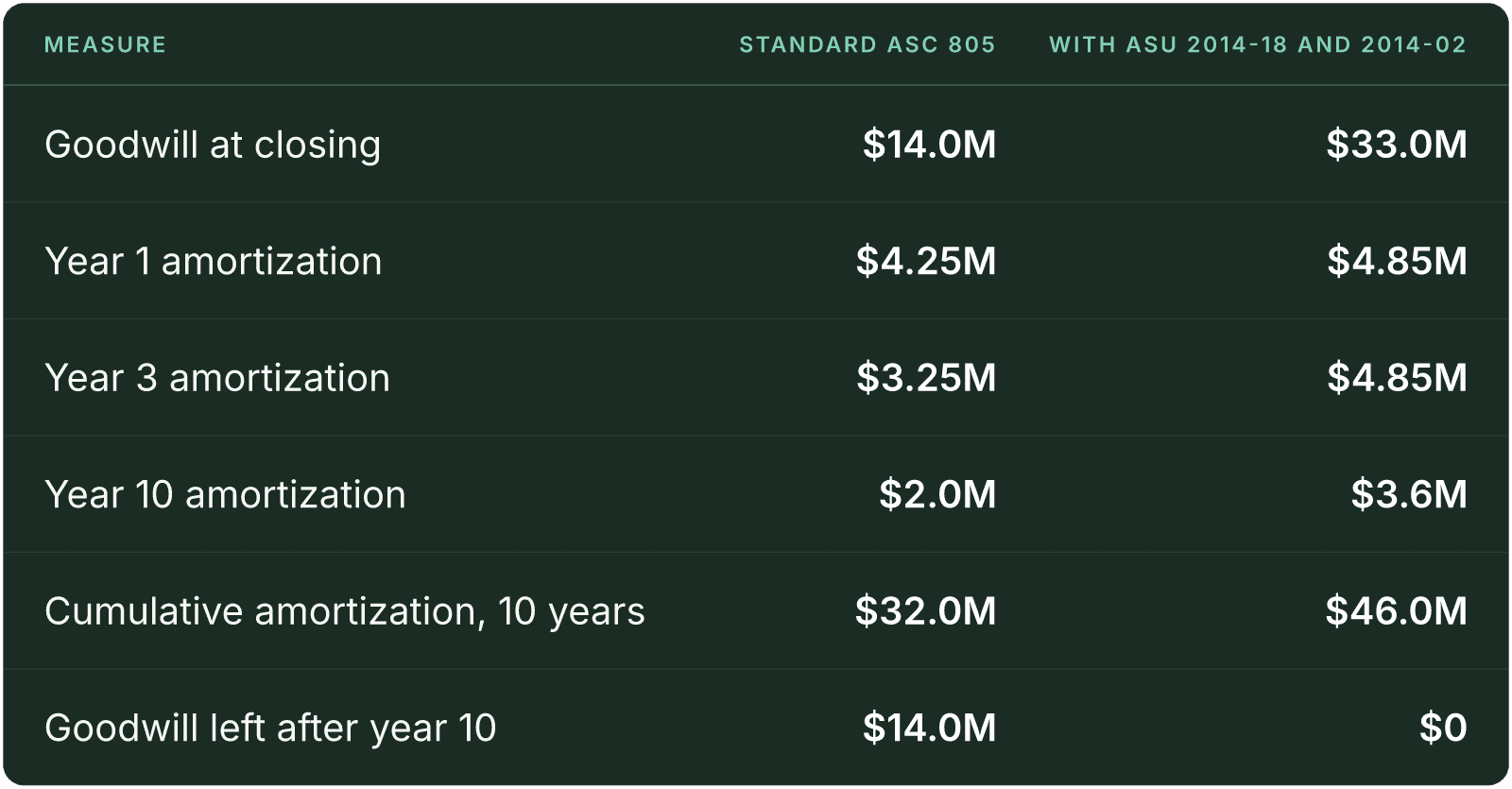
Without the election, goodwill is the remainder: $60M less $46M of identified assets, or $14 million. It is not amortized. With the election, the customer relationships and the non-compete fold in, so goodwill is $33 million, amortized over ten years at $3.3 million a year.
[](https://www.409.ai/uploads/asu_2014_18_private_company_election_first_add_on_goodwill_cost_table_1_0bd253b1bd.png)
The election made the reported expense larger in every year of the example, and by $14 million over ten years. That $14 million is not a new cost to the business. It is the goodwill the standard model never amortizes, now written off on a schedule instead of waiting for an impairment. Cash flow is the same either way.
What the election buys is a smaller allocation: two fewer intangibles to value, to document and to defend, and an impairment test that waits for a trigger. What it costs is a lower reported operating profit and a lower goodwill balance, which are the numbers lenders, buyers and your board read. Check how your credit agreement defines EBITDA and whether amortization is added back before you assume covenants are untouched.
Tax does not follow the election
The election is a financial reporting choice. It does not change how the purchase price is allocated for tax. In an asset deal, or a stock deal with a Section 338 election, the allocation among asset classes is reported on Form 8594 and is built on a different set of rules. Our comparison of [ASC 805 and Form 8594](https://www.409.ai/articles/asc-805-vs-form-8594-two-purchase-price-allocations-one-asset-list) shows why the two lists rarely match. A non-compete that vanishes from your book allocation can still carry a value on the tax side.
How to decide before the first add-on
Four questions settle most cases:
1. Will the platform stay private through the hold period, or is a public exit a real possibility? 2. Do the covenants or the sponsor's reporting package depend on a profit measure that goodwill amortization would depress? 3. Is the target's value mostly customer relationships and a non-compete? If so, the election removes the largest and hardest valuation work. If its value sits in technology and brands, the election saves less. 4. How many add-ons does the plan include? Every one of them inherits the choice.
Put these to your auditor in the scoping call, not after the draft allocation arrives. The conversation is also the moment to confirm the scope and the wording of the standard in ASC 805-20 and ASC 350-20 against the current codification, since your auditor will test against those paragraphs and not against a summary.
If the answer is to elect, the allocation is smaller and cheaper to support. If it is not, you know the full intangible list is coming and can budget for it. If you want to see what an auditor tests in either case, read [what a purchase price allocation costs and what the auditor tests](https://www.409.ai/articles/purchase-price-allocation-cost-asc-805-what-auditors-test), and for the deal-level question of whether you are booking goodwill at all, [the ASC 805 screen test](https://www.409.ai/articles/asset-acquisition-vs-business-combination-asc-805-screen-test-goodwill).
409.AI prepares ASC 805 allocations for acquirers, with or without the private company alternative. The scope of work is on the [purchase price allocation page](https://www.409.ai/products/purchase-price-allocation).