Financial Reporting
How to Value Customer Relationships in a Purchase Price Allocation: the MPEEM, Step by Step
For the CFO after an acquisition: how the MPEEM values customer relationships under ASC 805, with attrition, contributory charges and a worked $60M example.
By 409.AI Team - 2026-11-14
# How to Value Customer Relationships in a Purchase Price Allocation: the MPEEM, Step by Step
If you are the CFO or controller of a company that closed an acquisition this year, the customer relationship intangible is often the largest number in your purchase price allocation after goodwill, and one your auditor will spend real time on in the year-end file. It is also the asset most often valued with a shortcut that does not survive review.
This article walks through how the multi-period excess earnings method (MPEEM) values acquired customer relationships under ASC 805, with one worked $60 million deal, and shows which inputs move the answer and what an auditor asks to see behind each one.
First, does the relationship qualify as an asset?
ASC 805 recognizes an intangible apart from goodwill when it is separable or when it arises from contractual or legal rights. Customer relationships usually pass on the second test. The guidance treats a customer relationship as contractual when the acquiree has a practice of establishing contracts with its customers, whether or not a contract or purchase order is open on the acquisition date (ASC 805-20-55-25), and a purchase order counts even if it is cancelable, as [PwC's business combinations guide](https://viewpoint.pwc.com/dt/us/en/pwc/accounting_guides/business_combination/business_combination__28_US/chapter_4_intangible_US/42_intangible_assets_US.html) sets out.
Three related assets are kept apart from the relationship:
- **Order backlog**: revenue on open orders is often valued as its own short-lived asset, and it then comes out of the relationship forecast so the same dollars are not counted twice.
- **Customer list**: names and contact data, a smaller asset that matters mostly when no relationship exists.
- **Assembled workforce**: never recognized apart from goodwill (ASC 805-20-55-6), but valued anyway, because the relationship cannot earn without it. More on that below.
One exception for private acquirers: a private company that elects the alternative in ASU 2014-18 does not recognize customer-related intangibles that cannot be sold or licensed independently, and folds them into goodwill instead. We covered that election, and the goodwill amortization it requires, in [ASU 2014-18 for a first add-on](https://www.409.ai/articles/asu-2014-18-private-company-election-first-add-on-goodwill-cost). Everything below applies when the election is not made, which is the case for any acquirer heading to an IPO or reporting under full GAAP.
Why the excess earnings method
A customer relationship does not earn anything on its own. Revenue from existing customers needs the product, the brand, the working capital, the equipment and the people who serve the account. The excess earnings method values the relationship as what is left of the cash flow from existing customers after every other asset that helps produce it has been paid a fair return.
Those payments are contributory asset charges (CACs). The Appraisal Foundation's [VFR Valuation Advisory 1](https://appraisalfoundation.org/pages/resources/vfr-valuation-advisory-1-identification-of-contributory-assets-and-calculation-of-economic-rents) is the best-practice document on how to identify them and compute them, and [VFR Valuation Advisory 2](https://appraisalfoundation.org/pages/resources/vfr-valuation-advisory-2-the-valuation-of-customer-related-assets) covers customer-related assets specifically. Neither is authoritative GAAP, but a report that departs from them should say why.
The method is "multi-period" because the cash flows run year by year over the life of the existing customer base, which shrinks as customers leave. That decay is the attrition rate, and it is usually the input that moves the value most.
The worked example
An acquirer buys a B2B software and services company for $60 million. The illustrative assumptions:
- Revenue from customers on the books at the close: $20 million in year 1, growing 3% a year in price, with 15% of revenue lost to attrition each year. No new customers are in this forecast: they belong to goodwill.
- EBITA margin on that revenue of 28%. This is higher than the company's reported margin because the sales and marketing spent to win new customers, and the R&D spent on the next product, are taken out. Existing customers do not need them.
- Tax at 25%, a 14% discount rate, mid-year discounting.
Step 1: the contributory asset charges
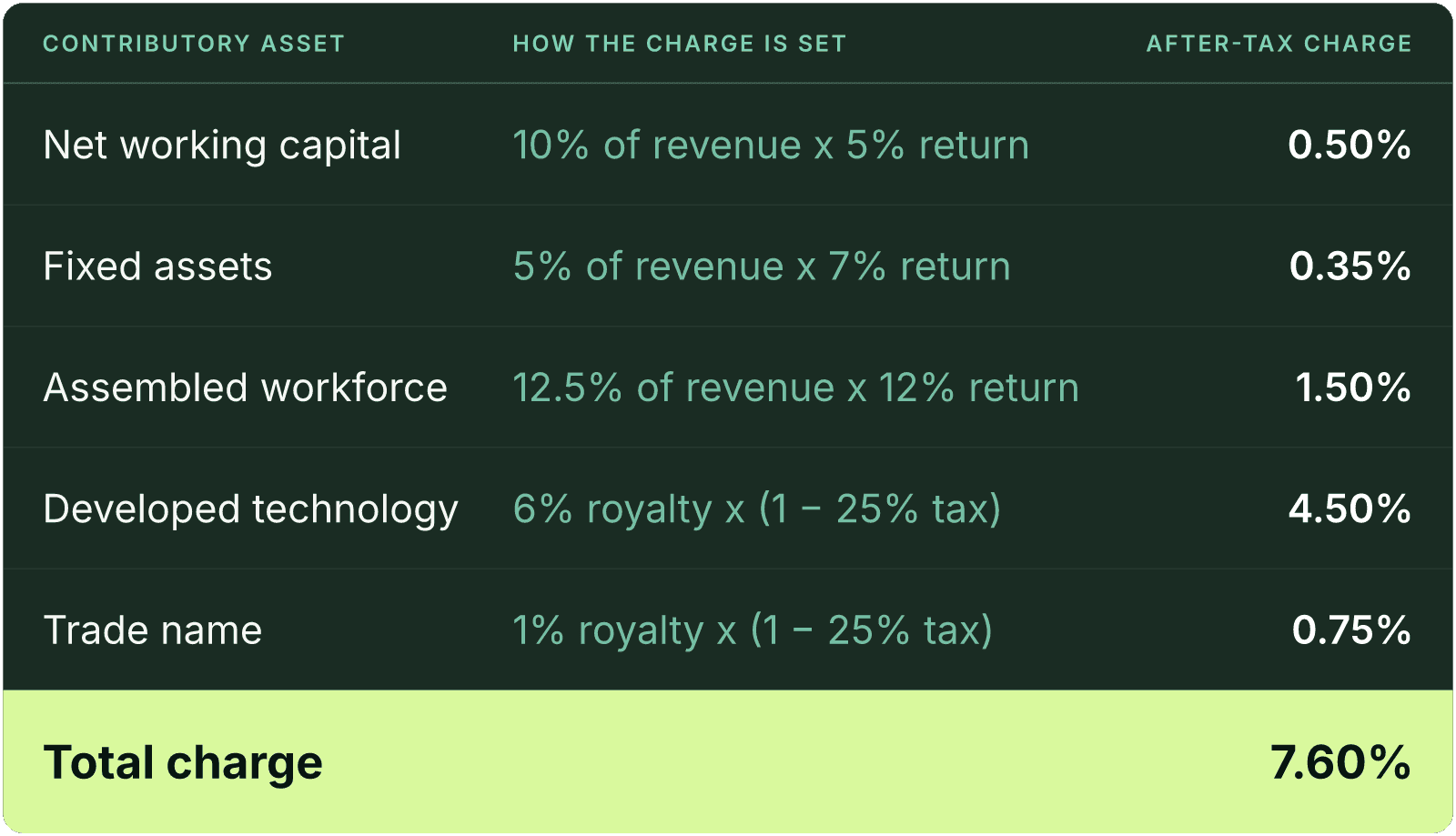
Each supporting asset gets an after-tax charge, expressed here as a share of revenue.
[](https://www.409.ai/uploads/customer_relationships_purchase_price_allocation_mpeem_contributory_asset_charges_attrition_table_1_bb9347731c.png)
Two details are worth reading slowly. The return of the fixed assets, their consumption, is already inside the 28% margin as depreciation, so only the return on them is charged here. And the technology and trade name charges are the same royalty rates used to value those assets on their own with relief from royalty, which we explained in [how a royalty rate is set for an IP valuation](https://www.409.ai/articles/relief-from-royalty-royalty-rate-ip-valuation-comparable-licences). If the technology report uses 6% and the customer model charges 4%, the auditor will find it.
Step 2: the excess earnings, year by year
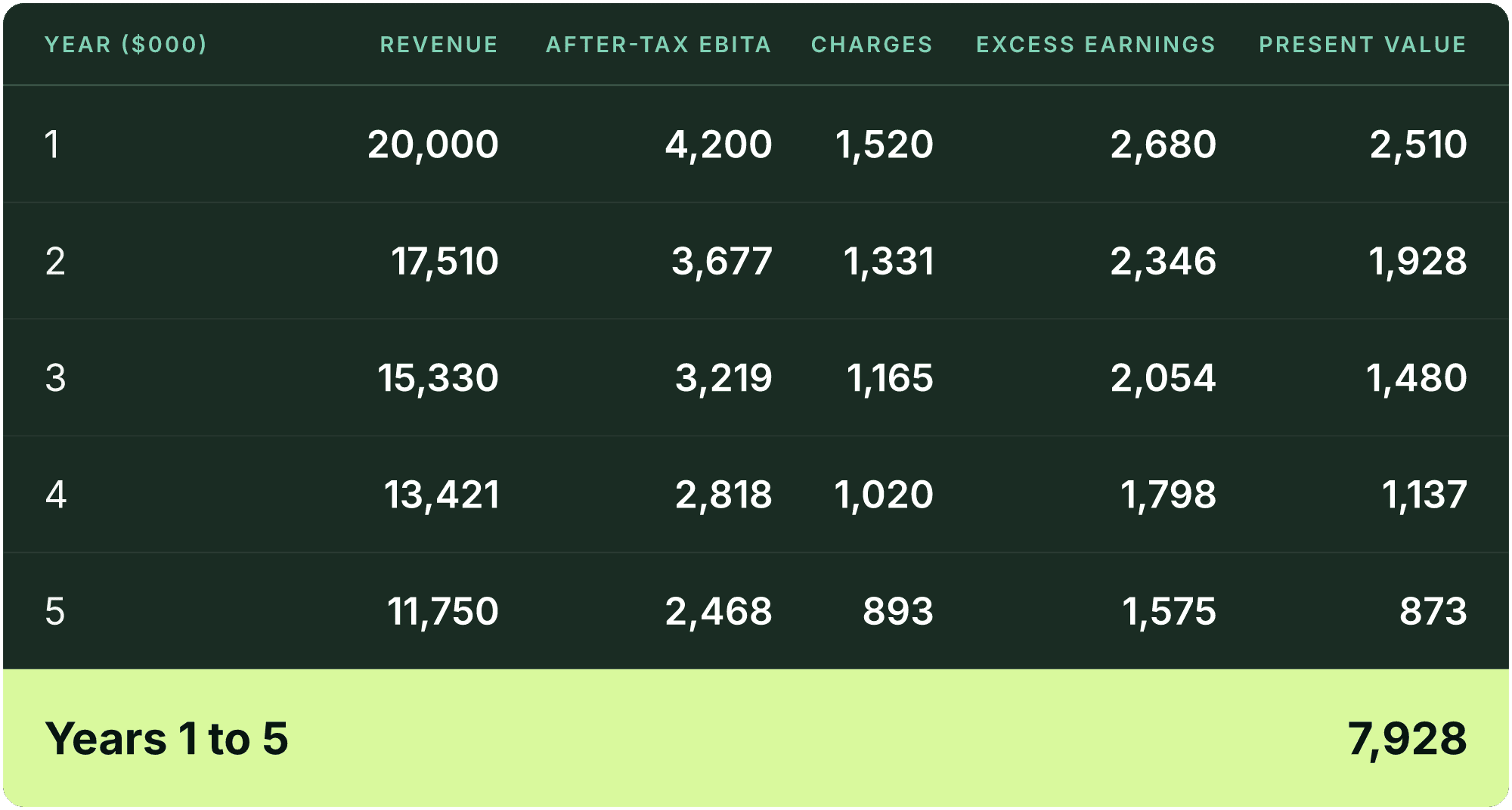
After-tax EBITA is 21% of revenue (28% x 75%). Take off the 7.6% charge and 13.4% of revenue is left for the relationship.
[](https://www.409.ai/uploads/customer_relationships_purchase_price_allocation_mpeem_contributory_asset_charges_attrition_table_2_ed1da9fdab.png)
Revenue falls each year by the attrition, partly offset by price: year 2 is $20,000k x 1.03 x 0.85 = $17,510k. Each year's excess earnings are discounted from mid-year at 14%, a factor of 0.937 in year 1 and 0.555 in year 5. By year 6 the customers on the books at the close bring about $10.3 million, roughly half of year 1.
Step 3: the tail and the tax amortization benefit
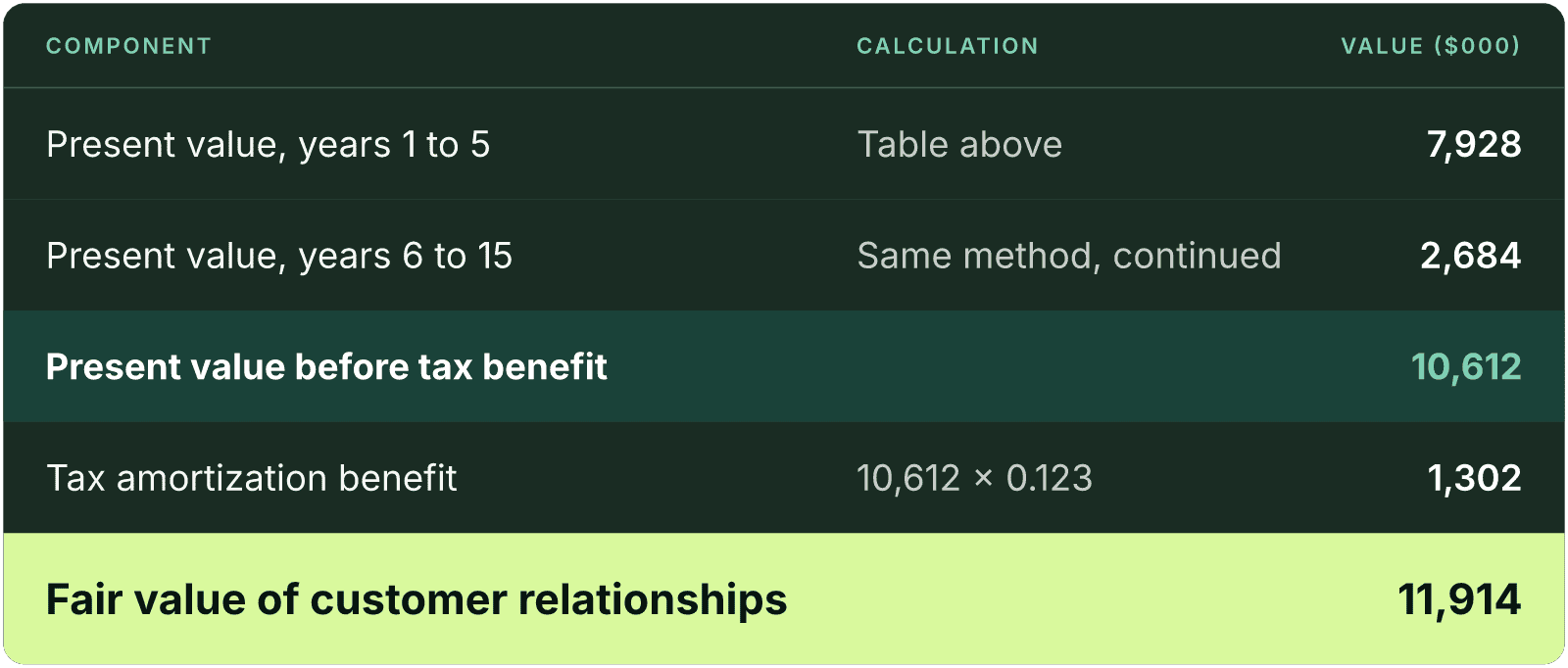
The forecast runs on to year 15, when the remaining revenue is small. Years 6 to 15 add $2,684k of present value, for a total of $10,612k.
A market participant buying this relationship would amortize it for tax over 15 years under Section 197 and save tax on the deductions. Fair value includes that saving, the tax amortization benefit. At a 25% tax rate and a 14% discount rate it multiplies the present value by about 1.123, adding $1,302k.
[](https://www.409.ai/uploads/customer_relationships_purchase_price_allocation_mpeem_contributory_asset_charges_attrition_table_3_a6b6e2ac3d.png)
So about $11.9 million of the $60 million price goes to customer relationships. The rest is split between the technology, the trade name, working capital, fixed assets, any backlog, deferred taxes, and goodwill as the residual. Whether that residual is believable is a separate test, the reconciliation of the deal IRR, the WACC and the weighted average return on assets that we covered in [your purchase price allocation has to reconcile](https://www.409.ai/articles/purchase-price-allocation-reconcile-irr-wacc-wara-goodwill-return-asc-805).
Which inputs move the answer
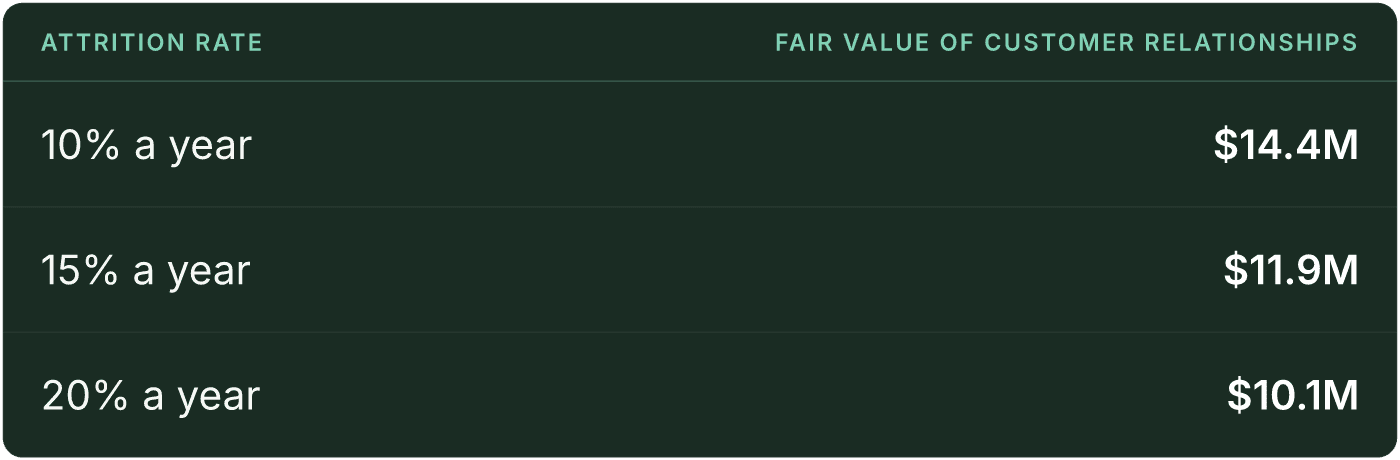
Attrition first. Holding everything else constant, the same model gives:
[](https://www.409.ai/uploads/customer_relationships_purchase_price_allocation_mpeem_contributory_asset_charges_attrition_table_4_603d9c00eb.png)
Five points of attrition either way moves the value by $1.8 million to $2.5 million, on an asset worth $11.9 million. That is why the attrition rate should come from the acquiree's own data: revenue by customer cohort over at least three to five years, measured in dollars rather than logos, since a company that loses many small accounts and keeps its large ones has lower revenue attrition than its customer count suggests.
The charges come second. Leave out the workforce charge, a common slip because the workforce is not on the balance sheet, and the value rises to $13.2 million, overstated by $1.3 million. Leave out every charge and you get $18.7 million, a number that assigns the whole margin of the business to its customer list and leaves too little for goodwill. An auditor who sees customer relationships larger than the residual goodwill in a growing software company will ask why.
The margin comes third. Removing the cost of winning new customers is correct; removing the cost of serving and keeping existing ones is not. Account management, support and renewal costs stay in.
What the auditor asks to see
The valuation specialist on the audit team will usually test the same handful of things, in roughly this order:
1. The attrition evidence: the cohort data, how it was cleaned, and why the rate chosen fits the customers acquired rather than the industry. 2. The forecast: that revenue from existing customers ties to the deal model, and that new-customer revenue is excluded. 3. The margin: the costs removed and the reason for each. 4. The charges: that every contributory asset is charged, that the rates match the values and royalty rates used elsewhere in the same allocation, and that the returns rise with the risk of the asset. 5. The discount rate: set against the WACC and the deal IRR, with the premium for this asset's risk explained. 6. The tax amortization benefit: its formula and the tax life used.
Our article on [what a purchase price allocation costs and what auditors test](https://www.409.ai/articles/purchase-price-allocation-cost-asc-805-what-auditors-test) covers the rest of the file and the timeline against the one-year measurement period.
The useful life is a separate decision
The forecast also tells you how to amortize the asset in the books. ASC 350-30-35-6 asks for an amortization method that reflects the pattern in which the economic benefits are consumed, and straight-line only when that pattern cannot be reliably determined. In this example about three quarters of the present value arrives in the first five years, so a straight-line charge over 15 years would push expense later than the benefits arrive. Many acquirers use an accelerated pattern that follows the excess earnings, and the auditor will ask which one was chosen and why. For book amortization the remaining life usually ends where the forecast stops producing meaningful cash flow, which is a judgment you should write down, not inherit from the tax life.
Alternatives the auditor may expect you to consider
The MPEEM is the most common method for customer relationships, but not the only one. When another asset, often the technology, is the primary earner and is valued with the MPEEM, the customer relationship may be valued with a with-and-without method (the value lost if the business had to rebuild its customer base) or with a distributor method that uses the margins a distributor would earn on the same customers. Two assets in one allocation should not both be valued with the MPEEM on the same revenue, since each would claim the excess earnings of the other. The report should say which asset is primary and why.
If your deal closed in 2026, this allocation sets years of amortization expense and the goodwill you will later test for impairment. A [purchase price allocation](https://www.409.ai/products/purchase-price-allocation) that shows its attrition data, ties its charges to the rest of the file and explains its useful life is the version that clears the year-end audit without a second round. For the full sequence of the allocation after a close, start with [ASC 805 purchase price allocation after a startup acquisition](https://www.409.ai/articles/asc-805-purchase-price-allocation-startup-acquisition).