Financial Reporting
How Much Does a Purchase Price Allocation Cost, and What the Auditor Tests in It
For the CFO or controller who just closed a $1M to $50M acquisition: what an ASC 805 purchase price allocation costs, its deadline and what the auditor tests.
By 409.AI Team - 2026-10-27
# How Much Does a Purchase Price Allocation Cost, and What the Auditor Tests in It
You closed the acquisition. Somewhere between the wire and the first board update, your auditor sent the email every controller of a newly acquisitive company gets: "We'll need the purchase price allocation before fieldwork." If you run finance at a company that just bought another one for $1 million to $50 million, this article answers the two questions that email raises and nobody answers with a number: what a purchase price allocation costs, and what the auditor will test when it lands on their desk.
The mechanics, which assets get identified and why, are in [our ASC 805 explainer](https://www.409.ai/articles/asc-805-purchase-price-allocation-startup-acquisition). This one is about the money, the clock and the audit.
The price, in plain numbers
Most valuation firms will not put a PPA price on their website; they size up the deal and send a quote. Published fee guides put that quote between about $10,000 for a simple all-cash deal with one or two intangibles and $60,000 for a deal with several intangibles, an earnout and rollover equity.
409.AI publishes its price: a [purchase price allocation](https://www.409.ai/products/purchase-price-allocation) costs $9,999, flat, expert-reviewed. The report identifies and values the acquired intangibles under ASC 805, derives the goodwill residual and documents the inputs the auditor will ask about.
On a $20 million deal, a $10,000 to $60,000 allocation is 0.05% to 0.3% of the price. The decision that matters is not whether to pay it but what you get for it, because the auditor decides whether the work holds.
What makes one PPA cost more than another
Four things move the price, and you can read most of them off the purchase agreement.
How many intangibles the business has, and which ones. Each identifiable intangible is valued on its own. Customer relationships usually get the multi-period excess earnings method: project the cash flows the existing customers will generate, deduct a charge for every other asset that helps produce them, discount what is left. Developed technology and trade names get the relief-from-royalty method: what the acquirer would have paid to license the asset. A non-compete gets a with-and-without analysis: the business with the agreement versus without it, weighted by the chance the seller would have competed. One trade name is a short engagement. A customer base, a codebase, a brand, a backlog and three sellers under non-competes is not.
Contingent consideration. If part of the price is an earnout, the earnout is a liability measured at fair value on the closing date, and when the payout depends on a revenue or EBITDA threshold that usually means a simulation of outcomes rather than one discounted number. Our article on [earnouts under ASC 805](https://www.409.ai/articles/earnout-contingent-consideration-valuation-asc-805) explains why "up to $20 million" is not worth $20 million on day one. An earnout adds a model to the engagement.
Rollover equity and replacement awards. Shares the sellers take in the buyer need a fair value too, and replacement awards for the target's employees can be partly consideration and partly compensation expense, the first pitfall KPMG lists in [Avoiding pitfalls in business combinations](https://kpmg.com/kpmg-us/content/dam/kpmg/pdf/2022/avoiding-pitfalls-business-combo-5cc.pdf).
The quality of your data room. The specialist will ask for the purchase agreement, the information memorandum or quality of earnings report, three to five years of revenue by customer, the forecast the deal was priced on, and the technology and contract inventory. When customer revenue has to be reconstructed from invoices, someone pays for the reconstruction.
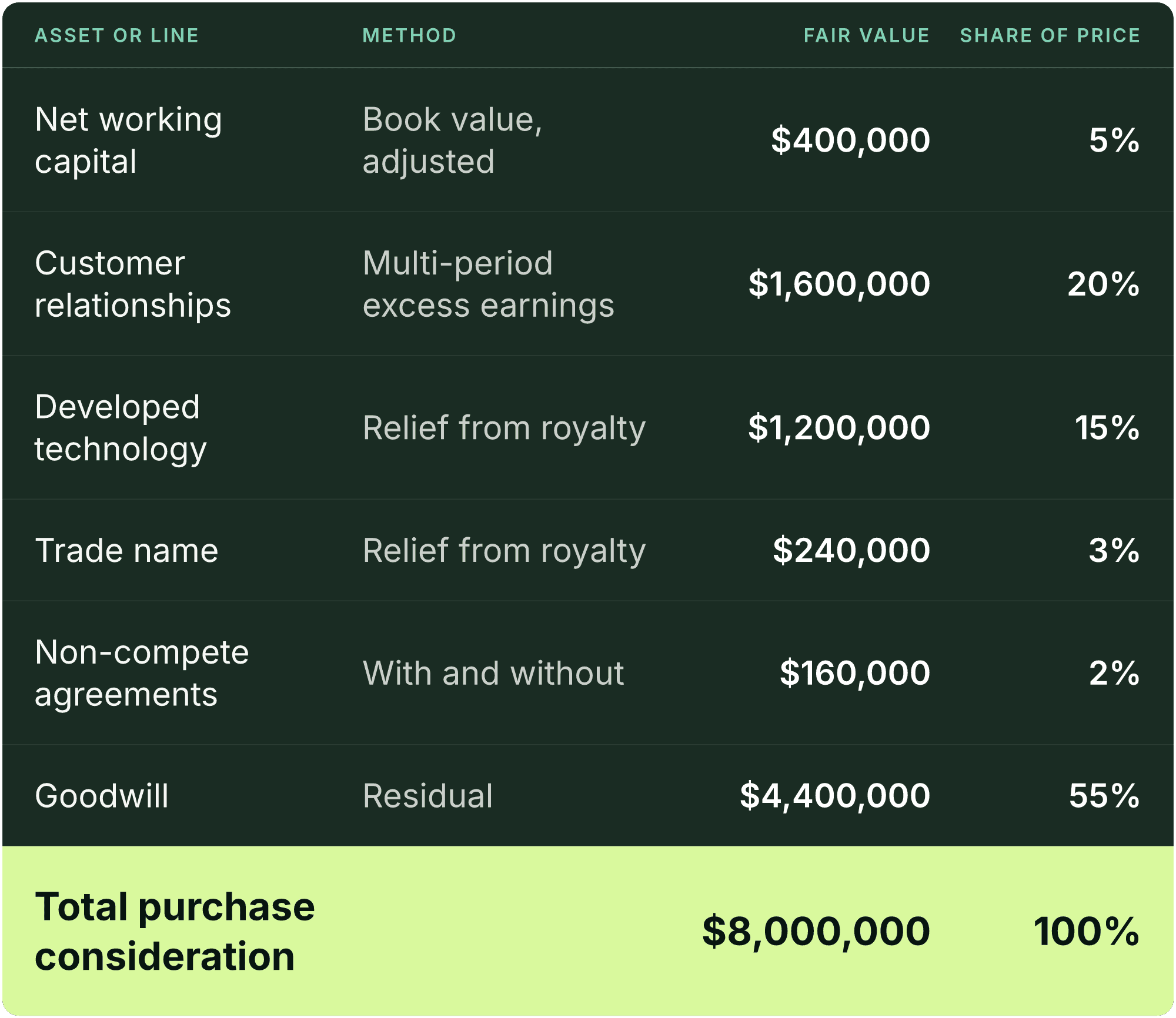
Here is the allocation of an illustrative $8 million acquisition of a small SaaS company. The figures are made up to show the shape, not a real client.
[](https://www.409.ai/uploads/purchase_price_allocation_cost_asc_805_what_auditors_test_table_1_c2016256fe.png)
The shape is typical: identifiable intangibles at 40% of the price, goodwill above half, and the two biggest numbers, customer relationships and technology, the two the auditor spends the most time on.
What the benchmarks say
Houlihan Lokey's [2019 and 2020 Purchase Price Allocation Study](https://hl.com/media/1odaxqbq/purchase-price-allocation-study-2019-2020.pdf) reviewed the public filings of 560 completed acquisitions in 2019 and 475 in 2020. Across all industries, the median allocation to identifiable intangible assets was 34% of purchase consideration in both years, and the median allocation to goodwill was 47%. Customer-related assets were identified in 76% of the 2020 deals, developed technology in 59% and trademarks or trade names in 58%.
It also shows where small deals sit: 208 of the 475 deals in 2020 had purchase consideration below $50 million, and about 72% were below $250 million. A sub-$50 million deal is not an edge case, and it needs the same allocation a billion-dollar deal does.
The clock: one year on paper, one audit in practice
ASC 805 gives the acquirer a measurement period. Under ASC 805-10-25-14, as summarized in [Deloitte's roadmap](https://dart.deloitte.com/USDART/home/codification/broad-transactions/asc805-10/roadmap-business-combinations/chapter-6-other-acquisition-method-guidance/6-1-measurement-period), that period ends as soon as the acquirer receives the information it was seeking about facts that existed at the acquisition date, or learns that it is not obtainable, and it can never exceed one year from the acquisition date. Provisional amounts are allowed meanwhile.
In practice the measurement period is not your deadline. Your first audited financial statements that include the acquisition are. Fieldwork is planned around year-end, and the allocation has to be substantially complete before the auditor's own specialist can review it. A company that closes in October and audits a December year-end has a few months, not twelve.
If you book provisional amounts and adjust them later, [ASU 2015-16](https://viewpoint.pwc.com/dt/us/en/fasb_financial_accou/asus_fulltext/2015/asu_201516business_c/asu_201516business_c_US/asu_201516business_c_US.html) sets the mechanics: the adjustment is recognized in the period in which it is determined, with an offsetting change to goodwill, and the cumulative effect on amortization, calculated as if the accounting had been completed at the acquisition date, lands in that period's earnings. No restatement, but a visible catch-up, and a large one invites the question of why the first numbers were so far off.
What the auditor tests
An auditor does not re-perform the valuation. They test it, and the questions arrive in a predictable order:
Completeness. Did the valuation consider every asset that is separable or arises from a contract or legal right: customers, technology, trade names, non-competes, backlog, licenses, favorable leases? An asset in the purchase agreement but not in the report is the first finding.
The forecast. The cash flows behind the intangibles should tie to the projections the deal was priced on. A rosier forecast inflates the intangibles; a more conservative one pushes value into goodwill. Either way the auditor asks which forecast management believes.
Attrition. For customer relationships, the most sensitive input is how fast the acquired customers leave, and the auditor expects it from the target's own revenue-by-customer history, not a rule of thumb.
Royalty rates. The rate has to be supported by observable license agreements for comparable assets and by the profitability of the asset itself. A rate that would consume the product's whole margin is one no licensee would pay.
Discount rates and the reconciliation. Where most of the review time goes. KPMG's paper puts it plainly: many valuations "lack sufficient quantitative support and documentation for the discount rates used." The test is the reconciliation of three numbers: the internal rate of return implied by the price paid and the forecast, the weighted average cost of capital of the acquired business, and the weighted average return on assets, which weights the discount rate of each acquired asset by its fair value. In theory the three should be closely aligned. A gap means the consideration was not fair value (an overpayment or a bargain), an asset is missing, or a rate is wrong. One rate for every intangible, or a flat 100 or 200 basis points added to the WACC without explanation, is the shortcut the paper calls out. It names the contributory asset charge, the deduction in the excess earnings method for the working capital, fixed assets, workforce and other intangibles that help generate the customer cash flows, as one of the most significant and most often mishandled inputs.
Goodwill. The residual has to make sense for the business bought. For a mature company its implied return sits just above the return on customer relationships; for a high-growth company the gap is wider. A return on goodwill far above every identified asset usually means one of them was undervalued.
A report that documents each point, in that order, is what the auditor means by "audit-ready." One that has to be rebuilt to answer them ends up costing more than its fee.
Why your auditor cannot do it for you
A CFO who already pays an audit firm asks whether that firm can do the allocation. For an SEC registrant the answer is in the independence rules: under [17 CFR 210.2-01(c)(4)(iii)](https://www.law.cornell.edu/cfr/text/17/210.2-01), an accountant is not independent if it provides "any appraisal service, valuation service, or any service involving a fairness opinion" to an audit client, "unless it is reasonable to conclude that the results of these services will not be subject to audit procedures." A purchase price allocation is, by definition, subject to audit procedures, and audit firms of private companies decline the work on the same principle. The allocation comes from management's specialist; the auditor's specialist tests it.
The private-company alternatives change less than you'd hope
Private companies can elect two accounting alternatives. Under ASU 2014-02, as the [Journal of Accountancy](https://www.journalofaccountancy.com/issues/2019/mar/private-company-gaap-alternatives.html) summarizes, a private company may amortize goodwill on a straight-line basis over 10 years, or a shorter period if it can show one is more appropriate, and test goodwill for impairment only on a triggering event instead of every year. Under ASU 2014-18, customer-related intangibles that cannot be sold or licensed separately from the rest of the business, and noncompetition agreements, can be folded into goodwill instead of valued separately; electing that alternative also requires goodwill amortization, though not the reverse.
That removes two of the six lines in the table above. It leaves developed technology, trade names, backlog, the earnout and the goodwill residual to value, and a company that later goes public has to unwind the election and build the allocation it skipped. The alternatives are worth taking for many PE-backed companies; they are not a way around the valuation. What happens to that goodwill afterwards is the subject of [Goodwill Impairment for Private Companies](https://www.409.ai/articles/goodwill-impairment-private-company-asc-350).
The tax allocation is a separate exercise
One thing the auditor will not test, but your tax preparer will: in an asset purchase, or a stock purchase treated as one for tax, buyer and seller also allocate the price across the seven asset classes of Form 8594 under Section 1060, with the residual method and tax lives rather than ASC 805 categories and economic lives. The financial-reporting values are the natural starting point, but the two reports serve different filings. Our walkthrough of [how Form 8594 splits the price](https://www.409.ai/articles/form-8594-asset-allocation-small-business-sale) covers the tax side.
What to do the week the deal closes
Three moves save the most money and audit time. Send the specialist the purchase agreement and the deal model the same week, so the allocation runs on the forecast the deal was priced on. Pull revenue by customer for the last three to five years before the integration overwrites it; attrition is the input you will be asked about most. Decide on the private-company alternatives before the allocation is built.
Do that, and the allocation arrives before fieldwork, the reconciliation is on page one, and the fee stays what you were quoted. At 409.AI that quote is published: $9,999 for a [purchase price allocation](https://www.409.ai/products/purchase-price-allocation) written for the auditor who will read it.