Financial Reporting
How to Value Developed Technology in a Purchase Price Allocation
For the CFO who bought a software company: how developed technology is valued in an ASC 805 PPA, the royalty, the migration curve and what the auditor tests.
By 409.AI Team - 2026-11-28
# How to Value Developed Technology in a Purchase Price Allocation
If you are the CFO or controller of a company that bought a software business this year, the developed technology is probably the line your auditor's valuation specialist reads first. It's often the largest intangible after customer relationships, sometimes larger, and its value rests on three judgments: which method, which royalty or return, and how fast the acquired code stops earning.
This article walks through those judgments the way they come up in an ASC 805 allocation before the year-end audit, with one worked example and the questions the auditor will ask about each input.
What counts as developed technology
ASC 805 recognizes an intangible asset apart from goodwill when it is separable or arises from contractual or legal rights. Technology passes that test almost every time: software can be licensed or sold on its own, and the code is usually protected by copyright and trade secret law even when nothing is patented.
In practice, "developed technology" in a PPA means the products the target was already selling at the close: the platform, its modules, the proprietary algorithms and data structures behind them. Technology still in development is a different asset, in-process research and development, with its own recognition rules (we covered that in our article on IPR&D in an acquisition). Future versions the buyer expects to write are neither. They belong in goodwill.
One point private acquirers sometimes miss: the private company alternative of ASU 2014-18 lets you subsume certain customer-related intangibles and non-compete agreements into goodwill. It does not cover technology. Even with the election, the developed technology is valued and recognized on its own (how the election works).
Three methods, and which one the auditor expects
There are three ways to value acquired technology, and the choice is not a matter of taste.
Relief from royalty. The technology is worth the royalties you no longer have to pay because you own it. You forecast the revenue the acquired technology supports, apply a royalty rate a licensee would pay for similar technology, take out tax and discount the savings. PwC's fair value guide describes the result as "the present value of license fees avoided by owning it" (PwC Viewpoint, FV 7.3.4).
Multi-period excess earnings (MPEEM). The technology is worth the cash flows left after every other asset that helps produce them is paid a fair return: working capital, fixed assets, the trade name, the assembled workforce. That method isolates one asset's earnings from the whole business, so it can be used only once per revenue stream. The same PwC guide says the method "is generally used only to measure the fair value of the primary intangible asset" and "should not be used to measure the fair value of two intangible assets using a common revenue stream."
Cost approach. The technology is worth what it would cost to rebuild it, less obsolescence. PwC limits this to assets that are "readily replicated or replaced, such as routine software," and calls it generally not appropriate for primarily cash-generating assets such as technology. Internal tools, a billing system or a back-office module can take a cost approach. The product your customers pay for usually cannot.
Is the technology the primary asset?
The method follows from one question: what earns the excess return in this business?
In a mature SaaS company with long-tenured enterprise customers, renewal economics usually drive value, and customer relationships are the primary asset. They take the MPEEM, the technology takes relief from royalty, and the technology royalty becomes a contributory asset charge inside the customer valuation (the mechanics are in our walkthrough of the MPEEM for customer relationships).
In an early-stage company with a product that wins new logos and a short customer list, the technology is the reason the deal happened. It takes the MPEEM, and the customer relationships are valued another way, for example with a with-and-without analysis or a distributor method, both income approaches the PwC guide describes.
Whichever way you go, the royalty has to be the same number in both places. If the technology is valued at a 15% royalty, the charge for technology inside the customer MPEEM is 15% too. An auditor who finds 15% in one schedule and 8% in another has found an inconsistency in the allocation itself, and the goodwill moves when it is fixed.
The worked example: relief from royalty
Take an illustrative acquisition. A software company closed on a target whose revenue is forecast at $20 million in the first year after the close, growing to $35 million in year five. Customer relationships are the primary asset, so the developed technology takes relief from royalty.
Three inputs drive the answer.
The migration curve. Software doesn't stop earning on a fixed date. Each release replaces part of the code the buyer acquired, so a falling share of each year's revenue is attributable to technology that existed at the close. Here, management's release plan supports 100% in year one, then 75%, 50%, 30% and 10%. Revenue on code written after the close belongs to future technology, which is goodwill.
The royalty rate. 15% of revenue, pre-tax, supported by licences of comparable software and checked against the target's operating margin. A royalty a licensee would pay has to leave the licensee a profit, so a 15% royalty on a business with a 10% operating margin fails the profit check before anyone looks at the comparables (where a royalty rate should come from).
The discount rate. 16%, three points above the deal's 13% WACC. Technology is riskier than the business as a whole, and PwC's guide notes that technology-related and customer intangibles are generally assigned higher discount rates.
The table shows the royalty savings year by year, in millions of dollars, with a 25% tax rate and mid-year discounting.
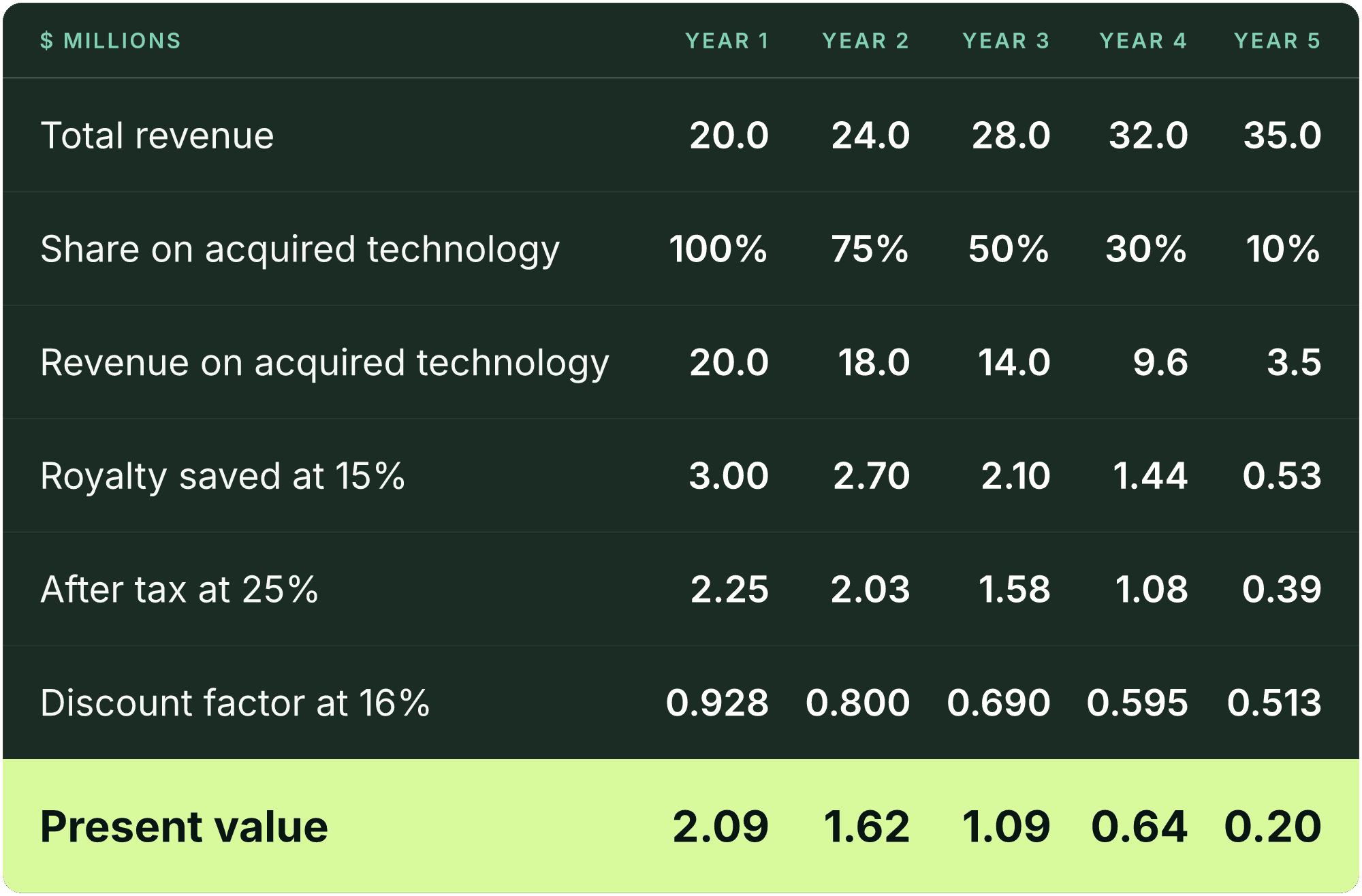

The present values add up to $5.64 million. That is not yet the fair value. A market participant buying the technology on its own would amortize it for tax over 15 years under Section 197, and the fair value includes that tax amortization benefit. At a 16% rate, the benefit adds $0.63 million, for a fair value of $6.27 million (how the tax amortization benefit is computed).
Notice what the total revenue line does not do. The target grows 75% over five years, and almost none of that growth reaches the technology's value, because the growth runs on code the buyer will write. That's the most common error in a first draft: applying the royalty to total revenue and valuing the buyer's future roadmap as if it were acquired.
Which inputs move the number
Every input above is a judgment, and the auditor will ask how much each one matters. Here is the same example with one input changed at a time.
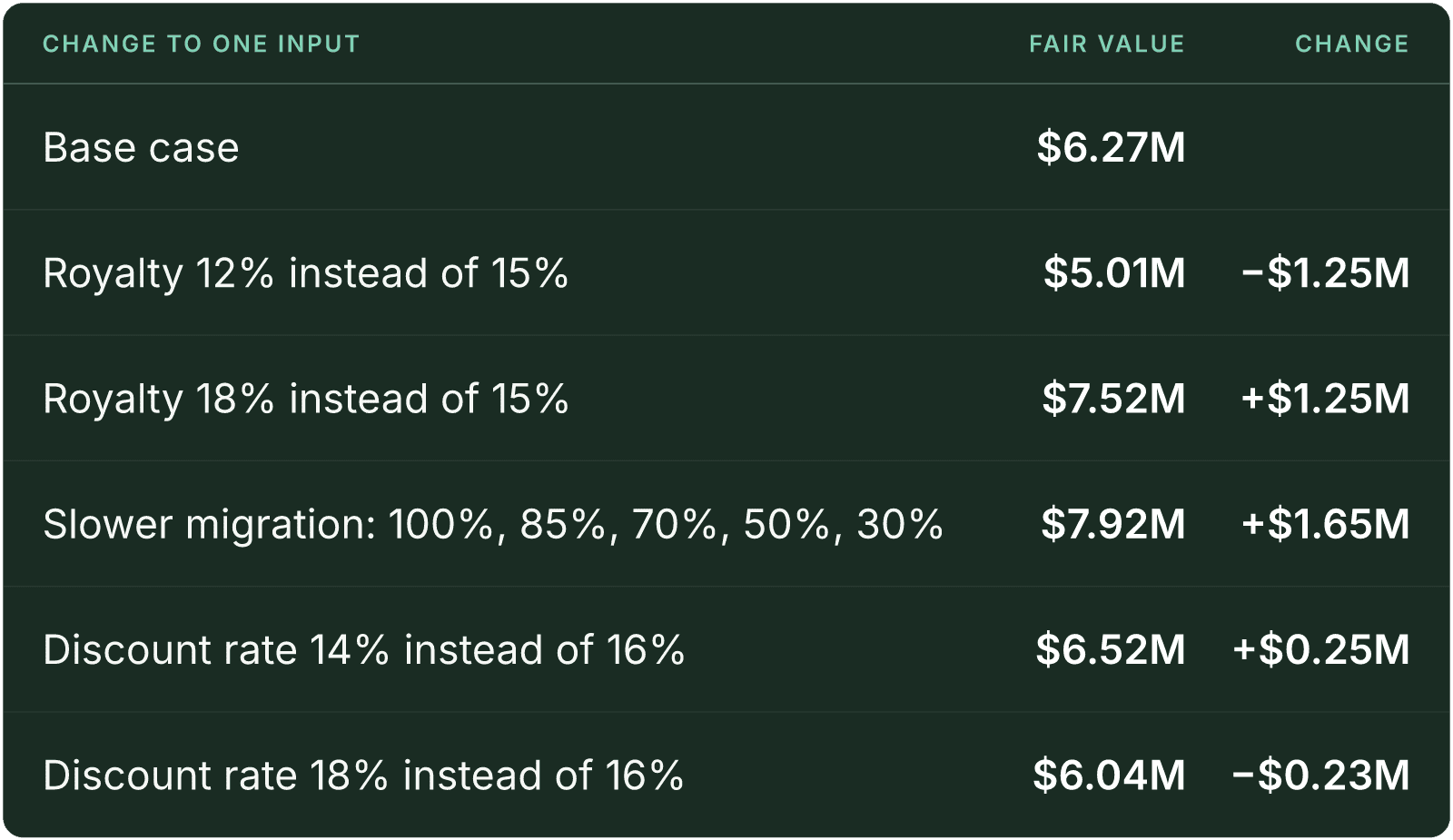

The migration curve moves the value more than any other input here, and it is the one most often left unsupported. A royalty can be tested against licences. A discount rate can be tested against the IRR and WACC (reconciling IRR, WACC and WARA). The migration curve can only be tested against the target's own history: how long its past releases kept generating revenue, how much of today's code base is more than three years old, what the product roadmap actually replaces.
Every dollar the technology loses or gains goes the other way in goodwill. Before deferred taxes, the $1.65 million between the two migration curves is $1.65 million of goodwill, which a private company that elected the goodwill alternative amortizes over ten years or less, and a company without the election tests for impairment instead.
The gross royalty and the R&D trap
One error shows up often enough that KPMG lists it among the common pitfalls in business combinations. A gross royalty assumes the licensor pays for all future development of the technology. If the technology charge in the customer MPEEM is a gross royalty, the R&D spend for that technology must come out of the projections, because the royalty already pays for it; otherwise the same cost is counted twice (KPMG, Avoiding pitfalls in business combinations, 2022). A net royalty works the other way: the licensee carries part of the cost, and the projections keep the R&D the licence terms put on the licensee.
For a software target spending 20% of revenue on R&D, this is not a rounding difference. Getting it wrong understates the customer relationships, and the error lands in goodwill.
The useful life is the same curve
The migration curve does double duty. It sets the value, and it should also support the amortization life the controller books. A curve that reaches 10% in year five and a booked life of ten years tell the auditor two different stories about the same code. The life is usually the period over which most of the value is consumed, and the amortization pattern should follow the curve where it is reliably determinable, not a straight line chosen for convenience (why legal life is rarely the answer).
What to have ready before the valuation starts
The file that gets a developed technology value through the audit is mostly built from the target's own records:
- a product and module list as of the close, with the revenue each one carries;
- release history for the last three to five years and the roadmap the deal model assumed;
- R&D spend by product, so the royalty and the projections don't count it twice;
- the deal model's forecast, because the PPA forecast should tie to the one the price was set on.
If you closed in the second half of 2026 and audit a December year-end, the allocation has to be substantially done before fieldwork, not at the end of the one-year measurement period. A purchase price allocation from 409.AI is built around that file and that timeline.
The point to carry into the audit: the royalty rate gets the attention, but the migration curve decides the number. Support it with the target's release history before the auditor asks, and the technology value, the customer value and the goodwill will hold together.
About the author
409.AI Team
Startup valuation and equity workflow specialists
The 409.AI team writes practical valuation content for founders and finance teams preparing 409A reports, equity documentation, and related startup finance workflows.
Related valuation reports
- Purchase price allocation report: 409.AI helps acquirers prepare expert-reviewed purchase price allocation reports under ASC 805, with fair value analysis of acquired intangible assets and goodwill.
- 409A valuation report: 409.AI helps private companies prepare expert-reviewed 409A valuation reports for equity compensation and option strike price support.
- Pricing for every report type
- 409A valuation calculator
- Sample 409A report