Education
Relief From Royalty: Where the Royalty Rate in an IP Valuation Comes From
For CFOs and founders valuing code, patents or a brand: how the royalty rate in a relief-from-royalty model is built, tested and challenged, with worked numbers
By 409.AI Team - 2026-11-11
# Relief From Royalty: Where the Royalty Rate in an IP Valuation Comes From
If you're a CFO or founder commissioning a standalone value for your code, a patent family or a brand, whether for a licence, a sale, a move to a holding company or a loan secured against the asset, most of the answer comes down to one input. The forecast matters, and so does the discount rate. But in a relief-from-royalty model, the royalty rate moves the conclusion more than anything else, and it's the number an auditor, the IRS or opposing counsel goes after first.
Here's how a defensible rate gets built, what gets it thrown out, and how much a single percentage point is worth.
The method in one paragraph
Relief from royalty asks a simple question: if you didn't own this asset, what would you pay someone else to use it? The answer is a royalty, usually a percentage of the revenue the asset supports. Owning the asset spares you that payment. Project the royalty you avoid over the asset's remaining useful life, take tax off it, discount it back, and you have the value.
We walked through the three valuation approaches, and where each one fits, in [how startup IP actually gets valued](https://www.409.ai/articles/startup-ip-intangible-asset-valuation-methods). This piece stays with the input those models are most often wrong about.
Why one percentage point is worth so much
Take a software company whose core platform code supports $10 million of revenue this year, growing 10% a year. The code has eight years of useful life left before a rewrite replaces it. Use a 25% tax rate and an 18% discount rate with a mid-year convention. All of it is illustrative, but the shape is typical.
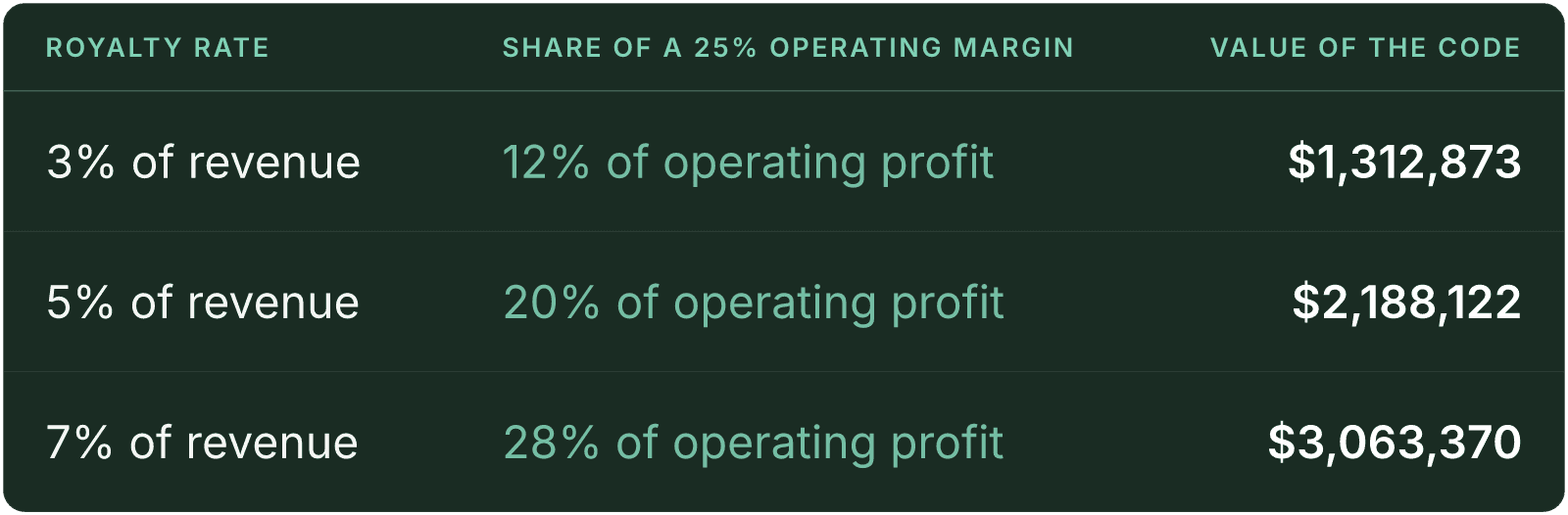
Over those eight years the code supports about $114 million of revenue. Every point of royalty on that revenue is worth roughly $438,000 of present value. The table runs three rates through the same model, next to what each rate implies about the profit the product makes. Assume the product earns a 25% operating margin.
[](https://www.409.ai/uploads/relief_from_royalty_royalty_rate_ip_valuation_comparable_licences_table_1_bb657129c9.png)
Same forecast, same discount rate, same life. Move the rate from 3% to 7% and the conclusion more than doubles. That's why a report that spends ten pages on the forecast and one sentence on the royalty rate won't hold up. The forecast is usually management's. The rate is the appraiser's judgment, and it has to be shown.
Where a rate should come from
Licences of comparable assets
The strongest evidence is what unrelated parties actually agreed to pay for something similar. The US transfer pricing rules spell out what "similar" means better than any valuation text does. Under [Treasury Regulation §1.482-4(c)](https://www.law.cornell.edu/cfr/text/26/1.482-4), the comparable uncontrolled transaction method tests a price against what was charged in comparable uncontrolled transactions. It requires the two intangibles to be used with similar products or processes in the same general industry, and to have similar profit potential.
The same paragraph lists the circumstances that make one licence a fair stand-in for another:
- the rights granted, including exclusivity and territory;
- the asset's stage of development;
- rights to updates and new versions;
- how unique the asset is, and for how long;
- the length of the licence and any right to end or renegotiate it;
- the risks the licensee takes on;
- side deals and ongoing relationships between the parties;
- the work each side does.
A valuation for financial reporting or a sale isn't a transfer pricing study. But the checklist is the right one either way, and a reviewer who knows the regulation will ask about each item.
You'll find those licences in two main places: commercial royalty databases, and licence agreements that public companies file with the SEC as material contracts. A caveat on the second source: under [Item 601(b)(10)(iv) of Regulation S-K](https://www.law.cornell.edu/cfr/text/17/229.601), a registrant may redact terms it customarily treats as confidential, as long as they aren't material. The royalty rate is often the first thing blacked out, so a filed agreement shows the structure of a deal more often than its price.
What a real comparable set looks like
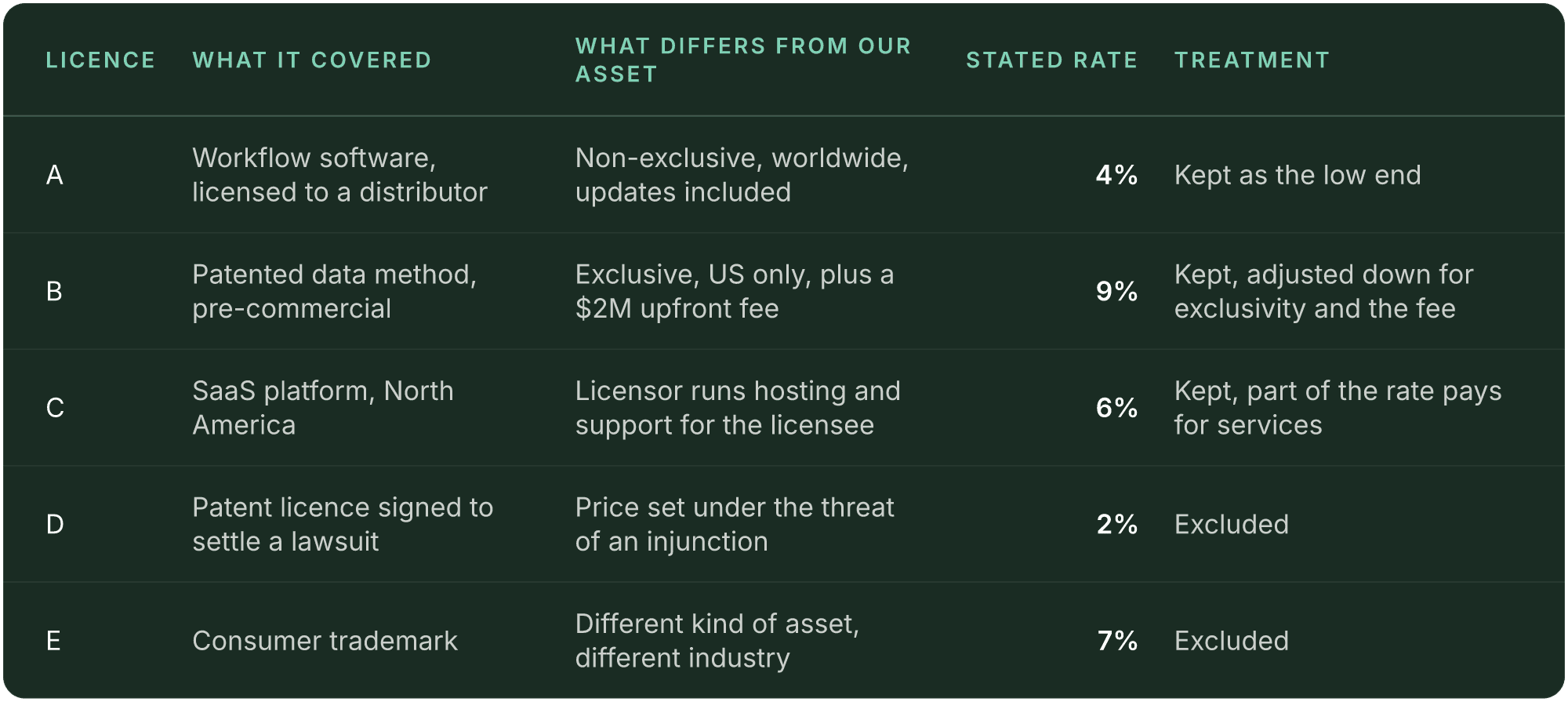
A search rarely returns five clean matches. It returns a pile of agreements that each differ in some way, and the work is deciding which ones to keep and how to adjust them. Here's an illustrative set for the platform code in the example.
[](https://www.409.ai/uploads/relief_from_royalty_royalty_rate_ip_valuation_comparable_licences_table_2_4827be920f.png)
Licence B looks like the best evidence because it's the richest deal, and it's the one most easily misread. The rate pays for exclusivity our asset's hypothetical licence wouldn't grant. The $2 million upfront also means the running royalty understates the total price, so you have to convert the fee into an equivalent rate before you compare anything. Licence C bundles services: when the licensor does the hosting, part of the 6% is a fee for work, not for the code. Licence D was priced in a courtroom, not a market.
After that work, the three licences that survive point to a range of roughly 4% to 6%. The report picks a point inside it and says why: 5% here, because the code is mature and non-exclusive, and the licensee in the hypothetical deal would do its own hosting.
The profit check
A rate drawn from comparables still has to make sense against what the product earns. No licensee pays away all its operating profit for the right to sell a product, and a royalty that takes most of the margin will be questioned. In the table above, 5% leaves the licensee with 80% of the operating profit. That's believable for an asset that is the core of the product but not the whole of it: the licensee still brings sales, customers, a brand and a team.
The check runs both ways. If the comparables point to 9% and the product's operating margin is 12%, either the comparables aren't comparable or the forecast is wrong. Resolve that before the report goes out, not after a reviewer finds it.
The shortcut that courts threw out
For decades a common starting point was the "25 percent rule": give the licensor a quarter of the licensee's expected profit on the product and turn that into a royalty. The Federal Circuit ended its use in patent damages in *Uniloc USA, Inc. v. Microsoft Corp.*, 632 F.3d 1292 (Fed. Cir. 2011), decided January 4, 2011. The court held the rule to be "a fundamentally flawed tool for determining a baseline royalty rate in a hypothetical negotiation," and evidence relying on it inadmissible, because it "fails to tie a reasonable royalty base to the facts of the case at issue."
Uniloc is a patent damages case, not a valuation standard, and the profit check above isn't the 25 percent rule in disguise. The difference is the direction. A profit split used as a test asks whether a rate taken from market evidence is plausible for this product. A rule of thumb used as a starting point replaces the evidence. The court's reasoning carries over to any valuation a third party will test: a rate with no link to this asset, this industry and these parties doesn't hold up.
Who tests the rate, and what they ask
The reviewer depends on why you ordered the valuation.
A transfer to a related party. When IP moves to a holding company, an affiliate or a foreign subsidiary, the tax rules want the price to be arm's length. [Section 482](https://www.law.cornell.edu/uscode/text/26/482) adds that for a transfer or licence of an intangible, the income "shall be commensurate with the income attributable to the intangible." A rate that looked fine on day one can be revisited if the asset earns far more than the forecast said. For an outbound move, the [Section 367(d) deemed royalty](https://www.409.ai/articles/section-367d-ip-transfer-foreign-subsidiary-valuation) runs on the same logic.
An acquisition. When the asset was bought with a business, the rate feeds the buyer's ASC 805 allocation, and the auditor checks it against the deal's returns. A technology rate too high for the margins pushes value out of goodwill. The cross-check we described in [reconciling the IRR, WACC and WARA in a purchase price allocation](https://www.409.ai/articles/purchase-price-allocation-reconcile-irr-wacc-wara-goodwill-return-asc-805) catches that. The broader allocation is laid out in our guide to [purchase price allocation after a startup acquisition](https://www.409.ai/articles/asc-805-purchase-price-allocation-startup-acquisition).
A licence or a sale of the asset itself. The counterparty's adviser will ask for your comparables and argue the adjustments. This is the case where licence B's upfront fee turns into a negotiating point. Deals that license a team's model without buying the company, the structures in [our piece on reverse acqui-hires](https://www.409.ai/articles/reverse-acqui-hire-cap-table-409a-valuation), turn on the same question.
A lender or an impairment test. A lender lending against IP wants to see the downside, so the low end of the range matters more than the point estimate. An impairment test revisits the rate used at acquisition, and a rate that can't be supported again becomes part of the write-down. We cover that test in [goodwill impairment for private companies](https://www.409.ai/articles/goodwill-impairment-private-company-asc-350).
What a report should show about the rate
A royalty rate that holds up comes with its working shown: the search (sources, dates, the terms searched), every licence considered, why each was kept or dropped, the adjustment made to each one kept, the resulting range, the point chosen and why, and the profit check. It also states the royalty base, because 5% of gross revenue and 5% of net revenue after returns and channel fees aren't the same number.
If your current report states a rate and cites "industry norms," it has the weakest version of the most important input. At 409.AI, an [IP and intangible asset valuation](https://www.409.ai/products/ip-valuation) documents the royalty evidence licence by licence, so the reviewer can see where the rate came from.
The takeaway for the CFO ordering one: before you read the conclusion, find the royalty-rate page and ask what would have to change to move the rate one point. At about $438,000 a point in a model like ours, that answer tells you how much of the value is evidence and how much is judgment.