Tax
Tax Amortization Benefit in an IP Valuation: When 15 Years Is Wrong
For founders and CFOs buying or selling a patent, codebase or brand: how the tax amortization benefit is calculated and why 15 years is often the wrong life.
By 409.AI Team - 2026-11-25
# Tax Amortization Benefit in an IP Valuation: When 15 Years Is Wrong
If you're a founder, CFO or deal advisor buying or selling a single patent, a codebase or a brand, part of the price you're negotiating is a tax deduction. A buyer who pays cash for an intangible asset can usually write that cost off over time, and those write-offs are worth money. An appraiser captures that value with the tax amortization benefit, or TAB, and on a $4 million patent it can add anywhere from about $300,000 to more than $700,000 to the number in the report.
Most models assume the deduction runs over 15 years. For an asset bought on its own, that is often the wrong life, and the error moves the value. This article explains what the TAB is, how it is calculated, which tax life applies to which asset under the Internal Revenue Code, and the transactions where there is no benefit to add at all.
What the tax amortization benefit is
An income-approach valuation of an intangible, whether it uses relief from royalty or excess earnings, estimates the after-tax cash flows the asset produces and discounts them. That gives the value of the asset's earnings. It leaves out one thing a buyer gets: the right to deduct the purchase price.
Say a company pays $4 million for a patent. Over the years that follow, it deducts the $4 million against taxable income. At the 21% federal corporate rate set by IRC Section 11(b), those deductions save $840,000 of tax in total, spread over the amortization period. Discounted to today, the savings are worth less than $840,000, but they are worth something, and a buyer who knows it will pay for them.
The TAB is the present value of those savings, added to the value of the earnings. There is one wrinkle. The deduction depends on the price, and the price includes the TAB. So the benefit is computed with a factor that solves the loop:
TAB factor = 1 / (1 − (tax rate ÷ tax life) × annuity factor)
The annuity factor is the present value of $1 a year over the tax life at the asset's discount rate. Multiply the value before the benefit by the factor and you have the value with it.
A worked example
Take a patent whose relief-from-royalty cash flows are worth $4,000,000 before any tax benefit, discounted at 18%. The buyer is a US corporation paying tax at 21%. The table below shows what the TAB adds under three different tax lives. Illustrative numbers, annual end-of-year deductions, no state tax.
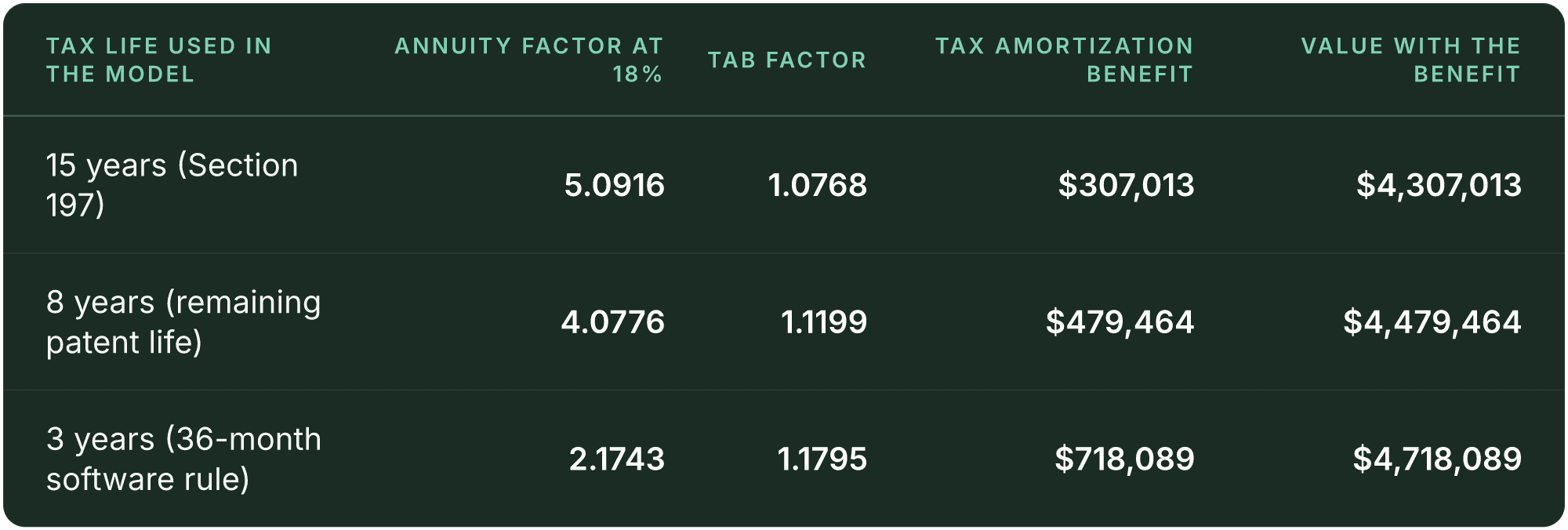

Same asset, same cash flows, same discount rate. Only the tax life changes, and the value moves by $411,076 from the first row to the last. A shorter life means the deductions arrive sooner, and money saved sooner is worth more.
You can check the first row by hand. A $4,307,013 basis deducted over 15 years is $287,134 a year. At 21% that saves $60,298 a year, and $60,298 times the annuity factor of 5.0916 is $307,013. The benefit pays for itself exactly, which is the point of the factor.
Which tax life applies
The life is not a modelling choice. It follows from what the asset is and how it was acquired.
Bought with a business: 15 years
IRC Section 197 amortizes a "section 197 intangible" ratably "over the 15-year period beginning with the month in which such intangible was acquired." The list in Section 197(d)(1) is wide: goodwill, going concern value, workforce in place, "any patent, copyright, formula, process, design, pattern, knowhow, format, or other similar item," customer-based intangibles, licences and permits, and franchises, trademarks and trade names.
When a patent, a codebase or a brand comes over as part of the purchase of a trade or business, it sits in that list and the life is 15 years, whatever its economic life. That's the case behind the familiar 15-year assumption, and it's correct in a purchase price allocation for an asset deal. It's also why the remaining useful life that drives the cash flows and the tax life that drives the TAB are two different numbers.
A patent bought on its own: its remaining life
Section 197(e)(4) carves out certain rights "not acquired in a transaction" involving the acquisition of a trade or business, and subparagraph (C) names "any interest in a patent or copyright." A patent bought by itself is not a Section 197 intangible.
Its deduction then comes from Section 167, and Treas. Reg. Section 1.167(a)-14(c)(4)-14) says how. The basis of the patent is depreciated "either ratably over its remaining useful life or under section 167(g) (income forecast method)." A patent with eight years left before it expires, and no shorter economic life, is written off over eight years, not fifteen. In the table, that is the difference between the first and second rows: $172,451 of value.
The same paragraph has a second rule that changes the structure, not just the life. When the price of a separately acquired patent or copyright is payable at least annually "as either a fixed amount per use or a fixed percentage of the revenue derived from the use," the deduction for the year equals the amount paid that year. There is no lump sum to amortize, so there is no benefit to gross up. The value is the present value of the payment stream itself.
Software bought on its own: 36 months
Section 197(e)(3) excludes computer software "readily available for purchase by the general public" under a nonexclusive licence and not substantially modified, and it also excludes other software not acquired in the purchase of a trade or business. Under Treas. Reg. Section 1.167(a)-14(b)(1), software covered by Section 167(f)(1) is amortized straight line over 36 months from the month it's placed in service.
A codebase bought outright from a founder or a shuttered startup, without the business around it, falls here. That's the third row of the table, and it's where a 15-year assumption understates the benefit most.
A trademark bought on its own: still 15 years
The Section 197(e)(4) carve-out covers patents and copyrights, not trademarks. A brand bought without the business that used it stays on the 15-year schedule. Mixed bundles need each asset checked on its own: a patent, its related trademark and a software tool sold together, outside a business acquisition, can carry three different lives.
When there is no benefit to add
The TAB exists because a buyer gets a new tax basis by paying for the asset. Some IP transactions never create one.
- A contribution to a corporation for stock. In a Section 351 exchange, the corporation takes the contributor's basis under IRC Section 362(a), increased only by any gain the contributor recognized. Founders who assign a self-developed patent into a new company usually have little basis, so there is little or nothing for the company to amortize.
- A contribution to a partnership or LLC taxed as one. Under IRC Section 723, the partnership's basis is the contributing partner's adjusted basis.
- A licence. A licensee pays royalties for the right to use the asset and doesn't buy it. What it deducts is the royalty as paid, so a licence valuation values the royalty stream and adds no TAB.
These are the moments when someone asks for a value anyway: to set the number of shares a founder receives, to record a capital account, to support a transfer to an IP holding company. The value of the asset still exists. What changes is whether the buyer's tax deduction is part of it. An IP transfer to a foreign affiliate raises its own set of rules, covered in our piece on Section 367(d).
Fair value is a different question
For financial reporting, the question is what a market participant would pay, not what this buyer's tax return will show. In a purchase price allocation, appraisers commonly include a TAB for an income-approach intangible on the view that a participant buying the asset would get the deduction, even when the actual deal was a stock purchase with no step-up. We walk through that case for customer relationships valued with excess earnings.
So the same patent can carry a TAB on a 15-year life in a business combination's allocation, a TAB on an eight-year life in a standalone sale, and no TAB at all in a contribution to a subsidiary. None of those is inconsistent. Each answers a different question, and the report should say which one it answers.
What to settle before the valuation starts
An appraiser can only pick the right life if the facts are on the table. Before the work starts, write down:
- What is being transferred. A patent family, a codebase, a brand, or a bundle. List each asset separately.
- Whether a trade or business comes with it. Employees, customer contracts, a product line in operation. This decides between Section 197 and the separate-acquisition rules, and it can also decide whether the deal is an asset acquisition or a business combination for the books.
- How the price is paid. A lump sum, instalments, or a running payment tied to use or revenue.
- How title moves. A taxable purchase, a contribution for stock or units, a licence.
- The legal and economic life of each asset. The patent's expiry date, the expected life of the code, the brand's history. The methods we use for startup IP all depend on it.
- The purpose of the value. A negotiated price, a tax filing, or financial reporting, because the standard of value decides whether a TAB belongs.
Who settles the tax characterization is your tax advisor. What the appraiser needs is the answer, stated before the model is built, so the benefit is calculated on the life the law gives the asset.
The takeaway
The tax amortization benefit is a real part of what an intangible is worth to a buyer, and it is only as right as the tax life behind it. Fifteen years applies when the IP comes with a business. A patent bought on its own runs on its remaining life, software on 36 months, and a running royalty or a basis-carryover contribution may leave nothing to add. On the patent in our example, that choice alone is worth $411,076. If you're pricing or documenting an IP transfer, an IP and intangible asset valuation that states its tax life and why is the one that holds up when the buyer's tax team or the IRS reads it.
About the author
409.AI Team
Startup valuation and equity workflow specialists
The 409.AI team writes practical valuation content for founders and finance teams preparing 409A reports, equity documentation, and related startup finance workflows.
Related valuation reports
- IP & intangible asset valuation report: 409.AI helps companies prepare expert-reviewed valuations of patents, trademarks, software, and other intangible assets for transactions, licensing, tax, and reporting.
- 409A valuation report: 409.AI helps private companies prepare expert-reviewed 409A valuation reports for equity compensation and option strike price support.
- Pricing for every report type
- 409A valuation calculator
- Sample 409A report