Tax
Moving Your IP to a Foreign Subsidiary: What Section 367(d) Does to Its Value
Founders and tax teams moving patents or code to a foreign subsidiary face Section 367(d). See how the deemed royalty, 20-year election and appraisal interact.
By 409.AI Team - 2026-11-04
# Moving Your IP to a Foreign Subsidiary: What Section 367(d) Does to Its Value
A US startup decides to set up an Irish or Singapore subsidiary, and the plan is to put the code, the patents and the brand there so the new entity can sell into Europe or Asia. The lawyers draw the structure. The founder assumes a tax-free contribution of property to a corporation is just that. Then the tax advisor mentions Section 367(d), and the question becomes: what is this intellectual property worth, and who gets to say?
This article is for the founder, the CFO and the tax advisor planning that move. It explains what the statute does to the transfer, why the valuation sits at the center of it, and what a defensible IP appraisal has to show before the structure is signed.
The rule: a contribution that is taxed like a sale
Contributing property to a corporation for its stock is normally tax-free under [Section 351](https://www.law.cornell.edu/uscode/text/26/351). When the corporation is foreign and the property is intangible, Section 367(d) takes over. Under [26 U.S.C. § 367(d)(1)](https://www.law.cornell.edu/uscode/text/26/367), the usual nonrecognition rule does not apply to the transfer, and the special rules of subsection (d) do.
Those rules treat the US transferor as having sold the property "in exchange for payments which are contingent upon the productivity, use, or disposition of such property." The transferor is also treated as receiving amounts that reasonably reflect what would have been received annually over the property's useful life, or at the time of a later disposition. The statute adds the sentence that drives everything else: the amounts "shall be commensurate with the income attributable to the intangible."
In plain terms, the US company reports a royalty-like income inclusion every year, whether or not the subsidiary pays anything. If the intangible turns out to earn far more than expected, the inclusions rise with it. There is no one-time gain fixed by an appraisal on the transfer date, which is what separates this regime from an ordinary sale.
Why valuation still matters if the payments float
Because the inclusions follow actual income, a founder might conclude that the appraisal doesn't matter. It does, for four reasons.
It sets the starting royalty. The first years of inclusions need a rate. A relief-from-royalty analysis, the same method described in [how startup IP actually gets valued](https://www.409.ai/articles/startup-ip-intangible-asset-valuation-methods), gives a documented rate based on comparable licences and the asset's profit contribution. Without it, the rate is a guess an examiner can replace.
It defines what was transferred. The statute covers intangible property as defined in subsection (d)(4). An appraisal that identifies each asset (the patent family, the software, the trademarks, the know-how, the customer data) shows what moved and what stayed in the US. The assets left behind still need a value too, because they may be licensed to the subsidiary later.
It sets the useful life. Under [Treas. Reg. § 1.367(d)-1(c)(3)](https://www.law.cornell.edu/cfr/text/26/1.367(d)-1), useful life is the period over which exploitation of the property is reasonably expected to affect taxable income, measured at the time of transfer. Exploitation includes direct or indirect use, transfer and further development. A software platform with a three-year technology life and a brand with no foreseeable end are very different transfers, and the appraisal is where that judgment is documented.
It is the benchmark if anyone asks. Years later, an examiner or a buyer's diligence team will compare what was reported against what the asset earned. An appraisal dated at the transfer shows the reasoning was sound on what was known then.
A worked example
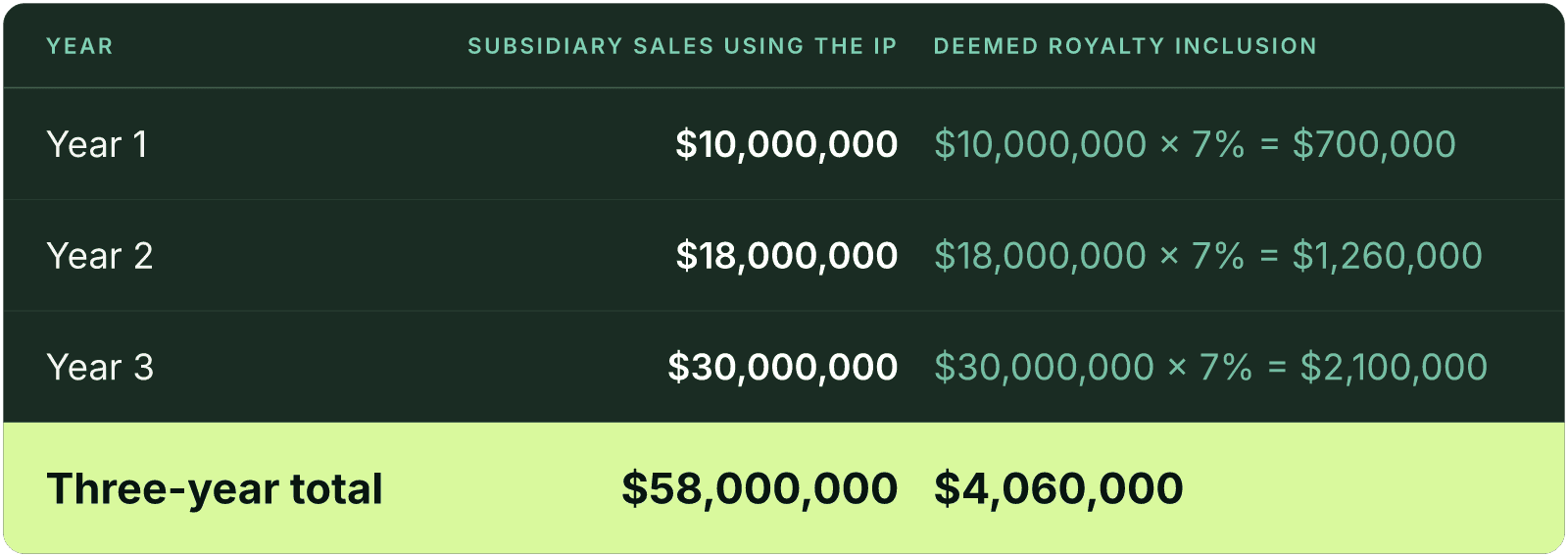
Take a US software company that contributes its platform and patents to a new Irish subsidiary for stock. An independent appraisal supports a 7% royalty on sales that use the intangibles. The numbers below are illustrative, not a recommendation.
[](https://www.409.ai/uploads/section_367d_ip_transfer_foreign_subsidiary_valuation_table_1_610436515e.png)
The US parent reports $4.06 million of income over three years from an asset it did not sell and for which it received no cash. If sales had stayed flat at $10 million, the inclusions would have stayed at $700,000 a year.
That is the cost of the structure, and it is the number to model before the move, not after. If the plan is to put a fast-growing product in the subsidiary, the US tax cost grows with the product. If the subsidiary's profit comes mostly from local sales and services that have nothing to do with the transferred IP, the appraisal is what separates the two.
The 20-year question
A common shortcut says the deemed payments stop after 20 years. The regulation is narrower. For property with an indefinite useful life, or one expected to last beyond 20 years, [§ 1.367(d)-1(c)(3)(ii)](https://www.law.cornell.edu/cfr/text/26/1.367(d)-1) lets the taxpayer choose, in the year of transfer, to increase annual inclusions during a 20-year period. No adjustments are made for later years, though the Commissioner may consider later-year income when testing whether the amounts are commensurate with income.
The choice is made through a statement titled "Application of 20-Year Inclusion Period to Section 367(d) Transfers," attached to a timely filed original return, including extensions, for the transfer year. The regulation says the election is irrevocable and that a failure to file the statement on time "may not be remedied."
The regulation's own illustration shows the cost: a royalty rate of 6.8 percent under the indefinite-life method becomes 10.3 percent under the 20-year option. A longer life does not make the tax go away. It changes how the valuation is spread, and the appraiser has to model both so the founder can see the difference before the return is filed.
What happens if the IP moves again
The regime follows the property. Under [§ 1.367(d)-1(f)](https://www.law.cornell.edu/cfr/text/26/1.367(d)-1), a later transfer of the intangible by the foreign corporation to a related person does not end the US person's obligation to recognize income, and the related person is treated as the transferee. A disposition to a qualified domestic person within the useful life can bring the property out of the regime, but the transferor recognizes gain on the way out, and the regulation conditions the treatment on the transferor providing required information.
For a startup, the practical trigger is a later sale. If the Irish subsidiary is acquired, or its stock is sold, the acquirer will run its own [purchase price allocation](https://www.409.ai/articles/asc-805-purchase-price-allocation-startup-acquisition) that values the same technology at fair value. The two numbers will sit side by side in the diligence file, one from the transfer and one from the deal. A large gap needs an explanation, and the earlier appraisal is the document that supplies it.
What a defensible IP valuation contains
Before the structure is signed, ask the appraiser for these:
- A list of every intangible in the transfer and every one that stays, with the legal owner of each.
- A royalty rate built from documented comparables and a profit-split cross-check, not a rule of thumb.
- A useful life for each asset, with the technology and market evidence behind it.
- A forecast that matches the one used for the financing, the [409A](https://www.409.ai/articles/reverse-acqui-hire-cap-table-409a-valuation) and the budget. Three different growth stories in three documents is the fastest way to lose an argument.
- Both the indefinite-life and the 20-year inclusion paths, so the election is made with the numbers in hand.
Related tax questions travel with the same facts. A company that capitalised or deferred research costs should read the guidance on [unamortized Section 174 costs](https://www.409.ai/articles/unamortized-section-174-recovery-2025-rev-proc-2025-28) before moving the IP those costs created, and a company that has had a financing round should check whether an [ownership change under Section 382](https://www.409.ai/articles/section-382-ownership-change-startup-nol-carryforwards) limits the losses it expected to absorb the inclusions.
The takeaway
The most expensive version of this move is the one planned around the legal structure and valued afterwards. Get the appraisal first, model three years of inclusions at the documented rate, model the 20-year option if the asset has no foreseeable end, and then decide where the IP should live. Transfers like this also need international tax counsel; an appraisal supports their analysis and does not replace it.
If you are weighing a transfer of patents, software or brand to an affiliate, [409.AI's IP and intangible asset valuation](https://www.409.ai/products/ip-valuation) gives the tax team a documented value and royalty analysis to work from.