Financial Reporting
Private Equity Valuation at Quarter-End: How a Fund Marks a Leveraged Buyout
For buyout fund CFOs: how a December 31 mark goes from a calibrated EBITDA multiple to the fund's equity under ASC 820 and IPEV, with a worked $150M deal.
By 409.AI Team - 2026-11-27
# Private Equity Valuation at Quarter-End: How a Fund Marks a Leveraged Buyout
If you are the CFO or controller of a buyout fund, your December 31 marks are due to the auditor in a few weeks, and most of the portfolio is companies you control and financed with debt. The textbook answer to "how is private equity valued" lists three methods: discounted cash flow, trading comparables and precedent transactions. That list is correct, and it is nowhere near enough to build a mark an auditor will sign off.
A fund's mark is a fair value measurement under ASC 820, and a buyout mark is a chain of steps: a multiple calibrated to what you paid, an enterprise value, adjustments, the debt that sits ahead of you, dilution, and finally your share. Each step has a rule behind it. This article walks through all of them with one worked company.
Fair value, not fair market value
Start with the standard of value, because it decides almost everything that follows. ASC 820 defines fair value as the price that would be received to sell an asset in an orderly transaction between market participants at the measurement date. The International Private Equity and Venture Capital Valuation Guidelines (the December 2025 edition, known as IPEV) repeat that definition word for word in Guideline 1.1.
Fair market value is a different thing. It is the tax standard, the willing buyer and willing seller of Treas. Reg. § 20.2031-1(b), and it belongs in a gift tax return or a 409A, not in a fund's financial statements. A report that concludes on "fair market value" for a fund's investment answers the wrong question, and your auditor will notice the label before reading the numbers.
You don't choose the valuation date
For a fund, the date is fixed. IPEV Guideline 2.1 says fair value is assessed at each measurement date, and the commentary on Guideline 1 says the value should reflect what a seller would receive under current market conditions at that date. If your quarter ends December 31, the mark is as of December 31.
That rules out a tempting move. When public peers drop 10% in the last two weeks of December, you cannot pick November 30 because it looks calmer. The guidelines also limit what you may use: information known or knowable at the measurement date. A February trading price is neither. A January event can matter only if it tells you about conditions that already existed on December 31, which is the same line ASC 855 draws for subsequent events in a year-end mark.
Step one: calibrate at entry
Here is our illustrative company. In October 2025 the fund bought it for an enterprise value of $150.0 million, 7.5 times last-twelve-months EBITDA of $20.0 million. A $90.0 million term loan financed part of the price, so equity was $60.0 million. The fund paid $54.0 million for 90% of the shares and management rolled $6.0 million for the other 10%. On the closing date, the public peer set traded at a median of 9.0 times EBITDA.
ASC 820-10-35-24C requires calibration when the transaction price was fair value at initial recognition and later measurements use unobservable inputs: the technique has to reproduce the entry price on day one. The SEC staff made the same point in its September 28, 2026 statement on private asset fair value, and we covered what that statement asks funds to fix separately.
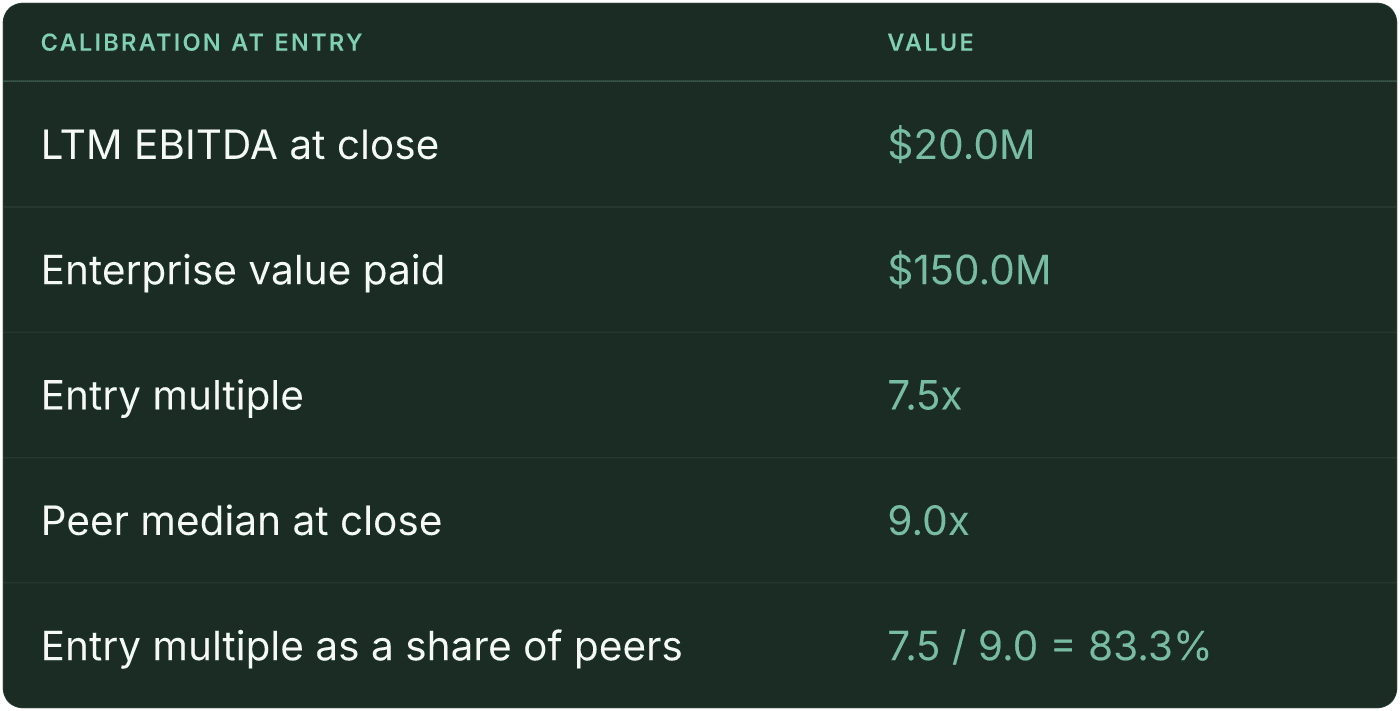

The deal priced at 83.3% of the peer multiple, or about 16.7% below it. You don't need to explain that gap piece by piece. IPEV says calibration captures size, growth, control and liquidity differences together, without measuring each one. What you need is the relationship, documented, so you can carry it forward.
Step two: roll the multiple to the measurement date
By December 31, 2026, the peer median has fallen from 9.0x to 8.1x, a 10% drop. The company has grown: EBITDA reported through September 30 is $21.6 million, and October and November results show the trend holding, so you estimate December 31 LTM EBITDA at $22.0 million. IPEV allows exactly this: when the latest reported figures lag the measurement date, you adjust them for a trend you already know about.
Keep the 83.3% relationship and the calibrated multiple is 8.1 x 83.3% = 6.75x. IPEV lets the valuer choose between moving the multiple by the same percentage as the peers or by the same number of turns, provided the choice is applied consistently. The absolute version, 7.5x minus 0.9 turns, gives 6.6x. In this example that choice moves the fund's mark by about $2.8 million, so write it into your valuation policy once and stop deciding it every quarter.
If your fund also holds venture positions marked on revenue multiples, the same mechanics apply. Our guide to calibrating peer revenue multiples to the entry price covers that case. A buyout mark adds the steps below, which a venture mark usually doesn't need.
Step three: from enterprise value to the fund's equity
IPEV Guideline 2.4 sets out the order: determine enterprise value, adjust it for what a market participant would take into account, deduct the instruments ranking ahead of the fund, allow for dilution, then apportion what is left. Here it is for our company at December 31, 2026.
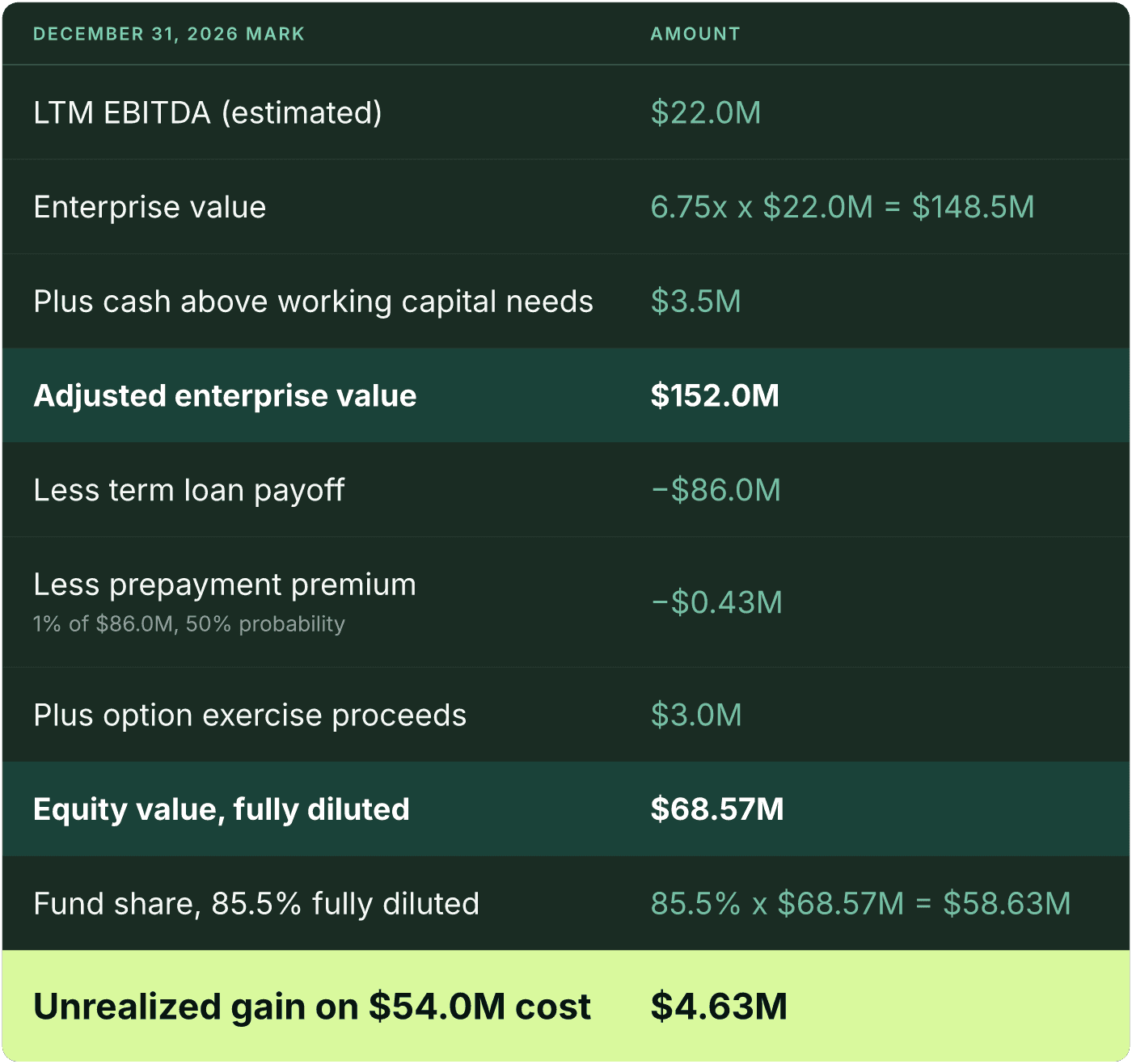

Each line has a reason behind it.
The debt is deducted at payoff, not at its trading price. The term loan must be repaid on a change of control, as is often the case in a buyout. IPEV says a market participant would then assume the change of control happens at the measurement date and deduct the par or payoff amount: here the $86.0 million balance after amortization. If the loan were quoted at 95 cents, you still could not deduct $81.7 million. IPEV allows the lower figure only once the company or the fund has actually bought the debt back at that price and intends to cancel or restructure it.
A prepayment premium is weighted by its probability. The loan carries a 1% premium if repaid early. IPEV asks you to include it in the deduction according to the likelihood that it would be paid, considering timing and the room to negotiate with lenders. At a 50% probability, that is $0.43 million.
Cash and other surplus items move the value. Enterprise value from an EBITDA multiple prices the operating business only. Cash beyond what the business needs to run is added; unpaid bonuses, deferred consideration and tax liabilities a buyer would inherit are deducted. IPEV lists these items explicitly.
Options in the money are treated as exercised. Management holds options over 5% of the fully diluted shares with an aggregate strike of $3.0 million. Their 5% of the equity, about $3.4 million, exceeds the strike, so IPEV's approach assumes exercise and adds the $3.0 million of proceeds. The fund's 90% of the existing shares becomes 85.5% of the fully diluted total.
Then read the result. EBITDA grew 10% and the multiple fell 10%, so enterprise value barely moved: $148.5 million against $150.0 million at entry. The gain comes from $4.0 million of debt paid down and $3.5 million of cash built up. For a leveraged company that is a normal result, and it is the sentence your valuation committee memo should open with.
What happens without calibration
Suppose the mark simply applied the 8.1x peer median. Enterprise value becomes $178.2 million, fully diluted equity $98.27 million and the fund's share $84.02 million. The mark would show a gain of about $30 million over cost on a company whose operating value didn't change. The $25.4 million difference from the calibrated mark is the size of the problem calibration exists to prevent, and it is the first thing an auditor tests in a Level 3 file.
A DCF, run as a second technique, follows the same discipline. IPEV suggests breaking the discount rate implied at entry into its components, updating the market components at each measurement date and keeping the company-specific premium unless facts change. When the DCF and the calibrated multiple disagree by more than a few percent, find out why before you weight them. Where the gap starts with the management forecast, our note on how ASC 820 treats the portfolio company forecast sets out what to do with it.
Discounts that don't belong in the mark
Two adjustments often appear in generic valuation material and need care in a fund's file.
A flat marketability discount on top of a calibrated multiple usually counts the same thing twice. IPEV's commentary on Guideline 1 states that a discount for marketability, defined as the time needed to complete a transaction, is not appropriate in fair value, and it treats calibration as the way to capture what illiquidity does to the price. If a 15% discount sits on a buyout mark, expect to justify why the entry calibration didn't already capture it.
A blockage discount for the size of the stake is never allowed, while a control premium can be part of fair value when the unit of account and market participants support it. We set out where ASC 820 draws that line for a majority stake.
What goes in the year-end file
For each buyout position, the file your auditor reads should hold the entry calibration with the peer set as it stood at close; the peer set and multiples at December 31, with any change in its makeup explained; the EBITDA used, with the reported figure and the adjustment to the measurement date; the enterprise value bridge above, line by line, with the credit agreement sections on change of control and prepayment; the dilution and waterfall, if there is preferred equity or a management incentive plan; and a reconciliation of the second technique. After an exit, compare the sale price with your last marks, because back-testing is how you find out whether the calibration held up.
The steps above follow the IPEV guidelines in force for 2026 year-end files, and a provider supporting your marks should be able to show you every one of them. 409.AI prepares ASC 820 portfolio valuations scoped to your positions and the audit timetable.
The takeaway for this quarter: before anyone debates the multiple, check that the equity bridge deducts the debt at payoff and that the multiple still sits in the same relationship to peers as on the day you bought. Those two lines decide most of a buyout mark.
About the author
409.AI Team
Startup valuation and equity workflow specialists
The 409.AI team writes practical valuation content for founders and finance teams preparing 409A reports, equity documentation, and related startup finance workflows.
Related valuation reports
- ASC 820 valuation report: 409.AI helps funds and companies prepare expert-reviewed ASC 820 valuation reports with fair value analysis and Level 3 documentation support for US GAAP reporting.
- 409A valuation report: 409.AI helps private companies prepare expert-reviewed 409A valuation reports for equity compensation and option strike price support.
- Pricing for every report type
- 409A valuation calculator
- Sample 409A report