Financial Reporting
IPEV 2025 Governs Your 2026 Quarters: What the Year-End Level 3 File Must Show
IPEV 2025 already governs fund marks for quarters from April 2026. A guide for fund CFOs to the changes and the evidence the year-end Level 3 file needs.
By 409.AI Team - 2026-10-26
# IPEV 2025 Governs Your 2026 Quarters: What the Year-End Level 3 File Must Show
If your fund's valuation policy cites the IPEV Valuation Guidelines, you are probably already marking to a new edition. The December 2025 Guidelines say they supersede the 2022 edition and are "in effect for quarterly reporting periods beginning on or after 1 April 2026". For a calendar-year fund, that means the Q2 and Q3 2026 marks, and the December 31 file your auditor will test, all sit under the 2025 text.
That is a question for the CFO or controller more than for the investment team. The policy still says "2022", the quarterly workpapers were built on 2022 habits, and the first audit under the new edition is a few months away. This post walks the 2025 change log as an evidence list: what moved, what did not, and what the year-end file should be able to show.
What changed, and what did not
The IPEV Board's own summary is the useful starting point. It did not rewrite the Guidelines themselves. Apart from a minor clarification in 1.4, the numbered guidelines are unchanged. The Board worked on the explanatory text under them and on the additional guidance in Section II.
That matters for how you respond. Nothing in the 2025 edition asks you to adopt a new method. It asks you to document more precisely the judgement you already make, because the text an auditor or reviewer will point at is now sharper. The changes that bear most on a Level 3 file are these:
- Recent investment price is not automatically fair value (Section I 2.3)
- Known and knowable information, expanded (I 2.5)
- Calibration, including calibration to follow-on transactions (I 2.6)
- Scenario analysis named as a valuation technique (I 3.2)
- A test of whether a transaction price is fair value, and new text on complex capital structures and liquidation preferences (I 3.10)
- Secondary market discounts or premia on fund interests (I 4.3)
- Transaction costs, rewritten (II 5.14)
- Limited information, more frequent valuations, venture debt and SAFEs (II 5.18 to 5.20)
- A statement on artificial intelligence in the introduction
Each of these maps to a document the year-end file either holds or does not.
The price of the last round is a data point, not the answer
Section I 2.3 reconfirms that the price of a recent investment "is not automatically deemed to be Fair Value", and adds that fair value will generally change from one measurement date to the next because performance and markets change. Section I 3.10 goes further: the price of a recent investment should not be treated as a standalone valuation technique.
The practical effect is on the "held at cost" position. A Level 3 schedule where a company sits at the last round price for three quarters running invites the question of what you looked at each quarter. The 2025 text does allow for the case where fair value stays the same, but only after you consider the facts. The file needs a short note per position per quarter saying what was reviewed (performance against plan, market movement in comparables, financing events) and why the conclusion held or moved.
The same section tells the valuer how much weight a recent round deserves: the size of the investment relative to total ownership, when the price was agreed, and whether new investors took part. Write those three factors into the position memo. They are the evidence an auditor will look for when you rely on a round.
Calibration now covers follow-ons
Calibration is the discipline of running your valuation model on the entry date's inputs and confirming it returns the entry price. The 2025 edition reorders and expands Section I 2.6, recasts the worked example and adds a paragraph on calibrating to follow-on transactions.
The IPEV example is simple. An investment is bought at fair value at an implied 8x EBITDA multiple while comparable companies trade at 10x. The 20% gap is what the calibration captures: control, liquidity, growth and other differences from the peers. At later dates, you apply judgement to how that gap should move. We covered the mechanics in [how to calibrate peer multiples to your entry price](https://www.409.ai/articles/peer-multiples-fund-level-3-mark-calibrate-entry-price-asc-820).
What is new is the expectation that a later round at a different price can re-set the calibration, if it is an orderly transaction and you have weighed it. So the file should hold, for each position that raised capital this year, the original calibration, the follow-on analysis and the decision about which one the current mark rests on. If the follow-on was a bridge or an insider round, say why it was or was not treated as a market participant price.
Scenario analysis, preferences and the capital structure
Section I 3.2 now names scenario analysis as a valuation technique, and Section I 3.10 adds significant text on complex capital structures, particularly for early-stage and venture investments, with a separate part on liquidation preferences. The warning is specific: do not apply the value of a round of financing to other share classes without considering their different rights and preferences. When rights differ, the post-money equity value may not equal the round's price multiplied by the shares, and you may need a valuation technique to estimate it.
For a fund holding common or junior preferred next to a senior series, the file should show the waterfall, the scenarios and their weights, and the reason the held class is worth what it is. Our piece on [why a Series A position is not worth the latest round price](https://www.409.ai/articles/fund-mark-junior-preferred-liquidation-waterfall-asc-820-latest-round-price) works through the arithmetic.
SAFEs, venture debt and limited information
Section II 5.20 is new. It treats venture debt through contractual cash flows, credit risk, market yield and optionality such as attached warrants, with inputs calibrated to the transaction price and updated each date. For convertible loan notes, SAFEs and advance subscription agreements, it asks the valuer to understand the conversion terms case by case, including any discount to the next round and any valuation cap.
If your fund holds SAFEs at cost because "they are not priced until conversion", this is the paragraph to read first. The file needs the conversion terms, the scenarios considered and how the next round's expected pricing enters the mark. See [how a fund marks a SAFE or convertible note at quarter-end](https://www.409.ai/articles/fund-mark-safe-convertible-note-asc-820-quarter-end).
Section II 5.18 addresses co-investments and limited information rights. The obligation to determine fair value does not change because the lead investor holds the information. The co-investor uses what the lead provides but should reach its own conclusion rather than adopt the lead's. Where information is stale, the valuer reflects market movement and anticipated performance through the measurement date, and a total lack of information may call for a higher required return, which lowers value. The year-end file should show, for each co-investment, the date of the latest information received and the adjustment made from that date to December 31.
Transaction costs and the first-quarter loss
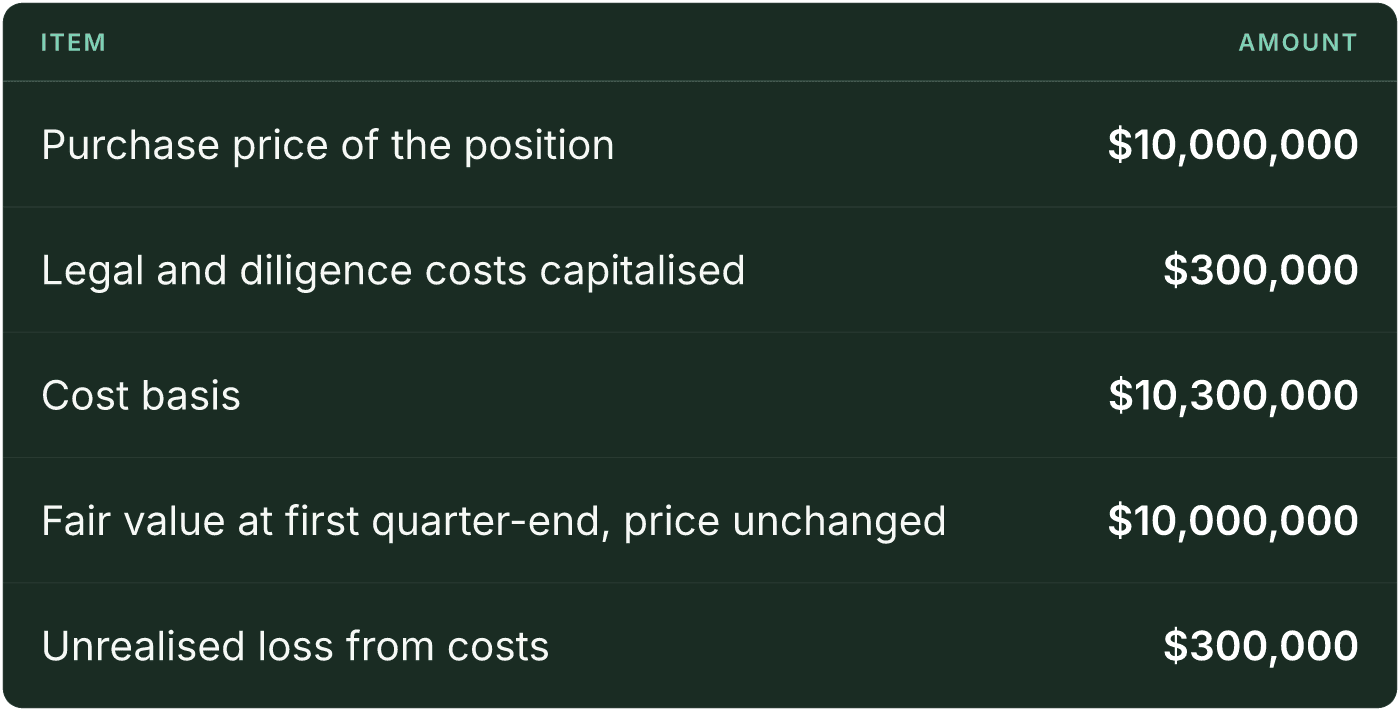
Section II 5.14 was rewritten to line up with accounting guidance: transaction costs are not a characteristic of an investment. Where costs are capitalised into cost basis under the applicable standard, a position whose fair value has not moved since closing is carried below cost, and the difference is an unrealised loss.
A worked example, with illustrative figures:
[](https://www.409.ai/uploads/ipev_2025_valuation_guidelines_in_effect_2026_year_end_level_3_file_table_1_e49bde1f5e.png)
The point for the file is consistency: the same treatment in every position, and a clear bridge in the roll-forward between cost and fair value so the first-quarter loss is explained before an LP asks. We explain the pattern in [why a new investment shows an unrealized loss at its first quarter-end](https://www.409.ai/articles/first-quarter-end-mark-unrealized-loss-transaction-costs-asc-820-asc-946).
Secondary prices on fund interests
For funds of funds and secondaries funds, Section I 4.3 adds guidance on secondary market discounts or premia. If the valuer of a fund interest knows the terms of an orderly secondary transaction in that fund, the price must be considered as one component of fair value. Secondary prices are negotiated, can reflect buyer return expectations and may be stale, so using one takes considerable judgement. If orderly prices exist but the market is not active, they should be augmented with other inputs, generally NAV. A holder that has decided to sell is a different case: orderly transaction data is then likely to be better evidence.
The file needs a record of the secondary quotes you saw, whether each was orderly, and how it was weighed against reported NAV. The accounting side of NAV as a mark is in [our guide to the NAV practical expedient](https://www.409.ai/articles/nav-practical-expedient-asc-820-fund-of-funds-lp-interest-marks).
AI does not carry the accountability
The introduction adds a statement on artificial intelligence. It cites the IVSC Standards Review Board view that automated valuation models are not a replacement for human professional judgement and scepticism, and says the valuer "remains fully accountable" for all inputs, processes, outcomes and conclusions, including outputs obtained from AI. If any part of your quarterly process uses a model to pull comparables or draft position memos, the policy should say who reviews that output and the file should show the review.
The year-end checklist
Before the auditor's request list arrives:
1. Change the policy's reference from the 2022 edition to the 2025 edition, and state the date from which it applies (quarters beginning on or after April 1, 2026; early adoption was encouraged). 2. For every position, a quarterly note on why the mark moved or held, not only the schedule. 3. Calibration memos that cover follow-on rounds, and the decision on which calibration governs. 4. Waterfalls and scenarios for every position with more than one class. 5. Conversion terms and scenarios for every SAFE and note. 6. Last-information dates for every co-investment, with the roll-forward to December 31. 7. A consistent transaction cost treatment and a cost-to-fair-value bridge. 8. Secondary quotes, with the orderly-transaction assessment, for fund interests. 9. A line on AI use and review.
The IPEV Guidelines are industry guidance, and where they conflict with accounting standards or applicable law, the Guidelines say the latter take precedence. Your auditor tests against ASC 820 and ASC 946; the Guidelines are how your policy says you meet them. A policy that cites an edition you no longer follow weakens that link. For the wider picture of how the policy, the marks and the audit fit together, read [why your auditor and the SEC read your valuation policy](https://www.409.ai/articles/fund-valuation-policy-asc-820-audit-sec-exam).
If you want an independent mark on the positions that carry the most judgement, 409.AI's [ASC 820 valuation service](https://www.409.ai/products/asc-820) is built for the fund reader's year-end file.
Source: [International Private Equity and Venture Capital Valuation Guidelines, December 2025](https://www.privateequityvaluation.com/Portals/0/Documents/Guidelines/2025%20IPEV%20Valuation%20Guidelines.pdf), including its "Changes to the Guidelines" section.