Financial Reporting
Peer Multiples in a Fund's Level 3 Mark: How to Calibrate Them to Your Entry Price
How a fund CFO calibrates a public peer revenue multiple to the entry price under ASC 820, with a worked quarter-end Level 3 mark and the audit file to keep.
By 409.AI Team - 2026-10-22
# Peer Multiples in a Fund's Level 3 Mark: How to Calibrate Them to Your Entry Price
A fund controller opens the quarter-end valuation file and finds the same line the auditor will find: the portfolio company was bought at 9.0 times next-twelve-month revenue, and the comparable public companies trade at 4.8 times. Which number marks the position? If the answer is "the public multiple, because it's observable," the fund just wrote its own stake down by a third on day one. If the answer is "the entry multiple, because that's what we paid," the fund hasn't marked anything at all.
The market approach with peer multiples is the most common technique behind a venture or growth fund's Level 3 marks, and the step that separates a defensible file from a weak one is calibration. This article is for the fund CFO, the controller, the GP who signs the marks and the valuation committee that reviews them. It walks through how calibration works under ASC 820, with one position carried through a full quarter.
What ASC 820 asks for
ASC 820 says a fund measures an investment at the price a market participant would pay for it at the measurement date, in an orderly transaction. For a private company with no quoted price, the fund picks a valuation technique and the inputs that go with it. A revenue multiple built from public peers is a market approach technique, and its multiple, the peer set and every adjustment are unobservable or partly observable inputs. That's why the position lands in Level 3. If you want the full classification logic, [our note on Level 3 classification and significant unobservable inputs](https://www.409.ai/articles/asc-820-level-3-classification-significant-unobservable-input) covers it.
The calibration requirement sits in ASC 820-10-35-24C. When the transaction price is fair value at initial recognition and the fund will use a technique with unobservable inputs afterwards, the technique has to be calibrated so that, at initial recognition, it produces the transaction price. In plain terms: before you use the model to move the mark, you check that the model returns what you paid. Whatever gap exists between your entry price and the raw peer multiple is information, and you carry it forward instead of throwing it away.
The AICPA's accounting and valuation guide for portfolio company investments of venture capital and private equity funds says the same thing in practical terms, and the SEC's staff has raised calibration in its comments on private asset marks. We've written about that in [what the SEC staff statement means for calibration and NAV](https://www.409.ai/articles/sec-staff-statement-private-asset-fair-value-calibration-nav).
Step one: calibrate at the date of investment
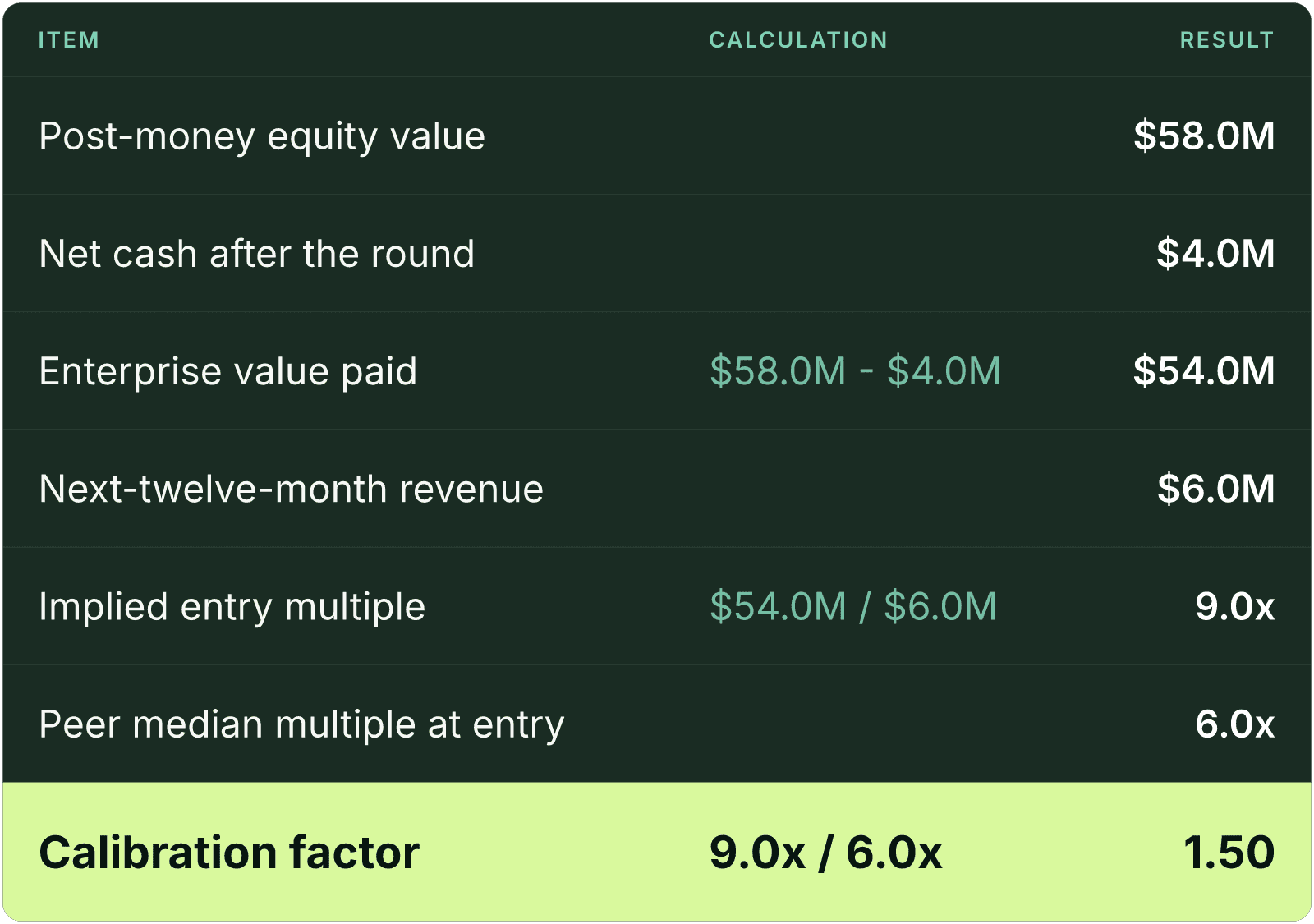
Suppose a fund invests in a software company in March. The round values the company at $58.0 million post-money. The company holds $4.0 million of net cash after the round, so the enterprise value the investors paid for is $54.0 million. Next-twelve-month revenue is forecast at $6.0 million. The comparable public set, selected at that date, trades at a median 6.0 times next-twelve-month revenue.
Here's the calibration, laid out as a table.
[](https://www.409.ai/uploads/peer_multiples_fund_level_3_mark_calibrate_entry_price_asc_820_table_1_dcb616185d.png)
The factor of 1.50 says this company was priced 50% above the median of its peers at the time of the round. That premium is not an error. Private growth companies often grow faster than a public median, and investors pay for that. The point of calibration is to find out what premium the market just paid and to write it down, so that next quarter's mark starts from a model that has been shown to work on this company.
Two cautions belong in the file. First, calibrate only when the transaction price is fair value, which means a real arm's-length round with a participating outside investor. A round where the fund set its own price, or a bridge with insiders only, deserves a note on why it still counts. Second, record the peer set and the date. A calibration factor means nothing without the peers that produced it. [A fund's first quarter-end mark after a new investment](https://www.409.ai/articles/first-quarter-end-mark-unrealized-loss-transaction-costs-asc-820-asc-946) often shows an unrealized loss from capitalised deal costs, and a clean calibration at entry is what lets the controller explain the difference between price and fair value.
Step two: roll the mark forward at quarter-end
Six months later the multiples have moved. The peer median is now 4.8 times next-twelve-month revenue, a drop of 20%. The company has grown faster than plan, and next-twelve-month revenue is now forecast at $7.5 million. It holds $5.0 million of cash and $3.0 million of debt. The fund owns 20% of the company on a fully diluted basis, and for this illustration its preferred shares rank equally with the other preferred holders, so the equity value splits in proportion to ownership. Real capital structures rarely behave that way, and [the waterfall problem for a junior preferred position](https://www.409.ai/articles/fund-mark-junior-preferred-liquidation-waterfall-asc-820-latest-round-price) is worth reading before you apply this to your own portfolio.
[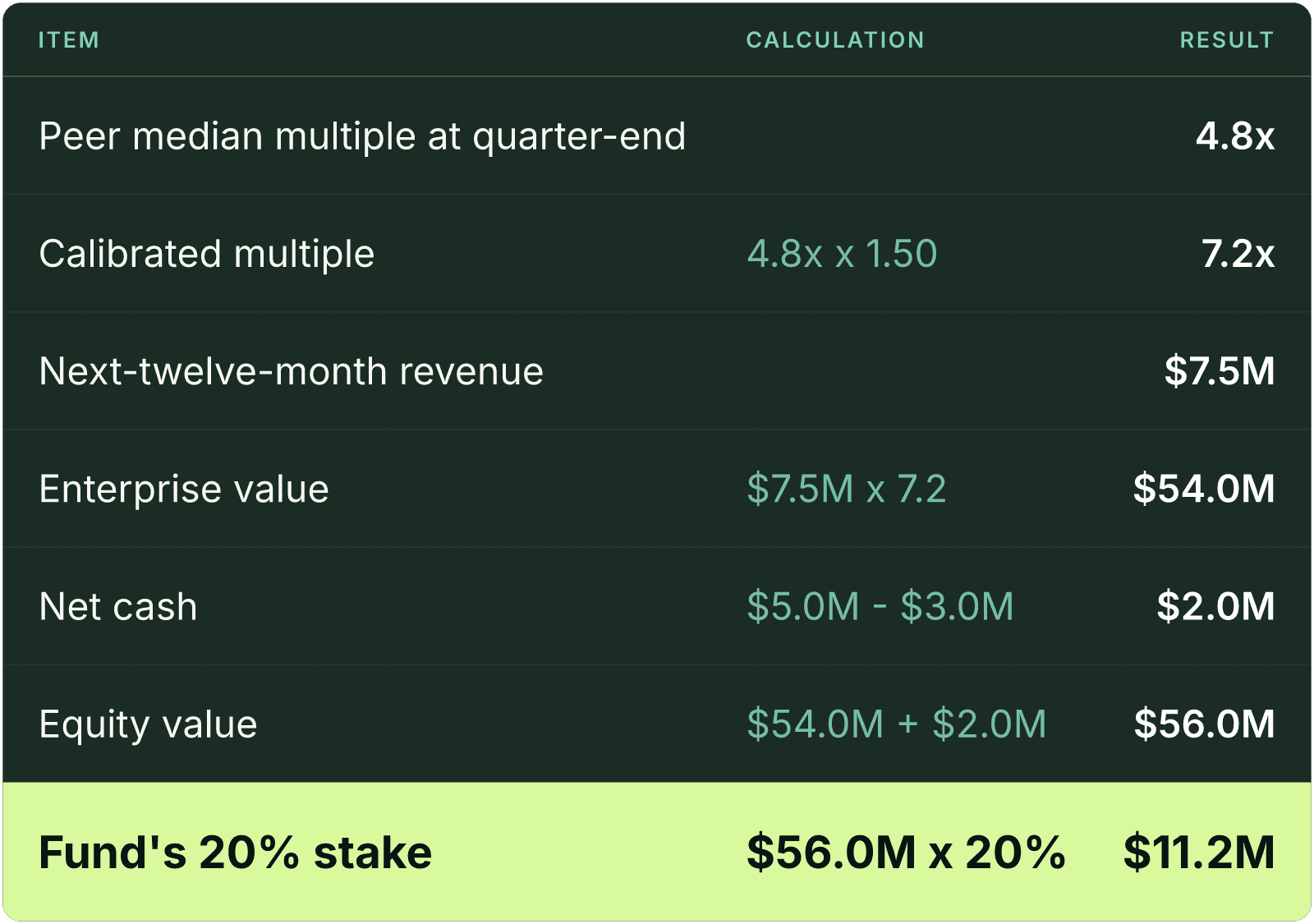](https://www.409.ai/uploads/peer_multiples_fund_level_3_mark_calibrate_entry_price_asc_820_table_2_84412b0e4e.png)
The fund paid $11.6 million for its 20% ($58.0 million post-money times 20%). The calibrated mark is $11.2 million, a decline of about 3.4%. The story the numbers tell is coherent: peers lost 20% of their multiple, the company grew its forward revenue by 25%, and the two nearly offset.
Now compare the two shortcuts. Use the raw peer multiple of 4.8 times and the enterprise value is $36.0 million, equity value $38.0 million, and the fund's stake $7.6 million. That's a 34.5% write-down on a company that is outperforming its plan. Keep the old 6.0 times peer multiple, and the stake goes to $9.4 million, ignoring the market move that did happen. The calibrated approach is the only one of the three that uses both the market's movement and the company's own information.
Choosing the peer set and the metric
Calibration doesn't rescue a bad peer set. A few habits keep the file credible with an auditor:
Select peers on business model, growth rate, margin profile and size, not on sector label alone. A median built from 12 companies, three of which are ten times your company's revenue, will pull the calibration factor in directions that have nothing to do with the company. Write down why each peer is in and why excluded names are out.
Use the same metric, the same period basis and the same peer set at entry and at every mark. If the entry calibration used next-twelve-month revenue and the quarter-end mark uses trailing revenue, the factor no longer applies. When the fund has a reason to change the peer set, recalibrate on the old and new set at the same date so the change is visible instead of buried in the result.
Check the forecast. Forward revenue is management's number, and the auditor will test it. A fund that marks on forward revenue should compare last year's forecast with what the company actually delivered. If the company missed by 30%, a forward multiple is applying a stale optimism to the mark.
Think about what the multiple excludes. Net cash, debt, preferred terms and any liquidation preference all sit between enterprise value and the fund's share. The multiple gives you enterprise value; the rest of the work is the bridge to the security you hold.
When the calibration factor drifts
A factor of 1.50 at entry doesn't have to stay at 1.50. If the company's growth slows from 80% to 30%, a market participant wouldn't keep paying a 50% premium over peers, and holding the factor flat would overstate the mark. The reverse also happens: a company that accelerates may deserve a higher factor. The valuation team's job each quarter is to ask what changed in the company's growth, margin and risk relative to the peers since the last calibration point, and to document the answer.
A new financing round or a meaningful secondary sale gives a fresh data point. Recalibrate to it when it's an orderly transaction between informed parties. If the fund is weighing a sale that priced below its mark, [our article on secondary sales priced below a fund's mark](https://www.409.ai/articles/secondary-sale-below-fund-mark-asc-820-orderly-transaction-weight) explains how much weight such a sale deserves.
Restrictions on selling the shares can matter too. The recent FASB update on contractual sale restrictions bears on whether a lock-up discount applies, and [we've written about the decision for quarter-end](https://www.409.ai/articles/asu-2026-03-final-lock-up-discount-quarter-end-decision-funds).
What to put in the audit file
An auditor reviewing a market approach mark will ask for the same set of items each time, so assemble them as the quarter closes:
The transaction documents and the evidence that the entry price was arm's length. The calibration worksheet at the date of investment with the peer set, the metric and the factor. The quarter-end peer data with its source and date. The company's forecast, the bridge from enterprise value to the fund's security, and a note on what changed since the last mark. And finally, a back-test: after exits, compare the final proceeds with the last mark. [Our back-testing guide](https://www.409.ai/articles/back-testing-fund-marks-exit-prices-asc-820-disposition-analysis) shows how to read the pattern, and if the marks run high or low in one direction, the calibration factor is the first place to look.
If an outside firm prepares or reviews any of this, the auditor will evaluate it as management's specialist, which brings its own file requirements, described in [the SAS 143 piece on the valuation firm and the audit](https://www.409.ai/articles/fund-valuation-firm-sas-143-auditor-tests-management-specialist-file).
The takeaway for this quarter
Before the December 31 marks, pull the calibration worksheet for each position valued on peer multiples and check three things: it exists, it uses the same peers and metric as the current mark, and someone has written down why the factor still holds. A position with no entry calibration is the one an auditor will find first.
If your fund needs an independent Level 3 valuation with that file built in, [409.AI's ASC 820 valuation](https://www.409.ai/products/asc-820) starts from $2,999 and is reviewed by valuation experts.