Financial Reporting
The Portfolio Company Sent Its Plan: Why Your Level 3 Mark Can't Use It as Written
A fund CFO's guide to the portfolio company forecast in a Level 3 mark: how ASC 820 treats it, how to weight cases, and the back-test file auditors want.
By 409.AI Team - 2026-10-31
# The Portfolio Company Sent Its Plan: Why Your Level 3 Mark Can't Use It as Written
It's the third week after quarter-end and the package from a Series B portfolio company has just landed. The board deck shows revenue growing from $8 million over the last twelve months to $12 million next year. The CEO's note says the plan is "conservative." Your fund's mark on this company is due to the administrator in four days.
If you're the CFO, controller or valuation lead at a fund, you'll recognize the moment. The forecast is the best information about the company that anyone has. It is also written by the people who most want the mark to rise. ASC 820 asks you to use the first fact and to correct for the second. This article is about how to do that, and how to show an auditor that you did.
What ASC 820 says about your own data
A forecast from the portfolio company is a Level 3 input: it isn't observable in a market. ASC 820-10-35-54A lets a reporting entity start from its own data when it builds an unobservable input, but requires it to adjust that data if reasonably available information shows that market participants would use something different. Deloitte's [Level 3 roadmap](https://dart.deloitte.com/USDART/home/codification/broad-transactions/asc820-10/roadmap-fair-value-measurements-disclosures/chapter-8-fair-value-hierarchy/8-4-level-3-inputs) walks through the same paragraph and notes that a forecast built from the entity's own data qualifies as a Level 3 input only when nothing reasonably available points to different market participant assumptions.
Read that as a fund. The "entity" in your case is you, and the "own data" is whatever management sends. The question the standard asks isn't "what does the CEO expect?" It's "what would a buyer of this position assume?" A buyer would read the same deck, then ask how often the last three plans were met.
The AICPA's [valuation guide for portfolio company investments](https://www.aicpa-cima.com/cpe-learning/publication/valuation-of-portfolio-company-investments-of-venture-capital-and-private-equity-funds-and-other-investment-companies-accounting-and-valuation-guide) lists a review of management projections, the business plan, the expected time to exit and key milestones as part of the valuation analysis. A review means you form a view. It doesn't mean you copy the numbers into the model.
Three ways a plan goes wrong
Plans fail in predictable ways, and each one calls for a different fix.
The plan is optimistic about timing. A contract expected in the second quarter closes in the fourth. Revenue is real but late, which pushes the whole curve to the right. The fix is a delay, not a lower end state.
The plan is optimistic about level. The company assumes a conversion rate or a net retention figure it has never reached. Here the fix is a lower trajectory, anchored to what the company has actually delivered.
The plan was built for a different purpose. A deck prepared for a fundraise, a lender or an acquirer's diligence is written to persuade. A budget set for the board's compensation committee is often deliberately low. You need to know which one you were handed, because the two require opposite adjustments. Ask.
A worked example
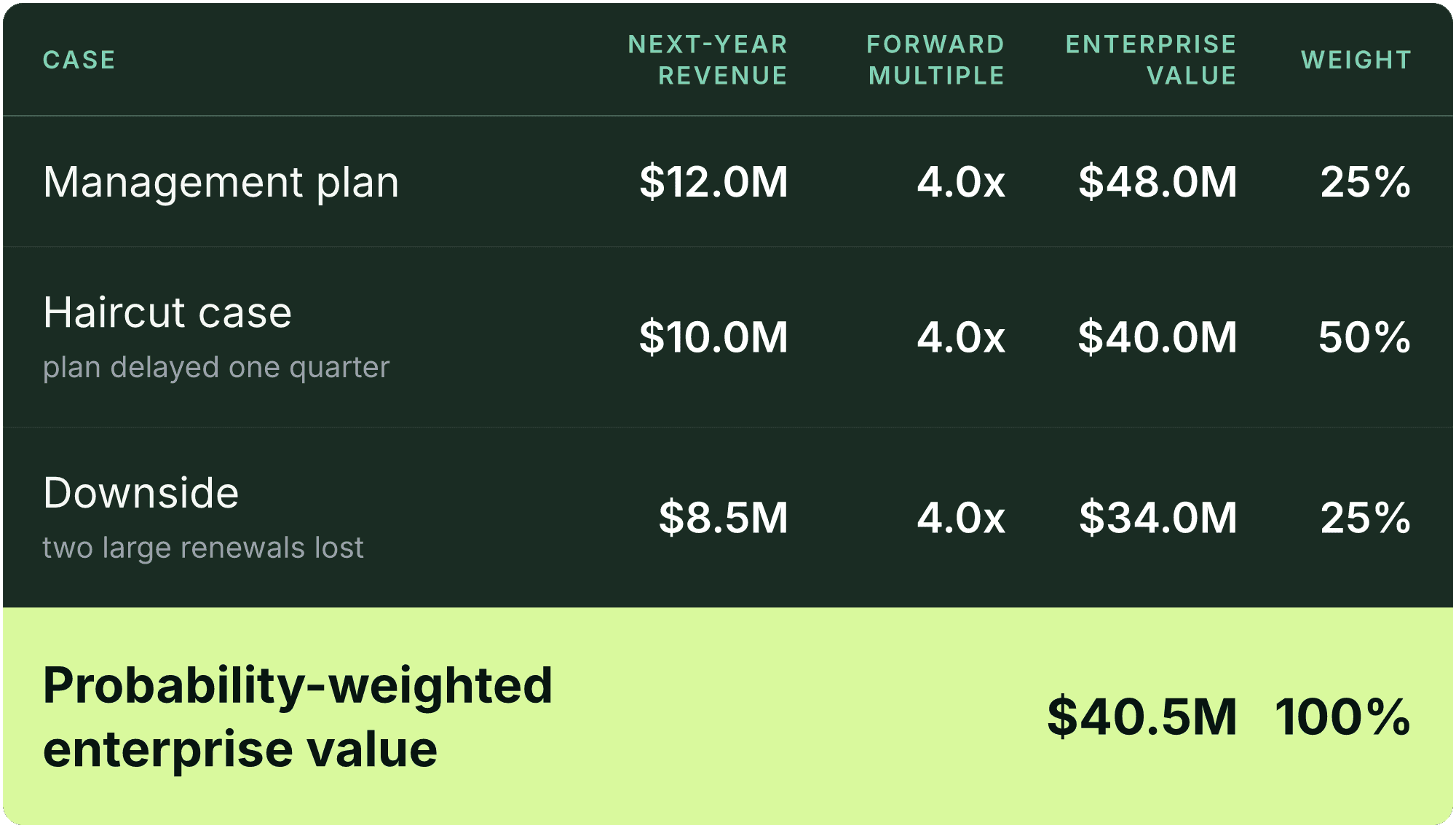
Take the portfolio company above, with illustrative numbers. Trailing twelve-month revenue is $8.0 million. Management's plan says $12.0 million next year. Your calibration to the entry round, done when you made the investment, gave an implied multiple of 4.0x forward revenue, consistent with where comparable companies trade on forward estimates.
Using the plan alone, the enterprise value is $12.0 million x 4.0, or $48.0 million. That's one point estimate resting on one party's expectations. A better file builds three cases and weights them.
[](https://www.409.ai/uploads/management_forecast_fund_level_3_mark_asc_820_haircut_plan_back_test_table_1_fd093a82d2.png)
The weighted value is $0.25 x $48.0M + $0.50 x $40.0M + $0.25 x $34.0M, or $40.5 million. The plan-only number is about 18.5% higher than that. On a position where the fund owns a large preferred stake, that gap flows straight to NAV, and from there to any NAV-based fee and to the carried interest accrual.
The weights are a judgment, not a formula. What matters is that you can say why the haircut case carries half the weight. The best answer is a record, which brings us to the part most funds skip.
Back-test the plan before you weight it
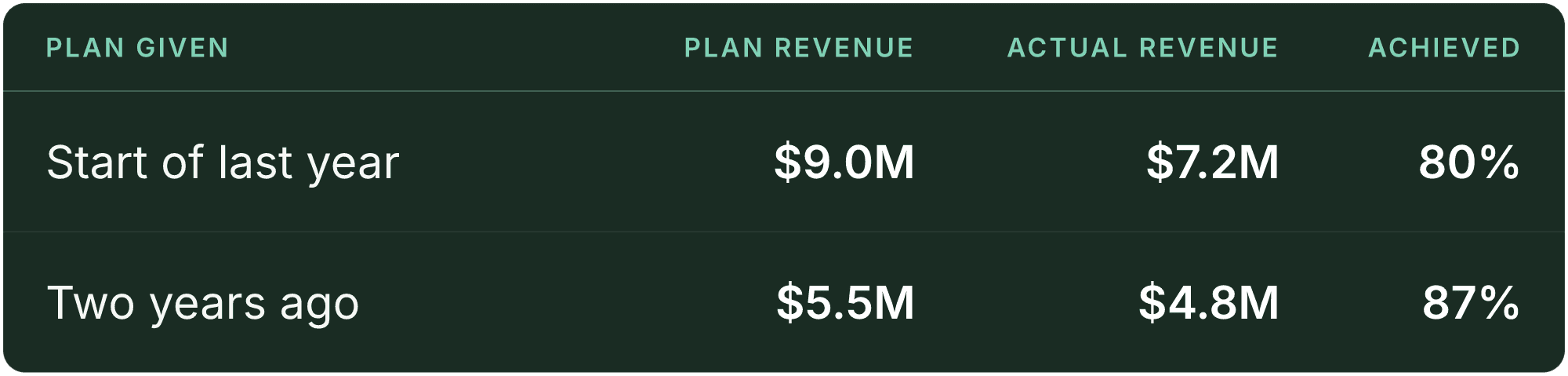
The strongest support for a haircut is the company's own history. Pull the plans it gave you in each of the last several periods and compare each to what happened.
[](https://www.409.ai/uploads/management_forecast_fund_level_3_mark_asc_820_haircut_plan_back_test_table_2_b3276972d7.png)
If a company has delivered 80% to 87% of its plan in two years running, a haircut case at 83% of the plan ($10.0M of $12.0M) isn't pessimism. It's the track record. When someone asks why you didn't use the plan, you hand over this page.
This is the same discipline the auditor applies to you. Under SAS 143 (AU-C 540), the auditor of a private fund reviews how last period's estimates turned out, and we covered what that review looks like in practice in [back-testing fund marks against exit prices](https://www.409.ai/articles/back-testing-fund-marks-exit-prices-asc-820-disposition-analysis). A forecast haircut that you can tie to the company's own misses is the same exercise run one step earlier.
Keep the multiple and the metric on the same footing
One trap deserves its own warning. If you calibrated the multiple at entry using the company's plan revenue at that time, then applying it to a new plan revenue is internally consistent only when both come from the same kind of forecast. Peer multiples that are quoted on consensus estimates of public companies do not carry the same optimism as a private company's own deck. Applying a consensus-based multiple to an unadjusted management figure double counts the growth.
Our piece on [calibrating peer multiples to the entry price](https://www.409.ai/articles/peer-multiples-fund-level-3-mark-calibrate-entry-price-asc-820) covers the calibration itself. The point here is narrower: whatever adjustment you make to the forecast, make the same one when you recalibrate, or the two will drift apart quarter by quarter and your mark will move for reasons that have nothing to do with the company.
What goes in the file
An auditor will look for four things, and so will an SEC examiner if your adviser is registered. We described the wider framework in [the fund valuation policy, the audit and the SEC exam](https://www.409.ai/articles/fund-valuation-policy-asc-820-audit-sec-exam).
1. The forecast as received, with its date and its stated purpose. 2. The back-test of the last plans against actual results. 3. The cases you built, the reason for each weight and who approved them. 4. The unobservable inputs you used, named and quantified for the Level 3 table. Our guide to [what makes an input significant and unobservable](https://www.409.ai/articles/asc-820-level-3-classification-significant-unobservable-input) explains why the forecast metric belongs on that list.
Keep the file in the same place every quarter. A reviewer who finds the same four items for each Level 3 position stops asking about the process and starts asking about the judgment, which is where you want the conversation.
Two cases where the plan carries more weight
A haircut isn't automatic. If the company has met or beaten its plan for several periods, the back-test supports a higher weight on the plan, and a flat 25% would be too cautious. Likewise, if revenue is already contracted and the plan only assumes renewals at current terms, the plan has less uncertainty in it than a plan that depends on new logos. The same method that lowers the weight for a company that misses will raise it for a company that doesn't.
The takeaway
Next quarter, before you open the package, write down what share of last year's plan the company achieved. Then decide the weights, and only then read the new plan. Setting the haircut before you see the number removes the pull of an attractive deck, and it gives you a record that holds up on the day someone asks why the mark moved. If you'd like a second set of eyes on the cases and the file, [409.AI's ASC 820 valuation](https://www.409.ai/products/asc-820) is built for exactly this review.