Financial Reporting
Control Premium or Blockage Discount? What a Fund's Majority Stake Can Carry Under ASC 820
Fund CFOs: a control premium can be fair value, a blockage discount never is. See where ASC 820 draws the line, with a worked $9.9M example for a 62% stake.
By 409.AI Team - 2026-10-25
# Control Premium or Blockage Discount? What a Fund's Majority Stake Can Carry Under ASC 820
A fund CFO holding 62% of a portfolio company will hear two opposite instructions at year-end. The GP says the stake is worth more than its share of the equity, because it controls the board. The auditor says no discount or premium for the size of the position, ever. Both are partly right, and the line between them decides a seven-figure difference in the mark.
This article is for fund CFOs, controllers and valuation committee members who mark control and large minority positions as Level 3 and have to defend the answer to an auditor. It sorts the adjustments ASC 820 allows from the ones it forbids, and shows the arithmetic on one illustrative position.
Two adjustments that sound alike and are not
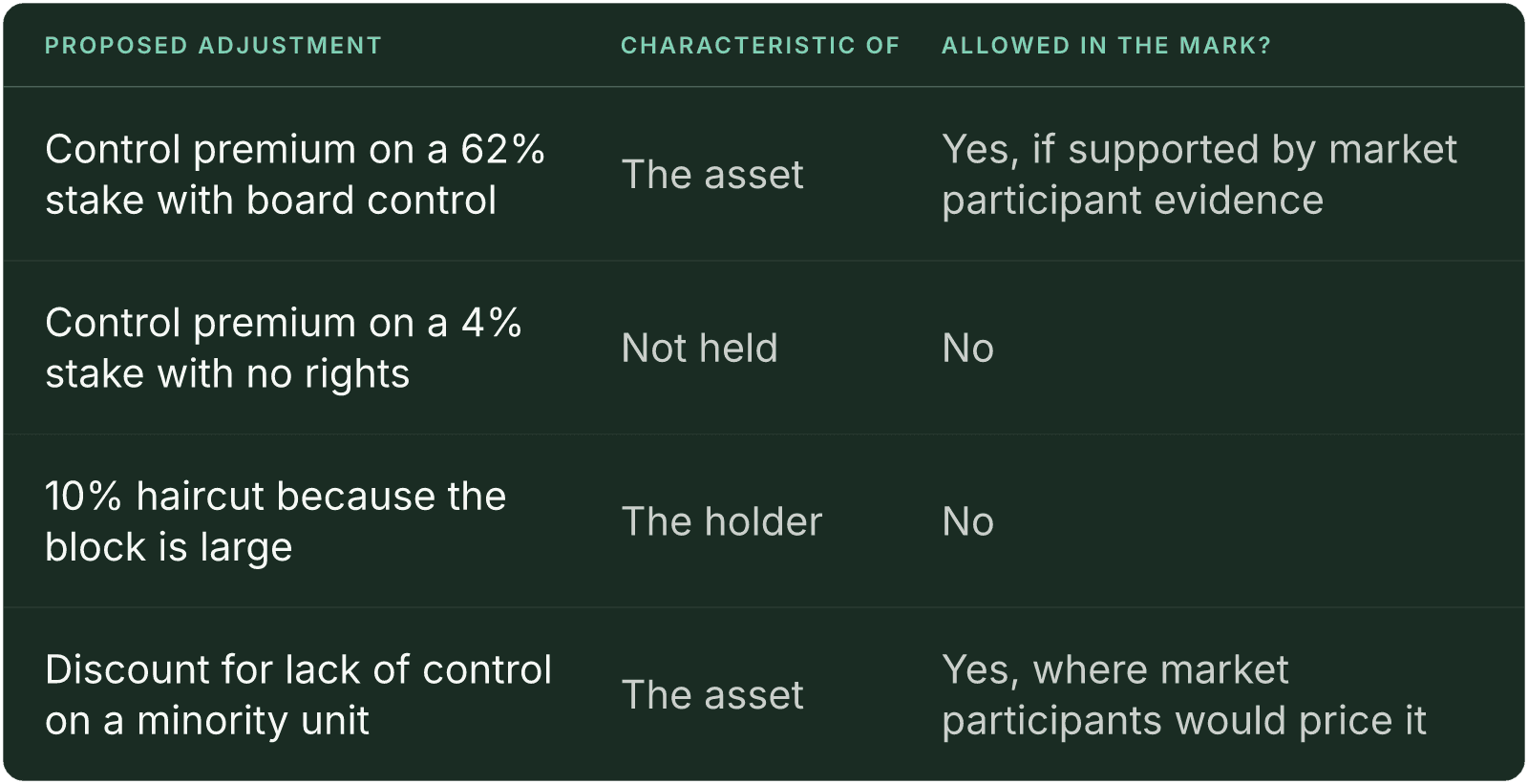
A control premium is the amount a buyer pays above the value of a marketable minority interest to get control of the business: the ability to set strategy, change management, cut costs or combine it with another company. It is a characteristic of the asset being bought.
A blockage factor is a discount for the size of the holder's position. The idea is that selling a very large block would push the price down, so the block is worth less than the number of shares times the price of one. It is a characteristic of the holder.
ASC 820 treats them differently for the same reason. Under ASC 820-10-35-36B, a fair value measurement uses inputs that reflect the characteristics market participants would consider, and it may not include a premium or discount that is inconsistent with the unit of account. Deloitte's [roadmap on inputs to valuation techniques](https://dart.deloitte.com/USDART/home/codification/broad-transactions/asc820-10/roadmap-fair-value-measurements-disclosures/chapter-10-subsequent-measurement/10-4-inputs-valuation-techniques) summarizes the result. Size-based adjustments that reflect the holder's position are not permitted where the unit of account is the individual instrument. A control premium is a different matter: it is not allowed as an adjustment to a Level 1 price, but it can be appropriate in Level 2 and Level 3 measurements, and the same text says a control premium and a corresponding minority interest discount may be appropriate when measuring a noncontrolling interest.
So the answer to the GP is "maybe, with evidence". The answer to the auditor is "agreed, and that is not what we are doing".
Start with the unit of account
Everything turns on what you are measuring. ASC 820 itself sets the unit of account in one narrow case, a position in a single asset or liability traded in an active market, where fair value is the quoted price times the quantity held, even if the market's daily volume could not absorb the position (ASC 820-10-35-44). For everything else, the unit of account comes from the Topic that requires or permits the fair value measurement. For a fund, that is its investment company accounting, and in practice the unit is the investment in a given portfolio company, security or class.
Write down your unit of account in the valuation policy, class by class. A fund holding common and two series of preferred in the same company has more than one position to value, and the [liquidation waterfall mechanics](https://www.409.ai/articles/fund-mark-junior-preferred-liquidation-waterfall-asc-820-latest-round-price) matter far more to those marks than any premium. Once the unit is set, the question for any adjustment is simple: would a market participant buying that unit price this characteristic into it?
Control passes that test when the unit carries it. A buyer of the whole company, or of a stake that comes with control rights, pays for the ability to run the business. A seller of a 4% stake with no governance rights cannot claim a premium it does not own.
Where the premium comes from in a Level 3 mark
Most private company marks start with guideline public company multiples or precedent transactions. Public company multiples reflect trades of small, marketable, noncontrolling interests. If the fund's unit is a controlling interest, a bridge from that minority-based value to a control-based value may be warranted. If the fund's unit is a minority position, the bridge runs the other way, or stops at the public multiple.
A premium needs support a reviewer can test:
- **Specific benefits a buyer could capture.** Cost savings, pricing power or a combination with another business that market participants, not just this fund, could realize. Benefits only the current GP could extract are not a market participant's.
- **Market evidence.** Precedent acquisitions of comparable companies, with the multiples paid compared against the trading multiples of the same sector at the time.
- **Calibration to the entry price.** If the fund bought control, the premium implied by the purchase price is the first data point. The same discipline applies as in any [peer multiple calibration to the entry price](https://www.409.ai/articles/peer-multiples-fund-level-3-mark-calibrate-entry-price-asc-820), and the premium should be re-tested, not carried forward unchanged for eight quarters.
- **No double counting.** If the multiples already come from control transactions, adding a premium on top counts the same benefit twice.
A worked example (illustrative)
Take a fund that owns 62% of a single-class software services company. The numbers are invented for the example and describe no real position.
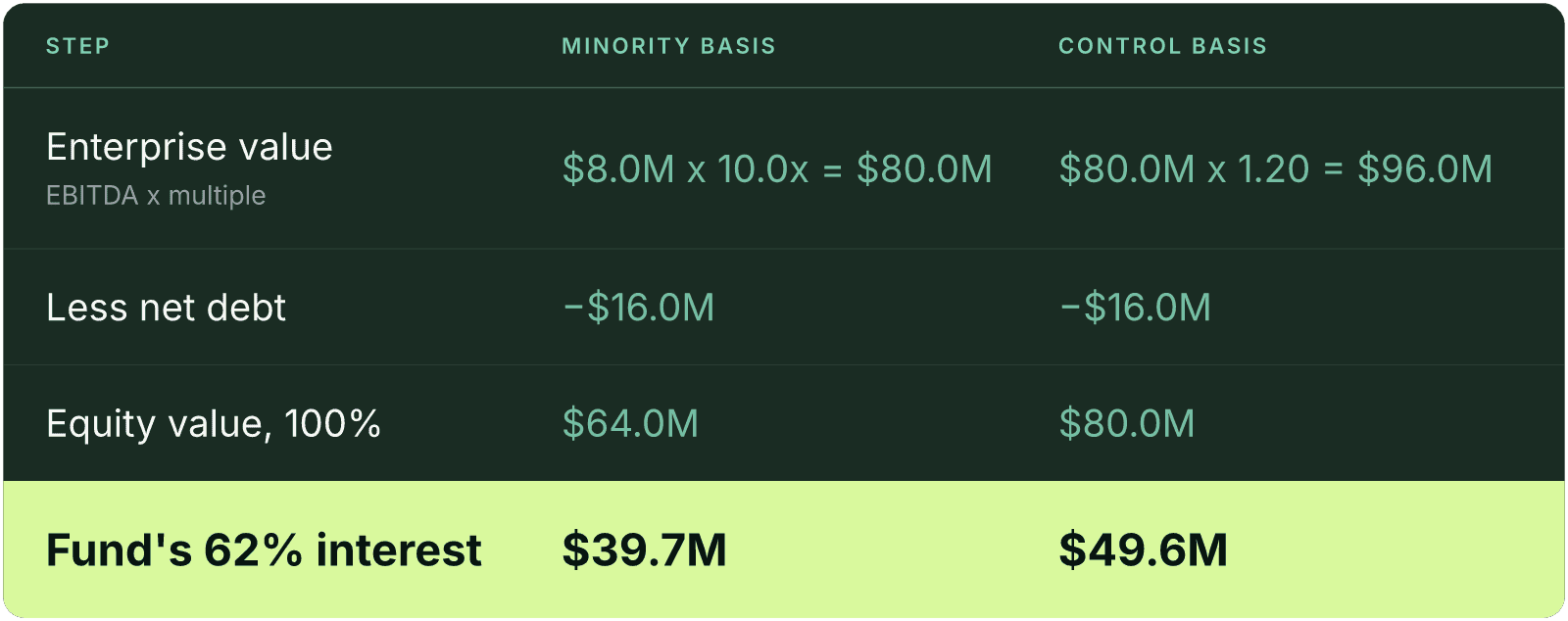
The company has $8.0M of adjusted EBITDA and $16.0M of net debt. Guideline public companies trade at 10.0x EBITDA on a marketable minority basis. After reviewing precedent transactions, the valuation committee concludes market participants would pay about 20% more than the trading multiple to control this business, and it can name the cost savings behind that number.
[](https://www.409.ai/uploads/control_premium_vs_blockage_factor_fund_majority_stake_asc_820_mark_table_1_c0881d768e.png)
The control-basis mark is $9.9M higher. That gap is the reason auditors read this section of a valuation file closely. It is not a rounding choice. It is a claim that a market participant would pay for control, and the file has to carry the evidence for it.
Now the same fund holds 15% of a second company, valued by the same multiples. A well-meaning analyst proposes a 10% haircut because "we could never sell 15% in one trade." That adjustment reflects the size of the fund's holding, not a characteristic of the asset. It is a blockage factor, and it is not allowed where the unit of account is the individual investment. What the analyst may legitimately consider is a different thing: whether a noncontrolling interest lacks the rights a market participant would value, and whether the multiples need adjusting for that.
[](https://www.409.ai/uploads/control_premium_vs_blockage_factor_fund_majority_stake_asc_820_mark_table_2_717d13ec56.png)
What the auditor will ask for
Expect these requests, roughly in this order:
1. The unit of account for each position, and where the policy says so. 2. The multiple source: trading or transaction, and the date of the data. 3. The evidence behind any premium or minority discount, and the benefits a market participant would capture. 4. The calibration to the transaction price at entry and the rolled-forward premium since. 5. A check that no adjustment is driven by the fund's own size, exit timing or inability to sell.
The last item connects to a nearby rule. A sale restriction attached to the holder is not reflected in fair value either, which is the subject of the FASB's recent work on [contractual sale restrictions and lock-up discounts](https://www.409.ai/articles/fasb-2026-contractual-sale-restrictions-asc-820-lock-up-discount). The same test applies: is it a characteristic of the asset, or of who holds it?
A significant unobservable input, such as a premium or a minority discount, is also what places the mark in Level 3, as covered in our note on [Level 3 classification](https://www.409.ai/articles/asc-820-level-3-classification-significant-unobservable-input). That means the premium belongs in the disclosure of significant unobservable inputs, and the policy that governs it belongs in the [fund valuation policy](https://www.409.ai/articles/fund-valuation-policy-asc-820-audit-sec-exam) your auditor and, for registered advisers, the SEC examiner will read.
A takeaway for the next valuation committee
Add one line to the mark memo for every position that carries a premium or a discount: "This adjustment reflects a characteristic of the asset because ___, and market participants would pay for it because ___." If you cannot finish the second blank with evidence, delete the adjustment. If the adjustment depends on how many shares the fund holds or how long it would take to sell them, it fails the first blank.
If your fund wants an independent view on a control or minority mark before the year-end audit, [409.AI's ASC 820 valuation service](https://www.409.ai/products/asc-820) delivers a reviewed report built for that conversation.