Financial Reporting
Bargain Purchase Gain Under ASC 805: What the Auditor Asks Before You Book It
For the CFO of an acquirer that bought from a distressed seller: the ASC 805 reassessment and IRR check to run before a bargain purchase gain hits earnings.
By 409.AI Team - 2026-11-25
# Bargain Purchase Gain Under ASC 805: What the Auditor Asks Before You Book It
If you are the CFO or controller of a company that bought a business from a distressed or forced seller this year, your first purchase price allocation may show something unusual: the net assets you acquired are worth more than you paid. ASC 805 calls the difference a bargain purchase, and it lets you record it as a gain in earnings on the acquisition date. It also makes you prove the gain is real before you book a dollar of it. With year-end audits of 2026 deals about to start, that proof is the part of the file your auditor will read first.
This article walks through what the standard requires before the gain is recognized, how a reassessment usually shrinks the number, and the valuation diagnostic that the September 2026 exposure draft of the Valuation Performance Framework (VPF) describes for business combinations.
What a bargain purchase is
Under ASC 805, the acquirer measures the identifiable assets acquired and the liabilities assumed at acquisition-date fair value, with a few listed exceptions such as deferred taxes. Goodwill is the residual: the consideration transferred, plus the fair value of any noncontrolling interest and any equity interest the acquirer already held, less those net identifiable assets. When the net assets come out larger than that sum, the residual is negative and there is no goodwill. The excess is the bargain purchase gain (ASC 805-30-25-2), attributed to the acquirer and recognized in earnings on the acquisition date.
There is only one residual, so a single acquisition produces either goodwill or a bargain purchase gain, never both. If you want the full mechanics of the allocation first, start with how an acquisition is split into intangibles and goodwill.
The standard expects bargains to be rare. It names the usual cause: a forced sale in which the seller is acting under compulsion (ASC 805-30-25-3). A lender calling a loan, a parent company exiting a segment on a deadline, a founder group that has run out of runway. It also notes that the measurement exceptions, deferred taxes among them, can create a gain, or change its size, without any bargain in the economic sense. U.S. bank regulators made the same point in their 2010 interagency guidance on bargain purchases: the accounting literature does not expect bargain purchases to be common, even if assisted deals can produce them.
The reassessment comes before the gain
ASC 805-30-25-4 is the paragraph your auditor will cite. Before the acquirer recognizes a gain, it must reassess whether it has correctly identified all of the assets acquired and all of the liabilities assumed, and recognize any it missed. Then it must review the procedures used to measure each of the amounts in the calculation:
- the identifiable assets acquired and liabilities assumed;
- the noncontrolling interest in the acquiree, if there is one;
- the acquirer's previously held equity interest, in a deal achieved in stages;
- the consideration transferred.
The objective is that the measurements reflect all the information available at the acquisition date. In practice, the reassessment is a second, harder pass over every input that pushed the net assets up or the price down. It is not a formality. The Deloitte roadmap on measuring a bargain purchase gain treats it as a required step, and auditors test it as one.
A worked example: a $4 million gain becomes $500,000
A manufacturer buys a competitor out of a lender-driven sale process for $18 million in cash. It is a stock deal, so the tax bases carry over. The first draft of the allocation shows $22 million of net identifiable assets and a $4 million bargain purchase gain. The reassessment goes back over each line.
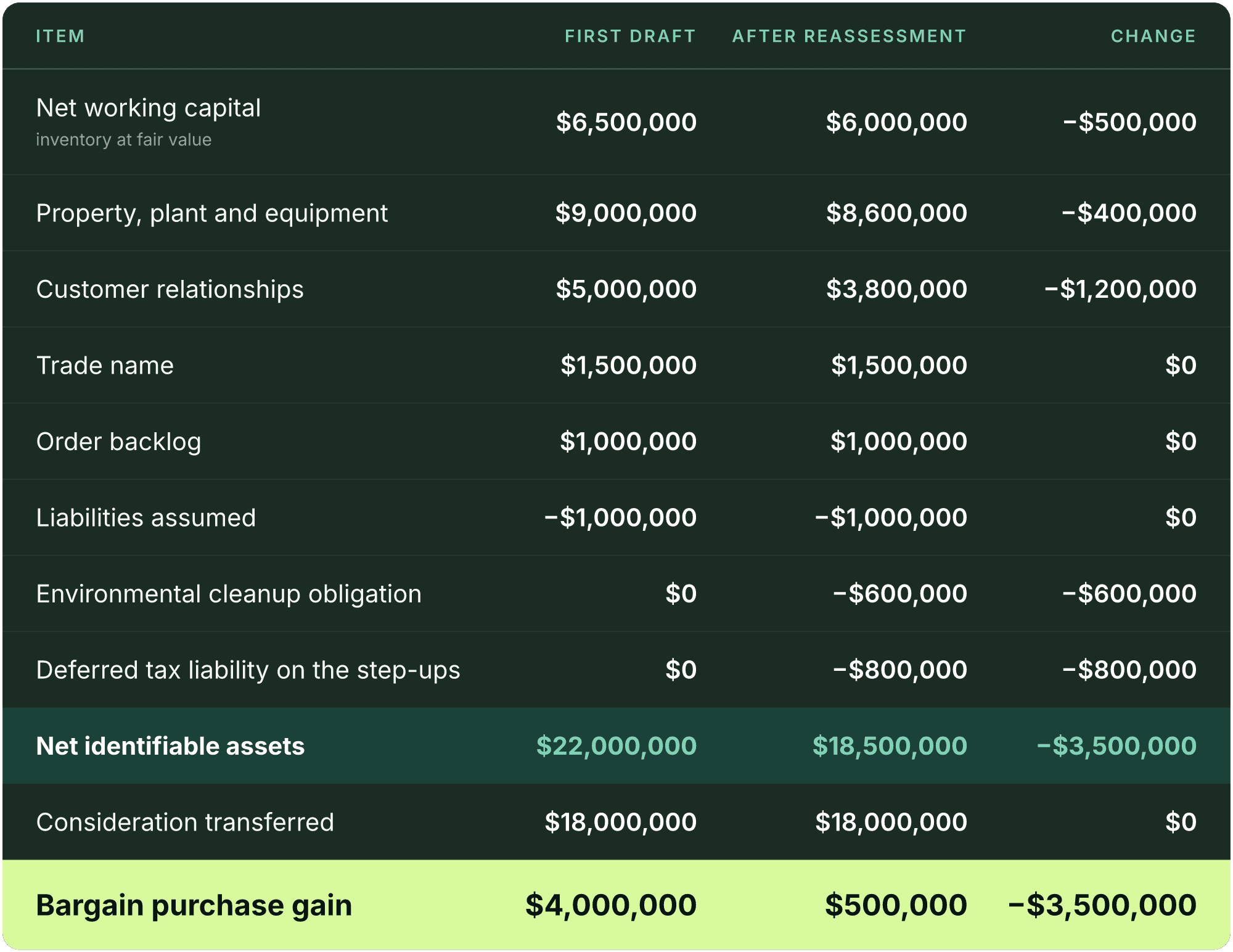

Each change has an ordinary explanation, and each is the kind a reviewer finds:
Inventory. The first draft stepped finished goods up close to selling price. Fair value deducts the costs to sell and a reasonable profit for the selling effort the buyer still has to make. That takes $500,000 off. The same step-up comes back through cost of sales in the first quarters after the close, as the inventory step-up article explains.
Plant and equipment. A cost approach that ignores how the assets are used overstates them. The target's main plant was running well below capacity, which is often why the seller was in trouble. Economic obsolescence for the idle capacity takes $400,000 off.
Customer relationships. The first draft used an 8% annual attrition rate from the seller's best years. The customer list in the last two years, while the seller was struggling, lost closer to 14% a year. At the higher rate the asset falls by $1.2 million. Attrition is the input that moves this asset most; the MPEEM walkthrough shows why.
A liability nobody had booked. The identification step turned up a cleanup obligation at one site that the seller had not recorded. It is a liability assumed at the acquisition date, measured at $600,000.
Deferred taxes. In a stock deal the step-ups have no tax basis, so the acquirer records a deferred tax liability on them. The first draft left it out. At an illustrative 25% rate on $3.2 million of book-over-tax differences, it is $800,000, and it comes straight off the gain. The same mechanism grows goodwill in an ordinary deal, covered in deferred taxes in a purchase price allocation.
After the reassessment, $500,000 of gain is left. That may be correct. The point is that the $4 million in the first draft was never a number anyone could defend, and a gain in earnings that shrinks by seven eighths between the draft and the audit is exactly what an auditor is trained to look for. All figures in this example are illustrative.
The valuation diagnostic: IRR against WACC
The reassessment tests the asset side. The VPF exposure draft, issued in September 2026 by the AICPA, the American Society of Appraisers and RICS, adds a test of the price itself. The exposure draft is documentation guidance for valuation professionals, not GAAP, but it describes what a well-supported work file looks like, and auditors' valuation specialists read the same document.
Three points in it bear directly on a bargain purchase:
- The price is presumed to be fair value. Paragraph 6.1.3.19 states a general rebuttable presumption that the purchase price paid is fair value, absent evidence to the contrary, and names a bargain purchase as one case where that evidence exists.
- Bargains are anomalous, and they are yours to call. The same paragraph notes that assessing whether a bargain purchase exists is management's responsibility, and that bargain purchases are considered anomalous transactions.
- The IRR tells you which way the evidence points. Paragraph 6.1.3.20 asks the valuation professional to remove entity-specific synergies and non-operating items from the forecast, compute the internal rate of return that equates the adjusted forecast to the transaction operating value, and compare it with the WACC. An IRR above the WACC, it says, may indicate entity-specific synergy cash flows in the forecast, an optimistic bias, or a purchase price below fair value.
Read that list in order. A high IRR has three possible explanations, and only the third supports a bargain purchase gain. Say the forecast behind the $18 million price gives an IRR of 22% against a WACC of 15%. First strip out the savings only this buyer gets, such as closing its own overlapping warehouse. If the IRR drops to 18%, part of the gap was synergy, not bargain. Then test the forecast against the target's own history. Whatever gap is left after both steps is the room for a price below fair value, and the file needs facts to fill it: a lender deadline, a short marketing period, few bidders.
The draft also asks that the work file record the adjustments made for the IRR analysis, the nature of the difference between the IRR and the WACC, and any discussion of apparent underpayments or overpayments, including discussions with management and auditors (paragraph 6.1.3.23). And it keeps the asset-side check: even when the price is not fair value, as in a bargain purchase, a WARA diagnostic is still performed on the operating value of the business (paragraph 6.3.6.4). How that reconciliation works is in reconciling the IRR, WACC and the return on goodwill.
What the year-end file should hold
If your 2026 statements will show a bargain purchase gain, the auditor will want to see the reassessment as its own document, not as a conclusion inside the valuation report. A file that holds up has:
- a memo on the identification step: what was searched for (unrecorded liabilities, contingencies, indemnification assets, contracts) and what was found;
- the measurement review of each line, with the before and after, as in the table above;
- the deferred tax calculation on every step-up;
- the IRR analysis, the synergies removed, and the WACC it is compared with;
- the evidence that the seller acted under compulsion, dated and sourced;
- the disclosure draft. ASC 805-30-50-1 requires the amount of the gain, the line item where it is recognized, and a description of the reasons the transaction resulted in a gain.
Timing matters too. ASC 805 allows a measurement period of up to one year from the acquisition date to finalize provisional amounts, and an adjustment in that period moves the gain as well. A gain booked on provisional numbers in December and cut in March is a restated earnings figure your lender and your board will notice. For a sense of what the auditor tests across the whole allocation, see what a purchase price allocation costs and what the auditor tests in it.
The takeaway
Treat a bargain purchase gain as a hypothesis, not a result. Run the reassessment of ASC 805-30-25-4 line by line, put the deferred taxes in, strip the synergies out of the IRR, and write down the facts that show the seller was forced. If $500,000 survives all of that, book it and disclose why. If you need the allocation and its reassessment prepared for the audit, 409.AI prepares purchase price allocations at a flat $9,999, with every report reviewed by a valuation expert.
About the author
409.AI Team
Startup valuation and equity workflow specialists
The 409.AI team writes practical valuation content for founders and finance teams preparing 409A reports, equity documentation, and related startup finance workflows.
Related valuation reports
- Purchase price allocation report: 409.AI helps acquirers prepare expert-reviewed purchase price allocation reports under ASC 805, with fair value analysis of acquired intangible assets and goodwill.
- 409A valuation report: 409.AI helps private companies prepare expert-reviewed 409A valuation reports for equity compensation and option strike price support.
- Pricing for every report type
- 409A valuation calculator
- Sample 409A report