Financial Reporting
Inventory Step-Up in a Purchase Price Allocation: Why Gross Margin Drops After the Close
For the acquirer's CFO: how ASC 805 measures the inventory step-up, why it cuts gross margin in the first quarter, and what it does to EBITDA, NRV and taxes.
By 409.AI Team - 2026-11-17
# Inventory Step-Up in a Purchase Price Allocation: Why Gross Margin Drops After the Close
You closed the acquisition of a manufacturer or distributor this fall. The first monthly close shows gross margin down by double digits, sales are on plan, and the board deck is due. Nothing went wrong in the business. The purchase price allocation did exactly what ASC 805 asks of it: it put the target's inventory on your balance sheet at fair value, and that higher number is now running through cost of goods sold.
This article is for the CFO or controller of the acquirer, usually a PE-backed platform doing an add-on or a growing company buying a product business, and for the auditor who will test the number before the first audited year-end.
Why acquired inventory is not carried at the seller's cost
ASC 805-20-30-1 measures every identifiable asset acquired in a business combination at its acquisition-date fair value, as ASC 820 defines it. Inventory is no exception. The seller carried it at cost, the cost of materials, labour and overhead to make it. You did not make it. You bought goods that are already made, and the price you paid for them includes part of the profit the seller earned by making them.
That profit is the step-up. Fair value sits above the seller's cost because the manufacturing is done, and below the selling price because you still have to sell and deliver the goods. The valuation splits the expected profit on the goods between the two: the part the seller earned (it goes into the inventory value and so into the price) and the part you will earn by selling (it stays out, so you report it after the close).
Neither ASC 805 nor ASC 820 gives a formula for that split. The method practitioners use comes from tax guidance that is older than both standards, and the AICPA's Accounting and Valuation Guide on business combinations (published in November 2024, nonauthoritative) works through it with examples of its own.
The three methods and which inventory each one fits
The IRS described the methods in [Rev. Proc. 2003-51](https://www.irs.gov/pub/irs-drop/rp-03-51.pdf), written for the purchase price allocation of an asset deal or a section 338 election. It names three: replacement cost, comparative sales and income.
Raw materials: replacement cost. What it would cost today to buy the same quantity, plus the costs of purchasing, handling and storage you avoided by acquiring them in place, less anything obsolete. Rev. Proc. 2003-51 says replacement cost "generally should not be used" for the work in process or finished goods of a manufacturer.
Finished goods: comparative sales, the top-down method. Start from the expected selling price to customers in the ordinary course of business and deduct, in the words of the revenue procedure, the time needed to dispose of the inventory, "all costs of disposition" (commissions, freight, discounts), and "a profit commensurate with the amount of investment in the assets and the degree of risk" for the buyer. Most of the step-up in a typical deal comes from here.
Work in process: comparative sales, less completion. The same top-down calculation, less the cost to finish the goods and a profit allowance for "the completion and selling effort of the acquiring corporation."
A bottom-up cross-check is common for finished goods: start from the seller's cost and add a return on the manufacturing effort already spent. When the two approaches disagree by much, one of the inputs is usually wrong, most often the profit split.
A worked example
A PE-backed platform buys a specialty packaging manufacturer. On the closing date the target's books show $4,000,000 of finished goods and $1,500,000 of raw materials, at cost. The figures below are illustrative.
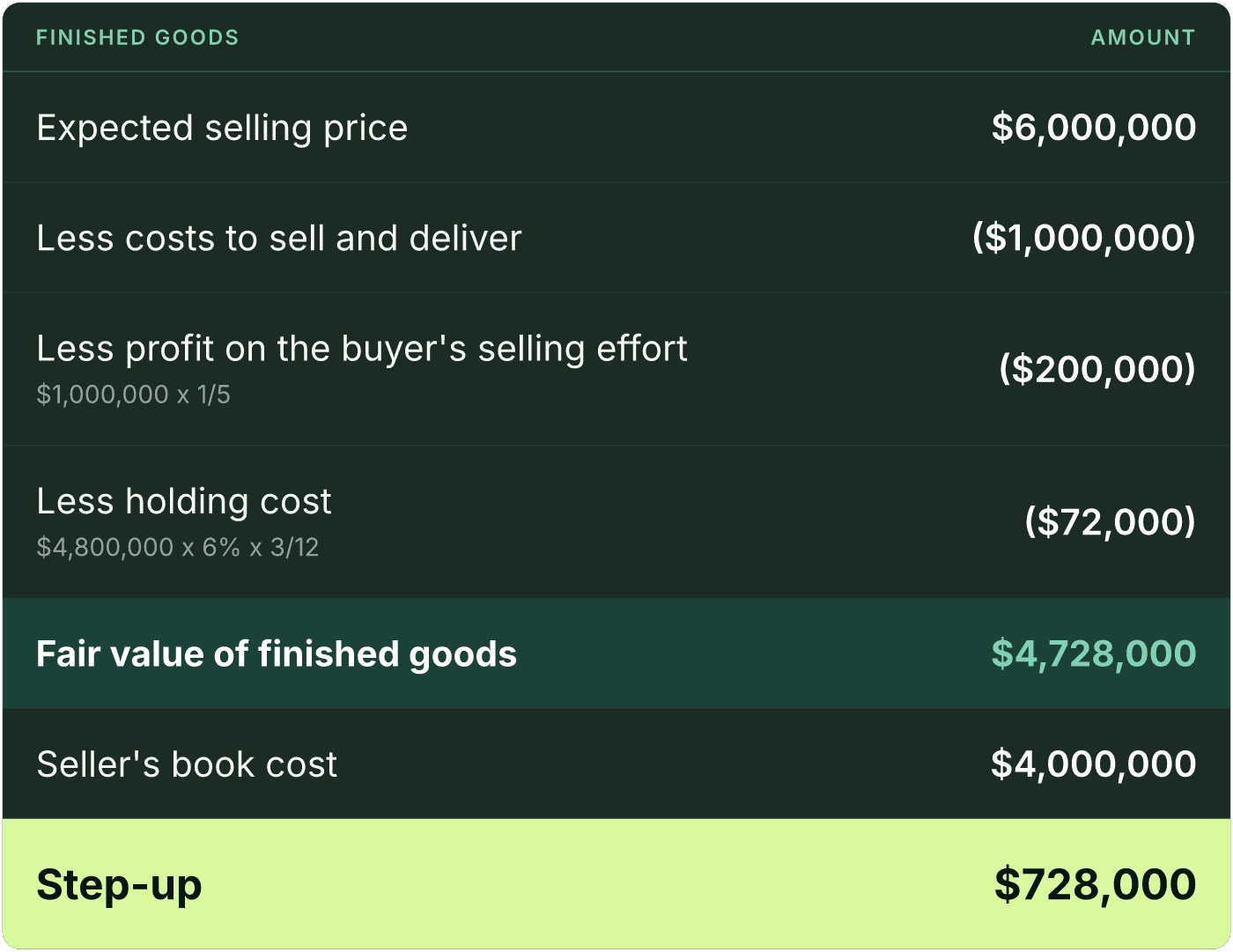
Management expects to sell the finished goods for $6,000,000 over the next three months. Selling, commissions and freight to deliver them run $1,000,000. That leaves $1,000,000 of profit on the goods ($6,000,000 less $4,000,000 of manufacturing cost less $1,000,000 of selling cost). One common way to split it is by effort, measured as cost: the seller spent $4,000,000 making the goods and you will spend $1,000,000 selling them, so one fifth of the profit, $200,000, belongs to you. Carrying $4,800,000 of inventory for three months at a 6% financing rate costs $72,000.
[](https://www.409.ai/uploads/inventory_step_up_purchase_price_allocation_asc_805_gross_margin_first_quarter_table_1_56a8fa4585.png)
The raw materials add little: replacement cost of $1,560,000, plus $15,000 of purchasing and handling, less $25,000 for slow-moving stock, gives $1,550,000 against $1,500,000 of book cost, a $50,000 step-up. Total inventory goes on the opening balance sheet at $6,278,000, $778,000 above the seller's books. Before deferred taxes, every dollar of that $778,000 is a dollar less of goodwill.
Why the step-up hits the first quarter, and only the first quarter
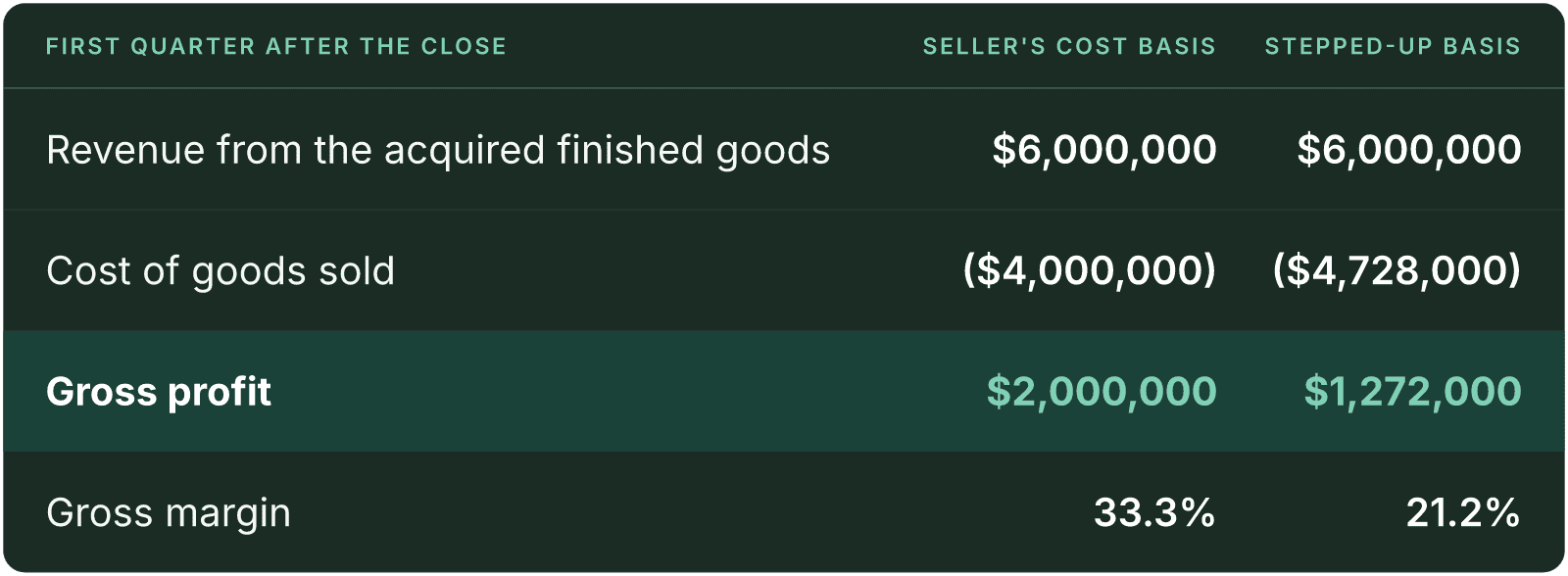
The stepped-up amount is your cost of the inventory now. When the goods ship, cost of goods sold carries $4,728,000 instead of the $4,000,000 the seller would have booked.
[](https://www.409.ai/uploads/inventory_step_up_purchase_price_allocation_asc_805_gross_margin_first_quarter_table_2_adb0c0bbcf.png)
Twelve points of gross margin vanish for one quarter. Once the acquired units are sold, new production comes in at normal cost and the margin returns. Unlike the step-up on customer relationships or technology, which amortises over years, the inventory step-up reverses in one inventory turn: weeks for a distributor with fast turns, a year or more for a business carrying aged stock.
Three consequences follow.
EBITDA drops with it. Cost of goods sold sits above EBITDA, so reported EBITDA for the quarter falls by the full $728,000. Many credit agreements and management reports add purchase accounting adjustments back in their definition of adjusted EBITDA. Check the definition in yours before the first covenant certificate, and label the adjustment plainly in the board pack so nobody reads it as a margin problem.
An earnout can feel it. If the seller's earnout is measured on gross margin or EBITDA in the first year, read whether the purchase agreement excludes purchase accounting adjustments. If it does not, the step-up lowers the metric the earnout pays on, and that argument is easier to settle at signing than at the first measurement date. How the earnout itself enters the allocation is a separate exercise, covered in [our guide to valuing earnouts under ASC 805](https://www.409.ai/articles/earnout-contingent-consideration-valuation-asc-805).
The step-up leaves little impairment headroom. For inventory measured under FIFO or average cost, ASC 330 requires the lower of cost and net realisable value, which is the selling price less the reasonably predictable costs of completion, disposal and transportation. In the example, net realisable value is $5,000,000 ($6,000,000 less $1,000,000) against a carrying amount of $4,728,000. The cushion is $272,000, exactly the profit allowance plus the holding cost. A 5% price cut on that inventory, $300,000 of revenue, takes net realisable value to $4,700,000 and forces a $28,000 write-down. The seller, carrying the same goods at $4,000,000, would have had a $1,000,000 cushion.
The tax side: a deferred tax liability or a Class IV asset
In a stock deal without a section 338 or 336(e) election, the tax basis of the inventory stays at the seller's $5,500,000. The book step-up of $778,000 creates a deferred tax liability; at an assumed 25% combined rate, $194,500, which also increases goodwill. It reverses as the inventory sells, so it disappears within the same quarter as the step-up. The mechanics are the same as for the larger liabilities on intangibles, set out in [our article on deferred taxes in a stock-deal PPA](https://www.409.ai/articles/deferred-tax-liability-purchase-price-allocation-stock-deal-goodwill-asc-805).
In an asset deal or with a section 338 election, the inventory gets a tax basis of its own. The regulations put it in Class IV of the residual method ([26 CFR 1.338-6](https://www.ecfr.gov/current/title-26/section-1.338-6)), and Rev. Proc. 2003-51 is the IRS's own guidance on valuing it. Your tax inventory value and your book fair value do not have to match, but an unexplained gap between the two is a question from both your auditor and the IRS. Keeping one asset list that feeds both allocations is the subject of [our comparison of ASC 805 and Form 8594](https://www.409.ai/articles/asc-805-vs-form-8594-two-purchase-price-allocations-one-asset-list).
When the valuation is late: the measurement period
Here is the timing problem. A deal that closes in October has inventory that is largely sold by December, often before the purchase price allocation is final. ASC 805 lets you report provisional amounts and adjust them during the measurement period, up to one year from the acquisition date. Since ASU 2015-16, the adjustment is recorded in the period it is determined, together with the effect on earnings that would have been recognised had the accounting been complete at the acquisition date.
For inventory, that means a step-up first booked at an estimate of $500,000 and finalised at $778,000 sends the additional $278,000 through cost of goods sold in the quarter of the change, even though the goods were sold months earlier, and that amount must be disclosed. A rough estimate of the inventory step-up on day one, refined quickly, keeps the swing small. The inventory is often the first number worth finalising for that reason, and [our walkthrough of what an auditor tests in a PPA](https://www.409.ai/articles/purchase-price-allocation-cost-asc-805-what-auditors-test) explains why the measurement period is shorter in practice than the one-year limit suggests.
What the auditor will test
Expect the audit team's valuation specialist to ask for support on five points.
- **Selling prices.** Post-close invoices for the acquired units are the best evidence. If you sold them at lower prices than the valuation assumed, the step-up was too high.
- **Costs to sell.** Commissions, freight and selling expense as a share of revenue, from the target's historical P&L, consistent with the selling cost the valuation deducted.
- **The profit split.** Why your share of the profit is a fifth, or a quarter, and not something else. This is the most judgemental input and the one with the largest effect on the step-up.
- **The disposal period and holding cost.** Turnover from the target's history, and a financing rate a market participant would bear.
- **Quantities and condition.** The closing inventory count, and a reserve for slow-moving or obsolete items consistent with the target's own policy.
The same specialist will check that the inventory value is consistent with the rest of the allocation. A profit split that is generous to the seller on inventory but lean on the buyer's selling effort in the [customer relationship valuation](https://www.409.ai/articles/customer-relationships-purchase-price-allocation-mpeem-contributory-asset-charges-attrition) is an inconsistency the auditor will spot.
The takeaway
The inventory step-up is the one purchase accounting number your operating team will see in a matter of weeks, through a margin that dips and then recovers for no operating reason. Estimate it on the closing date from the target's selling prices, selling costs and turns. Agree the treatment in your lender's adjusted EBITDA and the seller's earnout before the first measurement. Then document the profit split as carefully as any intangible, because it drives most of the number and is the input the auditor will question first.
If you closed a deal this year and the year-end audit is coming, 409.AI prepares [ASC 805 purchase price allocations](https://www.409.ai/products/purchase-price-allocation) with the inventory, intangibles and goodwill in one report your auditor can test, drafted in 24 hours and reviewed by a valuation expert.