Financial Reporting
Exit-Only Share Options Under IFRS 2: When the Expense Starts
For finance teams reporting under IFRS: why options that vest only on a sale or IPO cost money from grant, and how each exit estimate moves the IFRS 2 charge.
By 409.AI Team - 2026-11-26
# Exit-Only Share Options Under IFRS 2: When the Expense Starts
Plenty of UK and European startups grant options that vest only when the company is sold or lists. The employee has to still be there on the day, and nothing vests before it. For the finance lead who reports under IFRS, that design raises an awkward year-end question: if nobody knows when the exit will come, or whether it will come at all, when does the share-based payment expense start?
The answer surprises teams who have read US guidance first. Under IFRS 2, the expense usually starts at grant, years before any exit, and it moves every time your estimate of the exit date moves. This article walks through why, what the grant-date fair value includes and leaves out, and how a three-year schedule actually looks.
What kind of condition is an exit?
IFRS 2 sorts every condition attached to an award into a few boxes, and the box decides the accounting. The definitions sit in Appendix A of the standard, which you can read in the EU-adopted text of Commission Regulation (EU) 2023/1803.
A service condition only asks the employee to stay. A performance condition asks them to stay and asks for a target to be hit while they're still providing service. A target tied to the company's own operations is a non-market performance condition. A target tied to the share price is a market condition. Anything that decides whether the employee gets the award but carries no service requirement at all is a non-vesting condition.
An exit-only option, where a leaver forfeits, is a performance condition: there's a target (the sale or the listing) and an implicit requirement to remain employed until it happens. The IFRS Foundation's own staff said exactly this when the Interpretations Committee looked at vesting conditions in 2010, pointing to paragraph IG24 of the implementation guidance, which treats a successful IPO with a service requirement as a non-market performance condition (IFRS Interpretations Committee staff paper, July 2010, Appendix D). Since 2014 the definition has also said the performance period can't run past the end of the service period, which an exit-only option meets by design: the service ends at the exit.
That classification drives three consequences.
The fair value ignores the exit, but not the timing
Paragraph 19 of IFRS 2 says vesting conditions other than market conditions are not taken into account when estimating the grant-date fair value. So the valuer doesn't haircut the option for the chance that no exit ever happens. That probability goes into a different number: how many options you expect to vest.
The exit still shapes the valuation, though, through the expected term. Appendix B asks for the effect of expected early exercise and the option's expected life to be built into the model (paragraphs B16 to B21). An option that can only be exercised at a sale is, in practice, exercised at the sale. If the board's best estimate puts that four years out, a four-year expected term is the natural starting point, and the volatility and risk-free rate are matched to it. For a private company, the share price input itself comes from a valuation of the ordinary shares beneath the preference stack, the same exercise our IFRS 2 valuation guide describes in detail.
The expense follows your best estimate, and you revise it
Two paragraphs do the work here.
Paragraph 15(b) covers awards whose vesting period depends on when a performance condition is met. You estimate the length of the expected vesting period at grant, "based on the most likely outcome of the performance condition", and you spread the expense over that period. For a non-market condition like an exit, you revise that estimate whenever later information says the period has changed.
Paragraph 20 does the same for numbers: you recognise expense on "the best available estimate of the number of equity instruments expected to vest" and revise it as information changes. On vesting date the estimate is trued up to what actually vested.
There's no "probable" threshold in either paragraph. You don't wait for a signed term sheet. If the board's plan is a sale in about four years and that's the most likely outcome, the expense starts in the first reporting period after grant.
The flip side is the reversal. Because the exit is a non-market condition, paragraph 19 says that on a cumulative basis nothing is recognised for awards that don't vest. If the exit is abandoned and you no longer expect any options to vest within their life, the cumulative charge comes back out through profit or loss.
A worked example over three year ends
Take a UK company that reports under IFRS. On 1 January 2026 it grants 1,000,000 exit-only options to its team. A valuation puts the grant-date fair value at £0.50 per option, using a four-year expected term. At grant, the board's best estimate is a sale at the end of 2029, with 85% of the options still held by employees on that day.
In 2027 the plan slips: the board now expects the sale at the end of 2030, and more people have left, so 80% is the new estimate. Then a buyer arrives sooner than anyone planned, and the sale completes on 31 December 2028 with 760,000 options vesting.
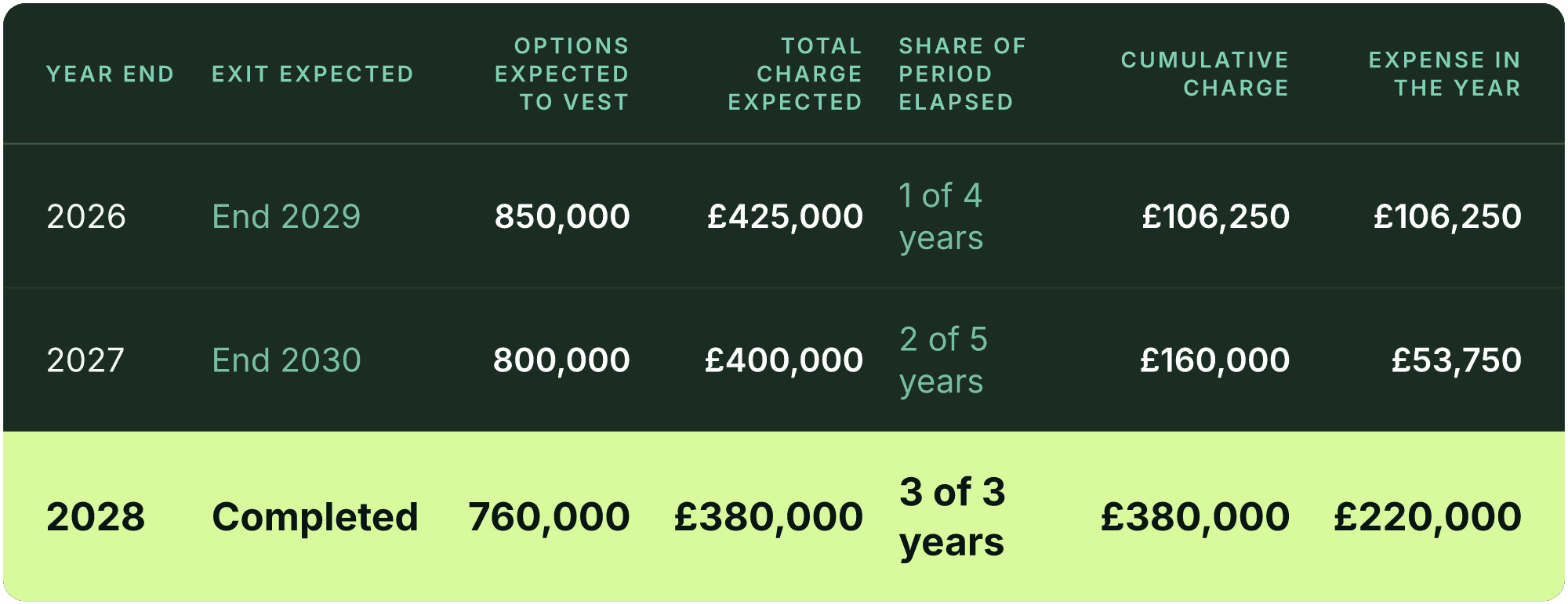

The first year books a quarter of the expected total. In 2027, the longer horizon and the smaller expected population both pull the cumulative figure down relative to where it would have been, so the year's charge drops to £53,750. In 2028 the exit happens early, the vesting period collapses to three years, and the whole remaining charge lands in one year.
The grant-date fair value of £0.50 never changes. Only the count and the period move. That's the core of equity-settled accounting under IFRS 2, and it's the reason the auditor will test your exit estimate as hard as the option model.
Now suppose the buyer had walked away in 2028 instead, and the board concluded no sale or listing was likely before the options lapse. The best estimate of options expected to vest becomes zero, the cumulative charge goes to zero, and the £160,000 booked in 2026 and 2027 reverses as a credit in 2028.
When the exit comes with a price target
Many plans add a hurdle: the options vest on an exit, but only if the sale price per share clears a set figure. A price target is a market condition. Paragraph 21 says market conditions go into the grant-date fair value, usually through a Monte Carlo simulation of the price path, and that the expense is then recognised for every employee who meets the other conditions, whether the price target is hit or not. For a market condition, paragraph 15(b) also says the expected vesting period comes from the valuation and is not revised later.
The combination of an exit and a price is where practice splits. The same 2010 staff paper set out three readings of an "IPO with a minimum price" award: two separate conditions (a non-market exit plus a market price target), a single non-market condition, or a single market condition with the exit as a precondition. The staff found no clear guidance in the standard for this pattern, and the text of IFRS 2 quoted above still doesn't pick one.
Each reading gives a different answer when the exit happens below the hurdle. Under the first, the price miss doesn't stop the expense, but a failed exit still reverses it. Under the second, a miss reverses everything. Under the third, nothing reverses once the employee has stayed through the period. The choice belongs in your accounting policy, it has to match how the valuation was built, and it should be agreed with the auditor before the first year end, not after. Our guide to option pricing models shows how a share price hurdle enters a Monte Carlo value under the US standard; the mechanics of the simulation carry across.
When leavers keep their options
Read the leaver clause before you classify anything. If the plan lets employees who leave keep their options until the exit, the award no longer asks them to stay. Without a service requirement, the exit can't be a performance condition under the Appendix A definition. It becomes a non-vesting condition.
Paragraph 21A then puts the exit into the grant-date fair value, as a probability the valuer has to model, and the expense is recognised over whatever service period remains, regardless of whether the exit ever happens. If a sale never comes, nothing reverses. That's a very different profit and loss profile from the worked example above, produced by one clause in the plan rules.
Mixed terms are common: a good leaver keeps a pro-rated slice, a bad leaver loses everything. Each slice may need its own analysis, which is one more reason to send the plan rules to the valuer with the cap table.
The US comparison, and why groups notice it
Under US GAAP, ASC 718 accrues the expense of a performance condition only when achieving it is probable, and practice treats a sale or IPO as generally not probable until it happens. Deloitte's comparison of US GAAP and IFRS for share-based payments sets out the difference: under US GAAP, an entity generally recognises no cost for an award that vests on an IPO or a change in control until the event occurs, so the charge tends to arrive in one go on the exit date, while IFRS spreads it over the years before.
A US subsidiary of a European group, or a UK company with a US parent, can end up keeping two schedules for the same grant. The IFRS 2 and ASC 718 comparison covers the other differences that tend to show up at the same time, including forfeitures and graded vesting.
What the year-end file should hold
For each exit-only grant, the auditor will want to see four things. The plan rules and the leaver terms, because they decide the classification. The grant-date valuation, with the expected term tied to the exit estimate. The board's current best estimate of the exit date and the population expected to remain, with the evidence behind it: a board paper, a banker's mandate, a strategy update. And the schedule that turns those estimates into the cumulative charge.
If you later reprice or swap these options, the rules on modifications apply on top; our piece on repricing underwater options under IFRS 2 covers that floor. UK teams granting EMI options on exit-only terms will also want the tax side, set out in what happens to EMI options when the company is sold.
An IFRS 2 valuation from 409.AI gives you the grant-date fair value and the assumptions behind it in a report built for that file.
The takeaway
An exit-only option isn't free until the exit. Under IFRS 2 it's a non-market performance condition, so the fair value ignores whether the exit happens, the expense starts at grant over the most likely vesting period, and every change in the exit estimate flows through the next year end. Write down the classification, the leaver terms and the exit estimate in the first year, because each one moves the charge more than the option model does.
About the author
409.AI Team
Startup valuation and equity workflow specialists
The 409.AI team writes practical valuation content for founders and finance teams preparing 409A reports, equity documentation, and related startup finance workflows.
Related valuation reports
- IFRS 2 valuation report: 409.AI helps companies reporting under IFRS prepare expert-reviewed IFRS 2 valuation reports with grant-date fair value analysis for share-based payment expense and audit support.
- 409A valuation report: 409.AI helps private companies prepare expert-reviewed 409A valuation reports for equity compensation and option strike price support.
- Pricing for every report type
- 409A valuation calculator
- Sample 409A report