Financial Reporting
Repricing Underwater Options Under IFRS 2: What the Modification Really Costs
Finance teams reporting under IFRS: what repricing underwater options adds to share-based payment expense, with the incremental fair value worked through.
By 409.AI Team - 2026-11-13
# Repricing Underwater Options Under IFRS 2: What the Modification Really Costs
If you run finance at a private company that reports under IFRS, in the UK, the EU, Canada or Australia, and a down round has left your employee options far above what the shares are now worth, the board will soon ask whether to reprice them. The tempting assumption is that the old options are nearly worthless, so lowering the strike should cost very little in the accounts. IFRS 2 says otherwise. The expense you were already booking keeps running in full, and the repricing adds a second charge on top of it.
This post works through that second charge: what the standard requires, how the number is measured, and how the choice between repricing, cancelling and granting new options changes the expense your auditor will test at year-end.
The rule: the original charge is a floor
IFRS 2 deals with changes to existing awards in paragraphs 26 to 29 and in Appendix B, paragraphs B42 to B44. Paragraph 26 names repricing as its own first example of a modification: reducing the exercise price "increases the fair value of those options."
Paragraph 27 then sets the principle that drives everything else. You recognise, as a minimum, the services received measured at the grant-date fair value of the original award, whatever you later do to its terms. On top of that minimum, you recognise the effect of any modification that increases the total fair value of the arrangement or is otherwise beneficial to the employee.
So a repricing never replaces the original expense. It sits beside it. The source for all of this is the standard itself, [IFRS 2 Share-based Payment](https://www.ifrs.org/issued-standards/list-of-standards/ifrs-2-share-based-payment/), as issued by the IASB and adopted in the UK and the EU.
Measuring the incremental fair value
Paragraph B43(a) defines the extra charge. The incremental fair value is the difference between the fair value of the modified option and the fair value of the original option, both estimated at the date of the modification. Two option values, one date, the same share price.
That detail matters more than it looks. The "before" value is not the grant-date value from two years ago. It's what the old, underwater option is worth today, with today's share value and its remaining term. Because the option is deep out of the money, that number is usually small, and the incremental value is therefore close to the full value of the repriced option.
Where it lands depends on timing:
- **During the vesting period**, the incremental value is spread from the modification date to the date the modified options vest. The original grant-date amount keeps running over the remainder of the original vesting period.
- **After vesting**, the incremental value goes to profit or loss immediately, unless the employee must complete more service to keep the repriced options, in which case it is spread over that new period.
A worked example
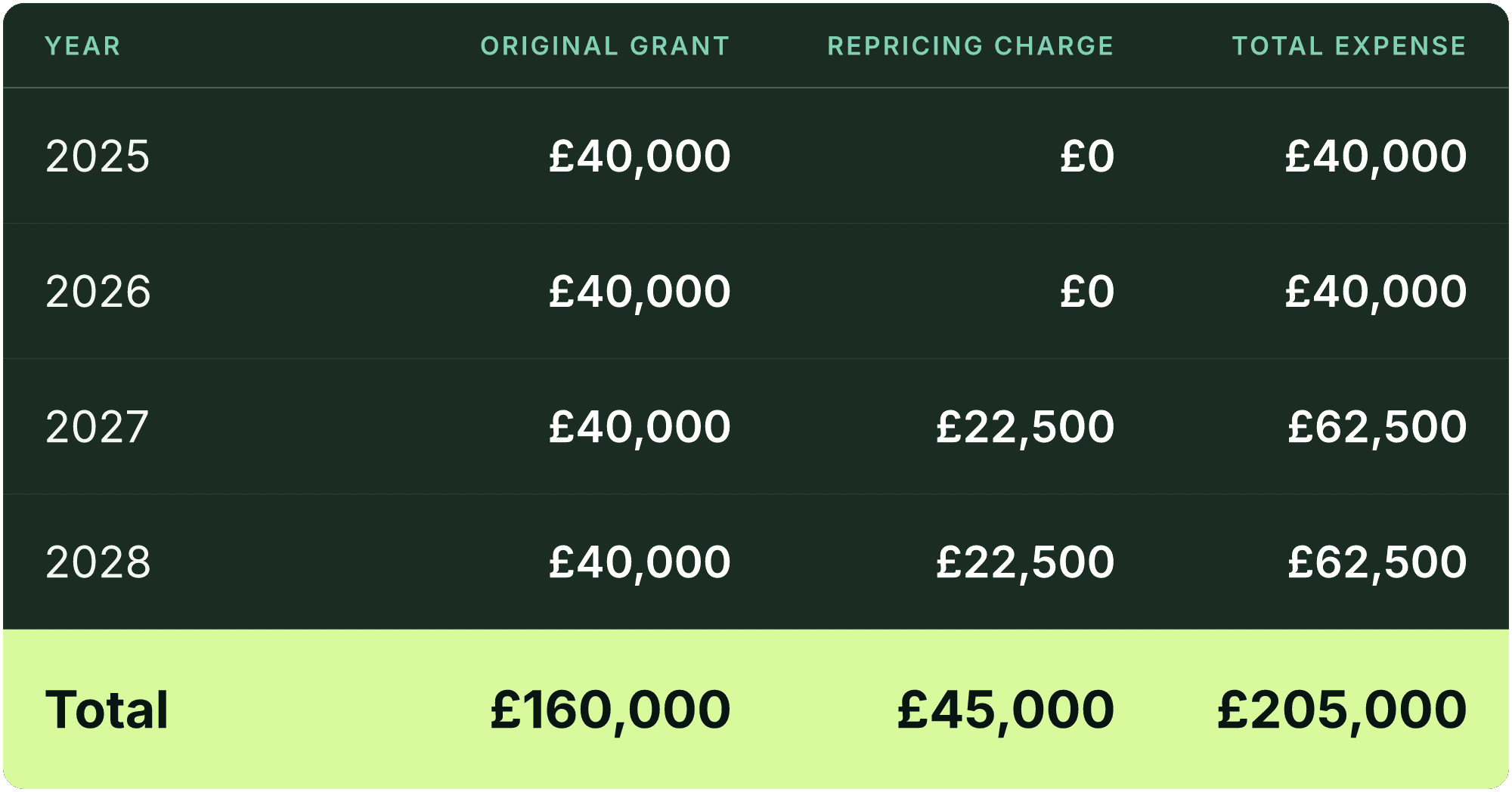
Here is an illustrative case. A UK company granted 100,000 options on January 1, 2025, at an exercise price of £4.00, vesting in full after four years of service. The grant-date fair value was £1.60 per option, so the total charge is £160,000, or £40,000 a year. To keep the arithmetic clean, assume nobody leaves.
On January 1, 2027, after a down round, the ordinary shares are valued at £1.50. The board reprices every option to a £1.50 strike, with the vesting date unchanged. The valuer measures both options on that date: £0.20 per option before the change, £0.65 after. The incremental fair value is £0.45 per option, or £45,000, spread over the two years left to vesting.
[](https://www.409.ai/uploads/ifrs_2_repricing_underwater_options_modification_incremental_fair_value_table_1_5240dda1eb.png)
The share-based payment expense for 2027 rises by more than half, in a year when the company has just raised money at a lower price. That's the conversation to have with the board before the vote, not after the audit.
Notice what did not happen. The £160,000 was never written down to reflect the fall in the share value. Paragraph B44 is explicit that a decrease in fair value is ignored: you keep measuring the original award at its grant-date fair value.
When the repricing comes with a longer vesting period
Boards often pair a repricing with a fresh vesting period, on the logic that employees who get a better strike should earn it again. IFRS 2 treats the two halves differently.
Extending vesting is not beneficial to the employee, so under B44(c) you ignore it for the original award. The £40,000 a year keeps running to the original vesting date of December 31, 2028. The incremental value, though, follows the modified award: under B43(a) it is spread to the date the modified options vest.
Take the same facts with vesting moved out one year, to December 31, 2029, and keep the £0.45 increment for the comparison (in practice the valuer would measure the modified option on its new terms). The original £40,000 still lands in 2027 and 2028. The £45,000 is spread over three years instead of two, at £15,000 a year from 2027 to 2029. The total is the same £205,000; the profile is flatter. A longer vesting period lowers the yearly charge of the repricing, but it does nothing to the charge you were already carrying.
Reprice, cancel, or grant new options?
Some companies prefer to cancel the underwater options and start again. Paragraph 28 makes that route expensive unless it is handled with care.
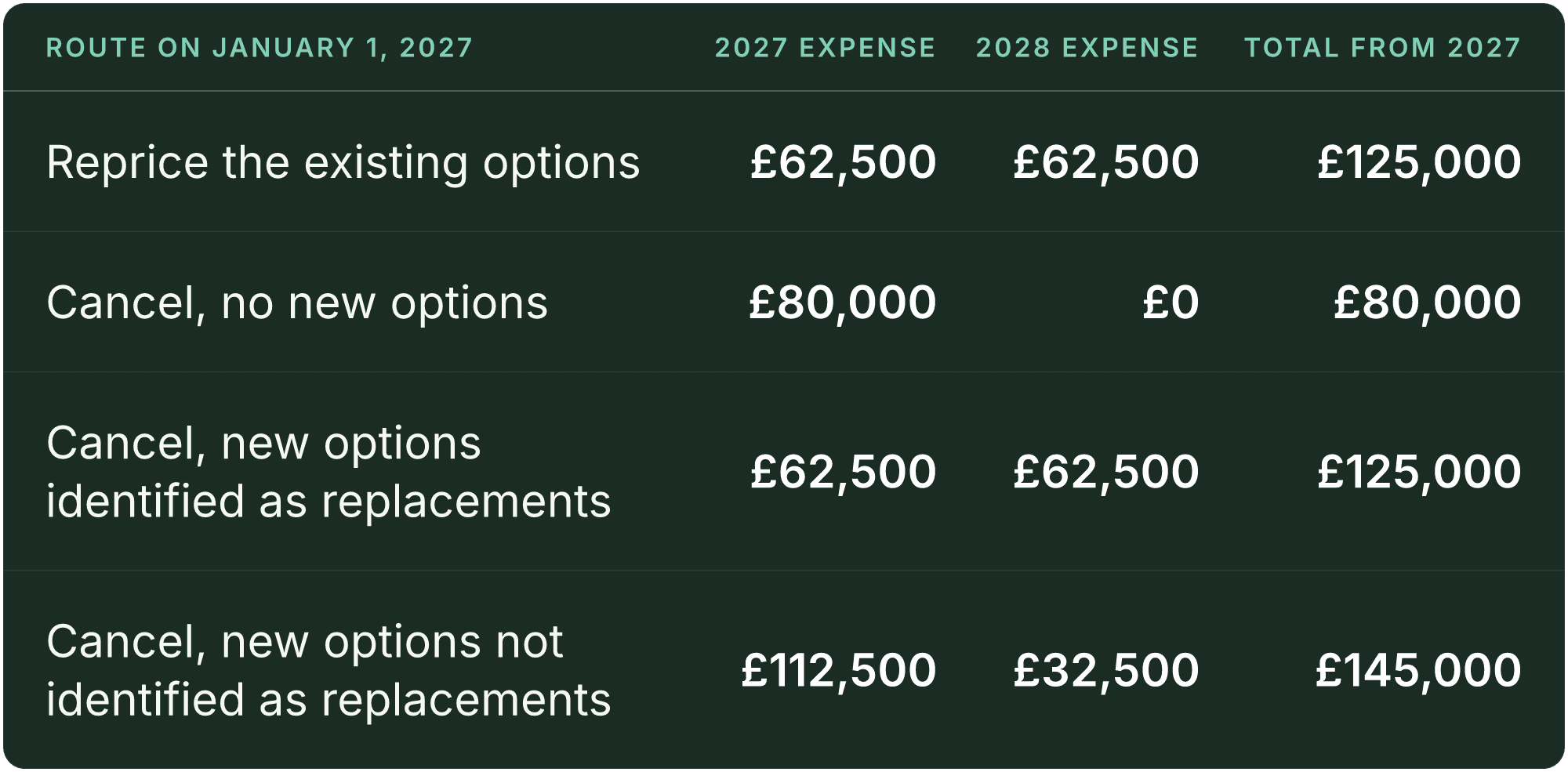
A cancellation during the vesting period is treated as an acceleration of vesting: everything not yet recognised on the original grant is expensed at once. If new options are granted and, on the date they are granted, the company identifies them as replacements for the cancelled ones, the swap is accounted for as a modification, with the incremental value measured as the fair value of the replacement options less the net fair value of the cancelled ones. If the new options are not identified as replacements, they are a brand-new grant, expensed in full on top of the acceleration.
Using the same company, with any new options granted on January 1, 2027, at a £1.50 strike and vesting on December 31, 2028:
[](https://www.409.ai/uploads/ifrs_2_repricing_underwater_options_modification_incremental_fair_value_table_2_77d7a112b4.png)
The last row is the expensive mistake: £80,000 accelerated plus a £65,000 new grant, £20,000 more than the same economics booked as a replacement. The difference comes down to what the board minutes and grant documents say on the day of the new grant. The cheapest row in the table, cancelling with nothing in return, saves expense only by taking the incentive away from the people you were trying to keep.
Leavers and the floor
Paragraph 27 has one exception to the floor: an option that does not vest because a non-market vesting condition, such as a service condition, is not met carries no expense. Under paragraph 20 you estimate how many options will vest and true the number up as people leave, so the original charge and the repricing charge both fall away for an employee who resigns before vesting.
That has a practical consequence. The repricing charge only arises for employees who stay. If a reduction in headcount is coming, your leaver estimate at the modification date should already reflect it, and the auditor will ask how it was set.
What your auditor will ask for
Expect three things in the year-end file.
Both option values, on the same date. The before and after values must use the same share value, the same volatility, the same risk-free rate and the same remaining expected term, changing only the terms the board actually changed. A "before" figure lifted from the original grant report fails at once. Our post on [Black-Scholes inputs for private-company options](https://www.409.ai/articles/black-scholes-inputs-private-company-stock-options) explains where each input comes from, and [choosing between Black-Scholes, a lattice and Monte Carlo](https://www.409.ai/articles/black-scholes-lattice-monte-carlo-option-pricing-model-asc-718-market-condition) matters when the repriced options carry a market condition.
A share value at the modification date. For an unlisted company this is the input that moves everything. A down round prices preference shares, not ordinary shares, and the ordinary share value usually sits below that price once the new preferences are taken into account. That is the valuation work behind an [IFRS 2 valuation report](https://www.409.ai/articles/what-is-an-ifrs-2-valuation-grant-date-fair-value-report-auditor-wants).
The disclosure. Paragraph 47(c) requires, for arrangements modified during the period, an explanation of the modification, the incremental fair value granted and how it was measured. If the numbers above are documented, the note almost writes itself.
If your group also reports under US GAAP, the logic of a modification is close but the details of attribution and forfeitures differ; our comparison of [IFRS 2 and ASC 718](https://www.409.ai/articles/ifrs-2-vs-asc-718-share-based-payment) covers those, and the US side of a repricing, including the 409A, is in [down rounds and underwater options](https://www.409.ai/articles/down-round-409a-underwater-options-repricing).
The tax side is a separate question under each country's rules. For a UK company with EMI options, check any change to their terms against the [EMI disqualifying events](https://www.409.ai/articles/emi-disqualifying-events-90-day-exercise-window-hmrc-market-value) before the board meets.
The takeaway
Before the board votes, put two numbers in front of it: the expense already committed on the original grant, which does not move, and the incremental fair value of the repricing, measured on the vote date. In the example above, a repricing that felt like housekeeping added £45,000 to the expense and lifted 2027's charge from £40,000 to £62,500. If the plan is to cancel and regrant instead, make sure the new options are identified as replacements on the day they are granted. If you need the share value and both option values measured on the modification date, an [IFRS 2 valuation](https://www.409.ai/products/ifrs-2) gives your auditor one report with all three.