Financial Reporting
Black-Scholes, Lattice or Monte Carlo: Which Option Pricing Model ASC 718 Needs for Each Grant
For startup CFOs and controllers: when ASC 718 needs Black-Scholes, a lattice or Monte Carlo, and what a share price hurdle does to grant value and expense.
By 409.AI Team - 2026-11-11
# Black-Scholes, Lattice or Monte Carlo: Which Option Pricing Model ASC 718 Needs for Each Grant
If you're the controller or CFO of a venture-backed company, the first audit that tests stock-based compensation will ask a question the cap table can't answer: why did you value these awards with this model? Most private companies use Black-Scholes for every grant and never think about it. That works until the board approves something that isn't a plain option, such as a CEO grant that vests only if the share price triples, or an award that pays out only on an exit above a set price. Then the model itself becomes an audit finding.
This post is about that choice. It covers what US GAAP actually requires of a model, which of the three common models fits which award, and what a price hurdle does to the number and to the expense schedule, with a worked example.
What ASC 718 asks of a model
ASC 718 does not name a required model. The SEC staff spelled out the test in Staff Accounting Bulletin 107 (Topic 14.C), drawing on Statement 123(R), the standard now codified as ASC 718: the technique must be applied consistently with the fair value measurement objective, rest on established principles of financial economic theory, and reflect all substantive characteristics of the instrument. All three, not two of three. ([SEC, SAB 107](https://www.sec.gov/interps/account/sab107.pdf))
The third test is where most of the work sits. The same bulletin gives the example that matters here: for an option that only becomes exercisable after a specified increase in the share price, the Black-Scholes-Merton closed-form model "would not generally be an appropriate valuation model," because it isn't designed to capture that kind of market condition.
Two other points from SAB 107 are useful when an auditor pushes back. A company isn't required to use a lattice model just because it was the most complex one considered. And switching models for similar awards isn't a change in accounting principle, so no preferability letter is needed, though the staff doesn't expect frequent switching and expects the basis for a change to be disclosed.
So the question to ask is narrow: what does this award have that the model must capture?
The three models, by what they can see
Black-Scholes is a formula. It takes six inputs (share price, strike, expected term, volatility, risk-free rate, dividends) and returns one value. It assumes the option is exercised at a single point, the expected term, and it can't look at the path the share price takes on the way there.
A lattice (binomial) model builds a tree of possible share prices over the option's life. At each node it can apply a rule: exercise early if the price is high enough, forfeit if the employee leaves, vest after year one. That makes it the right tool when exercise behaviour or post-vesting terms drive value, and when assumptions such as volatility change over the life of the award.
Monte Carlo simulation draws thousands of random share price paths and evaluates the award's payoff on each one. Because it keeps the whole path, it handles conditions that depend on what the price did, not only where it ended: hurdles, caps, relative total shareholder return against a peer index, and awards that pay on a price at a future date.
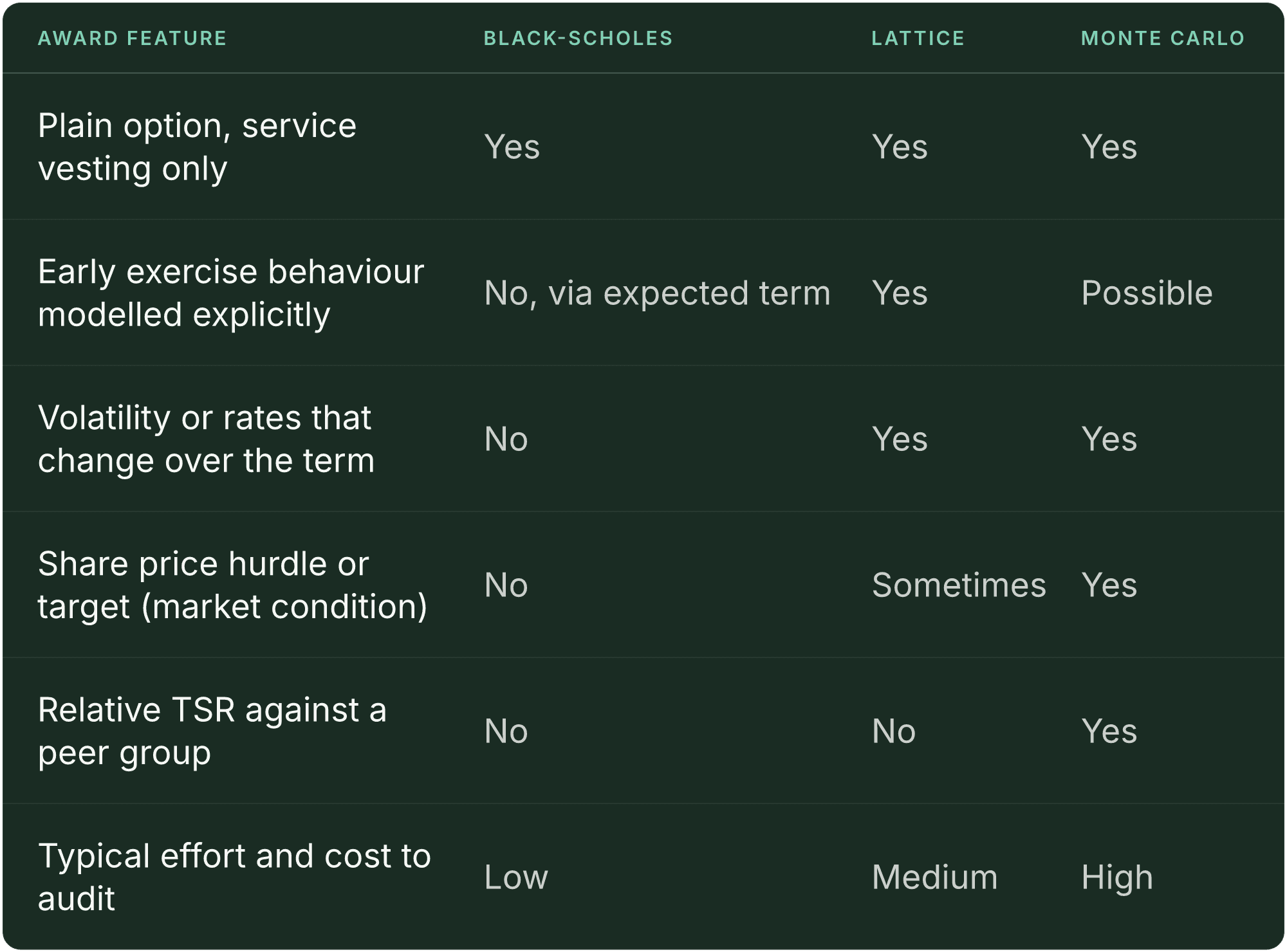
Here is how the three line up against the features that usually come up in a private company's equity plan.
[](https://www.409.ai/uploads/black_scholes_lattice_monte_carlo_option_pricing_model_asc_718_market_condition_table_1_9a3f5877fb.png)
For a plain option with a four-year vest and a ten-year term, Black-Scholes is accepted practice and the real fight is over the inputs. We cover where volatility, expected term and the risk-free rate come from in the [post on Black-Scholes inputs for private companies](https://www.409.ai/articles/black-scholes-inputs-private-company-stock-options). A nonpublic company can also elect the expected term practical expedient in ASC 718-10-30-20A, and the SEC staff's simplified method gives 6.25 years for a ten-year option with four-year graded vesting. Neither shortcut changes which model is right.
When a plain grant stops being plain
The features that push you off Black-Scholes tend to show up in the same places:
Founder and CEO grants with price targets. Vesting in tranches when the share price reaches 2x, 3x or 5x the grant price is a market condition. A closed-form formula can't see whether the target was ever touched.
Exit-price awards. An award that vests only if the company is sold or goes public at or above a set price per share combines a performance condition (the exit) with a market condition (the price). The [double-trigger RSU post](https://www.409.ai/articles/double-trigger-rsus-ipo-taxation-409a) covers the tax side of liquidity-event vesting; the accounting side starts with the model.
Options where exercise timing drives value. Ten-year options where exercise behaviour clearly depends on how far in the money they are can be priced more accurately on a lattice, though for most early-stage grants the difference is small and Black-Scholes with a supportable expected term remains common.
A worked example: the same grant, with and without a hurdle
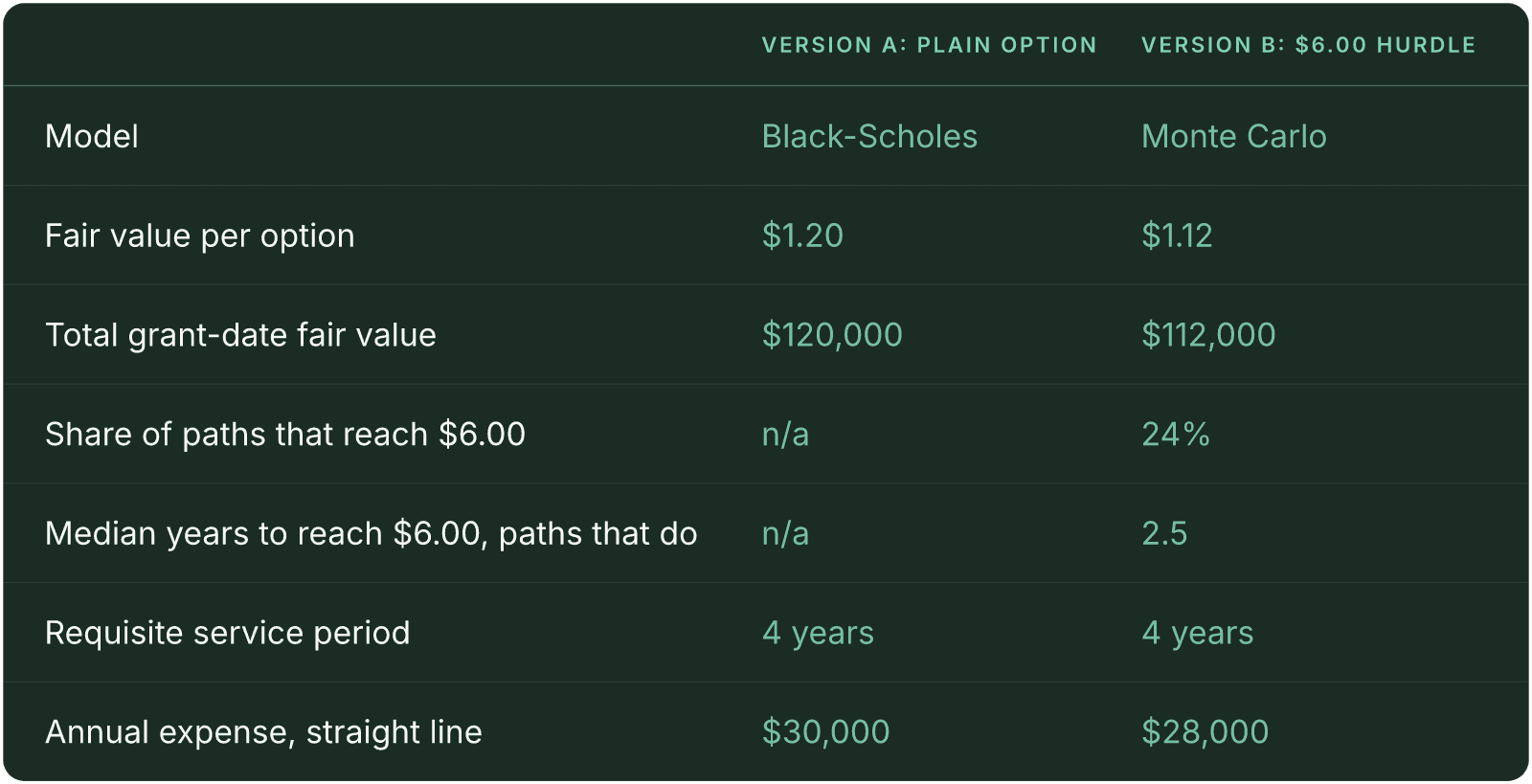
Illustrative numbers. A Series A company grants options on 100,000 common shares. The 409A sets the common value at $2.00 and the strike at $2.00. The options have a ten-year term and four-year vesting. We use a 6.25-year expected term, 60% volatility (from a peer set of public companies), a 4.0% risk-free rate and no dividends.
Version A is a plain option. Version B is the same option, except it can't be exercised unless the common value reaches $6.00 (three times the grant price) at some point during the term. We valued A with Black-Scholes and B with a Monte Carlo simulation of 100,000 monthly price paths using the same inputs, exercising at the expected term.
[](https://www.409.ai/uploads/black_scholes_lattice_monte_carlo_option_pricing_model_asc_718_market_condition_table_2_497d21c329.png)
Two things here surprise finance teams.
First, the hurdle cuts the value by about 7%, not by three quarters. Only 24% of the simulated paths ever touch $6.00, but the paths that never do were mostly worth little anyway: an option with a $2.00 strike on a share that never reaches $6.00 rarely pays much. The value of an option sits in the paths where the share does well, and those are the paths that clear the hurdle. A board that expected the hurdle to make the grant "cheap" in the income statement is usually disappointed.
Second, the 2.5 years is a derived service period: an estimate of how long it takes to satisfy the market condition, taken from the same simulation. When a grant has both a service condition and a market condition and both must be met, the requisite service period is generally the longest of the explicit, implicit and derived periods, which here is the four-year vest. If the derived period had been six years, the expense would have been spread over six.
The expense rule that catches people out
Under ASC 718 a market condition is not a vesting condition. Its effect goes into the grant-date fair value, and the compensation cost is recognised as long as the employee renders the requisite service, whether or not the market condition is ever met. ([Deloitte, Roadmap: Share-Based Payment Awards, 3.5](https://dart.deloitte.com/USDART/home/codification/expenses/71x/asc718-10/roadmap-share-based-payments/chapter-3-recognition/3-5-market-condition); [PwC, Stock-based compensation guide, 2.5](https://viewpoint.pwc.com/dt/us/en/pwc/accounting_guides/stockbased_compensat/stockbased_compensat__3_US/chapter_2_measuremen_US/25_vesting_condition_US.html))
In the example, an executive who stays four years while the common value never reaches $6.00 still generates the full $112,000 of expense, and none of it reverses. Compare a performance condition such as a revenue target, where cost is recognised only if the target is probable and is reversed if it fails. The hurdle is cheaper in fair value and harsher in the reversal rules.
The exit-price award adds one more layer. A liquidity event such as an IPO or a sale is generally not considered probable until it happens, so cost on an award that requires one is typically recognised when the event occurs, at the grant-date fair value that already reflects the price condition. A company can carry a valued but unexpensed award for years, then book a large catch-up in the quarter of the exit. That's worth knowing before the S-1 or the purchase agreement.
What the auditor will test
For a plain option, the file is short: the 409A that supports the share price (the [ASU 2021-07 checklist](https://www.409.ai/articles/asu-2021-07-409a-asc-718-current-price-checklist) covers when the 409A can serve as the current price), the volatility peer set, the expected term method and the rate.
For a market-condition award, expect questions on:
- why the chosen model reflects the hurdle, cap or peer comparison, tied back to the third SAB 107 test;
- the number of paths and time steps, and whether the result is stable when the seed changes;
- how the derived service period was computed and why it is or isn't the requisite service period;
- whether the common value used in the simulation is consistent with the 409A at the grant date.
If the company reports under IFRS as well, the treatment of market conditions is close but not identical; the [IFRS 2 and ASC 718 comparison](https://www.409.ai/articles/ifrs-2-vs-asc-718-share-based-payment) lists where the two standards part.
Picking the model before the grant, not after
The cheapest time to get the model right is before the board approves the award. A price target written as "the common value reaches $6.00" will need a simulation. The same incentive written as tranches that vest on time and service will price on Black-Scholes. Neither is wrong, but the accounting cost of each should be known when the plan is designed, not at the year-end audit.
The [ASC 718 guide for startups](https://www.409.ai/articles/asc-718-stock-based-compensation-startup-guide) walks through the expense mechanics for a standard grant, and the post on [what an ASC 718 valuation report contains](https://www.409.ai/articles/what-is-an-asc-718-valuation-grant-date-fair-value-report-auditor-asks-for) shows the file an auditor expects. When a grant carries a hurdle, a cap or an exit price, a [409.AI ASC 718 valuation](https://www.409.ai/products/asc-718) values it with the model the award's terms call for.
The takeaway: list the award's terms first, then pick the model that can see every one of them. If a term depends on the path of the share price, Black-Scholes can't price it, and the expense for it will run whether or not the target is hit.