Tax
EMI Options When Your Company Is Sold: Exercise, the 90-Day Window or a Replacement Option
UK founders and CFOs selling an EMI company: when options keep their tax relief, the 90-day window, the BADR two-year clock and the value a rollover must match.
By 409.AI Team - 2026-11-16
# EMI Options When Your Company Is Sold: Exercise, the 90-Day Window or a Replacement Option
A buyer has sent heads of terms for your UK company, and a dozen employees hold Enterprise Management Incentive options. Their first question will be whether the tax reliefs survive the sale.
They can. But the relief depends on three things the deal timetable decides: when the options are exercised relative to the moment the buyer takes control, how long ago each option was granted, and, if the buyer wants to roll the options over instead of cashing them out, whether the new options carry the same market value as the old ones.
This piece is for the founder, CFO or company secretary of an EMI company in a sale process, and the adviser running the employee side of the deal: the routes the legislation allows, what each costs an option holder in tax, and the valuation a rollover needs.
Why a sale is a disqualifying event
EMI options are tax-advantaged only while the company keeps qualifying. One of the conditions is independence: under [Schedule 5, paragraph 9 of the Income Tax (Earnings and Pensions) Act 2003](https://www.legislation.gov.uk/ukpga/2003/1/schedule/5/paragraph/9), the company must not be a 51% subsidiary of another company or under another company's control.
A sale to a corporate buyer breaks that condition by design. [Section 534 of ITEPA 2003](https://www.legislation.gov.uk/ukpga/2003/1/section/534) makes it a disqualifying event when the company becomes a 51% subsidiary of another company, or comes under another company's control without becoming one. HMRC's manual says the same thing in plainer words: a takeover or merger is a [disqualifying event unless the acquiring company grants a replacement option](https://www.gov.uk/hmrc-internal-manuals/employee-tax-advantaged-share-scheme-user-manual/etassum55010) within six months.
A disqualifying event does not cancel relief already earned. It starts a clock. Under [section 532](https://www.legislation.gov.uk/ukpga/2003/1/section/532), the modified tax treatment applies only when the option is exercised more than 90 days after the event. Exercise inside the window and the option is taxed as an ordinary EMI option. Exercise after it and the growth in value after the event date, which the statute calls the post-event gain, is taxed as employment income. Our guide to [EMI disqualifying events](https://www.409.ai/articles/emi-disqualifying-events-90-day-exercise-window-hmrc-market-value) covers the other events and HMRC's worked charge.
Route one: exercise on the sale
When the buyer pays cash, the options are often exercised at or just before completion, the new shares are sold to the buyer with everyone else's, and the option holder receives the sale price less the exercise price.
The tax result turns on the price set at grant. HMRC's guidance says there is [no Income Tax or National Insurance on exercise](https://www.gov.uk/tax-employee-share-schemes/enterprise-management-incentives-emis) when the employee pays at least the market value the shares had when the option was granted, and exercises within the 10 or 15 years the agreement allows. If the option was granted at a discount, the discount is taxed as income. The market value agreed with HMRC before grant is the line between an income tax charge and none; our [EMI valuation primer](https://www.409.ai/articles/what-is-an-emi-valuation-umv-amv-hmrc-val231-agreed-before-grant) explains how that value is set and agreed.
What remains is capital gains tax on the gap between exercise price and sale price, where the grant date matters again.
The two-year clock for Business Asset Disposal Relief
Shares acquired through an EMI option can qualify for Business Asset Disposal Relief without the 5% shareholding other shareholders need. HMRC's Capital Gains Manual sets the conditions at [CG64052](https://www.gov.uk/hmrc-internal-manuals/capital-gains-manual/cg64052): the shares must be acquired on the exercise of a qualifying EMI option, sold at least two years after the option was granted, and the holder must have been an employee or officer of the company or its trading group throughout the two years ending with the sale.
The rate is worth the attention. GOV.UK lists [Business Asset Disposal Relief at 18% for disposals from 6 April 2026](https://www.gov.uk/business-asset-disposal-relief), while a higher-rate taxpayer pays [24% on gains from the same date](https://www.gov.uk/capital-gains-tax/rates) without the relief.
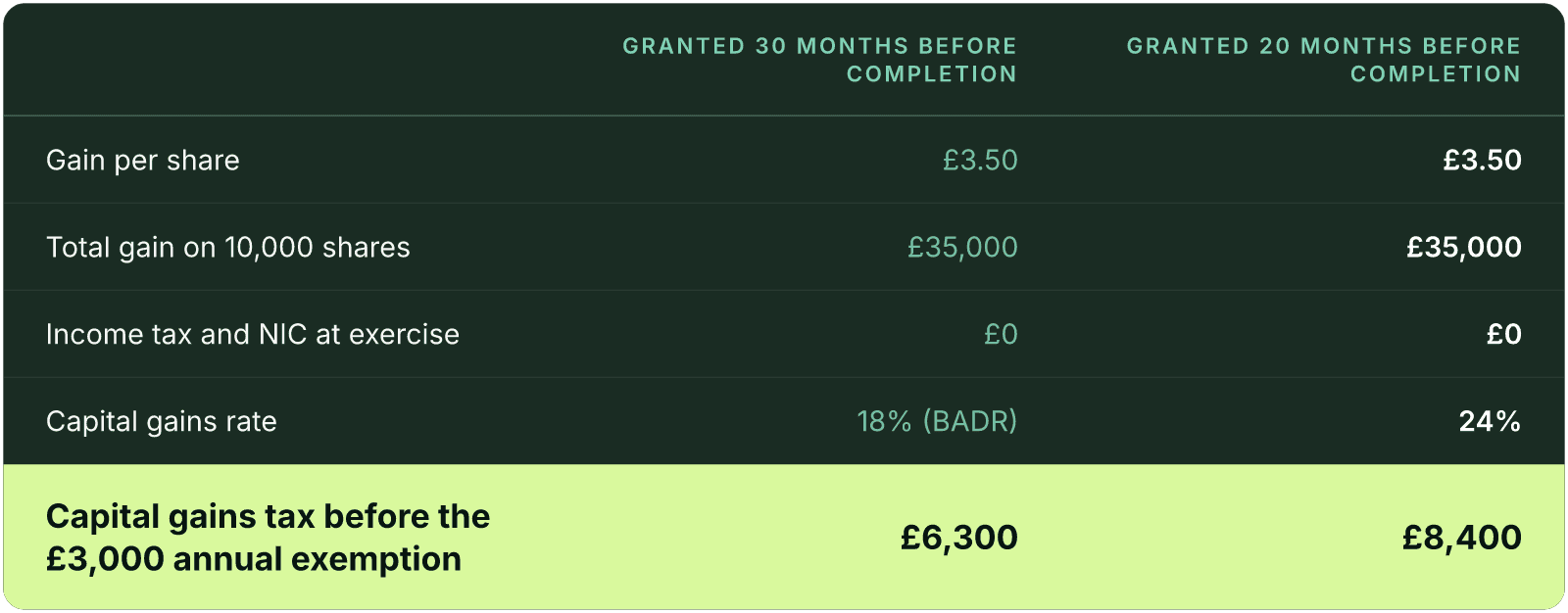
Take an illustrative option over 10,000 shares with an exercise price of £0.50, equal to the market value HMRC agreed at grant. The buyer pays £4.00 a share and the holder is a higher-rate taxpayer who has worked for the company since before the grant.
[](https://www.409.ai/uploads/emi_options_company_sale_exercise_90_day_window_replacement_option_hmrc_value_table_1_c8c48e174d.png)
Same option, same price, same day. The holder whose option is ten months younger pays £2,100 more, which is why every grant date belongs on a chart against the expected completion date before the timetable is fixed.
Route two: options left outstanding after the buyer takes control
Sometimes options are not exercised at completion: the rules may not allow it, or the buyer acquires control in stages. Once the buyer has control, the 90-day clock is running. An option exercised on day 85 keeps full EMI treatment. An option exercised on day 120 does not. Continuing the example: if the shares were worth £4.00 immediately before the buyer took control and £4.60 when the option is finally exercised, the £0.60 a share of growth after the event, £6,000 on 10,000 shares, is taxed as employment income under section 532. The £3.50 a share earned before the event still benefits from the EMI rules.
That cost usually comes from option paperwork nobody reread before signing, not from the deal.
Route three: a replacement option over the buyer's shares
A buyer that wants to keep the team invested may offer new options over its own shares in exchange for the old ones. If the exchange meets the conditions of [Schedule 5, paragraphs 39 to 43](https://www.legislation.gov.uk/ukpga/2003/1/schedule/5/paragraph/43), the new option is a replacement option, the takeover is not a disqualifying event, and the 90-day clock never starts.
When the legislation allows it
Paragraph 39 limits the route to four kinds of reorganisation: a general offer that gives the buyer control; a court-sanctioned scheme of arrangement; a squeeze-out of minority shareholders under the Companies Act 2006; and a qualifying share exchange into a new holding company.
[Paragraph 42](https://www.legislation.gov.uk/ukpga/2003/1/schedule/5/paragraph/42) sets the window. For a general offer, the replacement must be granted within six months after the buyer obtains control and the offer becomes unconditional. For a scheme of arrangement or a share exchange, six months after control passes. For a squeeze-out, while the buyer remains bound or entitled to acquire the shares.
What the buyer has to be
This is where many rollovers fail. Under paragraph 43, the buyer granting the new option must itself meet EMI's independence and trading activities requirements at the moment of the exchange, and each holder must be an eligible employee of the buyer or its group at that time. HMRC's manual adds that it expects a [new working time declaration](https://www.gov.uk/hmrc-internal-manuals/employee-tax-advantaged-share-scheme-user-manual/etassum55030) for each replacement option, and that the grant must be notified through the online ERS service by 6 July after the end of the tax year.
Two things are relaxed. The manual confirms the buyer does not have to meet the gross assets test or the employee number test when the replacement is granted. And for the company-wide limit of [£6 million of shares under option](https://www.legislation.gov.uk/ukpga/2003/1/schedule/5/paragraph/7), the replacement options are counted at the value of the old ones.
Test independence first. A buyer that is a 51% subsidiary of another company, or controlled by one, cannot grant a qualifying replacement option, which rules out many trade buyers inside a larger group. Whether a fund-owned buyer passes turns on who controls it, a question for the deal's tax adviser before the employee offer is drafted.
The value test
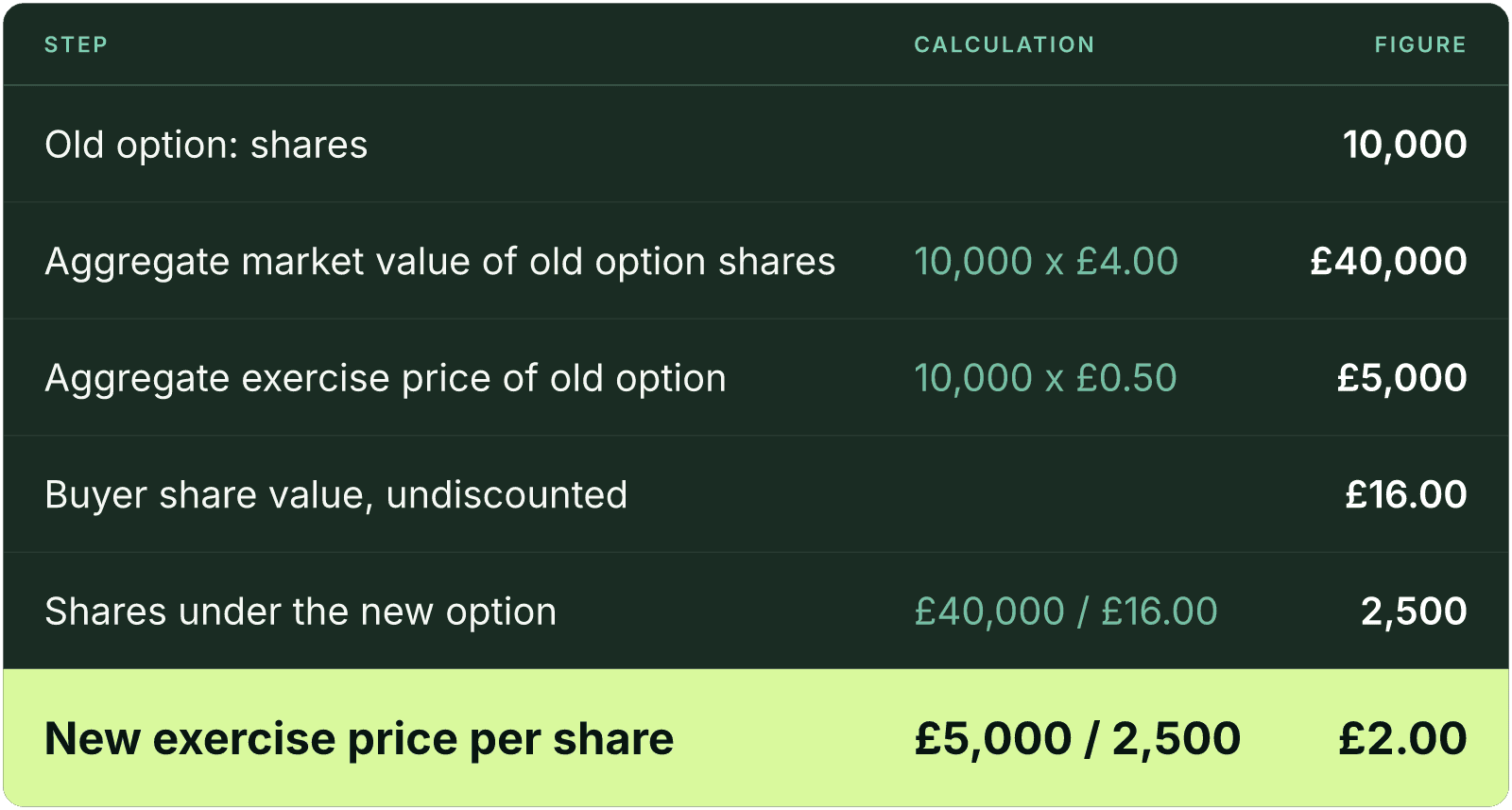
Paragraph 43 contains two equations. The total market value of the shares under the new option, immediately after its grant, must equal the total market value of the shares under the old option immediately before its release. And the total exercise price must stay the same.
HMRC's Shares and Assets Valuation team explains at [SVM110150](https://www.gov.uk/hmrc-internal-manuals/shares-and-assets-valuation-manual/svm110150) that the first equation fixes the number of new shares and the second the new exercise price per share. SAV will nearly always need to be consulted on the aggregate value, agreed exchange terms can normally hold for 21 days, and arranging every exchange on one date avoids repeated referrals.
The comparison is like for like: the buyer's shares are valued on the same undiscounted basis as the target's takeover price, not with a minority discount that would multiply the new shares.
Continuing the illustration, suppose the target's shares are worth £4.00 at the takeover and the buyer's shares are worth £16.00 each on the same undiscounted basis.
[](https://www.409.ai/uploads/emi_options_company_sale_exercise_90_day_window_replacement_option_hmrc_value_table_2_39b3e1c025.png)
The holder keeps the same £35,000 of value in the option, now over 2,500 buyer shares at £2.00. If the buyer's shares had been valued with a 75% minority discount at £4.00, the same formula would have produced 10,000 new shares at £0.50: shares worth £160,000 on the undiscounted basis, four times the £40,000 the old option shares were worth. SAV's example warns against exactly that, which is why the exchange needs an agreed valuation of both companies.
Why the original grant date carries over
[Paragraph 41](https://www.legislation.gov.uk/ukpga/2003/1/schedule/5/paragraph/41) treats a replacement option as granted on the date of the old option. That keeps the 10 or 15 year exercise period running from the original grant, and CG64052 confirms that the two-year Business Asset Disposal Relief period can include both options. A holder with a 20-month-old option whose rights roll into the buyer's options does not restart the clock; four months later, the two years are complete.
Other schemes in the same deal
The routes differ by scheme. A CSOP has a three-year rule and its own early-exercise conditions, set out in our piece on [CSOP options in a takeover](https://www.409.ai/articles/csop-options-takeover-cash-exercise-rollover-hmrc-agreed-market-value). US option holders fall under Section 424(a), covered in [stock options in an acquisition](https://www.409.ai/articles/stock-options-acquisition-rollover-section-424a-ratio-test), and a US GAAP acquirer splits replacement awards between consideration and later expense, as our [ASC 805 replacement options](https://www.409.ai/articles/replacement-options-acquisition-asc-805-consideration-transferred-postcombination-expense) piece explains.
What to settle before the heads of terms are signed
- **The grant register.** Every grant date, exercise price and HMRC-agreed value, against the expected completion date and the two-year line.
- **The option agreements.** What each says happens on a change of control, and whether exercise can be conditional on completion.
- **The buyer's status.** Independence and trading activities, if a rollover is on the table.
- **The valuations.** For a rollover, the target and the buyer valued on the same basis, sent to SAV in time for the 21-day exchange window.
- **The filing.** Exercises and replacement grants on the annual ERS return.
The 2026 changes, including the higher limits, are in our overview of [EMI share options in 2026](https://www.409.ai/articles/emi-share-options-2026-uk-rules-hmrc-valuation).
The takeaway
In an EMI exit, the tax outcome is decided by dates and values the company already holds: each grant date, the market value agreed at grant and, in a rollover, two companies valued on the same day. A cash exit needs exercise before the 90-day window closes; a share-for-share deal needs a buyer that qualifies and an exchange HMRC agrees is value for value. Both cost less to settle before signing than after completion.
409.AI prepares [EMI valuations](https://www.409.ai/products/emi-valuation) with the unrestricted and actual market values HMRC asks for on form VAL231, and the same expert review applies to the valuation a rollover needs.