Financial Reporting
What Is an IFRS 2 Valuation? The Report Your Auditor Wants
An IFRS 2 valuation sets the grant-date fair value of your options for your auditor. Here is what it covers, when a CFO needs it, and what it costs you.
By 409.AI Team - 2026-11-06
# What Is an IFRS 2 Valuation? The Report Your Auditor Wants
If your company reports under IFRS and grants options or shares to employees, your auditor will eventually ask a plain question: what was each award worth on the day you granted it? An IFRS 2 valuation is the written answer. It is the report that fixes the grant-date fair value of your awards, so your finance team can book the expense and your auditor can test it.
This primer is for the CFO or financial controller at a company outside US GAAP: a UK or EU scale-up, a Canadian or Australian company, a Brazilian group, or the IFRS-reporting subsidiary of a US parent. You may have heard "409A" for years and now hear "IFRS 2" from an auditor. They are related, and they are not the same document.
What IFRS 2 asks you to do
IFRS 2 *Share-based Payment* is the IASB standard that tells a company how to account for paying people in equity. The rule is simple. When you grant employees equity instruments, you recognise an expense for the services you receive, and you measure it by the fair value of the instruments at the grant date. The [IFRS Foundation's page for the standard](https://www.ifrs.org/issued-standards/list-of-standards/ifrs-2-share-based-payment/) sets out the full text.
Three words in that sentence do the work.
Grant date. Fair value is fixed on the date you and the employee share an understanding of the award's terms and any needed approval is in place. For an equity-settled award, you don't remeasure it afterwards, whatever happens to your share price.
Fair value. IFRS 2 defines it as the amount at which an equity instrument could be exchanged between knowledgeable, willing parties in an arm's length transaction. Where no market price exists, which is the case for every private company, you use a valuation technique. For options, that usually means an option pricing model such as Black-Scholes or a binomial lattice.
Equity instruments. The measurement above applies to equity-settled awards: options, restricted shares, and similar. Cash-settled awards such as phantom shares or SARs are a liability, remeasured at every reporting date until they settle. Check which kind of award you have before you order a valuation, because the work differs.
Why a private company needs a separate report
A listed company reads its share price off the screen. You can't. Before anyone prices an option, someone has to establish what a share of your company was worth on the grant date, with your preferred stock, your last round, your cash position and your outlook all in the picture.
That is the same hard problem a [409A valuation](https://www.409.ai/articles/what-is-a-409a-valuation-a-comprehensive-guide) solves for a US option strike price, and the same methods apply: the market approach, the income approach and an allocation of value across share classes. If you want to see how those methods work, our posts on the [market approach](https://www.409.ai/articles/market-approach-409a-valuation) and the [income approach](https://www.409.ai/articles/income-approach-409a-valuation) cover them.
The two reports answer different questions, though. A 409A is built to defend a strike price against IRS section 409A. An IFRS 2 report is built to support an accounting number. Two details show the gap:
- IFRS 2 has its own definition of fair value. The standard that governs fair value elsewhere in IFRS, IFRS 13, excludes share-based payment transactions that fall under IFRS 2 from its scope.
- IFRS 2 asks for the fair value of the **option**, not only of the share. Strike price, expected term, volatility, dividends and the risk-free rate all enter the model.
A UK company that already has an HMRC-agreed value for EMI options has a tax number, not an accounting number. The two can differ, because they answer to different rules. The [EMI valuation primer](https://www.409.ai/articles/what-is-an-emi-valuation-umv-amv-hmrc-val231-agreed-before-grant) explains the tax side.
When the need arrives
Most finance teams meet IFRS 2 at one of four moments:
1. The first IFRS audit. The statutory accounts include a share-based payment charge, and the auditor wants the grant-date support for each grant. 2. A group reporting package. A US parent consolidates an IFRS or local-GAAP subsidiary, and the subsidiary's employees hold parent equity. 3. A conversion to IFRS ahead of a listing, a sale, or a lender's covenant. 4. A large or unusual grant: a new plan, a founder grant, an award with a performance target tied to an exit or to a revenue milestone.
In each case the question is the same, and so is the reader. The auditor tests management's estimate, so the estimate needs a documented method behind it.
What the report contains
A good IFRS 2 report is a short file an auditor can follow without calling you. It holds:
- **The share value on the grant date**, with the approaches used and the weight given to each.
- **The option model and its inputs**: the exercise price, the expected term, expected volatility, the expected dividend yield and the risk-free rate. Appendix B of IFRS 2 discusses each. For an unlisted company, the standard points toward the historical volatility of comparable listed entities, since you have no trading history of your own.
- **The treatment of vesting conditions.** Service conditions and non-market performance conditions don't change the grant-date fair value: they change how many awards you expect to vest. Market conditions, such as a target share price, are built into the fair value itself.
- **The fair value per award and in total**, ready for the journal entry.
The valuation covers fair value. Your finance team still owns the vesting estimate and the attrition estimate, and your auditor will test both.
A worked example: where the expense lands
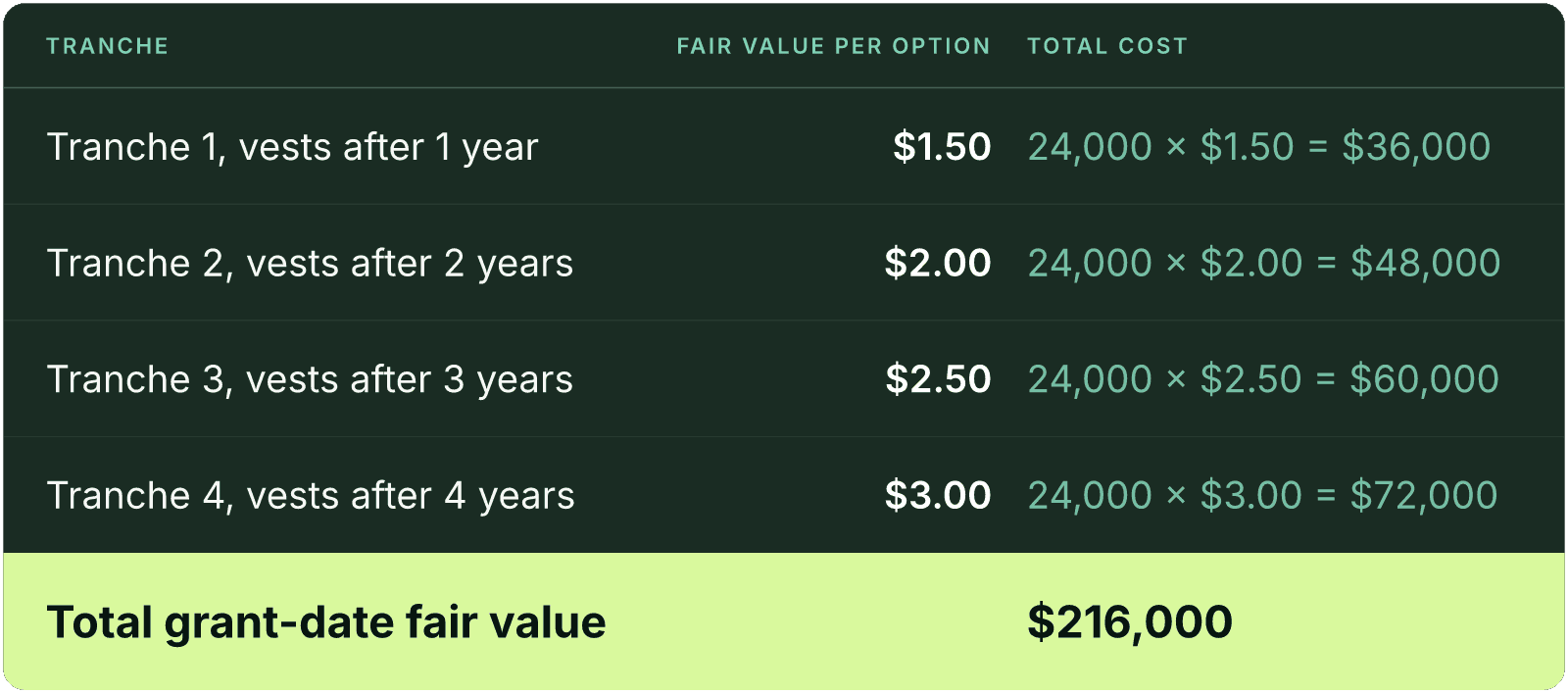
IFRS 2 treats each vesting tranche of a graded award as a separate award. Take 96,000 options granted at the start of Year 1, vesting in four equal annual tranches of 24,000. Each tranche has its own expected term, so each has its own fair value. These numbers are illustrative, not from a client:
[](https://www.409.ai/uploads/what_is_an_ifrs_2_valuation_grant_date_fair_value_report_auditor_wants_table_1_ccbb57264e.png)
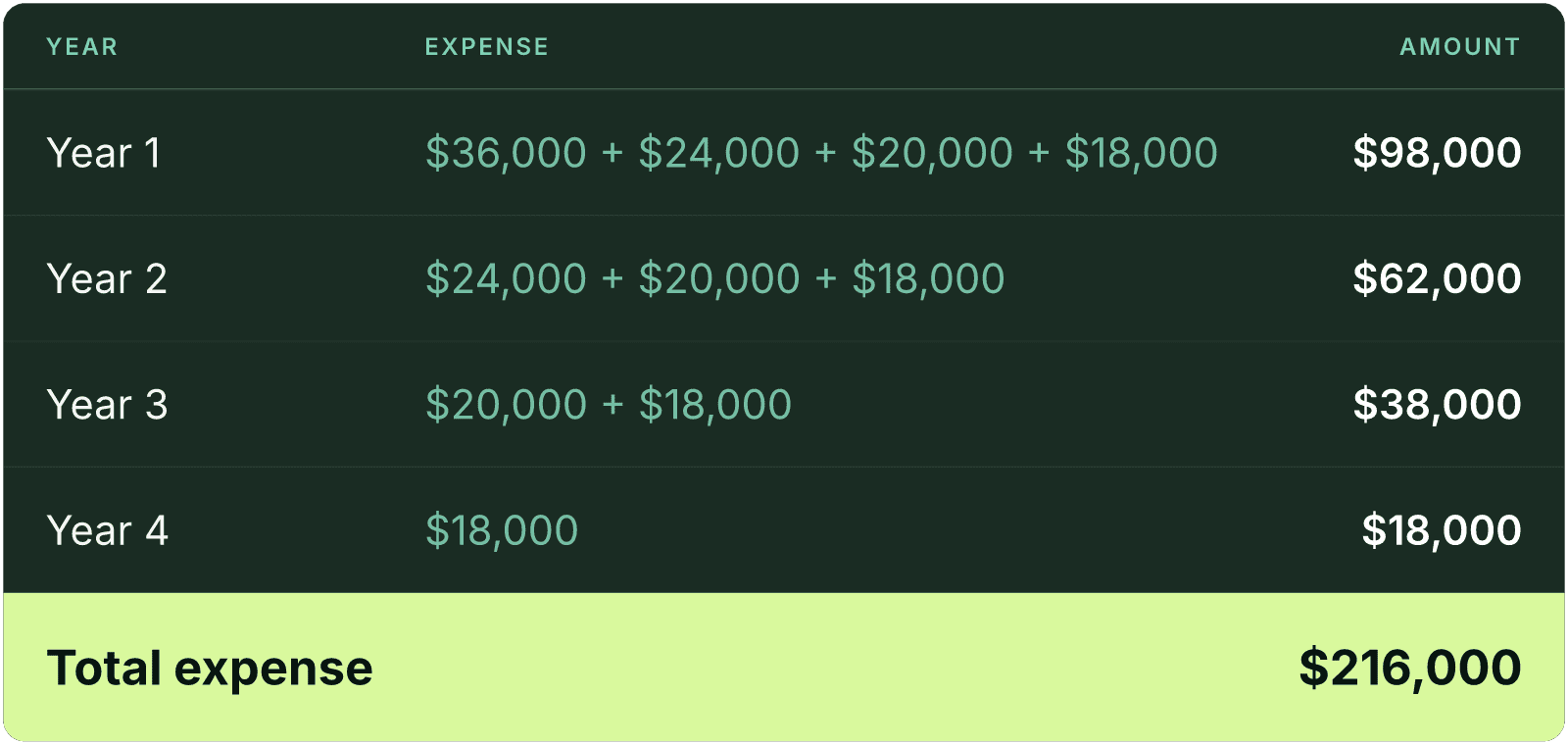
Longer tranches carry a higher fair value because a longer expected term gives an option more time to gain value. Each tranche is then expensed over its own vesting period, so the early years carry more of the cost:
[](https://www.409.ai/uploads/what_is_an_ifrs_2_valuation_grant_date_fair_value_report_auditor_wants_table_2_6ead95debf.png)
The total is fixed on day one. The pattern is front-loaded: $98,000 in Year 1, against $54,000 a year if the same award were spread on a straight line. US GAAP allows a company with service-only vesting to elect straight-line attribution, and IFRS 2 doesn't, so a company moving between the two frameworks sees this difference first. The detail of each difference is in our post on [IFRS 2 versus ASC 718](https://www.409.ai/articles/ifrs-2-vs-asc-718-share-based-payment).
In practice the expense is also adjusted for the awards you expect to be forfeited, and trued up to the number that actually vest. That is your estimate, not the valuer's.
What it costs and how long it takes
At 409.AI an IFRS 2 valuation starts at $1,499, as the [IFRS 2 product page](https://www.409.ai/products/ifrs-2) shows. We deliver a draft in 24 hours, and a signed report in 5 business days as standard, or 1 business day with express delivery. A valuation expert reviews every report. Complex structures, such as several share classes or performance conditions, can change the scope, so tell us about them up front.
If you already hold a current 409A and your grants are plain service-vesting options, ask whether your auditor will accept it as the starting point for the share value. The [ASU 2021-07 checklist](https://www.409.ai/articles/asu-2021-07-409a-asc-718-current-price-checklist) walks through that question for US GAAP, and the same thinking about currency and consistency applies. Your auditor decides, not the valuer.
Questions finance teams ask
Do we need an IFRS 2 valuation if we're private? If you report under IFRS and grant equity, you need a grant-date fair value for each grant. A private company has no market price, so someone has to produce it. A valuation report is the usual support.
Is an IFRS 2 valuation the same as a 409A? No. The share value work overlaps, but a 409A supports a US tax strike price and an IFRS 2 report supports an accounting expense at the fair value of the option.
Do we value every grant separately? The measurement date is each grant date. Grants made close together, on the same terms, often share one valuation. The auditor looks for a share value that still holds on the date used.
What if we change the terms later? A modification can add expense if it increases the fair value of the award or otherwise benefits the employee. Talk to your valuer and your auditor before you reprice.
Does the report cover the payroll tax on exercise? No. It values the award. How an employer's tax on the award is accounted for is a separate question for your auditor.
The takeaway
Ask for the valuation before the grant board meeting, not after the audit starts. The grant-date fair value can only be built from information that existed on the grant date, and the cleanest report is the one written while that information is still fresh. If your first IFRS year-end is close, [start with the product page](https://www.409.ai/products/ifrs-2) and send us your plan terms and your latest cap table.