Education
Divorce Double Dipping: Business Value, Alimony and the Same Earnings
For business owners in a divorce and their attorneys: why Connecticut lets one stream of earnings set business value and alimony, and what owner pay decides.
By 409.AI Team - 2026-11-24
# Divorce Double Dipping: Business Value, Alimony and the Same Earnings
If you own a closely held business and you are divorcing, the same dollars of profit can be counted twice. Once when an appraiser turns the company's earnings into a value that gets split, and again when a judge sets alimony from the income that business pays you. Owners call it double dipping and assume it is forbidden. In Connecticut, the state's highest court said in 2021 that it is not, at least not in the way most owners mean it.
This piece is for the owner of a professional-services or family business going through a divorce, and for the family law attorney or CPA who orders the business valuation. It walks through what the Connecticut Supreme Court decided in Oudheusden v. Oudheusden, why the court saw no double count, and the one valuation choice that decides how much of your income ends up in both columns. How your own state treats the question is for your attorney. What the appraiser does with your pay is something you can understand before the report is written.
What happened in Oudheusden
The facts are in the court's opinion, Oudheusden v. Oudheusden, 338 Conn. 761 (2021), released April 27, 2021.
The husband owned two closely held businesses, a computer consulting company and a writing services LLC. They were his only source of income. The trial court found his gross annual income was $550,000 and credited the wife's expert, who valued the two businesses at a combined $904,000 ($512,000 and $392,000).
The court then did two things. It let the husband keep 100% of both businesses and ordered him to pay the wife $452,000, half their value. And it awarded her alimony of $18,000 a month, $216,000 a year, for life and nonmodifiable as to duration and amount.
The husband argued he was paying twice for the same thing. The expert had valued the businesses largely from their earnings. The alimony was set from his income, which came from those same earnings. The Appellate Court agreed with him. The Connecticut Supreme Court did not.
Why the court said this was not double counting
The court held that "any rule against double counting does not apply when the distributed asset is the value of a business and the alimony is based on income earned from that business."
The reasoning turns on what each award is for. Property division sorts out who owns what at the end of the marriage. Alimony covers a continuing duty of support. Connecticut has no statute against double counting, the court noted, and its alimony statute, General Statutes 46b-82(a), tells the judge to weigh the "amount and sources of income" of each spouse and the property award itself.
The court also drew a line between this case and the ones where Connecticut does worry about double counting. That concern grew up around pensions, where the asset is literally the future income. If a court hands part of a pension to one spouse in the property split and then counts that same slice as the other spouse's income for alimony, the paying spouse is being asked to pay support from money they no longer have. Here, the husband kept the whole business. He paid a lump sum for half its value, and he still had the income stream to pay alimony from.
To decide the question, the court looked outside Connecticut and adopted the view of courts in New Jersey (Steneken v. Steneken, 2005), New York (Keane v. Keane, 2006) and Wisconsin (McReath v. McReath, 2011). It quoted the New York court's point that any valuation of an income-producing property "will necessarily take into account" its capacity to produce income, so a ban on counting that income twice would hollow out a judge's discretion. The court treated the income approach as one tool for finding fair market value, alongside the market and asset approaches. It added in a footnote that a value from the market approach does not raise the issue at all, because it is not built from the owner's income.
The husband did not walk away with the original order, though. The court agreed with the Appellate Court that lifetime, nonmodifiable alimony was an abuse of discretion. He was 58, the Appellate Court had pointed to a history of alcohol abuse, and the trial court had not weighed his age, health and future earning capacity. Nothing in the record supported the idea that he would earn the same $550,000 for the rest of his life. The case went back for a new hearing on all the financial orders.
Where the overlap actually comes from
The phrase "double dipping" hides a useful detail. Not all of your income is in the business value. Only the part above a fair wage for the work you do is.
When an appraiser values an owner-run company with an income approach, the first step is normalizing owner compensation. Whatever you actually take out, the appraiser replaces it with what the business would have to pay someone else to do your job, and treats the remainder as profit that belongs to the business. We go through that adjustment in owner pay in a small business valuation. The remaining profit is what gets capitalized into a value.
The Oudheusden expert did exactly that. His capitalization of income method subtracted cash flows paid to or for the benefit of the husband and accounted for reasonable compensation for the part-time services he provided. On the alimony side, a footnote in the opinion explains that the income finding appears to have come from the same expert's report: the husband's actual compensation, between $323,369 and $394,319, plus the earnings left in the businesses at year end, for a total of about $540,000.
So the market wage for the owner's job sat only on the income side. The earnings above that wage sat on both. That is where the overlap lives, and the reasonable compensation figure decides how big it is.
A worked example
Take a family-owned engineering firm whose owner takes $500,000 a year out of the business in salary and distributions. Suppose the appraiser capitalizes the earnings left after a market salary at a multiple of 3. The figures are illustrative and simplified: a real report works from several years of normalized earnings, pretax or after-tax consistently, and a capitalization rate built from risk and growth, which we explain in capitalization rate vs. discount rate.
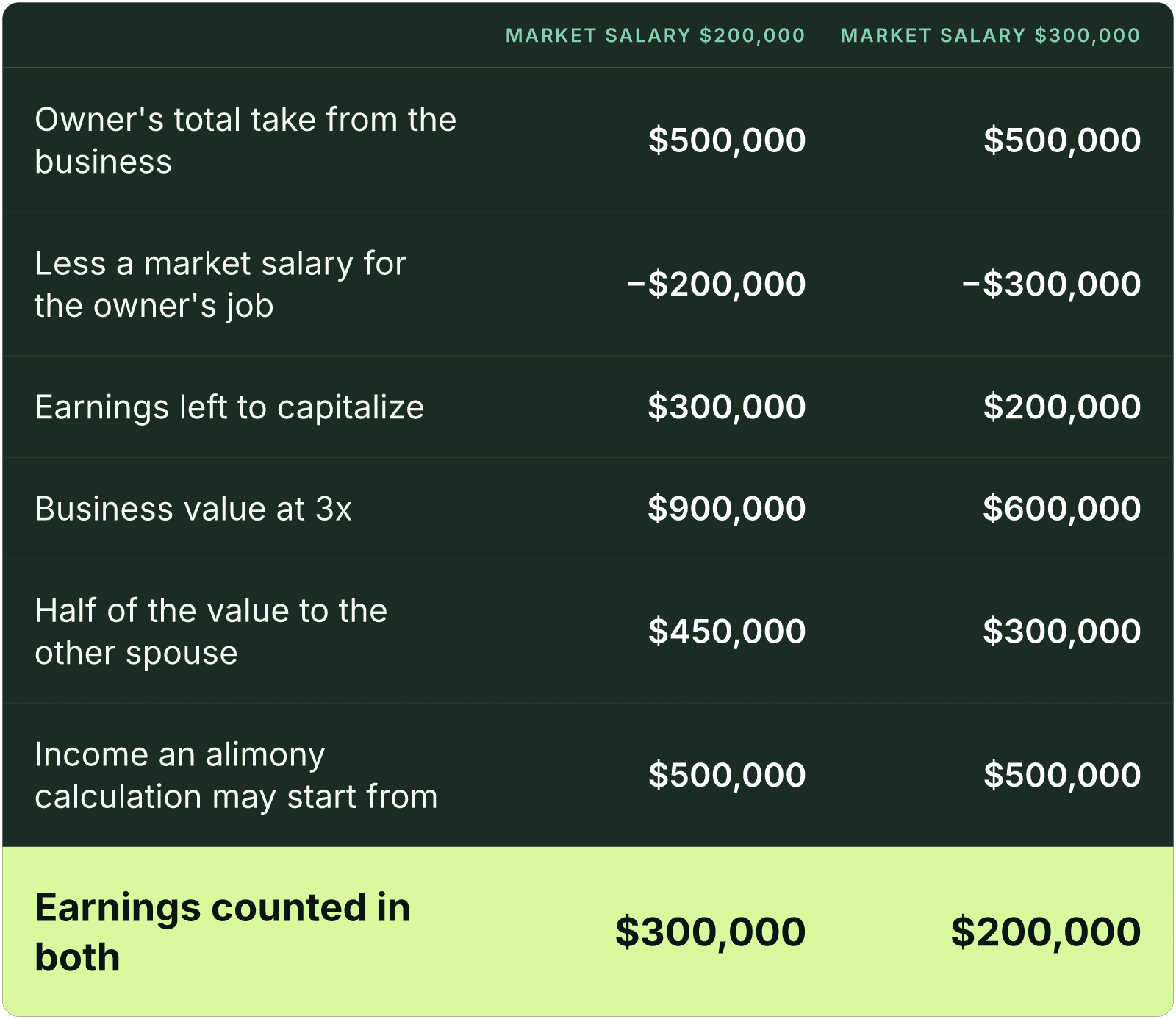

Moving the market salary from $200,000 to $300,000 cuts the business value by $300,000 and the property payment by $150,000. It does not change the $500,000 the owner actually earns, which is what a court may look at for support. The overlap shrinks by $100,000 a year.
That is why the reasonable compensation number deserves more attention than it usually gets. A low market salary makes the business look more valuable and puts more of the same earnings into both awards. A well-supported market salary, drawn from what it would cost to hire someone with the owner's role, hours and credentials, keeps the value honest.
Goodwill and earning capacity
There is a second route to a double count, and the court left it open. An older Connecticut decision, Eslami v. Eslami (1991), warned in passing that a valuation which does not separate the practice's saleable goodwill from the practitioner's own earning power "may well result" in counting the same thing twice: once as an asset and again as earning capacity for alimony.
The Oudheusden court found that warning did not apply because the trial court had based alimony on actual income, not on a finding of earning capacity. A case where alimony rests on what the owner could earn, and the business value includes goodwill that is really the owner's personal skill and relationships, may look different. The split between personal and enterprise goodwill, and how appraisers support it, is in our guide to business valuation in divorce. Related questions, such as how much of the value depends on one person, come up in the key person discount.
What a fair result still requires
Rejecting a double-counting rule did not leave judges free to pile on. The court said trial courts must still weigh every statutory factor and make sure the property award and the alimony are "as a whole" fair and equitable. It named one check in particular: making sure the payment for the other spouse's share of the business value does not unfairly reduce the owner's ability to earn income from it, for example by leaving the business undercapitalized.
That matters to an owner who has to fund a $452,000 lump sum. If the cash comes out of the company's working capital, or the business borrows to pay it, the income that alimony assumes may not be there. A judge who hears that evidence can weigh it. A judge who does not hear it cannot.
The rule also differs by asset. The court noted that New Jersey's statute bars counting income from a share of a retirement benefit for alimony once that share has been treated as an asset for equitable distribution, a rule written for retirement benefits, not businesses. Connecticut itself has said it would likely forbid counting, as a source of alimony, a slice of a pension already assigned to the other spouse. Other states have their own case law. The state, the asset and the way alimony is set (actual income or earning capacity) all change the answer.
What to bring the appraiser
The documents that let an appraiser support the compensation adjustment are the same ones your attorney will need to argue the overlap:
- Three to five years of business returns and financial statements, and which years the appraiser weights. Our piece on which years of earnings an appraiser uses explains the choice.
- A full record of what the owner takes out: salary, bonuses, distributions, retained earnings, and personal expenses run through the company.
- A description of the owner's actual role and hours, so the market salary fits the job and not a title.
- Salary data for that role in your region, and what it would cost to replace the owner.
- Any plan to fund a property payment from the business, and what it would do to working capital.
The appraiser should also show which approaches were used and how they were weighted. In Oudheusden the expert weighted the excess earnings and capitalization of income methods at 40% each and the market approach at 20%. The excess earnings method works from the same normalized earnings, so its result moves with the salary assumption too.
The takeaway
The double count most owners fear is allowed in Connecticut: the business value and your alimony can both rest on the same earnings. What you can influence is the size of the overlap, and that is set by one line in the appraisal, the market salary for your job. Get that number documented and defensible before the report is final, and make sure your attorney knows how much of your income it leaves in the value.
If you need an appraisal of a closely held business for a divorce, with the compensation adjustment shown and supported, see 409.AI small business valuation.
About the author
409.AI Team
Startup valuation and equity workflow specialists
The 409.AI team writes practical valuation content for founders and finance teams preparing 409A reports, equity documentation, and related startup finance workflows.
Related valuation reports
- 409A valuation report: 409.AI helps private companies prepare expert-reviewed 409A valuation reports for equity compensation and option strike price support.
- Pricing for every report type
- 409A valuation calculator
- Sample 409A report