Education
Business Valuation in Divorce: Personal vs. Enterprise Goodwill
Owning a small business in a divorce? See how appraisers split personal from enterprise goodwill, why it moves the number, and what to gather before they start.
By 409.AI Team - 2026-10-18
# Business Valuation in Divorce: Personal vs. Enterprise Goodwill
If you own a small business and your marriage is ending, the number an appraiser puts on the company can decide how much of it you keep. The same is true if you are the spouse who does not run it. Most of the fight is rarely about the equipment or the cash. It is about goodwill, and about whose goodwill it is.
This guide is for business owners, and for the CPAs and family law attorneys beside them. It explains what a divorce appraisal has to settle, why goodwill is the hinge, and what to gather before the appraiser starts. It does not tell you how your state will rule. That is a question for your attorney.
What the appraiser is actually asked to decide
A divorce valuation answers three questions before it produces a number.
Which standard of value? Fair market value is the price at which a business would change hands between a willing buyer and a willing seller, neither under pressure and both with reasonable knowledge of the facts. Some states use a different standard, often called fair value, for certain disputes. The AICPA's valuation standard tells its members to settle the standard of value and the premise of value (for example, a going concern) when they scope the engagement, which is why your attorney needs to name the standard first. The [AICPA Statement on Standards for Valuation Services, VS Section 100](https://www.aicpa-cima.com/resources/article/statement-on-standards-for-valuation-services-vs-section-100), is where that scoping duty lives. We cover the difference in [fair market value vs. fair value in a partner buyout](https://www.409.ai/articles/partner-buyout-fair-market-value-vs-fair-value-small-business-standard-of-value).
Which date? Courts differ on whether the business is valued at the date of filing, the date of separation or the date of trial. Florida, for one, leaves it to the judge: its statute says the date for valuing marital assets is the date or dates the judge finds just and equitable ([Fla. Stat. 61.075(7)](http://www.leg.state.fl.us/statutes/index.cfm?App_mode=Display_Statute&URL=0000-0099/0061/Sections/0061.075.html)). A business that grew 30% between filing and trial makes the date worth real money.
What counts as marital property? This is where goodwill comes in.
Goodwill is the part that moves
Take a business apart on paper and you find three layers. Tangible assets such as cash, equipment and inventory. Identifiable intangibles such as contracts and a customer list. And the leftover value, goodwill, which is whatever the business earns above a fair return on everything else.
Appraisers and courts split goodwill into two kinds:
- **Enterprise goodwill** belongs to the business itself: its location, brand, systems, trained staff and customer relationships that would stay if the owner left.
- **Personal goodwill** belongs to a person: their skills, reputation and relationships. It leaves when they leave.
Some states treat both kinds as marital property. Others divide only enterprise goodwill and leave personal goodwill with the owner. Florida wrote its rule into [Fla. Stat. 61.075(6)](http://www.leg.state.fl.us/statutes/index.cfm?App_mode=Display_Statute&URL=0000-0099/0061/Sections/0061.075.html) in 2024: goodwill that is separate and distinct from the continued presence and reputation of the owner spouse is enterprise goodwill, a marital asset the court must value, and the court has to consider evidence of a covenant not to compete, though that evidence alone does not rule out enterprise goodwill. For the rule in your state, ask your attorney. It changes by state and has been changing.
A worked example
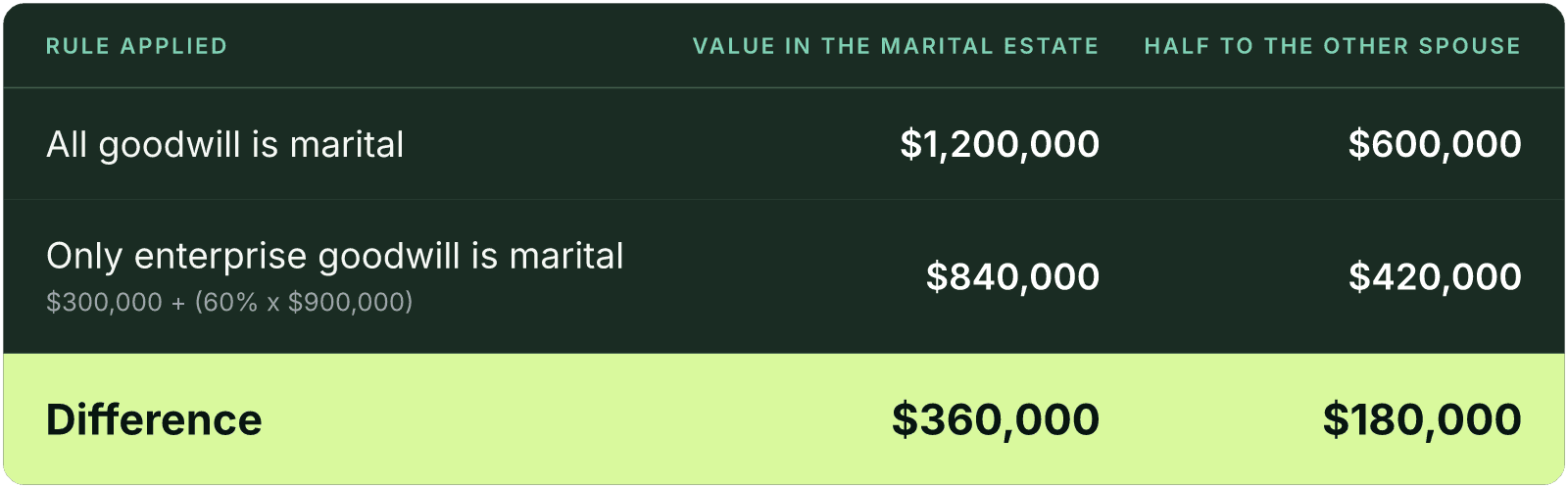
Suppose a plumbing contractor is appraised at $1,200,000 as a whole. Net tangible assets are $300,000, so goodwill is $900,000. The appraiser concludes that 60% of the goodwill is enterprise (the dispatch system, the crew, the repeat commercial accounts) and 40% is personal to the owner. The numbers are illustrative.
[](https://www.409.ai/uploads/divorce_business_valuation_personal_vs_enterprise_goodwill_small_business_table_1_ae6e619173.png)
The difference is the entire argument. The owner will want the personal share to be large. The other spouse will want it small. An appraiser who cannot show how the split was reached gives the judge no reason to prefer either side.
How appraisers separate the two
There is no single method, and a good report explains the one it chose. Three show up often.
Bottom-up. Value the tangible assets and identifiable intangibles, and call the remainder goodwill. This does not divide goodwill by itself, so it usually needs a second step.
Top-down attribute weighting. Start from the total value, subtract net tangible assets, then score and weight the features that make up the goodwill: who holds the customer relationships, how documented the processes are, how much the brand matters without the owner. It is inexpensive, but the weights are judgments, and two appraisers can land apart.
With and without. Value the business twice, once with the owner staying and once with the owner leaving and competing. The gap estimates personal goodwill. It needs real data: revenue by customer or referral source, contract terms and a view of which customers would follow the owner.
If you have read our piece on [the excess earnings method](https://www.409.ai/articles/revenue-ruling-68-609-excess-earnings-method-small-business-goodwill), you will recognize the logic. Goodwill is the earnings left over after a fair return on the tangible assets, and the question is how much of those earnings depend on the person.
Owner pay decides the earnings
Before any goodwill split, the appraiser has to know what the business earns. For an owner-operated company, that means adjusting what the owner takes out to a market wage for the job, and adding back personal expenses run through the company. We walk through that in [owner compensation and add-backs in small business valuation](https://www.409.ai/articles/owner-compensation-add-backs-small-business-valuation-sde-ebitda).
In a divorce this step is also contested. An owner who sets pay low to keep income away from support calculations is also raising the business's apparent profit and its value. An owner who sets pay high lowers both. The appraiser will test the number against what a replacement manager would cost, so expect the question and have an answer.
The same earnings can also show up twice, once as income for support and again as the basis for the business value. Lawyers sometimes call this double dipping. Whether your state limits it is a legal question, but your appraiser and your attorney should discuss it before the report is final, not after.
Discounts can matter, but not everywhere
Where the standard of value is fair market value, an appraiser may consider discounts for lack of control or lack of marketability when the interest being valued is a minority stake. Where a state uses fair value, discounts may be limited or excluded. Whether a divorce court allows them is state law, so ask. Our overview of the [discount for lack of control](https://www.409.ai/articles/discount-lack-of-control-dloc-409a-gift-tax-valuation) explains what the discount represents.
The tax angle is separate
How a court labels goodwill in a divorce does not decide how the IRS sees it. The tax treatment of personal goodwill in a business sale has its own case law, which we cover in [personal goodwill in a C corporation asset sale](https://www.409.ai/articles/personal-goodwill-c-corp-asset-sale-martin-ice-cream-tax-court). Talk to your CPA before assuming that a number in a settlement carries the same tax result.
What to gather before the appraiser starts
A faster, cheaper valuation starts with the documents. Ask your CPA to pull:
- Three to five years of business tax returns and financial statements, plus year-to-date numbers.
- Owner pay history, including bonuses, benefits, vehicles and personal expenses paid by the company.
- Customer data: revenue by customer for the last three years and the top ten accounts.
- Contracts, leases, loan agreements and any buy-sell agreement.
- Whether the owner has signed a non-compete, and any employees with their own client relationships.
- A list of assets and any equipment appraisals.
The appraiser should also know [Revenue Ruling 59-60](https://www.irs.gov/pub/irs-drop/rr-59-60.pdf), the IRS framework for valuing closely held stock. Valuation professionals commonly use its eight factors as a checklist for any private business, not only in tax cases. See our walk-through of [Revenue Ruling 59-60 and its eight factors](https://www.409.ai/articles/revenue-ruling-59-60-small-business-valuation-eight-factors).
The takeaway
Ask one question early: who would the customers follow if the owner left tomorrow? Document the answer with data before the appraiser asks. An owner who can show customers are tied to staff, systems and contracts has a stronger enterprise goodwill case, and an owner who can show they are tied to one person has a stronger personal goodwill case. Either way, the side with the cleaner records and a clear method is the side the judge can follow.
If you need a defensible appraisal of a small business for a divorce, a buyout or a sale, see [409.AI small business valuation](https://www.409.ai/products/smb-valuation).