Education
Which Years of Earnings Does a Small Business Appraiser Use?
Owners facing a loan, buyout or sale: how an appraiser picks and weights five years of earnings, with with a worked example of a $135,000 swing in value.
By 409.AI Team - 2026-10-26
# Which Years of Earnings Does a Small Business Appraiser Use?
If you own a small company and an appraiser asks for five years of financials, you may wonder why. Your business sells on what it earns, and what it earns is the most recent number you know. So why does an older year matter, and why does it change the price?
The answer is that an appraiser is not valuing the past. They are estimating what a buyer can expect to earn from now on, and the history is the evidence for that estimate. How the years are combined can move the value by six figures on a business of ordinary size. This article walks through the choices, with one worked example, so you know what question to put to the person preparing your appraisal for an SBA or bank loan, a buyout, a buy-sell trigger or a sale.
What the IRS guidance actually says about the years
The most cited document on the subject is Revenue Ruling 59-60 (1959-1 C.B. 237), whose text the IRS reproduces in an appendix to its [S corporation valuation job aid](https://www.irs.gov/pub/irs-lbi/S%20Corporation%20Valuation%20Job%20Aid%20for%20IRS%20Valuation%20Professionals.pdf). It sets out the IRS's long-standing approach to valuing closely held stock. It was written for estate and gift tax, and appraisers use it as a reference well beyond that. Two parts matter here.
First, Section 4.02(d) asks for detailed profit-and-loss statements "for a representative period immediately prior to the required date of appraisal, preferably five or more years." With statements of that quality, the ruling says, the appraiser "should be able to separate recurrent from nonrecurring items of income and expense."
Second, the same section warns about how the years are used: "Prior earnings records usually are the most reliable guide as to the future expectancy, but resort to arbitrary five-or-ten-year averages without regard to current trends or future prospects will not produce a realistic valuation." And it gives the way out: "If, for instance, a record of progressively increasing or decreasing net income is found, then greater weight may be accorded the most recent years' profits in estimating earning power."
Read together, those lines say three things. Collect many years. Clean each year before you use it. Do not average blindly when the trend is clear. Section 6 of the ruling adds that the earnings you capitalize may be "the average or current results", which leaves the choice to judgment, not to a formula.
Step one: clean each year before you combine them
Averaging dirty numbers just spreads the dirt. Before any year is compared with another, it is restated on the same basis. For a small company that usually means:
- Owner pay is replaced with a market wage, so the owner's good year and lean year compare fairly. The full method is in [how owner compensation and add-backs change SDE and EBITDA](https://www.409.ai/articles/owner-compensation-add-backs-small-business-valuation-sde-ebitda).
- One-time items come out: an insurance payout, a lawsuit settlement, a big repair that will not repeat, a pandemic-era grant.
- Every year uses the same accounting method. A year reported on cash and a year on accrual do not line up, which is the subject of [cash-basis versus accrual earnings](https://www.409.ai/articles/cash-basis-vs-accrual-small-business-valuation-tax-return-earnings).
- Related-party items are set to market, such as rent paid to an owner who holds the building.
Only after that does the question of which years to use become a real question. Often a business that looked erratic turns out to be steady once the oddities are removed, and the debate shrinks.
The four ways to use the years
There is no single rule, and a good appraiser says which one they picked and why. These are the four common choices.
The latest full year. Simple and current. It works when the business is stable and last year was typical. It fails when last year was unusually good or bad.
The simple average. Every year counts the same. It smooths a choppy business, such as a contractor whose big jobs land in lumps. It misleads when earnings are moving in one direction, because it prices the company on years that no longer describe it.
The weighted average. Recent years count for more, for example 5, 4, 3, 2, 1 from newest to oldest. This is the approach the ruling points to for a business with a clear rise or fall.
The trailing twelve months. The latest twelve months through the most recent month-end, built from interim statements. It catches a turn that the last fiscal year has not yet shown.
A worked example: a business in slow decline
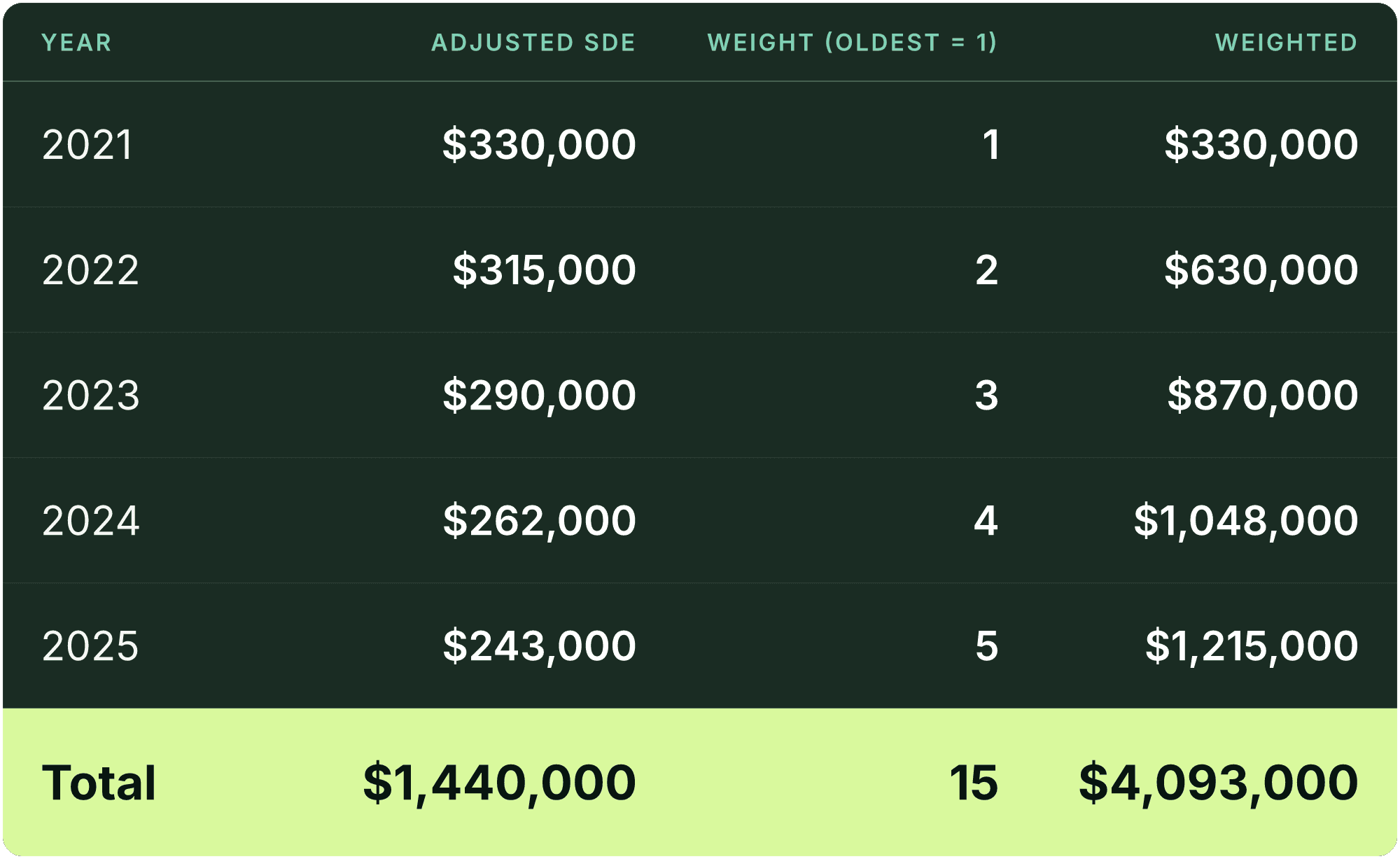
Take a small commercial cleaning company with five years of adjusted seller's discretionary earnings (SDE): the profit left for one working owner after the add-backs above. The numbers are illustrative.
[](https://www.409.ai/uploads/which_years_of_earnings_small_business_appraisal_weighted_average_trend_table_1_ffc0e731e6.png)
The simple average is $1,440,000 divided by 5, or $288,000. The weighted average is $4,093,000 divided by 15, or about $272,867. The latest year is $243,000.
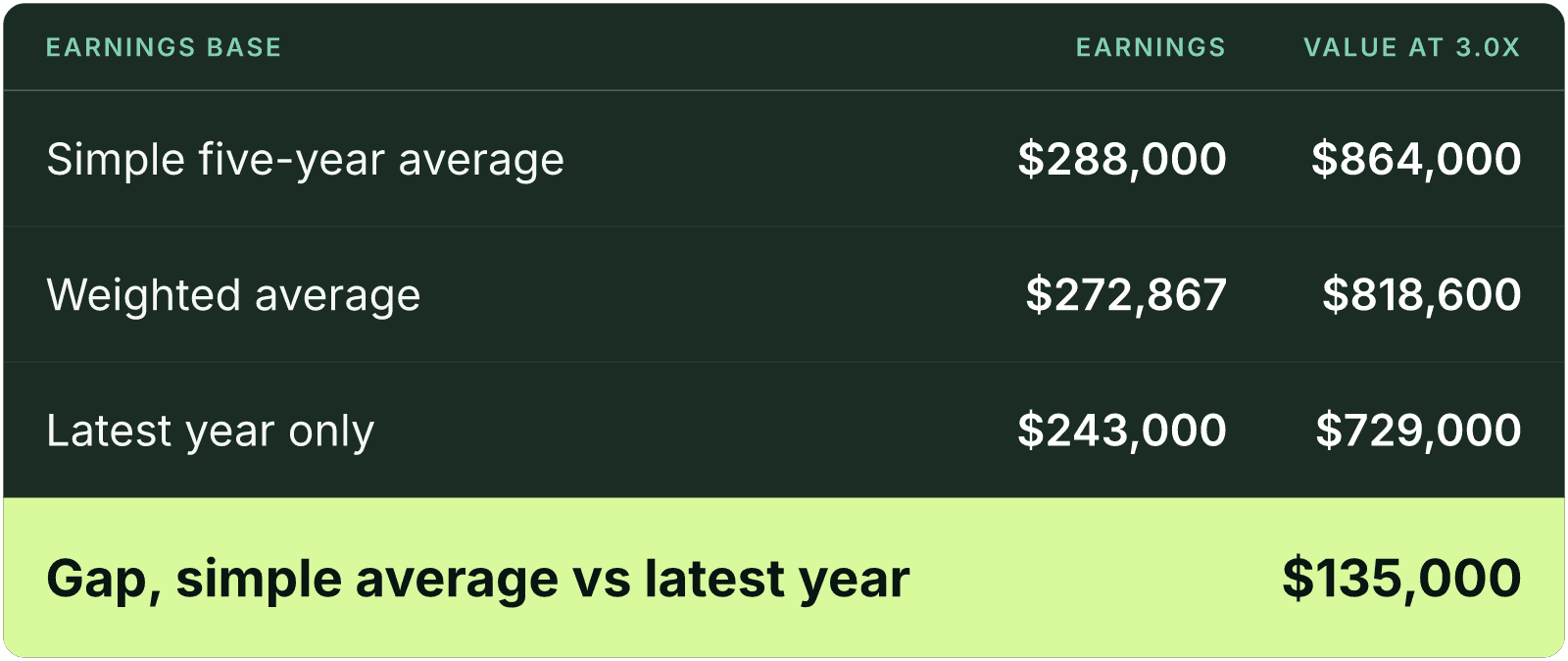
Now apply a multiple. Suppose the market for comparable businesses supports 3.0 times SDE. The choice of earnings base then gives three different answers.
[](https://www.409.ai/uploads/which_years_of_earnings_small_business_appraisal_weighted_average_trend_table_2_90bc9b57ed.png)
Same company, same multiple, a $135,000 spread. A seller who hands over the simple average is asking a buyer to pay for earnings the business stopped making two years ago. A buyer's lender who sees the latest year alone may undervalue a business whose decline has a one-time cause that is now fixed. Neither is automatically right. The appraiser's job is to find out why the line slopes, and then decide how much of that slope a buyer would expect to continue.
The mirror image: a growing business
Flip the picture. If earnings rose every year, the simple average understates the business and the owner pays for it. A weighted average moves closer to the present, and the trailing twelve months may be higher still. Here the owner has more reason to bring interim statements early, because the fiscal year may be nine months old by the time the appraisal is dated.
The ruling's wording is symmetrical for that reason: "increasing or decreasing." The method is a tool for reading the trend, and it does not favor the seller or the buyer.
Why the multiple and the earnings base go together
One mistake shows up often: mixing a multiple and an earnings base that do not belong together. A market multiple of SDE or EBITDA is observed against a particular kind of earnings, often a recent full year or the trailing twelve months of the sold business. Apply it to a five-year average and the result is not a market answer. It is a different measurement, and it has to be argued separately.
The same goes for the income approach. When an appraiser converts earnings to value by dividing by a rate, the earnings should be the ones expected for the coming period, and the rate should match them. [Capitalization rate versus discount rate](https://www.409.ai/articles/capitalization-rate-vs-discount-rate-small-business-valuation-earnings-multiple) explains why the rate for a growing stream is not the rate for a flat one.
When the history needs a story
Some years should not count at all, or not in the usual way. The common cases are a year when the owner was ill, a year when the largest customer left or arrived (see [customer concentration](https://www.409.ai/articles/customer-concentration-small-business-valuation-largest-customer-risk)), a year of a major change in prices or in the lease, and a year that includes an acquisition. For each, the appraiser either adjusts it, drops it with a note, or uses it as a scenario. Writing that reasoning down is what separates an appraisal a lender or a court can follow from a spreadsheet.
If you want the wider frame the appraiser works in, [the eight factors of Revenue Ruling 59-60](https://www.409.ai/articles/revenue-ruling-59-60-small-business-valuation-eight-factors) covers earning capacity next to the other seven.
What to bring, and what to ask
Before the appraisal starts, gather these:
1. Five fiscal years of tax returns and the matching profit-and-loss statements, if they exist. 2. Interim statements through the latest month-end. 3. A list of one-time items and owner expenses for each year, with the invoice or note behind each. 4. A short explanation of any year that does not fit the trend.
Then ask the appraiser three plain questions. Which years are you using and why? Is the trend rising, falling or flat after adjustments? Does the multiple you chose match the earnings base you applied it to? A clear answer to all three tells you the number was built, not guessed.
The takeaway
The years an appraiser picks are an opinion about the future, shown as arithmetic. Clean each year, read the direction, and be wary of any value that rests on a plain average when the numbers are clearly climbing or sliding. If a loan, a buyout or a sale is within twelve months, assemble the five years now, while the one-time items are still fresh in your memory. For an independent, expert-reviewed estimate of your own company, see [409.AI's small-business valuation](https://www.409.ai/products/smb-valuation).