Financial Reporting
Capitalization Rate vs. Discount Rate: Why a Small Business Sells for 3 or 4 Times Earnings
Owners, CPAs and lenders hear a 4x multiple and a 25% required return. See how a discount rate turns into a capitalization rate in a small business example.
By 409.AI Team - 2026-10-24
# Capitalization Rate vs. Discount Rate: Why a Small Business Sells for 3 or 4 Times Earnings
A buyer's lender says the business is worth four times its yearly cash flow. The owner's accountant says a 25% return is the going rate for a company this size. Both statements describe the same value, and almost nobody explains why. The rate people quote and the multiple people use are two faces of one calculation, and mixing them up is how an appraisal ends up 30% off.
This article is for owners of small private companies and the CPAs, attorneys, brokers and lenders who sit beside them. It explains the difference between a discount rate and a capitalization rate, shows how one turns into the other, and walks through a worked example with made-up numbers. It draws no conclusion about any particular loan, buyout, divorce or estate, because those turn on facts only the people involved have.
Two rates, one idea
Every earnings-based valuation answers the same question: how much would a buyer pay today for the money this business will produce? Buyers want a return that pays them for risk. The riskier and smaller the business, the higher that required return.
That required return shows up in two forms.
The discount rate is the return a buyer needs each year on the whole investment, counting growth. It is used when you forecast cash flow year by year and bring each year back to today. If a buyer needs 25% a year, the discount rate is 25%.
The capitalization rate is a shortcut for businesses expected to keep producing steady cash flow. Instead of forecasting ten years, you take one year of expected cash flow and divide it by a single rate. The capitalization rate is lower than the discount rate by the amount the cash flow is expected to grow:
*Capitalization rate = discount rate − expected long-term growth*
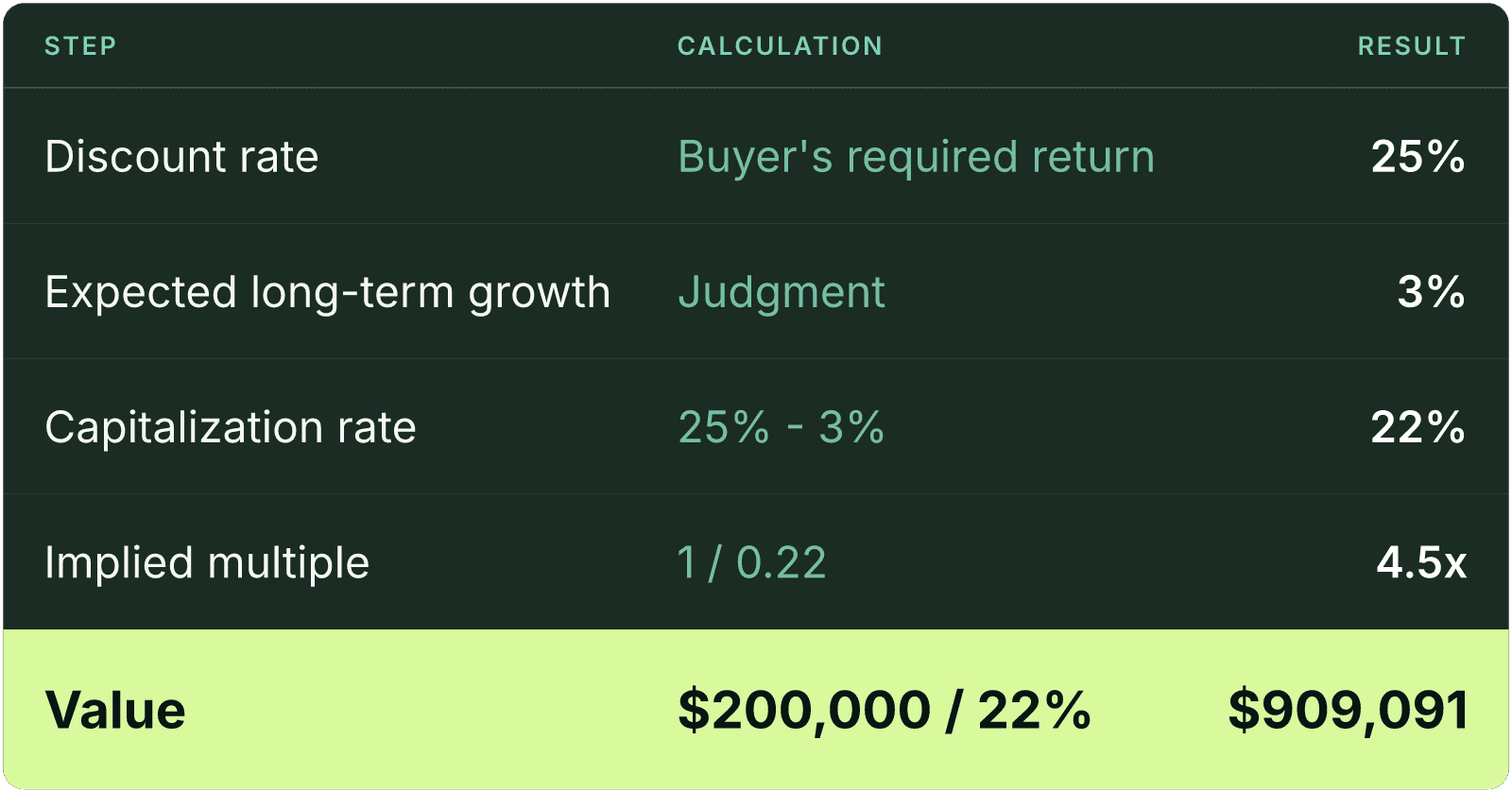
The reason is simple. A buyer who needs 25% a year and expects the cash flow to grow 3% a year does not need all 25% to arrive as cash in the first year. About 3 points of it come later, as a larger cash flow. So the first-year cash flow only has to equal 22% of the price.
The multiple is the same number turned upside down. A 22% capitalization rate is 1 ÷ 0.22, or about 4.5 times next year's expected cash flow.
A worked example
Take a landscaping company. Every number below is illustrative, not market data.
The company is expected to produce $200,000 of cash flow next year, after paying the owner's replacement salary. A buyer decides the business deserves a 25% discount rate and expects long-term growth of 3%.
[](https://www.409.ai/uploads/capitalization_rate_vs_discount_rate_small_business_valuation_earnings_multiple_table_1_0e8efc0d7f.png)
The multiple falls out of the rates. Nobody picks "4.5 times" first and justifies it later, or at least nobody should. When a broker's rule of thumb says landscaping companies sell for three to five times earnings, that range is a compressed version of this same arithmetic, applied to many sales.
What goes into the discount rate
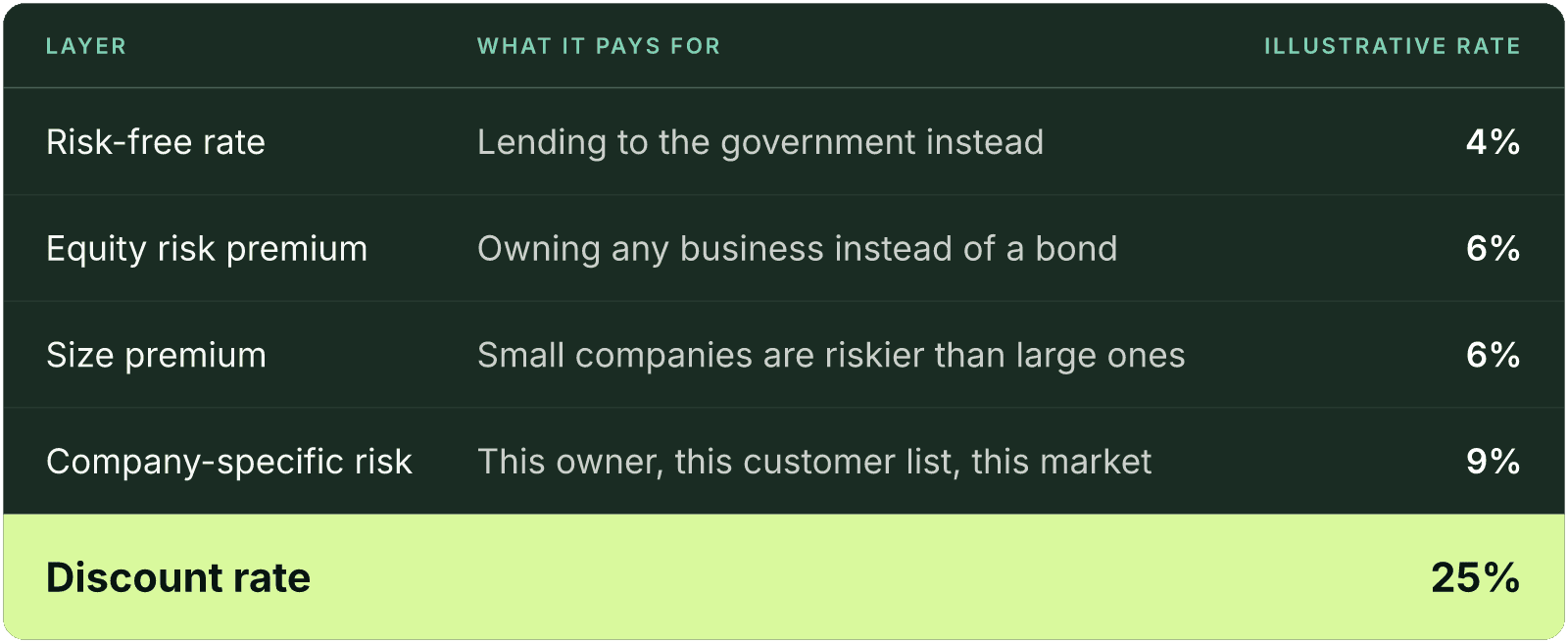
Appraisers usually build the discount rate in layers, a method called the build-up. Each layer pays the buyer for something. Here is an illustrative build-up for the same company.
[](https://www.409.ai/uploads/capitalization_rate_vs_discount_rate_small_business_valuation_earnings_multiple_table_2_e01b73677a.png)
The first two layers come from published market data and move with the economy. The last two are where small businesses differ, and where the argument usually happens. Company-specific risk is a judgment, and it should be tied to facts a buyer can check: one customer is a third of sales, the owner holds every key relationship, the books are on the cash basis, the lease ends in two years. Our articles on [customer concentration](https://www.409.ai/articles/customer-concentration-small-business-valuation-largest-customer-risk) and [owner dependence](https://www.409.ai/articles/key-person-discount-small-business-valuation-owner-dependence) show how those facts are measured. A bare statement that "small businesses are risky" does not support nine points of premium.
The layers above are the textbook structure, not figures to copy. Real build-ups use sourced, dated inputs, and two appraisers can defend different company-specific numbers. That is normal. What is not normal is an appraisal that gives the final rate without saying where it came from.
Why a small change in the rate moves the price so much
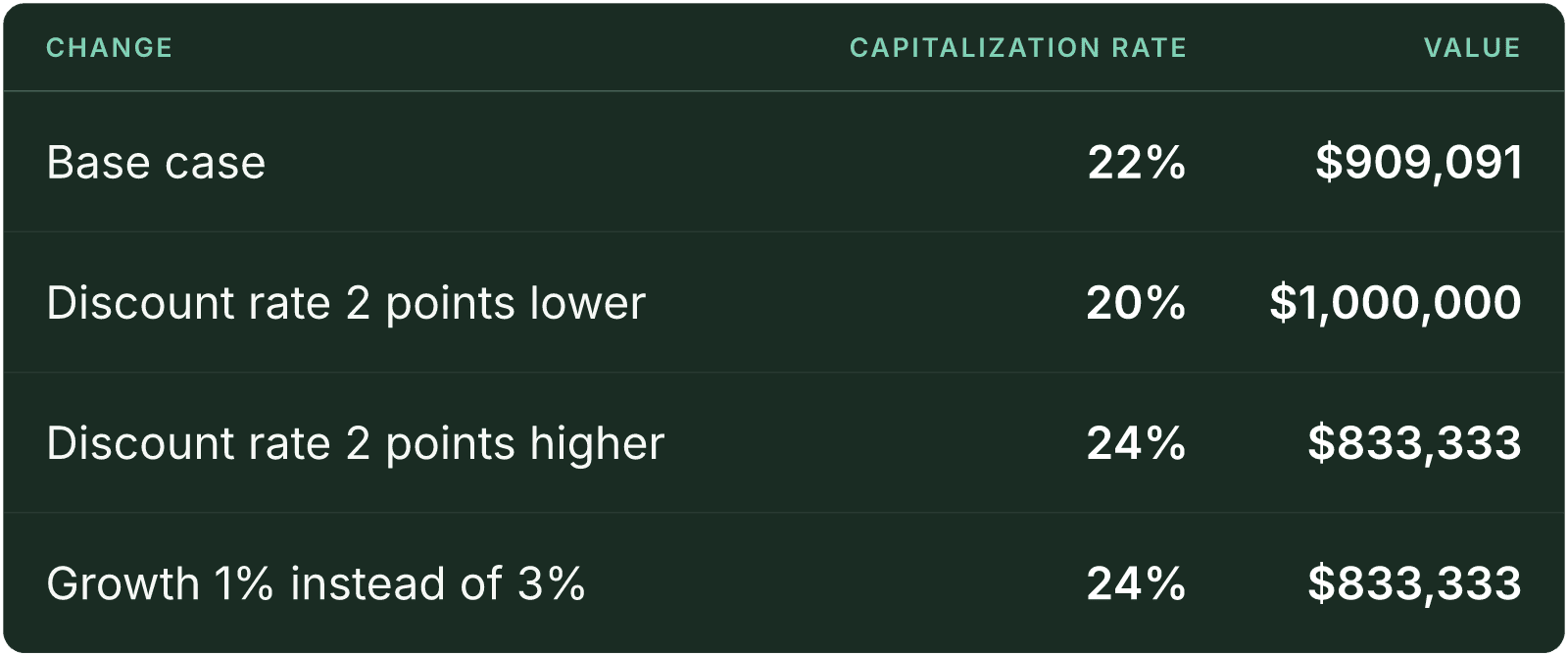
Because the rate sits under the cash flow, a small change in it has a large effect. Using the same $200,000:
[](https://www.409.ai/uploads/capitalization_rate_vs_discount_rate_small_business_valuation_earnings_multiple_table_3_d775749ab4.png)
Two points on the rate moved the value by roughly $76,000 down and $91,000 up, close to 10% either way. That is why the support behind the rate matters as much as the cash flow itself, and why a seller and a buyer can look at the same books and be $165,000 apart without either of them making an arithmetic error.
The last row shows the other lever. A more modest growth assumption lowers the value by exactly as much as a higher required return. When a buyer pushes the price down, check which of the two they are really arguing about.
Match the cash flow to the rate
The most common mistake is feeding the formula the wrong cash flow. A rate built for after-tax cash flow cannot be applied to a pre-tax number, and a rate built for the whole business cannot be applied to what is left after loan payments.
For the owner of an S corporation or LLC, the first question is whether the cash flow has been reduced by an income tax charge, since the business itself pays none. That choice, called tax affecting, is covered in our article on [S corporation valuation](https://www.409.ai/articles/tax-affecting-pass-through-entity-s-corp-valuation). The second is whether the owner's pay has been replaced with a market salary, which is the subject of the [add-back article](https://www.409.ai/articles/owner-compensation-add-backs-small-business-valuation-sde-ebitda). A sale priced on SDE, which includes one owner's pay, uses a lower multiple than a sale priced on a cash flow after a manager's pay, because the two numbers are not the same thing.
What the IRS says about the rate
The IRS has long refused to give a number. In [Revenue Ruling 59-60](https://www.irs.gov/pub/irs-tege/rr59-60.pdf), the ruling appraisers still cite for closely held stock, the section on capitalization rates opens by saying that determining the proper rate "presents one of the most difficult problems in valuation." It adds that there is no ready or simple solution and that no standard tables of rates for closely held companies can be written.
The ruling's later cousin on goodwill, Revenue Ruling 68-609, does mention figures: a return of 8% to 10% on tangible assets and a capitalization rate of 15% to 20% on earnings above that return, when no better industry data exists. The ruling itself limits the method to cases where there is no better basis. Our article on the [excess earnings method](https://www.409.ai/articles/revenue-ruling-68-609-excess-earnings-method-small-business-goodwill) walks through how those figures are used. They are a fallback for when nothing better exists, and a rate you cannot support from evidence is the first thing a reviewer will question.
What to do with this
Next time someone quotes a multiple, ask for the rate behind it. A 4x multiple on next year's cash flow means a capitalization rate near 25%. Then ask two things: what discount rate does that imply, and what growth did they assume? If they cannot answer, the multiple is a rule of thumb, which is fine for a first conversation and thin for a bank file, a buy-sell price or a court.
If you are the owner, the fastest way to raise the value is not to argue about the rate. It is to remove the company-specific risks a buyer will otherwise price in: sign a longer contract with the big customer, document the processes the owner carries in their head, and clean up the books so the cash flow is believable. Each one lowers the discount rate honestly.
A 409.AI small-business valuation shows the discount rate build-up, the growth assumption and the cash flow it was applied to, so each of the three can be checked on its own. You can see how it works at [our small business valuation page](https://www.409.ai/products/smb-valuation).