Education
Key Person Discount in a Small Business Valuation
How appraisers treat owner dependence in a small business: what Rev. Rul. 59-60 says, how it differs from owner pay add-backs, and a worked dollar example.
By 409.AI Team - 2026-10-19
# Key Person Discount in a Small Business Valuation
If you own a small company and the biggest customers call your cell phone, a buyer, a lender or an appraiser will eventually ask the same question: what is this business worth the day you are not in it? That question sits behind what valuation people call a key person discount. It comes up in a sale, a partner buyout, a divorce, an estate and a bank loan that needs an appraisal. And owners often hear about it for the first time when a number lands lower than they expected.
This article explains where the idea comes from, how it differs from the owner compensation adjustment you may already know, and how an appraiser can turn "the owner is the business" into dollars. It is written for owners and for the CPAs, attorneys, brokers and lenders who work beside them. It is not tax or legal advice, and every figure in the example is made up.
Where the idea comes from
The IRS has had a position on this since 1959. Revenue Ruling 59-60, the starting point for valuing closely held businesses for tax purposes, does not use the phrase "key person." It talks about the loss of the manager. In its discussion of economic outlook and the company's position, it says that the loss of the manager of a so-called "one-man" business "may have a depressing effect upon the value of the stock of such business, particularly if there is a lack of trained personnel capable of succeeding to the management of the enterprise."
The ruling then tells the appraiser what to weigh: the effect of that loss on the future expectancy of the business, and the absence of management-succession potentialities. It also names what can offset it. The nature of the business and its assets may be such that they are not impaired by the loss of the manager. The loss may be covered by life insurance. Competent management might be hired for what the company paid the former manager.
You can read the full text of the ruling in the appendix of an [IRS valuation job aid](https://www.irs.gov/pub/irs-lbi/S%20Corporation%20Valuation%20Job%20Aid%20for%20IRS%20Valuation%20Professionals.pdf). That document says it is a reference and not an official IRS position, but the ruling text it reproduces is the passage quoted above. For estate tax, the Treasury regulation on unlisted stock, [26 CFR 20.2031-2(f)](https://www.law.cornell.edu/cfr/text/26/20.2031-2), points the same way: it lists the company's management among the relevant factors when no sale or bid prices exist.
Notice what the ruling does not do. It gives no percentage. There is no table of key person discounts, and anyone who quotes you a standard rate for "owner dependence" is selling something the source material does not contain.
Two different adjustments, often mixed up
Owners who have read about [owner compensation add-backs](https://www.409.ai/articles/owner-compensation-add-backs-small-business-valuation-sde-ebitda) sometimes assume that adjustment already handles the owner's role. It handles part of it.
The compensation adjustment answers a payroll question. If you pay yourself $300,000 and a general manager would cost $150,000, the earnings of the business are higher than the tax return shows, and the appraiser normalizes them. That makes the owner's role a salary line.
The key person question is about something a salary does not buy: relationships, reputation, technical knowledge and judgment that sit in one head. A $150,000 manager can run the schedule. That manager cannot necessarily bring the three customers who only trust you. So there are two separate questions:
1. What would it cost to replace the owner's work? (Normalized earnings.) 2. Will the revenue and margins survive the change? (Risk.)
A careful appraiser handles the first in the earnings and the second in the risk, and takes care not to count the same problem twice.
Three ways an appraiser can reflect owner dependence
There is no single accepted method, and the choice depends on the facts. These are the approaches that come up most often.
Adjust the cash flows. If the customers tied to the owner are identifiable, the appraiser can model what happens to revenue and margin if some of them leave. This is the most transparent route because the reader can see each assumption.
Raise the risk in the rate or the multiple. A business that depends on one person is riskier than an otherwise identical business with a bench of managers. The appraiser can reflect that in a higher discount rate or a lower multiple than comparable companies support.
Apply a separate percentage discount to the value. This is the one most people mean by "key person discount." It is also the easiest to challenge, because a bare percentage invites the question of where it came from. If it is used, it should rest on facts about this company, and it should not overlap with an adjustment already made in the earnings or the rate.
A worked example
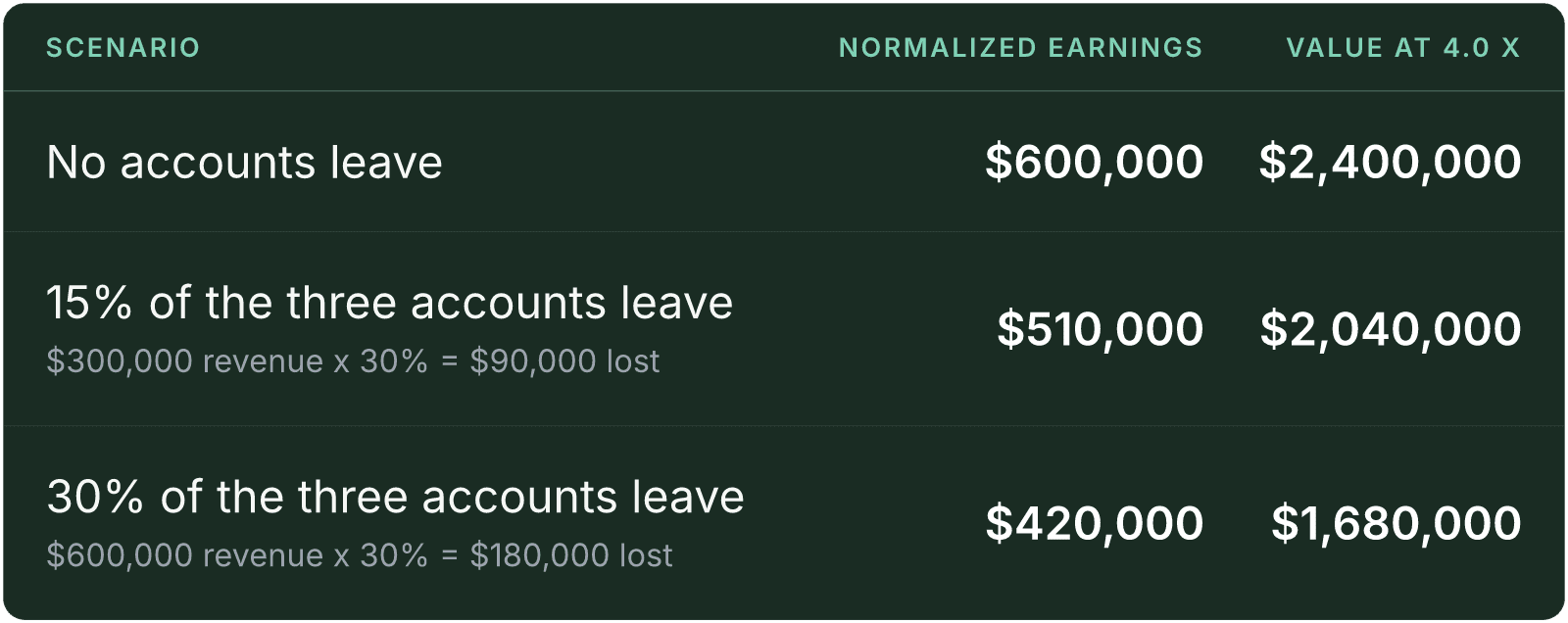
Take a mechanical contractor with $5,000,000 in revenue. After the owner's pay is set at what a hired general manager would earn, normalized earnings are $600,000, and comparable sales support a multiple of 4.0 times earnings. That gives a starting value of $2,400,000.
Now the facts that matter. The owner personally holds the relationships with the three largest accounts, which together bring in $2,000,000 of revenue, or 40 percent. Those accounts earn about a 30 percent contribution margin, so they generate roughly $600,000 of contribution. There are no written contracts, and no one else at the company has met the buyers at those customers.
An appraiser, or a buyer, can test how much of that revenue is at risk. The table below uses three scenarios for the share of those three accounts that leaves after the owner steps back.
[](https://www.409.ai/uploads/key_person_discount_small_business_valuation_owner_dependence_table_1_29a4286042.png)
The spread between the first and last rows is $720,000, or 30 percent of the starting value. That is the cost of owner dependence in this example, and it comes from named customers and a stated margin, not from a rule of thumb. If the owner signs a two-year transition agreement, introduces a successor to those accounts and the three customers sign multi-year contracts, the realistic scenario moves up the table. The business is worth more to a buyer for the same reasons a bank is more comfortable lending against it.
The numbers are invented. What carries over is the method: find out what depends on the owner, put a dollar figure on it, and show how the facts change the figure.
What moves the adjustment up or down
The ruling's own list of offsetting factors is a good checklist, and so is a plain read of how the business runs.
Documented customer contracts and recurring revenue lower the risk. A second-in-command with a real track record lowers it. A business whose value sits mostly in equipment, inventory or real estate suffers less from losing the manager, which is the point the ruling makes about assets that are not impaired. Transition commitments from the seller matter too. And [key person life insurance](https://www.409.ai/articles/buy-sell-agreement-valuation-connelly-life-insurance) can offset part of the loss, although the way policy proceeds count in a redemption price has its own rules, and the Connelly case is why an owner should look at that point before assuming insurance only helps.
On the other side, a founder who still handles sales, pricing, hiring and every quote pushes the adjustment up. So do customers who are on first-name terms with the owner only, a license held in the owner's name, and a technical process no one else can run.
Where it shows up in real transactions
A sale. Buyers price owner dependence whether or not they call it a discount. It appears as a lower multiple, an earnout, seller financing or a required transition period.
A partner buyout. When one of two partners leaves, the remaining partner often argues the business loses value without the departing one. The departing partner argues the opposite. The [standard of value](https://www.409.ai/articles/partner-buyout-fair-market-value-vs-fair-value-small-business-standard-of-value) written into the agreement shapes how far that argument can go.
A divorce. The line between what belongs to the person and what belongs to the enterprise is the heart of the matter. The [personal versus enterprise goodwill](https://www.409.ai/articles/divorce-business-valuation-personal-vs-enterprise-goodwill-small-business) question is related but not identical: it asks what value attaches to the owner as an individual, while a key person adjustment asks how much the enterprise's earnings depend on that individual.
An estate. If the business owner died, the loss of the manager is not hypothetical. It is a fact the appraiser has to deal with under the factors the ruling lists. A buy-sell price fixed years earlier is a separate matter, covered in the article on [Section 2703 and family business buy-sell prices](https://www.409.ai/articles/buy-sell-agreement-price-section-2703-family-business-estate-tax).
How this sits with the other discounts
A key person adjustment is not the same thing as a discount for lack of control or for lack of marketability. Those apply to the interest being valued: a minority stake, or shares that cannot be sold quickly. You can read how they work in [the discount for lack of marketability](https://www.409.ai/articles/discount-lack-marketability-dlom-409a-valuation) and [the discount for lack of control](https://www.409.ai/articles/discount-lack-of-control-dloc-409a-gift-tax-valuation). The key person adjustment is about the business itself, and it applies whether the interest is 100 percent or 10 percent. An appraiser who stacks all three without explaining why each is separate is a person to question.
What to do before the appraisal
Start a year before you need a number, if you can. List the customers, suppliers and employees who deal only with you. Write down what you do each week that nobody else can do. Then reduce the dependence where you can: put the top accounts under contract, introduce a second contact at each, and give a manager real authority.
When an appraiser interviews you, expect questions about exactly this. Answer with facts and documents, since the adjustment will rest on what the file supports. If you are preparing a valuation for a loan, a buyout or an estate, [409.AI's small business valuation](https://www.409.ai/products/smb-valuation) starts from $899 and covers these questions in the report.
The takeaway is practical. The IRS has said for more than sixty years that losing the manager can lower the value of a business, and it has also said the offsetting facts count. The owner who documents those offsets gets a smaller adjustment than the one who simply says the business will be fine.