Tax
Will the IRS Honor Your Buy-Sell Price? Section 2703 for Family-Owned Businesses
Family business owners and their CPAs: a buy-sell price counts for estate tax only if it passes the three-part test in IRC Section 2703. Here is what to check.
By 409.AI Team - 2026-10-16
# Will the IRS Honor Your Buy-Sell Price? Section 2703 for Family-Owned Businesses
Three siblings sign a buy-sell agreement in 2009. The price is five times trailing earnings, and nobody has looked at the formula since. When the oldest sibling dies, the surviving two buy out the estate at that price. Then the estate tax return goes in, and the IRS asks a question the family never considered: is the price in the agreement the value of the shares?
This article is for owners of small private companies and the CPAs, attorneys and brokers who draft and review their buy-sell agreements. It explains the federal test that decides whether a contract price controls for estate and gift tax, where agreements most often fail it, and what to check before the next valuation date. It draws no conclusion about any particular agreement. That depends on documents and facts we have not seen.
The default rule: the agreement price is ignored
The starting point surprises most owners. Under [26 U.S.C. § 2703(a)](https://www.law.cornell.edu/uscode/text/26/2703), the value of property for estate and gift tax is determined without regard to any option, agreement or right to acquire it at less than fair market value, and without regard to any restriction on the right to sell it. A buy-sell price below fair market value does not cap the value of the shares for the IRS. The default is that the contract is invisible.
Congress then carved out an exception in § 2703(b). The agreement counts only if it meets all three of these requirements:
1. It is a bona fide business arrangement. 2. It is not a device to transfer the property to members of the decedent's family for less than full and adequate consideration in money or money's worth. 3. Its terms are comparable to similar arrangements entered into by persons in an arm's-length transaction.
The regulations add detail. Treasury's rule at [26 CFR § 25.2703-1(b)(4)](https://www.law.cornell.edu/cfr/text/26/25.2703-1) treats terms as comparable when they could have been obtained in a fair bargain among unrelated parties in the same business dealing at arm's length, and that conforms with the general practice of unrelated parties under negotiated agreements in that business. An older rule, [26 CFR § 20.2031-2(h)](https://www.law.cornell.edu/cfr/text/26/20.2031-2), says a price in a restrictive agreement is disregarded unless it represents a bona fide business arrangement and is not a device to pass the shares to family for less than full consideration.
The safe harbor, and why family companies do not get it
The regulations offer a shortcut. Under § 25.2703-1(b)(3), an agreement is treated as meeting all three requirements if more than 50 percent by value of the property subject to it is owned directly or indirectly by individuals who are not members of the transferor's family.
Think about what that means for a typical owner. A software company with outside investors holding a majority may qualify without a fight. A manufacturer owned by a father, his two children and a son-in-law almost never does. In a family business the safe harbor is closed, so the agreement has to pass the three-part test on its merits, with evidence.
That evidence is a valuation question as much as a legal one. "Comparable to arm's-length arrangements" is a statement about price formulas, discounts, payment terms and triggers. Someone has to show that a stranger in the same industry would have accepted them.
Where agreements fail
Four patterns come up again and again.
The formula was never refreshed. A multiple or book value set when the business was small can sit untouched through years of growth. The price drifts further from market each year, and the gap is the first thing a reviewer sees.
The owner can change it alone. In *Estate of Blount*, the Tax Court disregarded an agreement's price partly because the controlling shareholder could modify it unilaterally, and the Eleventh Circuit affirmed ([T.C. Memo. 2004-116, aff'd, 428 F.3d 1338 (11th Cir. 2005)](https://sub.bvresources.com/freedownloads/estate_of_blount.pdf)). A price that one person can rewrite is not a price two unrelated parties bargained over. Our reading is narrow: that result turned on the facts in that record, and it is a reason to ask who holds the pen on your agreement, not a prediction of any outcome.
The agreement does not bind both ways. The older regulation looks at whether the owner could have sold at any price during life. A buy-sell that restricts lifetime sales and then pays a low fixed price at death looks more like an estate plan than a business arrangement.
The terms are not what strangers would sign. Payment over fifteen years with no interest, a price at a steep discount to appraised value, or a formula that changes depending on which sibling dies first all invite the question.
A worked example
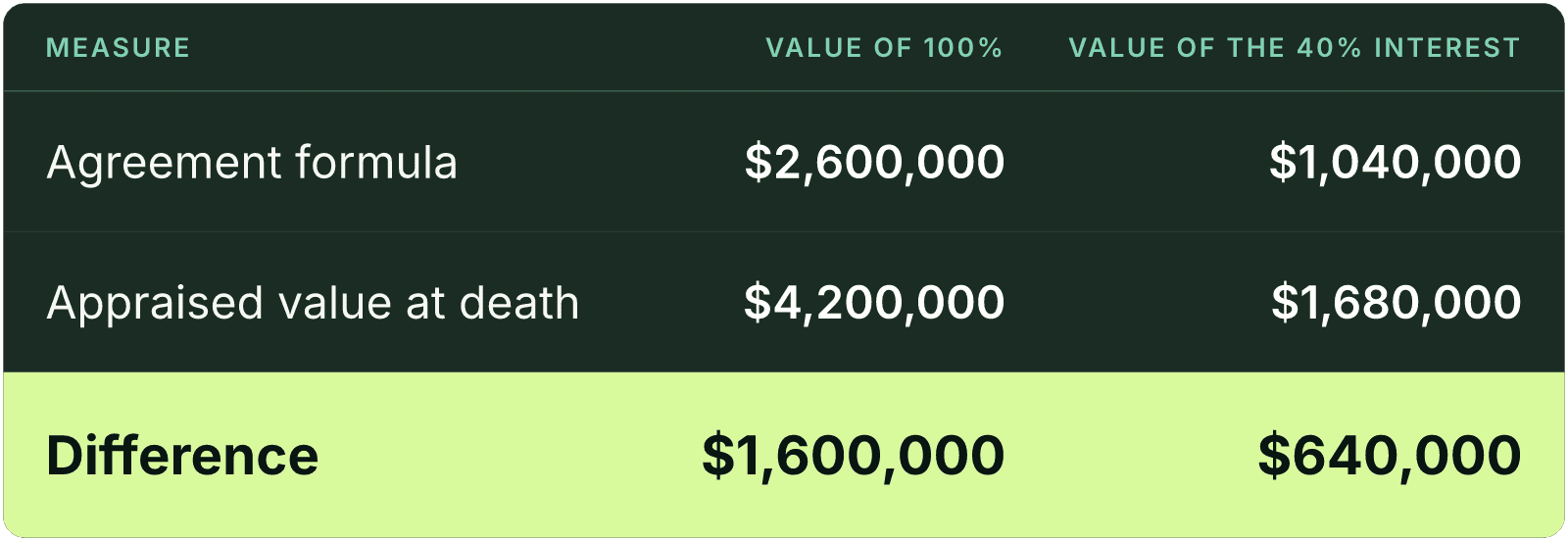
Return to the three siblings. Assume the agreement values the company at five times average earnings of $520,000, which is $2,600,000. A professional appraisal on the date of death, using current earnings and market evidence, puts the value of the whole company at $4,200,000. The decedent owned 40 percent. All figures are illustrative and ignore discounts.
[](https://www.409.ai/uploads/buy_sell_agreement_price_section_2703_family_business_estate_tax_table_1_85c59d4a52.png)
If the IRS treats the agreement as failing § 2703(b), the estate's gross estate includes the shares at the higher figure, not the $1,040,000 the family actually received. The extra $640,000 is taxed at up to 40 percent under [IRC § 2001(c)](https://www.law.cornell.edu/uscode/text/26/2001) if the estate is above the exemption, which would be $256,000 of tax. The estate also received only $1,040,000 in cash to pay it.
The table makes one point. The pain is not the formula itself, it is the distance between the formula and a supportable value on the day it matters. Discounts for lack of control and marketability, covered in our pieces on [the discount for lack of control](https://www.409.ai/articles/discount-lack-of-control-dloc-409a-gift-tax-valuation) and [the discount for lack of marketability](https://www.409.ai/articles/discount-lack-marketability-dlom-409a-valuation), would narrow the gap. They do not remove it.
How this differs from the life insurance problem
If you have read about the Supreme Court's decision in *Connelly*, note that it is a different issue. That case asked whether life insurance proceeds that fund a redemption raise the company's value. We walk through it in [buy-sell agreements after Connelly](https://www.409.ai/articles/buy-sell-agreement-valuation-connelly-life-insurance). This article asks the earlier question: whether the agreement's price gets any weight at all. An agreement can survive § 2703 and still hold an insurance problem, or the reverse. A careful review looks at both.
What to check this quarter
A short review costs far less than an audit. For each buy-sell agreement you own or advise on:
1. Date of the last valuation. If the formula or the last appraisal is more than two or three years old, schedule a fresh one. 2. Who can amend it. Every owner who is bound should have to agree. A clause that lets a majority holder rewrite the price alone is the one to fix. 3. Who owns the company. Find out whether more than half by value sits with non-family owners. If not, the safe harbor is unavailable. 4. The definition of earnings. The formula should say whether owner pay is before or after normalizing, and what counts as an add-back. Our guide to [owner compensation and add-backs](https://www.409.ai/articles/owner-compensation-add-backs-small-business-valuation-sde-ebitda) shows how far that single definition moves the answer. 5. Substantial modification. The regulation treats a substantially modified right as created on the date of the modification, so an amendment can start the clock again. Have counsel look at any change in that light.
A regular appraisal, signed by someone independent of the owners, is the cleanest evidence that the price tracks the market. For the broader method an appraiser follows, see our summary of [Revenue Ruling 59-60](https://www.409.ai/articles/revenue-ruling-59-60-small-business-valuation-eight-factors). For owners buying each other out in life, the standard of value you choose matters too, as covered in [partner buyouts and fair market value](https://www.409.ai/articles/partner-buyout-fair-market-value-vs-fair-value-small-business-standard-of-value).
If your agreement needs a current number, our [small business valuation service](https://www.409.ai/products/smb-valuation) provides an expert-reviewed report starting from $899.
The takeaway
Open your buy-sell agreement and find three things: the date the price was last tested, the name of anyone who can change it alone, and the percentage of the company owned outside the family. If you cannot answer all three in five minutes, the agreement has not been tested against § 2703, and the estate may be the one to find out.