Education
Partner Buyout: Fair Market Value or Fair Value of Your Business?
Owners and advisors settling a partner buyout: how fair market value, fair value and investment value give three prices for one business, with a worked example.
By 409.AI Team - 2026-10-15
# Partner Buyout: Fair Market Value or Fair Value of Your Business?
Two partners agree to part ways. One of them will buy the other out, and the agreement says the price is "the value of the business." Then an accountant, a lawyer and a banker each come back with a different number, and nobody is wrong. They were asked different questions.
This article is for the owner of a small private company, and for the CPA, attorney or business broker sitting beside them, who has to settle a buyout, a shareholder dispute or a transfer between family members. The question that decides the price is not how big the business is. It is which standard of value applies.
One business, three different questions
Valuation uses the word "value" for at least three different things. Mixing them up is the most common reason a buyout turns into an argument.
Fair market value is the tax standard. The Treasury regulations for both estate and gift tax define it as the price at which property would change hands between a willing buyer and a willing seller, neither under any compulsion to buy or sell, and both having reasonable knowledge of the relevant facts. You can read the wording in [26 CFR 20.2031-1(b)](https://www.law.cornell.edu/cfr/text/26/20.2031-1) for estates and [26 CFR 25.2512-1](https://www.law.cornell.edu/cfr/text/26/25.2512-1) for gifts. The buyer in that definition is a hypothetical one, not your partner and not the competitor who has wanted your customers for years.
Fair value is a legal standard. States set it by statute or by case law, mostly for disputes between owners: a shareholder who objects to a merger, a minority owner who claims oppression, a court-ordered buyout. The word "fair" does real work here. In a Delaware appraisal, for example, the court determines the fair value of the shares [exclusive of any element of value arising from the accomplishment or expectation of the merger](https://delcode.delaware.gov/title8/c001/sc09/index.html), and it takes into account all relevant factors. Other states write their own rules, and they do not all treat discounts the same way.
Investment value is what the business is worth to one specific buyer, including savings or growth only that buyer can bring. A strategic buyer who will close your second location and absorb your customers may pay more than any hypothetical buyer would. Neither the estate-tax regulation nor a typical buyout statute asks for that number, but it is often what a seller has in mind when they say "the business is worth more than that."
The same company can have a different value under each standard, with the same financials and the same appraiser.
Why the label moves the price
Most of the gap between standards comes from two adjustments that appraisers call discounts. A short reminder of each, because the buyout price depends on whether they apply.
A discount for lack of control reflects that an owner with 30% cannot set salaries, declare distributions or decide to sell. Our article on the [discount for lack of control](https://www.409.ai/articles/discount-lack-of-control-dloc-409a-gift-tax-valuation) explains how it is measured. A discount for lack of marketability reflects that a share of a private company cannot be sold on an exchange next week, and the [marketability discount](https://www.409.ai/articles/discount-lack-marketability-dlom-409a-valuation) article covers the evidence behind it.
Under fair market value, an interest is valued as the interest it is, so a 30% stake usually carries both discounts. Under a fair value standard that a state applies to a dissenting owner, a court may value the owner's pro rata share of the whole business instead and leave the discounts out. Whether a particular court does depends on its law, and that is a question for the attorney, not for the appraiser.
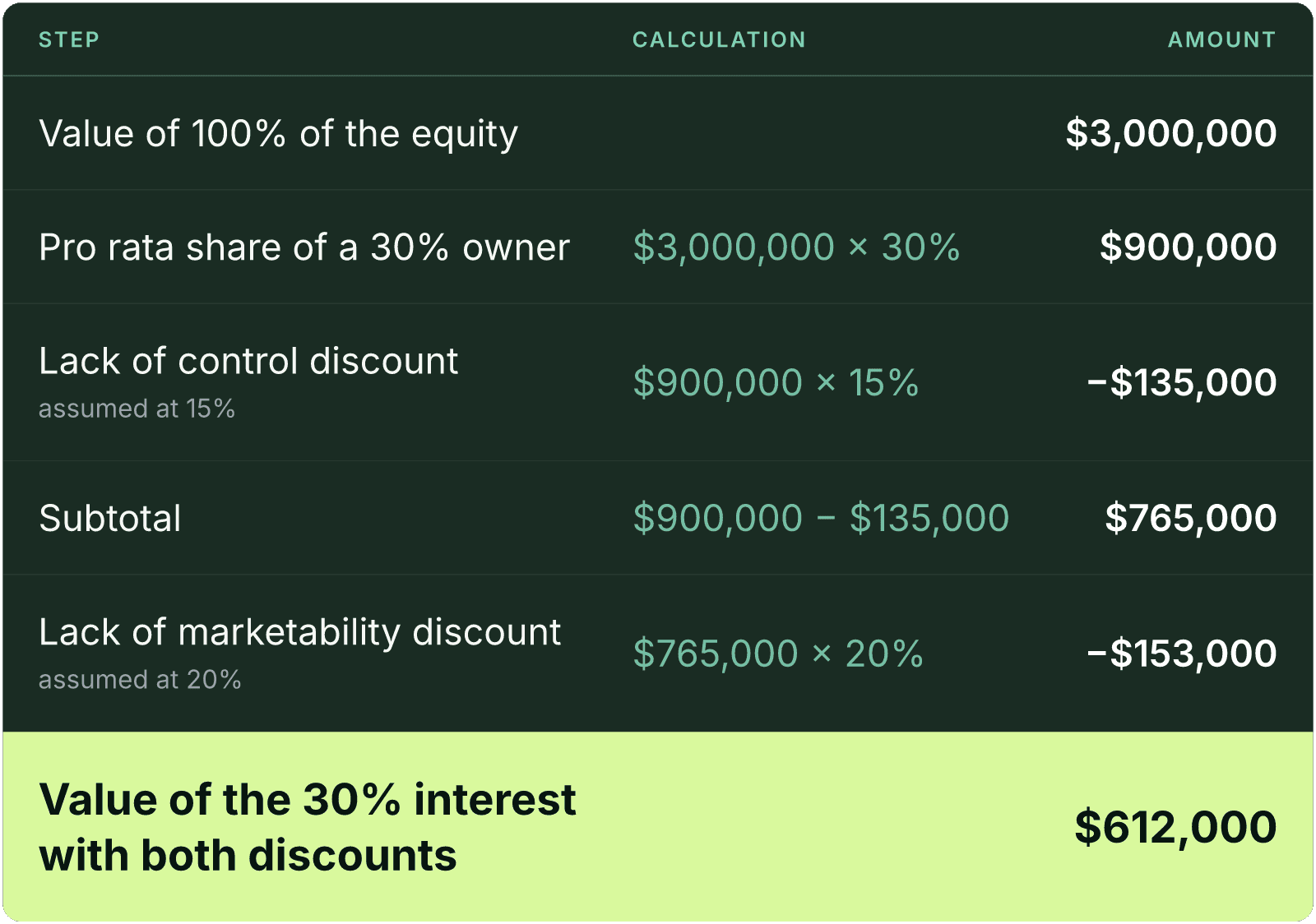
Here is what that looks like in dollars. Say an appraiser values 100% of the equity of a small business at $3,000,000, and a partner owns 30%. The two discounts below are assumptions chosen for the example, not benchmarks.
The table sets the pro rata share against the same share valued as a stand-alone interest.
[](https://www.409.ai/uploads/partner_buyout_fair_market_value_vs_fair_value_small_business_standard_of_value_table_1_f2293c8897.png)
The same stake is worth $900,000 on a pro rata basis and $612,000 as a discounted interest. The $288,000 difference is not an error by anyone. It is the cost of the choice between two standards, and in a buyout it moves from one partner's pocket to the other's.
What the agreement says comes first
If a buy-sell agreement exists, start there. Many agreements name a price formula, a standard of value, or an appraiser selection process, and a clause that says "fair market value" and one that says "fair value" can produce different prices from the same books.
Three things are worth checking in the document before any appraisal is ordered:
- **The standard of value.** Does the agreement name one, and does it define the term? An undefined "fair value" is an invitation to argue.
- **The treatment of discounts.** Some agreements say outright that the price is a pro rata share of the business with no minority or marketability discount. Others say nothing, which leaves the appraiser to apply the standard as written.
- **The valuation date.** The day of a death, a withdrawal notice or the last fiscal year end can give very different results for a business whose earnings are moving.
Funding matters as well. Company-owned life insurance used to pay for a redemption can raise the company's value for estate tax purposes, a point covered in our piece on [buy-sell agreements after Connelly](https://www.409.ai/articles/buy-sell-agreement-valuation-connelly-life-insurance). An agreement signed years ago and never updated is the most common source of surprise.
If the agreement is silent, or there is none, the standard may come from state law, from a court, or from whatever the two owners can agree on. Say the standard in writing before the appraiser starts. Handing an appraiser an engagement letter that says only "value the company" leaves the most expensive question unanswered.
What stays the same under every standard
The standard changes the final adjustments, but most of the work is shared. The appraiser still needs to understand the earnings and the risk behind them, and the same facts feed all three numbers.
Normalized earnings come first. A buyer, a court and the IRS all look at what the business earns after removing the owner's unusual pay, personal expenses and one-time items. Our guide to [owner compensation and add-backs](https://www.409.ai/articles/owner-compensation-add-backs-small-business-valuation-sde-ebitda) shows how those adjustments are made, because every dollar of add-back is multiplied in the final price.
The eight factors in Revenue Ruling 59-60 apply as well, since they describe what an appraiser weighs for a closely held company: the nature of the business, the economic outlook, book value, earning capacity, dividend capacity, goodwill, prior sales of the stock and the market price of comparable companies. The [walkthrough of those eight factors](https://www.409.ai/articles/revenue-ruling-59-60-small-business-valuation-eight-factors) covers each one. The ruling is tax guidance, so a court applying a different statute may borrow its method without being bound by it.
Other settings that use their own rules
A few situations come up often enough in small-business life that owners assume they follow the same rule as the buyout.
- **A bank or SBA loan with an ownership change.** The lender sets what appraisal it needs, and the SBA's operating procedure has its own conditions. Our article on the [SBA SOP 50 10 8.1 valuation requirement](https://www.409.ai/articles/sba-sop-50-10-8-1-business-valuation-change-of-ownership) lays out when one is required.
- **A gift or estate transfer.** Fair market value applies, and the return must carry enough detail for the IRS to understand how the number was reached.
- **A divorce.** The standard is set by state law and varies, so the attorney should say which one applies before an appraiser is engaged.
A single appraisal is not always usable across these settings. A report written for a gift tax return answers the fair market value question. Handing it to a court that applies a different standard, or to a partner who expected a pro rata number, often creates a second appraisal and a second invoice.
Settling it before the appraiser starts
A practical order of operations for a buyout:
1. Read the agreement for the standard, the discount language and the valuation date. 2. If the agreement is silent, ask counsel which standard state law points to, and get the two owners to agree on it in writing. 3. Put the standard, the date and the interest being valued in the engagement letter. 4. Ask the appraiser to show the pro rata value next to the discounted value, as the table above does, so both owners see what the choice is worth.
Owners often discover the standard issue only after a number lands on the table. Asking for the question in advance costs an hour of a lawyer's time. Asking after costs a negotiation.
If you need an independent number for a buyout, a gift or a loan, 409.AI prepares [small-business valuations](https://www.409.ai/products/smb-valuation) that state the standard of value on the first page, so each side knows which question the report answers. The most useful thing to do this week is simpler: find the buy-sell agreement, read the one clause that defines value, and check whether it matches what you would expect to be paid.