Tax
Gifting Carried Interest to a Trust: Section 2701 and the Vertical Slice
Fund GPs gifting carry to a family trust by December 31: why a carry-only gift can trigger Section 2701 and how a vertical slice keeps the Form 709 value true.
By 409.AI Team - 2026-11-26
# Gifting Carried Interest to a Trust: Section 2701 and the Vertical Slice
If you are the general partner of a venture or private equity fund and you plan to move part of your carried interest into a family trust before December 31, the structure of the gift matters as much as the appraisal. Give the carry alone and keep your capital interest, and Section 2701 of the Internal Revenue Code can value the interest you keep at zero. The result is a Form 709 that reports a gift several times larger than what the trust actually receives. Give a proportionate slice of every interest you hold, and the rule steps aside.
This article is for the GP and for the estate attorney preparing the Form 709. It walks through why a carry-only gift can fall under Section 2701, what the arithmetic does to the reported value, how the proportionate transfer exception in Treasury Regulation 25.2701-1(c)(4) works, and what the appraisal has to cover in each case.
Why carry is the asset GPs want to give
Carry is worth little on paper early in a fund's life and can be worth a great deal at the end. That is the whole appeal. A gift made while the hurdle is still far away uses a small amount of lifetime exemption, and any growth after the gift date builds up in the trust rather than in your estate.
The basic exclusion for 2026 gifts is $15,000,000 per person, as we covered in our note on December and January gifts. Most GPs have room. The question is how much of that room a given gift will use, and Section 2701 is where a well-meant gift can use far more than it should.
How the carry itself is valued at a reporting date is a separate exercise. Funds usually start from a hypothetical liquidation of the waterfall, which we explained in our piece on carried interest accrual at quarter-end. A gift tax appraisal starts there but has to answer a different question: what a willing buyer would pay for the transferred units on the gift date.
When Section 2701 applies
26 U.S.C. 2701 applies when an individual transfers an equity interest in a corporation or partnership to a member of the family and, immediately after the transfer, the transferor or an applicable family member holds an applicable retained interest. Family members are your spouse, your descendants and your spouse's descendants, and their spouses (Treas. Reg. 25.2701-1(d)). A trust for your children counts because interests held through a trust are attributed to its beneficiaries under Treas. Reg. 25.2701-6.
An applicable retained interest is one that carries either an extraordinary payment right (a put, call, conversion or liquidation right) or, in a controlled entity, a distribution right (Treas. Reg. 25.2701-2(b)). Two definitions do the work for a GP:
- Control of a partnership means holding at least 50 percent of the capital or profits interests, or, in a limited partnership, holding any interest as a general partner. A fund GP meets the second test by definition, and the regulations count interests held indirectly through the GP entity.
- A distribution right excludes distributions on an interest of the same class as the transferred interest, or of a class subordinate to it. So the question is which class sits higher in the waterfall.
Carry is paid only after the limited partners get their capital back, and in many funds a preferred return as well. If the documents put the carry behind your capital interest, the interest you keep is senior to the interest you gave, its distributions count as a distribution right, and Section 2701 applies.
What the rule does to the value
Once Section 2701 applies, a distribution right in a controlled entity is valued at zero unless it is a qualified payment right (Treas. Reg. 25.2701-1(a)(2)). A qualified payment is a cumulative distribution payable at least annually at a fixed rate or in a fixed amount. A GP capital interest that shares fund profits pro rata pays nothing of the kind.
The gift is then measured by the subtraction method of Treas. Reg. 25.2701-3. In plain terms: value everything the family holds as if one person held it, subtract the retained senior interests at their Section 2701 value (zero, here), and allocate what is left to the junior interests, including the ones given away. The same regulation adds a floor: a junior equity interest is never valued below its share of 10 percent of the total value of all equity in the entity, plus any debt the entity owes to you or an applicable family member.
The estate freeze article walks through the method for a family company recapitalised into preferred and common. A GP's carry gift is the same machinery with a fund waterfall underneath it.
A worked example
Take an illustrative GP, Dana, who owns all of the GP entity of a venture fund. The GP entity has two classes of units: capital units that track Dana's commitment to the fund, and carry units that receive the 20 percent carry. Its operating agreement pays the capital units first. On December 15, the appraisal values the capital units at $2,000,000 and the carry units at $800,000.
Dana gives 25 percent of the carry units to a trust for the children and keeps everything else. Under ordinary valuation principles, the gift would be 25 percent of $800,000, or $200,000, before any discount. Section 2701 asks a different question.
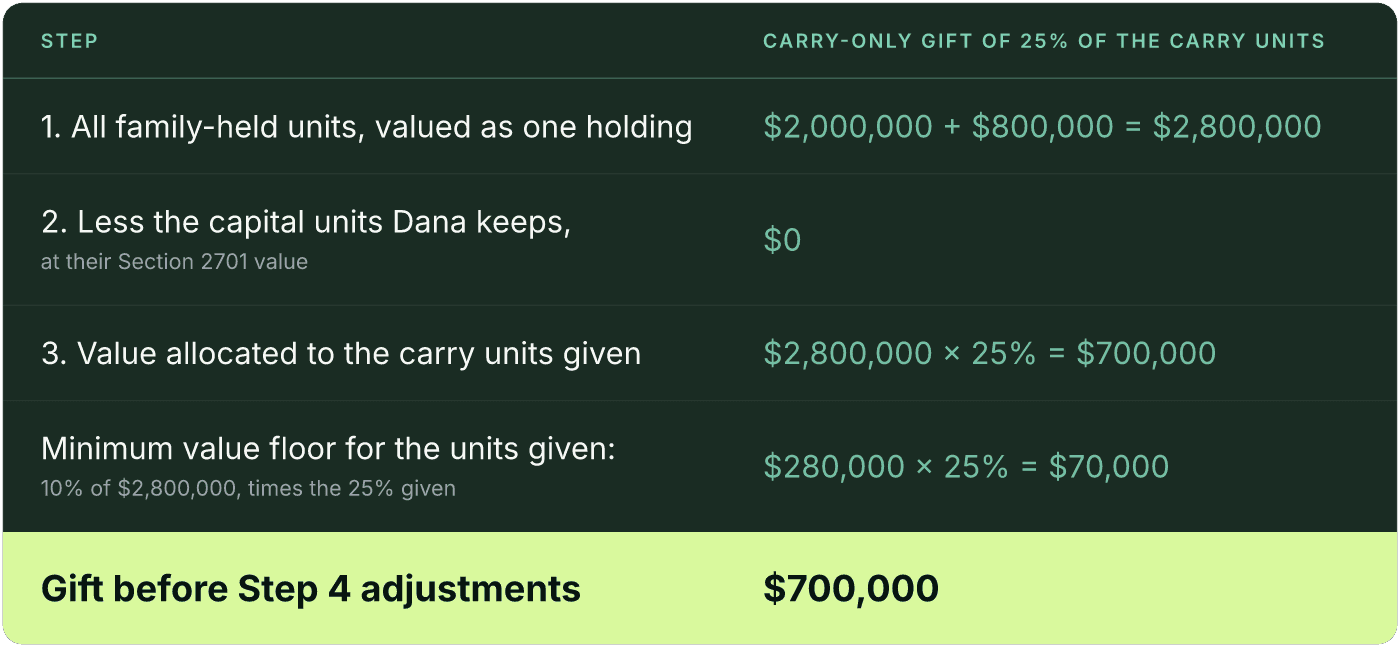

The trust received $200,000 of value. The Form 709 reports $700,000. The $500,000 difference is value Dana still owns, taxed as if it had been given away. Step 4 of the regulation can reduce the figure for a minority discount and for consideration received, but it does not undo the zero.
Treas. Reg. 25.2701-5 provides adjustments to mitigate the double taxation when the retained interest is later transferred or included in the estate. That relief comes years later and follows its own rules. It is not a reason to report $500,000 of phantom gift now.
The vertical slice
The way out is in Treas. Reg. 25.2701-1(c)(4). Section 2701 does not apply to a transfer to a family member to the extent the transfer results in a proportionate reduction of each class of equity interest held by the individual and all applicable family members, in the aggregate, immediately before the transfer. Practitioners call this a vertical slice: instead of cutting the carry off the top, you cut straight down through every class you hold.
For Dana, a vertical slice means giving the same percentage of the capital units and of the carry units. Nothing junior is given while something senior is kept, so no retained interest is valued at zero. The gift is valued interest by interest under ordinary principles, which means a non-controlling interest in the GP entity can carry its discounts for lack of control and marketability, the same discounts explained in our article on DLOC in gift tax valuations.
The cost is that the slice includes capital, so it moves more value. Here is how the three choices compare, with an illustrative 25 percent combined discount on the slices.
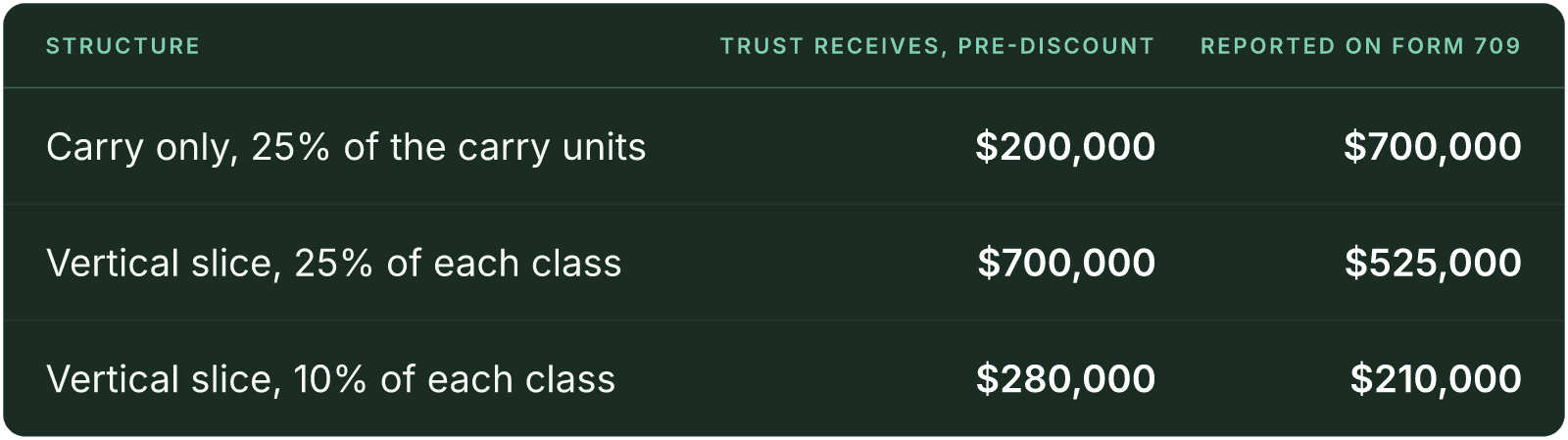

The 25 percent slice reports roughly what the carry-only gift reports, but the trust actually owns all of it, and the reported value reflects what a buyer would pay for a minority position. The 10 percent slice uses about the same exemption as the $200,000 Dana first had in mind and still moves a tenth of the carry's future growth. The point is not that one slice size is right. It is that every dollar on the return is a dollar the trust holds.
Where a vertical slice goes wrong
The exception is measured against the aggregate holdings of you and every applicable family member, in each class, immediately before the transfer. Three details catch GPs out.
Indirect holdings count. Interests held through another entity or a trust are attributed under Treas. Reg. 25.2701-6. A capital commitment held personally, a co-investment held through an LLC, or units held by a spouse can each be a class the slice has to reach.
Classes are defined by rights, not labels. Two series of units with different waterfalls are different classes, even if the operating agreement calls both "common units". The regulation treats interests as the same class only when their rights are identical or proportional, apart from non-lapsing differences in voting or, for a partnership, management and limitations on liability (Treas. Reg. 25.2701-1(c)(3)).
The slice must be proportionate in fact. A gift that gives 25 percent of the carry units and 20 percent of the capital units is not a vertical slice. The 5 percent shortfall leaves a senior interest behind, and Section 2701 applies to the excess.
Which entity to test, which interests form a class, and whether a fund's documents put carry behind capital are questions for the estate attorney reading the operating agreement and the fund's limited partnership agreement. The appraiser values what that reading produces.
What the appraisal and the Form 709 need
For a carry-only gift that falls under Section 2701, the appraisal values every family-held class as one holding, shows the subtraction, tests the 10 percent floor and documents any Step 4 reduction. For a vertical slice, it values each transferred interest on its own and supports each discount separately for the capital units and the carry units.
Either way, the gift date is the valuation date, the return is due April 15, 2027 for a 2026 gift, and the statute of limitations only starts if the return meets the adequate disclosure rules, which we set out in our guide to Form 709 adequate disclosure. The Form 709 instructions add that the Section 2701 elections, including treating a distribution right as a qualified payment right, can be made only by a statement attached to the transferor's Form 709 reporting the transfer. Discounts on the slice also need to stay defensible, because the valuation misstatement penalties start at 65 percent of the correct value, as covered in our article on gift tax valuation penalties.
409.AI prepares gift and estate tax valuations for private interests, including GP entity units, for the Form 709.
The takeaway
Before you sign the assignment, write down every class of interest you and your applicable family members hold in the GP entity and the fund, directly and through other entities. If the gift reduces each of those classes by the same percentage, Section 2701 does not apply and the appraisal values what the trust receives. If it gives only the carry, expect a return that reports the value of the capital you kept, and decide whether that is a price you meant to pay.
About the author
409.AI Team
Startup valuation and equity workflow specialists
The 409.AI team writes practical valuation content for founders and finance teams preparing 409A reports, equity documentation, and related startup finance workflows.
Related valuation reports
- Gift & Estate Tax valuation report: 409.AI helps shareholders prepare expert-reviewed private-company valuation reports for gift and estate tax filings, with fair market value analysis as of the transfer date.
- 409A valuation report: 409.AI helps private companies prepare expert-reviewed 409A valuation reports for equity compensation and option strike price support.
- Pricing for every report type
- 409A valuation calculator
- Sample 409A report