Tax
Estate Freeze With Preferred and Common: How Section 2701 Values the Gift
Recapitalizing a family company before a year-end gift? Section 2701 can value your preferred at zero. How the gift of common is computed for the Form 709.
By 409.AI Team - 2026-11-12
# Estate Freeze With Preferred and Common: How Section 2701 Values the Gift
You own a family company worth about $10 million. Your estate attorney suggests a classic estate freeze before year-end: recapitalize into preferred and common, keep the preferred, and give the common to your children. The preferred holds today's value. The common catches the growth outside your estate.
The question that decides whether the plan works is how much the common is worth on the gift date. In a family-controlled company, Section 2701 of the Internal Revenue Code replaces the ordinary fair market value answer with special rules, and depending on how the preferred is drafted, the taxable gift can be the whole company.
This article is for the owner planning that recapitalization and for the estate attorney or CPA preparing the Form 709 that reports it.
When Section 2701 applies
Section 2701 applies when you transfer an interest in a corporation or partnership to a member of your family and you (or an applicable family member) keep certain rights in the same entity ([26 U.S.C. 2701](https://www.law.cornell.edu/uscode/text/26/2701)).
The statute defines both groups. A member of your family is your spouse, a lineal descendant of you or your spouse, and the spouse of any such descendant. An applicable family member looks the other way up the tree: your spouse, an ancestor of you or your spouse, and the spouse of any such ancestor. So a gift of common to your daughter while you and your mother keep the preferred is squarely inside the rule.
The rights that trigger it fall into two groups:
- **Distribution rights**: the right to dividends on stock or distributions on a partnership interest. These count only in a **controlled** entity.
- **Liquidation, put, call and conversion rights**, and any similar right whose exercise or nonexercise affects the value of the transferred interest.
Control means at least 50 percent of the stock by vote or by value for a corporation. For a partnership, it means at least 50 percent of the capital or profits interests, or any general partner interest in a limited partnership. The regulations count holdings of the transferor, applicable family members, and the lineal descendants of the parents of the transferor or the transferor's spouse ([Treas. Reg. 25.2701-2](https://www.law.cornell.edu/cfr/text/26/25.2701-2)). Siblings, nieces and nephews count toward control even though they are not "family" for the gift itself.
There are three exceptions in the statute: the retained interest has readily available market quotations on an established securities market, the retained interest is of the same class as the transferred one, or it is proportionally the same as the transferred interest apart from voting rights. A recapitalization into preferred and common almost never fits one.
What your preferred is worth for the gift
Here is the core of the rule. Once Section 2701 applies, a retained distribution right is valued at zero unless it is a right to a qualified payment. Retained liquidation, put, call and conversion rights are also valued at zero, with one twist covered below.
A qualified payment, under Section 2701(c)(3), is a dividend payable on a periodic basis under cumulative preferred stock (or a comparable partnership payment), to the extent it is set at a fixed rate. A rate with a fixed relationship to a specified market interest rate also qualifies.
That definition is where most freezes are won or lost. A noncumulative 7 percent dividend that the board can skip is not a qualified payment. Neither is a dividend that floats with the company's earnings. Both count for nothing.
If the preferred does carry a qualified payment and also carries a put, call, conversion or liquidation right, the statute adds a lowest value rule: all of those rights are valued as if each one were exercised, or not exercised, in whichever way produces the lowest value for the preferred.
The rule has a carve-out that drafting attorneys use on purpose. A mandatory payment right, a payment required at a specific time for a specific amount (such as a mandatory redemption at par on a fixed date), is neither an extraordinary payment right nor a distribution right, so it is valued normally ([Treas. Reg. 25.2701-2(b)(4)](https://www.law.cornell.edu/cfr/text/26/25.2701-2)).
The subtraction method, step by step
The regulations do not value the common directly. They value everything the family holds, then subtract the preferred at its Section 2701 value ([Treas. Reg. 25.2701-3](https://www.law.cornell.edu/cfr/text/26/25.2701-3)):
1. Step 1. Determine the fair market value of all family-held equity interests immediately after the transfer, as if one individual held them. 2. Step 2. Subtract the family-held senior interests: the applicable retained interests at their Section 2701 values, and other family-held senior interests at fair market value. 3. Step 3. Allocate what is left among the transferred interests and the other family-held subordinate interests. 4. Step 4. Reduce the amount allocated to the transferred interests for the items the regulation lists, including part of a minority or similar discount and any consideration you received.
Then one more check. Under Section 2701(a)(4), a junior equity interest is never valued below its pro rata share of 10 percent of the total value of all equity interests in the entity plus the entity's debt owed to you and your applicable family members.
A worked example
Take an illustrative company. Maria owns all the stock of a manufacturing business. An appraiser puts the family-held equity at $10 million. The company also owes Maria $2 million on a shareholder loan. She recapitalizes into 9,000 preferred shares with a $1,000 par value ($9 million of par) and 1,000 common shares, keeps the preferred, and gives all the common to her two children.
We'll run three versions of the preferred:
- **Version A**: a 7 percent noncumulative dividend and a put at par.
- **Version B**: a 7 percent cumulative dividend, paid annually at a fixed rate, and a put at par. The appraiser concludes that a buyer would require a 10 percent yield on a security like this, so the dividend stream of $630,000 a year is worth $6.3 million. Exercising the put would produce $9 million, so the lowest value is $6.3 million.
- **Version C**: the same terms as B, but the appraiser concludes the required yield is 6.6 percent. The dividend stream is then worth about $9.5 million, and under the lowest value rule the put caps the preferred at $9 million.
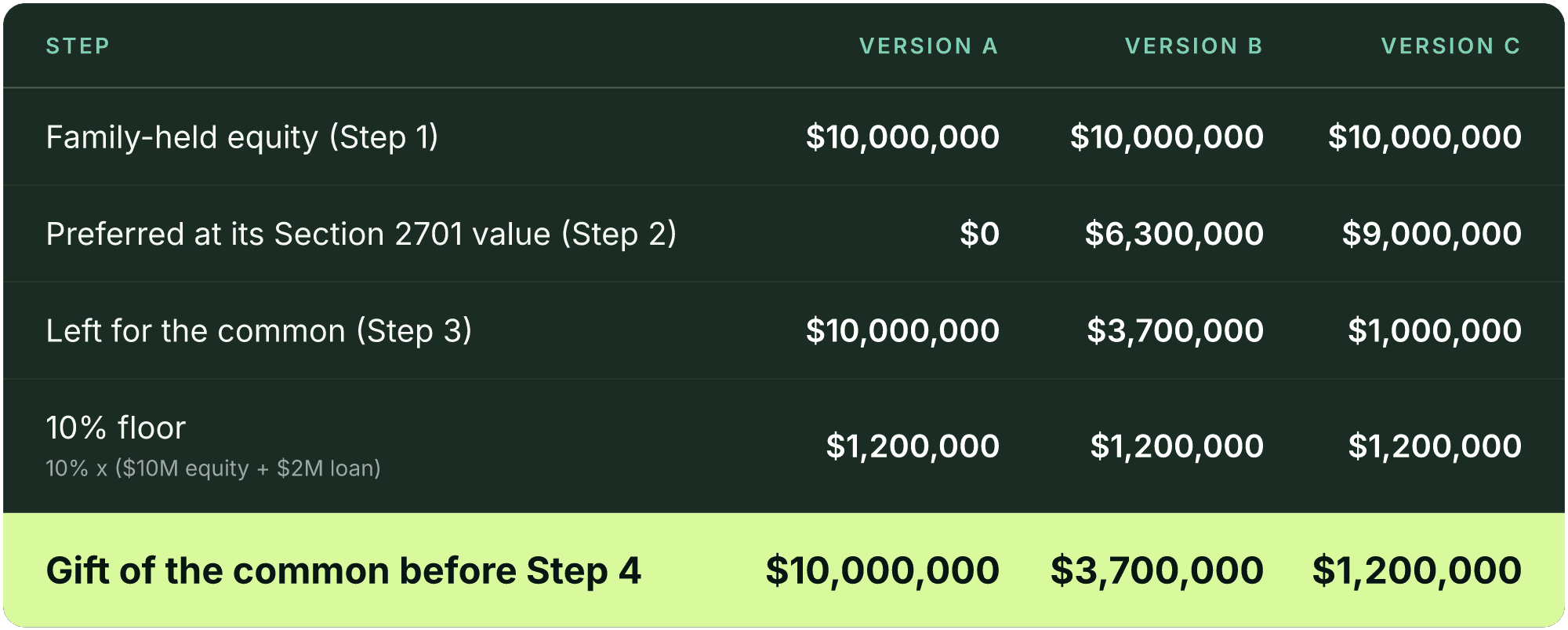
The table runs Steps 1 to 3 and the 10 percent floor for each version, before any Step 4 reduction.
[](https://www.409.ai/uploads/estate_freeze_section_2701_preferred_common_gift_valuation_table_1_3407edfc9c.png)
Version A is the trap. The preferred has real economic value to Maria, yet for the gift it counts for nothing, and the gift is the entire company. She has used a large share of her lifetime exemption to give away what an ordinary appraisal would call a small slice of the equity.
Version B is how a freeze is meant to work. The cumulative fixed dividend is a qualified payment, so it carries its value through Step 2, and the gift is the residual $3.7 million.
Version C shows both protective rules at once. The lowest value rule caps the preferred at the put price, and the 10 percent floor lifts the common from $1 million to $1.2 million. Notice that Maria's own loan to the company raised the floor by $200,000.
The cost of a qualified payment you skip
Version B only works if the company pays the dividends. Section 2701(d) deals with the cumulative dividend that comes due and is never paid. When Maria later transfers the preferred, by gift or at death, her taxable transfer can increase by the unpaid qualified payments plus a return on them, compounded at the discount rate used to value the preferred in the first place. A payment made within four years of its due date is treated as made on time.
In Version B that discount rate is 10 percent. Five skipped payments are $3.15 million of dividends before any compounding. A family that adopts a cumulative preferred to pass Section 2701 and then never pays it has moved the tax, not removed it.
Elections and disclosure on Form 709
Section 2701 gives the transferor two elections, and both are made only by attaching a statement to the Form 709 for the year of the transfer: an election to treat a qualified payment as not qualified, and an election to treat a distribution right that would not qualify as a qualified payment, paid in the amounts and at the times the election specifies ([Instructions for Form 709](https://www.irs.gov/instructions/i709)). Once made, an election can be revoked only with IRS consent.
The disclosure matters as much as the number. Under [26 U.S.C. 6501(c)(9)](https://www.law.cornell.edu/uscode/text/26/6501), gift tax on a gift that is not adequately disclosed can be assessed at any time, and the provision names the increases required under Section 2701(d). The Form 709 instructions point to Treas. Reg. 301.6501(c)-1(e) and (f) for what a Section 2701 transfer has to disclose. Our guide to [adequate disclosure on Form 709](https://www.409.ai/articles/form-709-adequate-disclosure-founder-stock-gift) covers the general requirements.
What the appraisal of the common has to show
An appraisal that values the common the ordinary way, as a percentage of enterprise value with a discount, is not enough here. For a recapitalization subject to Section 2701, the report the attorney attaches should show:
- **The value of all family-held equity immediately after the transfer**, as the Step 1 starting point, with the method and inputs behind it.
- **A classification of every right in the preferred**: qualified payment, extraordinary payment right (put, call, conversion, liquidation), mandatory payment right, or a right that falls outside the rule, tied to the actual charter or operating agreement language.
- **The valuation of any qualified payment right**, including the required yield and why, and the lowest value analysis when a put, call or conversion right sits beside it.
- **The subtraction**, step by step, with the residual allocated to the transferred common.
- **The 10 percent floor test**, including any company debt owed to the transferor or applicable family members.
- **Any Step 4 reduction**, such as the part of a [discount for lack of control](https://www.409.ai/articles/discount-lack-of-control-dloc-409a-gift-tax-valuation) or a [marketability discount](https://www.409.ai/articles/marketability-discount-minority-stake-family-business-mandelbaum-factors) that the regulation lets back in, measured as the regulation measures it.
Step 4 does not simply apply the discount you would take on a minority gift; it measures the reduction against a pro rata share of the family block. An aggressive discount stacked on a Section 2701 calculation invites the [Section 6662 valuation penalties](https://www.409.ai/articles/gift-tax-valuation-penalty-section-6662-65-percent-40-percent-discounts).
A freeze also rarely travels alone. Many family companies pair it with a buy-sell agreement, which brings in [Section 2703](https://www.409.ai/articles/buy-sell-agreement-price-section-2703-family-business-estate-tax), the next provision in the same chapter. If you are timing the gift around the annual exclusion, our note on [a December or January gift of private shares](https://www.409.ai/articles/december-or-january-gift-private-shares-2027-exclusion-rev-proc-2026-35) covers the 2027 figures.
The takeaway
The number on Maria's Form 709 swung from $10 million to $1.2 million on three drafting choices: whether the dividend is cumulative, whether its rate is fixed, and what the put is worth against the dividend stream. Those choices belong in the recapitalization documents before the gift, not in the appraisal after it. Have the appraiser run the Section 2701 subtraction on the draft terms while they can still change, and make sure the final report shows every step the regulation requires. A [gift and estate tax valuation](https://www.409.ai/products/gift-estate-tax) built that way gives the Form 709 a number that holds and a disclosure that starts the clock.