Tax
Gift Tax Valuation Penalties: The 65 Percent and 40 Percent Lines Your Discounts Have to Stay Clear Of
Gifting private shares before year-end? Section 6662 penalizes a Form 709 value at 65% or less of the final one. See where a discount stack crosses the line.
By 409.AI Team - 2026-11-05
# Gift Tax Valuation Penalties: The 65 Percent and 40 Percent Lines Your Discounts Have to Stay Clear Of
If you plan to gift private company shares before year-end, or you are the attorney or CPA who will sign the Form 709 in April, one test decides how much a bad valuation can cost. It is not how large the discount was. It is the ratio between the value you reported and the value the IRS finally accepts.
Section 6662 of the Internal Revenue Code sets two lines on that ratio, 65 percent and 40 percent. A reported value on the wrong side of either one adds a penalty to the tax, whatever the intent behind the number. This article shows where a stack of discounts can cross those lines, what the penalty costs in dollars, and what support keeps a return clear of them.
The two lines in the statute
Subsection (g) defines a substantial estate or gift tax valuation understatement. It exists when the value of property claimed on a return is "65 percent or less of the amount determined to be the correct amount of such valuation" ([26 U.S.C. 6662(g)](https://www.law.cornell.edu/uscode/text/26/6662)). The penalty is 20 percent of the portion of the underpayment attributable to the understatement. It applies only if that portion exceeds $5,000.
Subsection (h) raises the stakes. A gross valuation misstatement for gift and estate tax purposes uses the same test with 40 percent in place of 65 percent. To the extent the underpayment is attributable to a gross misstatement, the 20 percent rate becomes 40 percent.
Three details are easy to miss.
The test compares your number with the correct number, and the correct number is whatever the IRS or a court finally determines. You do not get to choose the denominator. A return that looked careful when it was filed can land on the wrong side years later.
The line is a ratio, so it moves with the size of the gift. A $50,000 shortfall on a $200,000 gift is a 75 percent ratio. The same $50,000 on a $75,000 gift is 33 percent. Small blocks have less room for error than their dollar amounts suggest.
The penalty attaches to an underpayment of tax. A gift that sits entirely inside your lifetime exclusion ($15 million per person for 2026) may owe nothing in the year it is made. A low value still has a cost, because it understates how much exclusion the gift used, and that shows up later when the numbers are rebuilt. How an exposed gift turns into a penalty depends on your gifting history, so it is a conversation for your estate attorney. The arithmetic below assumes the simplest case, a donor whose exclusion is used up and who owes tax on the full gap.
Where the lines fall in dollars
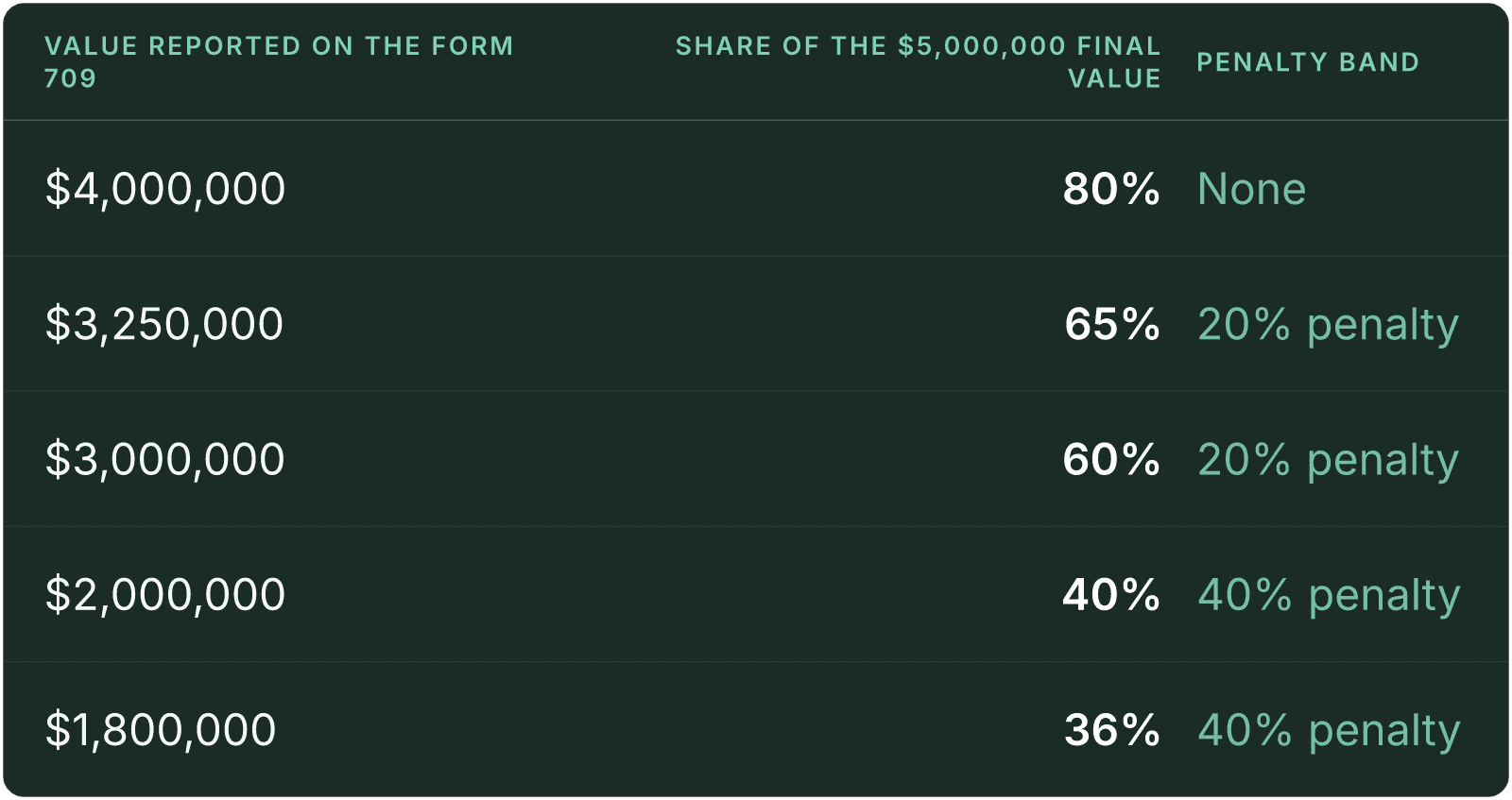
Take a gift that the IRS ends up valuing at $5,000,000. The 65 percent line sits at $3,250,000 and the 40 percent line at $2,000,000. The table shows how the reported value compares.
[](https://www.409.ai/uploads/gift_tax_valuation_penalty_section_6662_65_percent_40_percent_discounts_table_1_318c7178d9.png)
Notice that 65 percent is itself inside the band: the statute says "65 percent or less." A reported value of exactly $3,250,000 is penalized, and one dollar more is not.
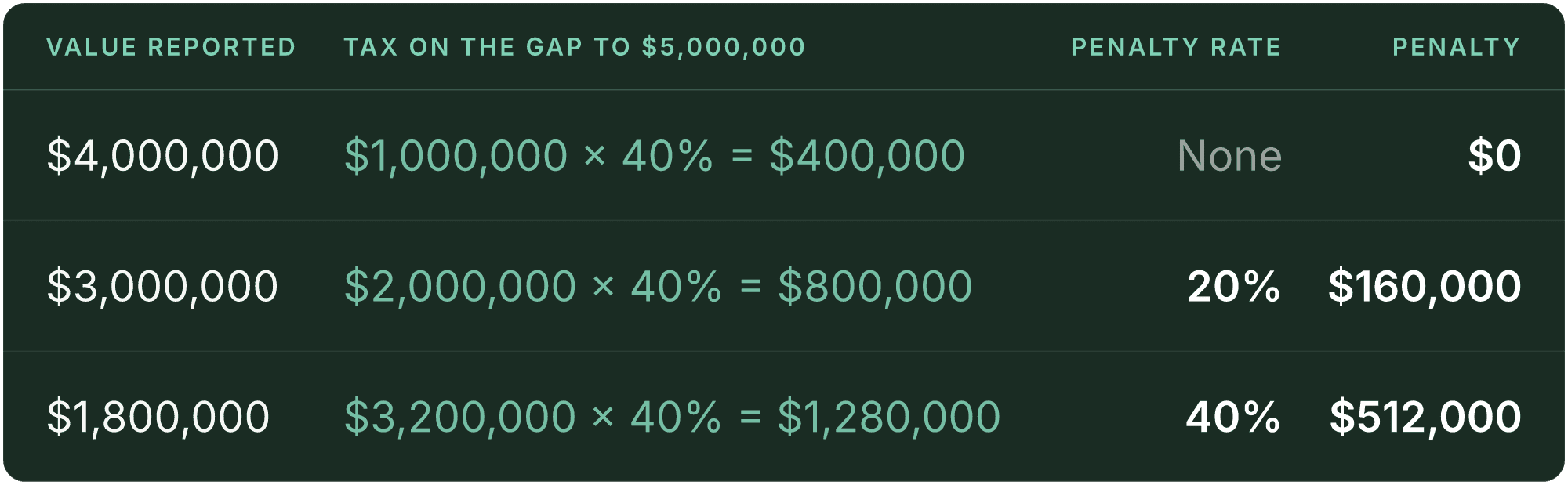
The next table converts the bands into money. It assumes the donor has no exclusion left, so every dollar of extra value is taxed at the 40 percent top rate ([IRS estate and gift tax FAQs](https://www.irs.gov/newsroom/estate-and-gift-tax-faqs)), and it leaves interest out.
[](https://www.409.ai/uploads/gift_tax_valuation_penalty_section_6662_65_percent_40_percent_discounts_table_2_a9ddd86bac.png)
The first row is worth a second look. A $1,000,000 undervaluation produces $400,000 of tax due and no penalty. One more million of undervaluation pushes the ratio under 65 percent, and the same logic that cost nothing now costs $160,000 on top of $800,000. The penalty is not proportional to the mistake. It switches on at a threshold.
How a discount stack crosses the line
Founders and family owners rarely report a value that is simply wrong. They report a value built from a pro rata share of the company less two or three discounts, and the penalty ratio is the product of all of them.
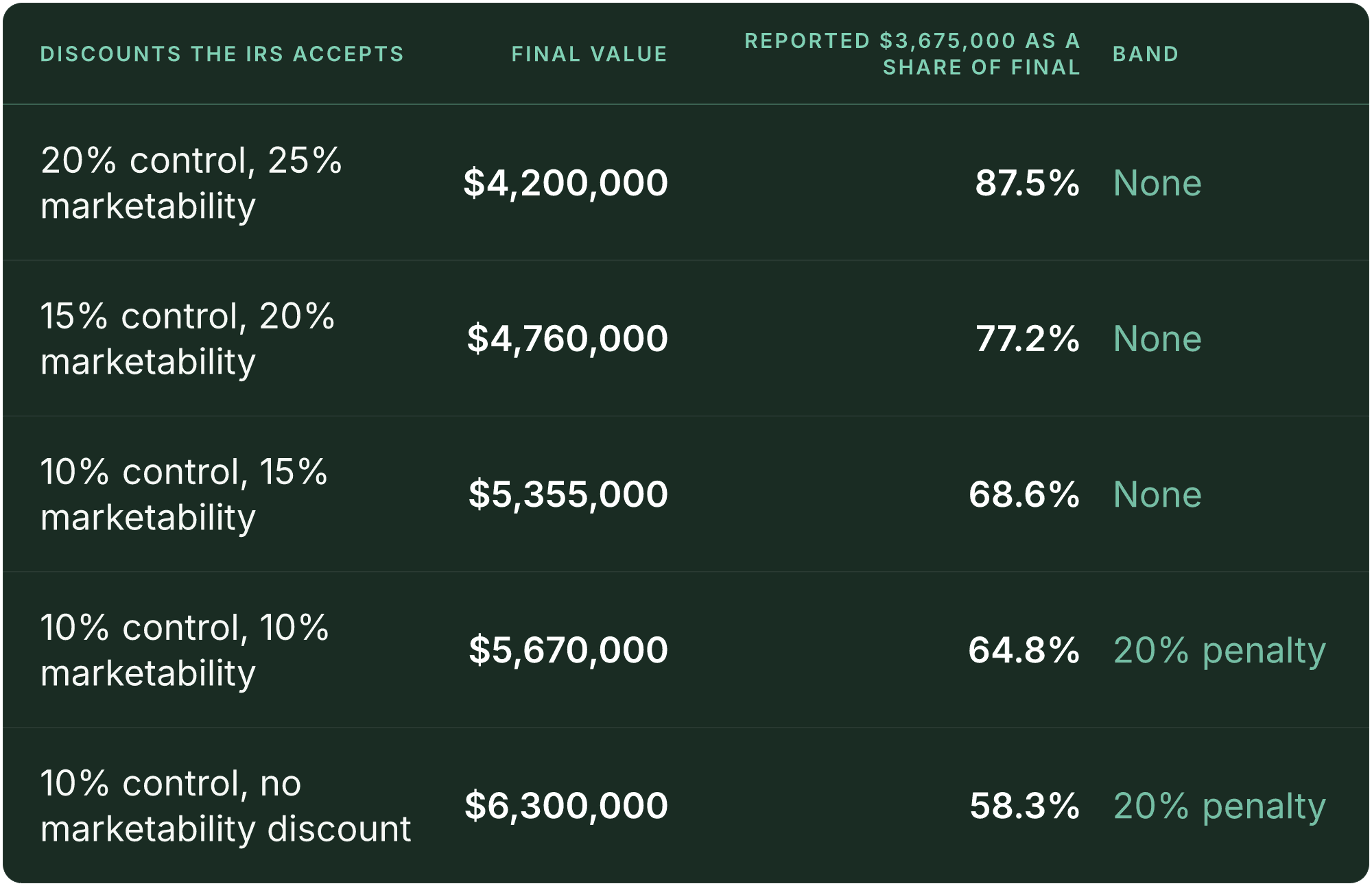
Suppose you gift a block that is 7 percent of a company worth $100 million, so the pro rata value is $7,000,000. Your appraiser applies a 25 percent discount for lack of control and a 30 percent discount for lack of marketability. Discounts compound, so the reported value is $7,000,000 x 75% x 70% = $3,675,000, a combined discount of 47.5 percent.
This is an illustration, not a recommendation of any discount. The question is what happens if an examiner accepts less.
[](https://www.409.ai/uploads/gift_tax_valuation_penalty_section_6662_65_percent_40_percent_discounts_table_3_793dc9ee4f.png)
The report survives three levels of examiner pushback and fails on the fourth. Working backward, $3,675,000 divided by 65 percent is about $5,654,000, which is 80.8 percent of the pro rata value. So a 47.5 percent stack clears the substantial line as long as the final combined discount stays above roughly 19 percent. Ask yourself whether your support would survive an examiner who cuts the stack to under 20 percent. If it would not, the gap is in the support, not in the arithmetic.
The 40 percent line is much harder to reach with ordinary discounts. In this example, even with no discount at all, the reported value is 52.5 percent of the pro rata figure. Gross misstatements tend to come from other places: a value anchored to an old or unrelated number, a block valued as if it carried no rights, or a stale valuation reused after a financing. The [409A and gift tax valuation comparison](https://www.409.ai/articles/409a-vs-gift-tax-valuation-form-709-founder-stock) walks through the most common one.
Reasonable cause is a defense, not a guarantee
Section 6664(c)(1) provides that no penalty is imposed on a portion of an underpayment if the taxpayer shows reasonable cause for it and acted in good faith ([26 U.S.C. 6664(c)](https://www.law.cornell.edu/uscode/text/26/6664)). The limit on that defense for valuation overstatements in paragraph (3) covers charitable deduction property. A gift of stock to a trust or to your children is not that, so the defense remains open.
Remaining open is not the same as being easy. The regulation says the facts-and-circumstances inquiry is made case by case and that "generally, the most important factor is the extent of the taxpayer's effort to assess the taxpayer's proper tax liability." It adds that "reasonable cause and good faith ordinarily is not indicated by the mere fact that there is an appraisal of the value of property." The factors it names include the methodology and assumptions underlying the appraisal, the circumstances under which it was obtained, and the appraiser's relationship to the taxpayer ([Treas. Reg. 1.6664-4(b)](https://www.law.cornell.edu/cfr/text/26/1.6664-4)).
In other words, holding a report is where the defense begins. It does not end there.
What support keeps a return clear
Nothing eliminates the risk, because the denominator is not yours. Support does change how the examination goes, and whether the reasonable-cause defense is credible if you reach it.
- **Value the block you gave, on the date you gave it.** The regulation measures a gift at its date ([26 CFR 25.2512-1](https://www.law.cornell.edu/cfr/text/26/25.2512-1)). A report dated months earlier, prepared for another purpose, is the weakest foundation, as the comparison of a 409A and a gift valuation explains.
- **Show each discount separately, with its reasoning.** A single combined percentage invites a single combined fight. Separate, sourced discounts let an examiner narrow one without discarding the rest. The [Mandelbaum factors for a minority stake](https://www.409.ai/articles/marketability-discount-minority-stake-family-business-mandelbaum-factors) are the usual frame for the marketability discount, and the [DLOM overview](https://www.409.ai/articles/discount-lack-marketability-dlom-409a-valuation) covers the same discount from the option-pricing side.
- **Use an independent appraiser who writes for the return.** The adequate-disclosure rules describe an appraisal that can replace a narrative on the Form 709: a qualified appraiser unrelated to donor and donee, with the transfer date, the method and the data stated so that another person can replicate it. The [adequate disclosure article](https://www.409.ai/articles/form-709-adequate-disclosure-founder-stock-gift) lists the contents. A report written to that standard also reads well as reasonable-cause evidence.
- **Record what the appraiser was given.** Financials, the shareholder agreement, transfer restrictions, recent rounds. Under the regulation, the methodology and the circumstances count, and a file that shows both is better than a number.
- **Check consistency before filing.** If a 409A, a financing or a loan document values the same shares differently in the same quarter, an examiner will find it. Have the appraiser address the difference in writing.
- **Stay aware of the structure.** Gifts to a grantor trust or in a [GRAT](https://www.409.ai/articles/grat-private-company-stock-valuation-annuity-gift-tax) turn on the same value, and a low number can carry through more than one calculation.
Before the April 15 filing
Gifts made in 2026 are reported on a Form 709 due April 15, 2027 ([Instructions for Form 709](https://www.irs.gov/instructions/i709)). That gives you a clean order of operations: value the block as of the gift date, test the reported number against the 65 percent line with the discounts cut to a level you would expect an examiner to accept, and fix the support before the return is signed. Do it in that order, because the appraisal that matters is the one you can show an examiner, not one you wish you had.
If the stack only works when every discount holds, you do not have a conservative position, you have a bet. Run the ratio at a combined discount of 19 percent before you file. If the result is under 65 percent, either the support has to get better or the gift has to change. For the wider planning picture around the 2026 exclusion, see [gifting startup equity in 2026](https://www.409.ai/articles/gifting-startup-equity-2026-estate-tax-exemption). If you want an independent appraisal prepared to the Form 709 standard, [409.AI's Gift & Estate Tax valuation](https://www.409.ai/products/gift-estate-tax) starts at $1,999.