Tax
December or January Gift of Private Shares: What 2027 Changes
Rev. Proc. 2026-35 sets the 2027 gift limits. A founder or owner weighing a December or January gift of private shares learns what changes and what doesn't.
By 409.AI Team - 2026-11-08
# December or January Gift of Private Shares: What 2027 Changes
If you plan to give private company shares to children, a trust or a family partnership this winter, the IRS just handed you a calendar question. On November 5, 2026 it released Rev. Proc. 2026-35, the inflation adjustments for 2027. Gifts made on or before December 31 use the 2026 numbers. Gifts made from January 1 use the new ones. This piece is for the founder or owner doing the gifting, and for the estate attorney, wealth advisor or CPA beside them, and it argues that the new numbers matter less than the one figure the revenue procedure does not touch: the value of the shares on the day you give them.
The numbers on each side of December 31
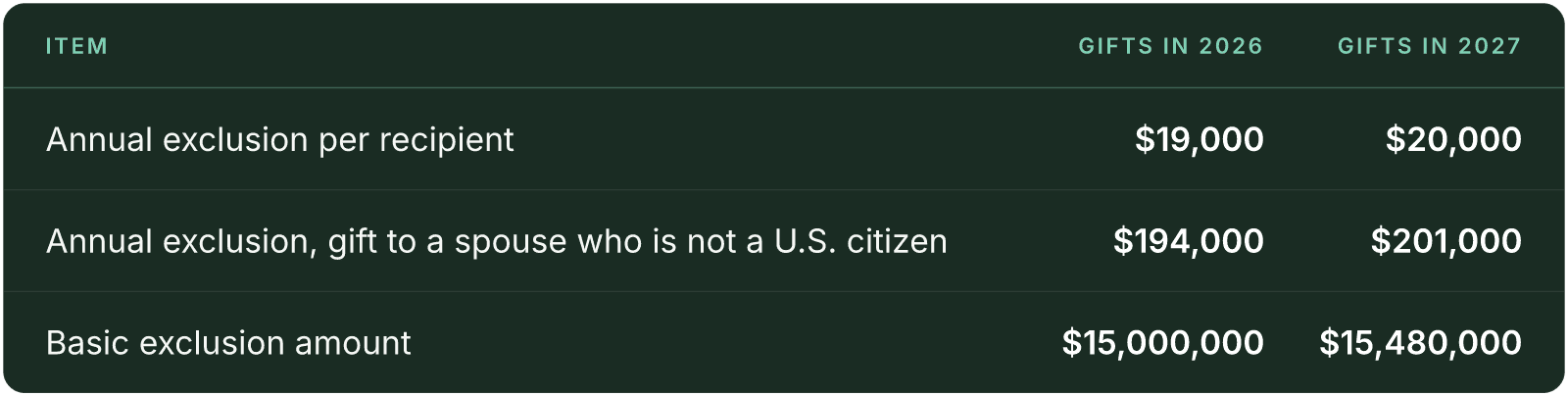
Rev. Proc. 2026-35 moves three gift and estate figures. The table sets them next to the 2026 amounts from Rev. Proc. 2025-32.
[](https://www.409.ai/uploads/december_or_january_gift_private_shares_2027_exclusion_rev_proc_2026_35_table_1_3be0d4a596.png)
The basic exclusion amount is the lifetime shelter from federal gift and estate tax. The One Big Beautiful Bill Act set it at $15 million for 2026 and made it permanent, with inflation indexing from there, which is why 2027 shows a $480,000 step. We covered how that change affects founders in [our guide to gifting startup equity under the 2026 exemption](https://www.409.ai/articles/gifting-startup-equity-2026-estate-tax-exemption).
Read the table for what it is. The annual exclusion resets every calendar year and does not carry over. A founder who skips 2026 does not get to add the unused $19,000 to 2027. The basic exclusion is different: it is cumulative across your lifetime, and a $480,000 increase does not expire on December 31. A large gift made in December simply uses part of the shelter, and the shelter keeps indexing for the years after.
So the honest answer to "should I wait for January?" is mostly no, for the big gift. For the annual exclusion gifts, the answer is that each year has its own allowance, and you can use 2026 now and 2027 in January.
What the annual exclusion buys in shares
The annual exclusion is measured in dollars. Shares are the vehicle, so the arithmetic starts with a price per share, and the price has to be the gift-date value of what the recipient receives, not what you paid and not a number picked for convenience.
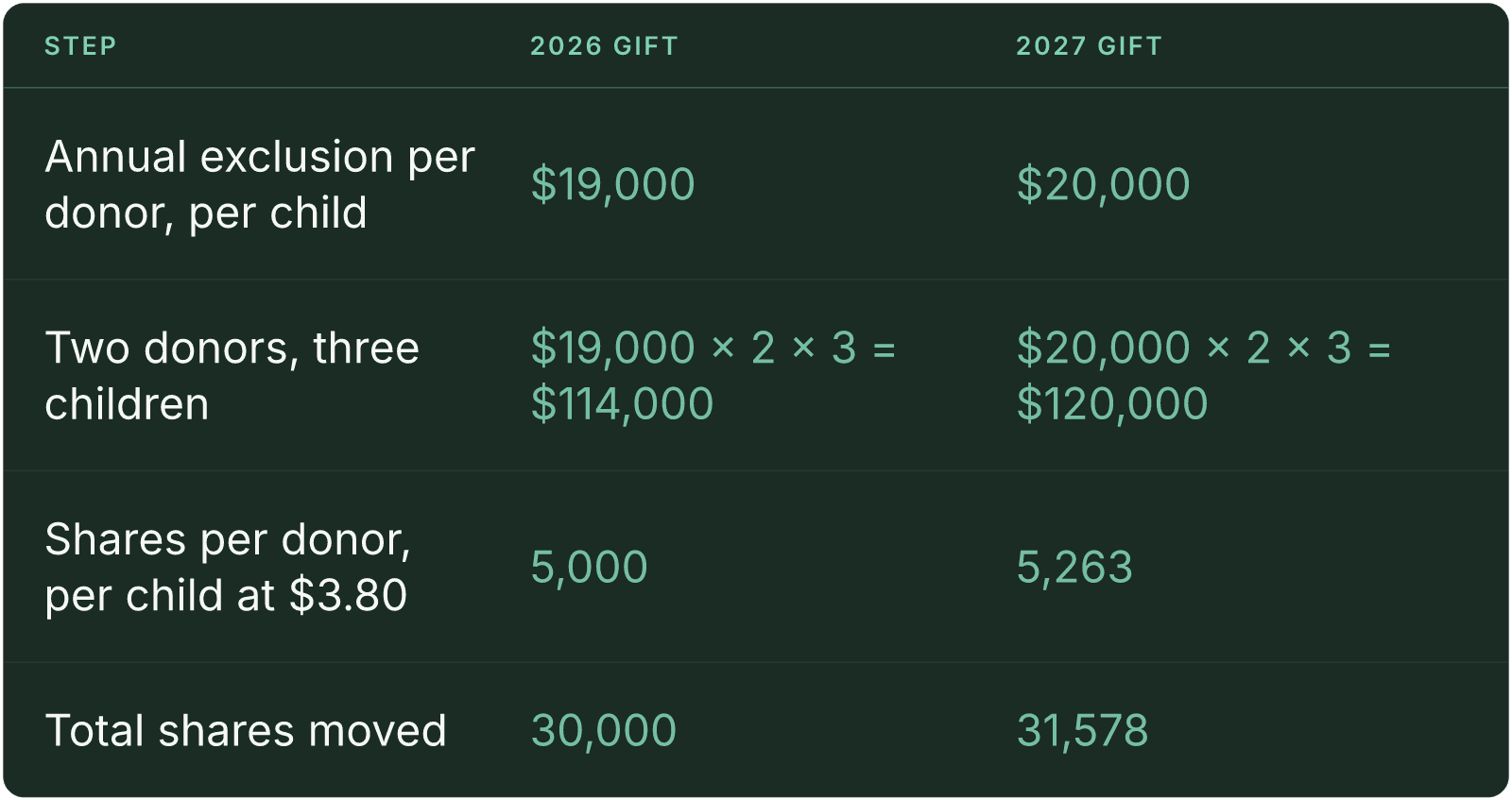
Take a founder and spouse who give shares to each of three children and elect gift splitting on Form 709. Assume a qualified appraisal puts the gifted common stock at $3.80 a share on the gift date, after the discounts the appraiser supports for lack of control and marketability.
[](https://www.409.ai/uploads/december_or_january_gift_private_shares_2027_exclusion_rev_proc_2026_35_table_2_440a281b57.png)
The 2027 gift moves about 1,600 more shares inside the exclusion, a gain of $6,000 of value. That is real but modest, and it is smaller than the swing that a 10 percent change in the appraised price would cause. If the price per share is $4.20 instead of $3.80, the same $114,000 buys only 27,142 shares. The number of shares you can fit under the exclusion is a function of the appraisal first and of the inflation adjustment second.
The gift date sets the value
A gift is measured at its fair market value on the date it is made (26 U.S.C. [2512(a)](https://www.law.cornell.edu/uscode/text/26/2512)). The regulation defines that value as the price at which the property would change hands between a willing buyer and a willing seller, neither under compulsion and both with reasonable knowledge of the relevant facts ([Treas. Reg. 25.2512-1](https://www.law.cornell.edu/cfr/text/26/25.2512-1)). Two consequences matter in a year-end transfer.
First, the date is the date the gift is complete, and for private stock that is a matter of mechanics. A gift is complete when the donor has parted with dominion and control over the property (Treas. Reg. 25.2511-2). For shares that usually means the transfer is made on the company's books, or an endorsed certificate is delivered, with any board consent, right of first refusal waiver or transfer restriction sign-off in hand. A founder who signs an assignment on December 30 but whose company records the transfer on January 6 may have made a 2027 gift without meaning to. Ask the corporate secretary for the effective date in writing.
Second, "reasonable knowledge of the relevant facts" cuts both ways at year end. Suppose a term sheet for a priced round is signed on December 18 and the round is expected to close in the second week of January. A gift on December 28 is not valued as if the round did not exist. A willing buyer would know about the signed term sheet, and the appraiser has to weigh it. Moving the gift to January 12, after the close, does not make the value lower. It tends to make it higher and cleaner, because the event is no longer pending. Either date needs an appraisal that addresses the round, and our walkthrough of [why a 409A is not the gift tax appraisal](https://www.409.ai/articles/409a-vs-gift-tax-valuation-form-709-founder-stock) explains which parts of the 409A can be reused and which are rebuilt.
Discounts have to be earned in the report
Most family gifts of private shares are minority, non-marketable blocks, and the appraised value usually reflects both a discount for lack of control and a discount for lack of marketability. Those discounts are where the IRS looks first, because they are large and they are judgment calls. The 409A skips the control discount entirely, which is one reason the gift report is a different document. We explain the mechanics in [the discount for lack of control article](https://www.409.ai/articles/discount-lack-of-control-dloc-409a-gift-tax-valuation).
The cost of getting it wrong is spelled out in the statute. If the value reported on a return is 65 percent or less of the value finally determined, the understatement is substantial, and at 40 percent or less it is gross, with penalty rates of 20 and 40 percent of the underpayment under Section 6662. The bands and a worked dollar example are in [our piece on gift tax valuation penalties](https://www.409.ai/articles/gift-tax-valuation-penalty-section-6662-65-percent-40-percent-discounts). A report built in a week, in the last days of December, is the report most likely to be thin on exactly these points.
Filing: the return and the clock
Gifts made in 2026 are reported on a Form 709 due April 15, 2027. Gifts made in 2027 are reported in April 2028. The return matters for the shares even when no tax is due, because an adequately disclosed gift starts the three-year assessment period under Section 6501, and an undisclosed one can leave the value open to challenge indefinitely.
Adequate disclosure for closely held stock is spelled out in Treas. Reg. 301.6501(c)-1(f). It includes a description of the property and the transfer, the relationship of donor and recipient, the method used to determine the value, and either a qualified appraisal or the detailed valuation information the regulation lists. The full checklist is in [our article on adequate disclosure on Form 709](https://www.409.ai/articles/form-709-adequate-disclosure-founder-stock-gift).
A gift that fits inside the annual exclusion generally needs no return at all, and many people stop there. The cost is that nothing starts the clock either. For a hard-to-value asset like private stock, ask your advisor whether to file anyway, with the appraisal attached.
One more point on the annual exclusion itself: it applies only to gifts of a present interest (26 U.S.C. [2503(b)](https://www.law.cornell.edu/uscode/text/26/2503)). Shares in a private company with no market, no dividends and transfer restrictions can fail that test when they go to a trust or to a minor without withdrawal rights. That is a legal question for the estate attorney, and it is a reason to settle the structure before the appraisal is ordered.
A workable year-end sequence
Putting the pieces in order helps, and the order is mostly about lead time:
1. By mid-November: decide the recipients and the vehicle (outright, trust, GRAT, sale to a grantor trust) with the estate attorney. Our articles on [funding a GRAT with private stock](https://www.409.ai/articles/grat-private-company-stock-valuation-annuity-gift-tax) and [selling private stock to a grantor trust](https://www.409.ai/articles/sale-to-idgt-private-stock-appraisal-note-afr-gift-tax) show how the appraisal sets the annuity or the note. 2. Late November: engage the appraiser and fix the valuation date to the intended gift date. Tell them about every pending financing, tender offer or acquisition approach. 3. December: confirm the company's transfer mechanics and the effective date on the books. 4. Gift date: complete the transfer and keep the evidence of the date. 5. By April 15: file Form 709 with the appraisal and the adequate disclosure items.
If the appraisal cannot be finished honestly before December 31, a January gift under the 2027 numbers is not a consolation prize. It is a better gift, made with a report that was not rushed.
The takeaway
The 2027 adjustments give a couple with three children roughly $6,000 of extra annual exclusion room and every donor $480,000 of added lifetime shelter. Neither figure should drive the date. Pick the date on the strength of the appraisal, the corporate records and any pending round, then use whichever year's numbers apply. If you are weighing a December or a January gift of private shares, [409.AI's Gift & Estate Tax valuation](https://www.409.ai/products/gift-estate-tax) delivers a report built for Form 709 with the discounts supported and the disclosure items ready.