Tax
Family Limited Partnership Discounts: How Section 2036 Erased One in Estate of Fields
For owners and estate attorneys using a family limited partnership: how Section 2036 erased a 36% discount in Estate of Fields and what the appraisal must show.
By 409.AI Team - 2026-11-26
# Family Limited Partnership Discounts: How Section 2036 Erased One in Estate of Fields
If you own shares of a family company or a large private portfolio and your estate attorney has suggested a family limited partnership (FLP) before you start gifting, this article is for you, and for the attorney, CPA or executor beside you. The plan rests on one idea: an interest in a partnership is worth less than the assets inside it, because nobody controls it alone and nobody can sell it easily. In the case below, that idea took about $6 million off $17 million of assets.
Section 2036 of the Internal Revenue Code can take all of it back. In June 2026 the Fifth Circuit affirmed a Tax Court decision that did exactly that, and it upheld a 20% penalty even though the estate had hired an estate-planning attorney, an appraiser and an accounting firm. Here's how the rule works, what went wrong in that case, and what the appraisal can and can't do.
The discount the partnership is built to capture
A typical FLP works like this. You contribute assets: shares of the family business, a brokerage account, real estate. In return you receive limited partner units, usually 98% or 99% of the partnership, while a general partner (often an LLC you or a family member controls) holds the rest and runs it. Over time you give limited partner units to children or to a trust.
For gift tax, each gift is valued at fair market value on the date of the gift, the price a willing buyer would pay a willing seller (26 CFR 25.2512-1). A buyer of a limited partner interest can't direct distributions, can't force a sale of the assets and can't easily resell the units. So the appraiser starts from the value of the underlying assets and then applies a discount for lack of control and a discount for lack of marketability to the exact block being transferred. The same logic applies at death to the units you still hold.
Those discounts are legitimate valuation. Section 2036 asks a different question: whether the partnership counts at all.
What Section 2036 says
IRC Section 2036(a) pulls into the gross estate any property you transferred during life if you kept, for life, either "the possession or enjoyment of, or the right to the income from, the property" or "the right, either alone or in conjunction with any person, to designate the persons who shall possess or enjoy the property or the income therefrom."
When it applies to an FLP, the estate doesn't report the discounted value of your units. It reports the full value of the assets you put in, as if the partnership had never existed.
There's one way out, written into the statute itself: a transfer that is "a bona fide sale for an adequate and full consideration in money or money's worth." Courts read that exception as requiring a real, significant non-tax reason for forming and funding the partnership. In Estate of Bongard, 124 T.C. 95 (2005), the Tax Court put it this way: the non-tax purpose "must be an actual motivation, not a theoretical justification."
The second prong is broader than most owners expect. In Estate of Powell, 148 T.C. 392 (2017), the Tax Court held that a limited partner's ability to join with the other partners to dissolve the partnership was enough to bring the assets back in under Section 2036(a)(2). The decedent there held no general partner interest at all.
What happened in Estate of Fields
The facts of *Estate of Fields v. Commissioner*, No. 25-60403 (5th Cir. June 8, 2026, revised July 31, 2026), affirming T.C. Memo. 2024-90, read like a list of what not to do.
Anne Milner Fields had been diagnosed with Alzheimer's disease in 2011. Her great-nephew, Bryan Milner, held her power of attorney. After she fell in May 2016, the family's estate-planning attorney recommended a limited partnership, filed its certificate of formation on May 20 and the same day emailed an appraiser about "obtaining a deeper discount." Between May 25 and June 13, Milner moved about $17 million of her assets into AM Fields, LP: two LLCs holding cash, notes, real estate and collectible guitars, a tree farm, $5.34 million of local bank stock and nearly $10 million from a brokerage account. Fields took a 99.9941% limited partner interest. A management LLC owned by Milner took the 0.0059% general partner interest for $1,000.
She entered hospice on June 15 and died on June 23, 2016, ten days after the last transfer. The estate then had to draw on the partnership to pay her cash bequests.
Here is what the estate reported and what the courts decided, using the figures in the Fifth Circuit's opinion:
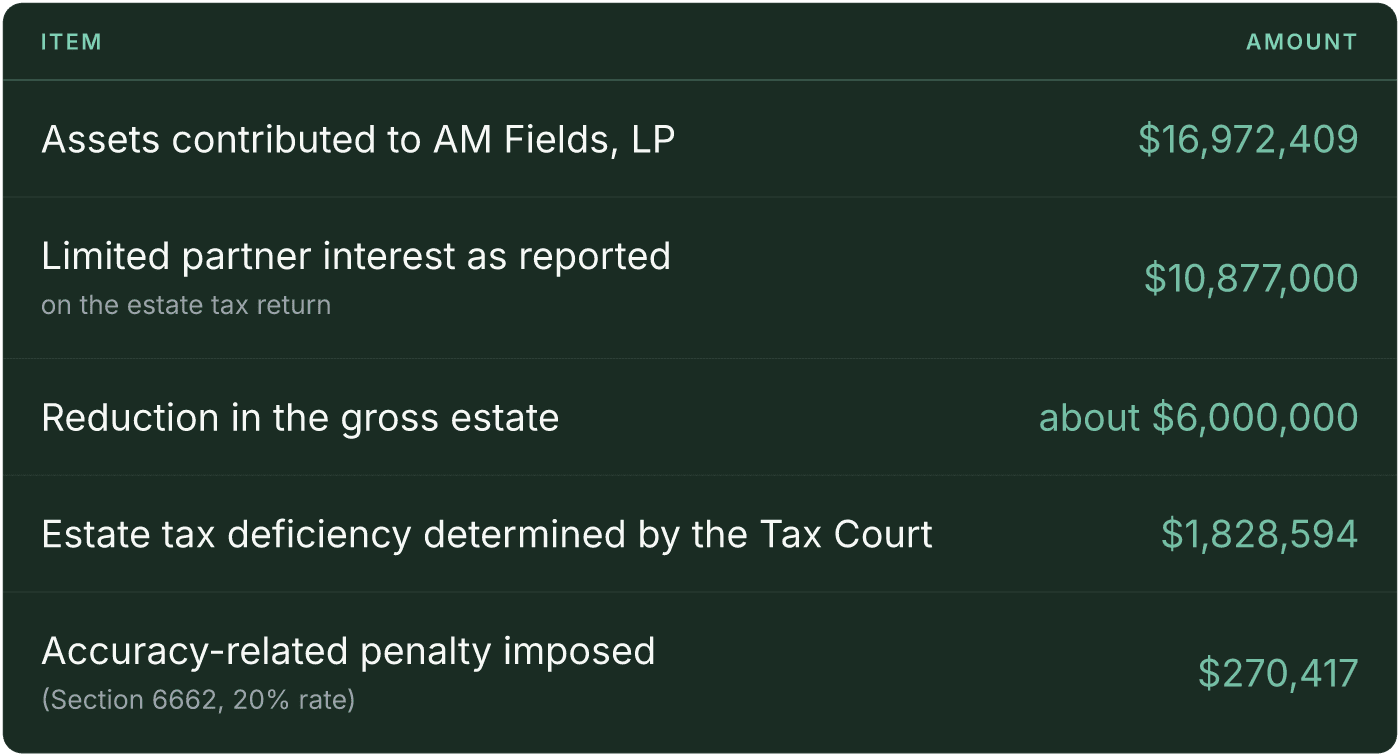

The reported value sat roughly 36% below the assets inside the partnership. The courts didn't argue with the appraisal's discounts. They held that the discounts never mattered, because Section 2036 required the $17 million of assets in the estate instead of the partnership interest.
On appeal, the estate argued only the bona fide sale exception, offering three non-tax reasons: weaknesses in the power of attorney, a need to consolidate the management of complex assets, and protection against elder abuse. The Fifth Circuit found the Tax Court hadn't clearly erred in rejecting all three. Milner had moved $17 million in a month on the strength of that same power of attorney. None of the assets was a working business that needed active management; the brokerage account was professionally managed and the tree farm had been run by a local company for decades. The two incidents of elder abuse had happened in 2011 and 2013, years before anyone formed a partnership.
The court contrasted the facts with Kimbell v. United States, 371 F.3d 257 (5th Cir. 2004), where the partnership held working oil and gas interests that did require active management, and the exception applied.
The penalty that professional advice didn't stop
The 20% penalty is the part every advisor should read twice. Section 6662 imposes it for negligence, and Section 6664(c) removes it when the taxpayer shows reasonable cause and good faith, which reliance on a professional can establish.
The Tax Court found, and the Fifth Circuit agreed, that a $6 million drop from $17 million of assets to an $11 million partnership interest should have struck a reasonable person "as very possibly too good to be true." The estate also couldn't show that its accountant had advised reporting the interest at a discount, or that anyone had told Milner the return's treatment of the partnership was proper. Hiring professionals wasn't enough. What the estate needed was advice on the specific position it took, from someone who had looked at the question.
The valuation misstatement penalties, which turn on how far a reported value sits from the final one, are a separate exposure, covered in the Section 6662 gift tax penalty article.
What the appraisal can and cannot do
An appraisal answers one question: what a willing buyer would pay for this interest on this date. It can't answer whether Section 2036 applies. That depends on why the partnership exists and how the family runs it, and those facts are set long before the appraiser opens a file.
Still, weak facts tend to surface first in the valuation work, and a good report helps the record in three ways.
It values the assets underneath before the interest. A partnership holding shares of a private company needs those shares appraised first, as of the transfer date. The interest-level discounts are then applied to the net asset value. If the underlying value is soft, every number built on it is soft too.
It ties each discount to the partnership agreement. Control and marketability discounts come from the rights the agreement actually gives the holder: distribution policy, transfer restrictions, who can remove the general partner, how the partnership dissolves. A report that applies a generic 35% without reading the agreement invites a challenge on the value itself. It also shows the attorney whether the agreement hands a limited partner the kind of dissolution right Powell treated as a retained power.
It reads as independent. An email asking for a "deeper discount," sent the day the partnership was formed, became one of the six facts the Tax Court counted against the estate. The appraiser works for the number, not for the plan.
For a lifetime gift of partnership units, the appraisal also does one job only a report can do: it lets the Form 709 meet the adequate disclosure rules of 26 CFR 301.6501(c)-1(f)-1), which start the three-year period for the IRS to challenge the gift's value. We walk through what the return must carry in the Form 709 adequate disclosure guide.
A partnership that holds up: what the record should show
Read against Fields, Kimbell and Bongard, the files that hold up tend to share these facts:
- The partnership was formed years before any health crisis, for a reason the family can document at the time, not reconstruct afterward.
- It holds assets that benefit from joint management, such as an operating business or property that needs decisions, rather than a brokerage account that someone else already manages.
- The person contributing kept enough outside the partnership to live on and to pay their own bequests and taxes.
- The assets come from more than one family member, or at least serve a joint enterprise, instead of arriving almost entirely from one person, as the Tax Court noted they did in Fields.
- Nobody sits on both sides of every transaction. In Fields, Milner signed for the incapacitated contributor and for himself.
- The appraisal came from an independent appraiser who was asked for fair market value, not for a target discount.
No list guarantees a result: Section 2036 is decided on the facts, and your attorney judges whether your structure holds. Every item above was missing in Fields.
Where the 2026 numbers leave you
For 2026, the basic exclusion amount is $15 million per person and the annual gift exclusion is $19,000 per recipient (Rev. Proc. 2025-32). A married couple has $30 million between them. Many families who formed partnerships when the exclusion was a fraction of that no longer need the discount to avoid tax, which changes the risk calculation: an FLP that saves nothing still carries the Section 2036 question, and the step-up in basis at death on assets included in the estate may be worth more than the discount.
For families above the exclusion, the partnership can still be sound planning. If you're gifting units before December 31, the year-end choice we laid out in December or January for a gift of private shares applies here too, with one addition: the appraisal of the units should be dated to the gift and should value the assets inside the partnership first.
If you're the attorney or CPA on one of these files, ask two questions before the gift date. Can the family state today, in writing, why the partnership exists apart from the discount? And will the appraisal value the partnership's own assets, private shares included, before it discounts a single unit? If either answer is no, the discount is the first thing the IRS will take. A gift and estate tax valuation built from the assets up, tied to the agreement, and dated to the transfer is what supports the number when the partnership itself stands.
About the author
409.AI Team
Startup valuation and equity workflow specialists
The 409.AI team writes practical valuation content for founders and finance teams preparing 409A reports, equity documentation, and related startup finance workflows.
Related valuation reports
- 409A valuation report: 409.AI helps private companies prepare expert-reviewed 409A valuation reports for equity compensation and option strike price support.
- Pricing for every report type
- 409A valuation calculator
- Sample 409A report