Tax
Marketability Discount for a Minority Business Stake: Mandelbaum Factors
Owners of a minority stake in a family business: how the Tax Court's Mandelbaum factors shape a marketability discount, with a worked example in dollars.
By 409.AI Team - 2026-10-25
# Marketability Discount for a Minority Business Stake: Mandelbaum Factors
You own 30% of a family company, or you advise someone who does. A brother wants out, a parent is gifting shares, or an estate has to report what a minority stake was worth on the date of death. The first number anyone offers is simple: 30% of the business value. The number that survives an IRS review is usually lower, and the gap has a name, the discount for lack of marketability.
This article is for the owner of a small private company and the CPA, attorney or business broker beside them. It explains what that discount is, which facts push it up or down, and how to see the effect in dollars.
Why a minority stake is worth less than its share of the whole
Take a company worth $4,000,000 as a whole. Thirty percent of it is $1,200,000 on paper. A buyer of that 30% gets no say over who runs the company, when it pays out profits or whether it is sold. And the buyer cannot turn the stake into cash on a Tuesday, because no market exists for it. Selling a stake in a private company takes months, costs fees and usually needs the other owners to cooperate.
Valuation separates these two problems:
- **Lack of control.** The holder cannot set pay, distributions or strategy. This reduces value for a stake that has no say. We cover it in [our post on the discount for lack of control](https://www.409.ai/articles/discount-lack-of-control-dloc-409a-gift-tax-valuation).
- **Lack of marketability.** The holder cannot sell quickly at a known price. This is the subject here. Our post on the [marketability discount in a startup valuation](https://www.409.ai/articles/discount-lack-marketability-dlom-409a-valuation) covers the same idea for venture-backed companies, where the inputs differ.
The IRS's own starting point is Revenue Ruling 59-60, which lists the factors for valuing closely held stock and says the degree of control and the marketability of the interest bear on value. You can read it on the [IRS site](https://www.irs.gov/pub/irs-tege/rr59-60.pdf), and we walk through it in [the eight factors of Revenue Ruling 59-60](https://www.409.ai/articles/revenue-ruling-59-60-small-business-valuation-eight-factors).
The case appraisers cite: Mandelbaum
When a valuation of a minority stake in a closely held company is challenged, the argument often turns to one decision. In *Mandelbaum v. Commissioner*, T.C. Memo. 1995-255, affirmed by the Third Circuit in 1996, the Tax Court valued minority interests in a closely held company for gift tax. It did not accept either side's number. It worked through the facts of the company and the stock, and it set the marketability discount at 30%.
The court's reasoning is useful because it is a checklist. Appraisers read it as nine questions about the company and the stake:
1. What do the financial statements show about the company's health? 2. What is the company's dividend policy? A company that pays steady distributions makes a stake easier to hold and easier to sell. 3. What is the nature of the business, its history, its position in its industry and its outlook? 4. Who runs it, and how strong is that management? 5. How much control does the transferred stake carry? 6. Are there restrictions on transferring the shares? 7. How long must a buyer expect to hold the stake? 8. Does the company redeem shares, and under what policy? 9. What would a public offering cost? For a small company this is mostly a thought experiment, since it will never list.
None of these produces a percentage by itself. Each one moves the conclusion up or down from a starting point, and a good report says which way and why.
Which facts push the discount up, and which pull it down
Here is how the questions play out in a small company.
Distributions. A stake in a company that pays out half its profits each year is worth more to a buyer than a stake in one that retains every dollar. If you can show a record of regular distributions, the discount tends to be lower. If the company has never paid one, the buyer waits with nothing in hand, and the discount tends to be higher.
Transfer restrictions. Many family companies have an operating or shareholder agreement that limits who can buy a share, or gives other owners a right of first refusal. A restriction makes the stake harder to sell, which supports a higher discount. A restriction that sets a low formula price is a different matter: for transfer tax purposes the IRS may disregard it, so read the rules in [our post on buy-sell agreements and Section 2703](https://www.409.ai/articles/buy-sell-agreement-price-section-2703-family-business-estate-tax) before relying on one.
Redemption history. If the company has bought back shares from departing owners at fair prices, a holder has a realistic exit, and the discount can shrink. If owners who wanted out were left waiting for years, that history works the other way.
Management depth. If the business depends on one person, a buyer of a minority stake is exposed to that person leaving. That risk is separate from marketability, and it should not be counted twice. We cover it in [key-person discount](https://www.409.ai/articles/key-person-discount-small-business-valuation-owner-dependence).
Size and earnings quality. Steady, well-documented earnings give a buyer comfort. A company whose books are thin or whose owner pay is far from market has a harder time attracting any buyer, and the discount reflects it.
A worked example in dollars
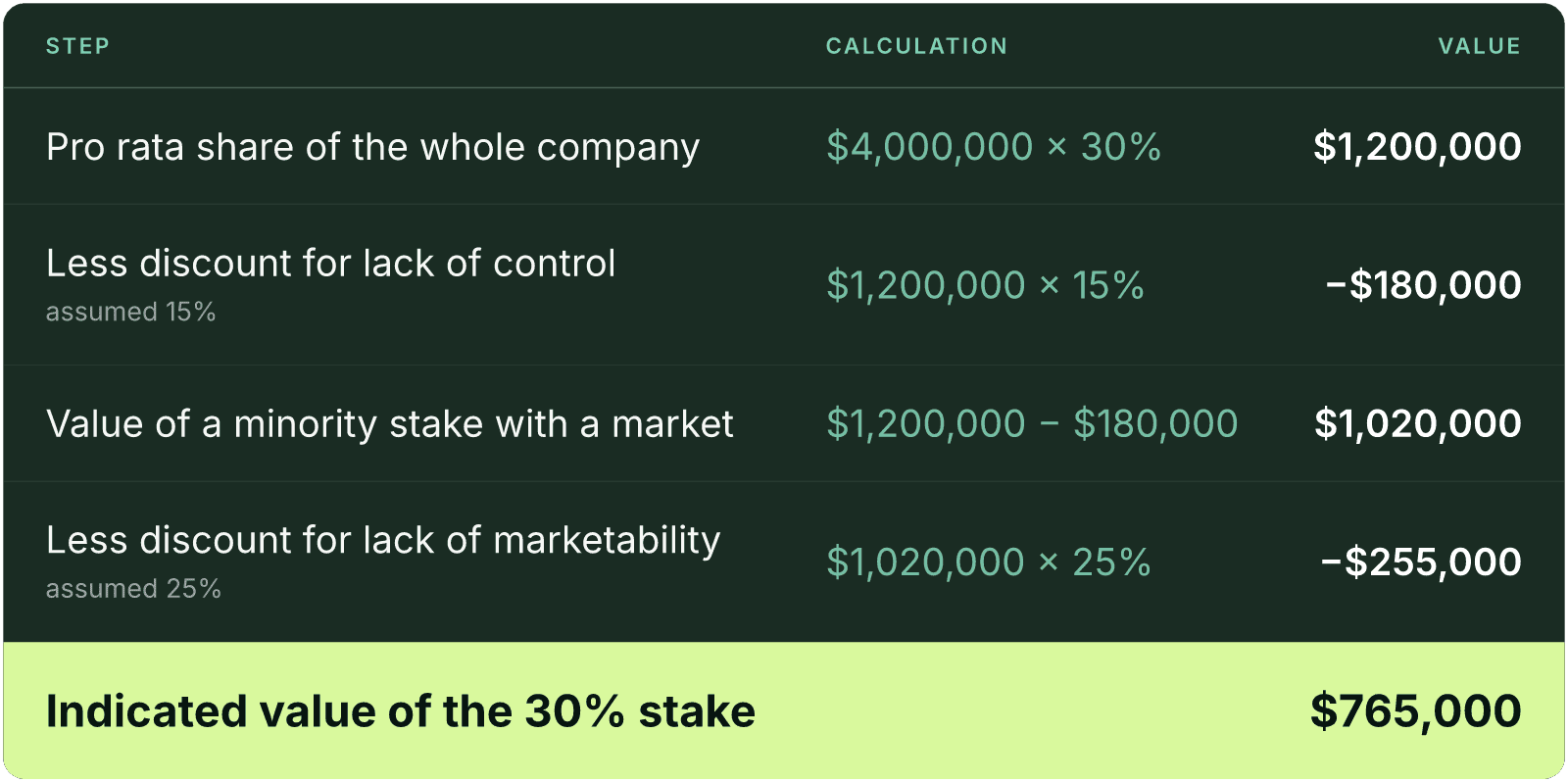
Suppose a family-owned distribution company is worth $4,000,000 as a whole, and a founder's daughter holds 30%. The figures below are illustrative. They show how the steps stack, and they are not benchmarks for any real company.
[](https://www.409.ai/uploads/marketability_discount_minority_stake_family_business_mandelbaum_factors_table_1_002ef986e9.png)
The arithmetic matters here. The two discounts are applied one after the other, not added. Adding 15% and 25% would give 40% and a value of $720,000. Applying them in sequence gives a combined discount of 36.25% and a value of $765,000, a difference of $45,000 on a single stake. A report that adds the percentages is easy to challenge.
The 25% figure is not a rule. It comes from the facts above and from studies the appraiser documents. If the company paid steady distributions and had a redemption record, the appraiser might support a lower number. If it had neither, and the agreement blocked outside buyers, a higher one.
What a defensible report shows
A reviewer, whether the IRS, a lender or the other side in a buyout, looks for the reasoning, not only the percentage. A report is stronger when it:
- Walks through the factors above for this company and this stake, and says which way each one points.
- Explains the source of the discount, such as restricted-stock or pre-IPO studies, and why those studies fit a company this size.
- Applies the control and marketability discounts in sequence, and does not count the same risk twice, for example in both a key-person adjustment and the marketability discount.
- States the valuation date and the standard of value. A buyout between partners may use a different standard from a gift or an estate. See [fair market value versus fair value in a partner buyout](https://www.409.ai/articles/partner-buyout-fair-market-value-vs-fair-value-small-business-standard-of-value).
- Fits the entity's tax status. For S corporations and other pass-through entities, whether to adjust earnings for taxes is a separate decision, covered in [tax-affecting for pass-through entities](https://www.409.ai/articles/tax-affecting-pass-through-entity-s-corp-valuation).
Where this comes up
Gifts are the common trigger. An owner who gives a minority stake to a child reports the gift on Form 709, and the value must be supported. Our post on [adequate disclosure for a gifted stake](https://www.409.ai/articles/form-709-adequate-disclosure-founder-stock-gift) covers the filing side. The same discount logic applies to an estate that holds a minority interest, to a divorce that divides one, and to a buyout in which the leaving partner owns less than half.
In each of these the question is the same. What would a hypothetical buyer pay for this stake, on this date, given that it carries no control and no ready market? A pro rata share of the whole answers a different question.
The takeaway
Before anyone agrees on a price for a minority stake, ask for the percentage discount and the reasoning behind it, and ask whether the control and marketability discounts were applied in sequence. If the number comes from a rule of thumb, it will not hold up when someone checks it. If it comes from the company's distribution record, its transfer restrictions and its redemption history, it can.
If you need an independent value for a minority stake in a small company, the [409.AI small-business valuation](https://www.409.ai/products/smb-valuation) service covers gifts, estates, buyouts and loan appraisals.