Compliance
Your 2027 Budget and Your 409A: Which Forecast the Appraiser Should Get
For founders and finance leads ordering a 409A after year-end: send the board budget or the fundraising deck? How each moves your strike price and what to send.
By 409.AI Team - 2026-11-27
# Your 2027 Budget and Your 409A: Which Forecast the Appraiser Should Get
December is when most startup boards approve next year's budget. It's also when a lot of founders are polishing a fundraising deck with a steeper revenue line than the budget will ever show. Then January arrives, the 409A comes due after the year-end close, and the appraiser's data request asks for one thing that suddenly has two answers: "management projections."
This article is for the founder or startup finance lead ordering that refresh. It covers where a forecast actually moves a 409A, what the Treasury regulation expects the appraiser to consider, why sending the deck instead of the budget costs your employees money, and when a new budget is itself a reason to update the valuation before the next grant.
Where a forecast enters a 409A
A 409A appraiser values the company first and then allocates that value between the preferred and common classes. The forecast can touch the first step in three places.
The most direct is the income approach. A discounted cash flow model takes your projected cash flows, discounts them at a rate that reflects the risk, and adds a terminal value. Every number in it starts with your forecast. We walked through the mechanics in our explainer on the income approach.
The second is the market approach, when the appraiser uses forward multiples. If comparable public companies trade at some multiple of next year's revenue, your next-year revenue is the number that multiple gets applied to. The market approach article covers how the comparables are chosen.
The third is the exit scenario. In a probability-weighted or hybrid method, the appraiser models what the company might sell for and when. Projected revenue at the exit date is usually where those values come from.
How much any of this matters depends on what else the appraiser has. A company that closed a priced round three months ago will usually be valued mostly by backsolving to that round, and the forecast plays a supporting role. A company whose last priced round was two years ago, or one with real revenue and no recent transaction, leans much harder on the forecast. That second group is exactly who's ordering a refresh in January.
What the regulation asks for
Treasury's regulation under Section 409A lists the factors a reasonable valuation method considers, as applicable, including "the present value of anticipated future cash-flows of the corporation" and "the market value of stock or equity interests in similar corporations." It then adds the sentence that matters here: a method is not reasonable if it does not take into consideration "all available information material to the value of the corporation" (Treas. Reg. 1.409A-1(b)(5)(iv)(B)).
The older authority points the same way. Revenue Ruling 59-60, the IRS's 1959 ruling on valuing closely held stock that appraisers still cite, describes a valuation as a prophecy about the future that has to rest on the facts available at the valuation date (Rev. Rul. 59-60, 1959-1 C.B. 237, section 3.03).
Read together, the two say something simple. The appraiser should see the forecast the company actually believes on the valuation date, and should know about any other forecast that exists. Picking one and hiding the other is how a report stops being reasonable.
The deck and the budget, side by side
Here's an illustrative company. It closed 2026 at $5 million of revenue and holds $8 million of cash. The fundraising deck shows $15 million of revenue in 2027. The budget the board approved in December shows $10 million. Suppose the appraiser's market approach applies a 4.0x multiple to next year's revenue.
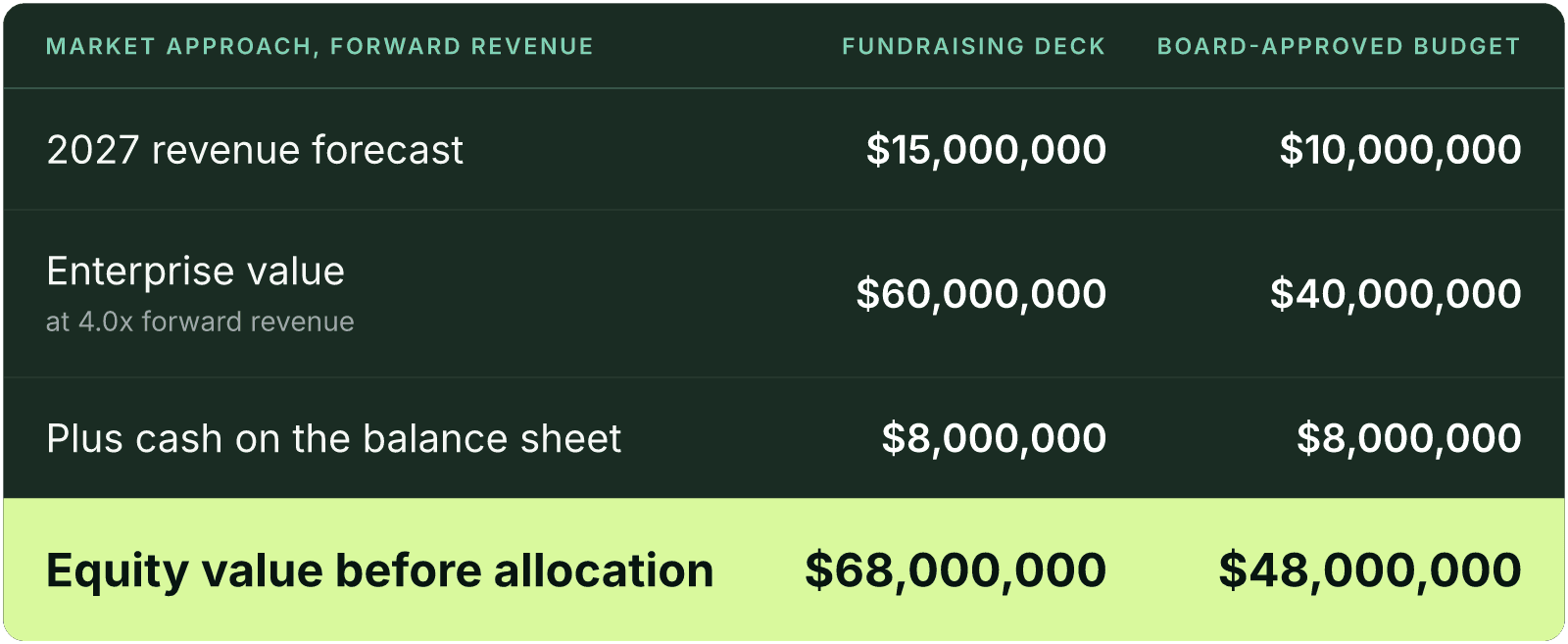

The deck produces an equity value $20 million higher, about 42% more than the budget supports. And common stock usually feels the gap more than that, because the preferred stock's liquidation preferences take a fixed slice before common sees anything. If $30 million of preferences sits ahead of common, the value above the preferences is $38 million under the deck and $18 million under the budget. An option pricing model doesn't allocate by straight subtraction, so the real gap in the common price lands somewhere in between, but the direction holds: a more optimistic forecast raises the strike price on every option you grant next.
That's the part founders miss. A higher 409A isn't a compliment. It's a higher exercise price for the engineers you're about to hire, a smaller spread for them when the company does well, and less room under the $100,000 ISO limit for each grant.
Why not just send the conservative one?
If the deck pushes the price up, the obvious move is to send the most cautious forecast you can justify. That fails for a different reason.
The 409A is read by people other than the appraiser. Your auditor tests the 409A behind the grant-date fair value in your ASC 718 expense, and one of the first things they compare is the forecast in the valuation against the plan in your board minutes. If the 409A used a forecast the board never saw, or one well below the plan it approved, expect questions. We covered what auditors test in our article on the first audit and the 409A.
The IRS can ask the same question in an examination, and under the regulation a method that leaves out material information the company had isn't reasonable in the first place. And if the company ever files for an IPO, the SEC staff routinely asks companies to explain how the fair value of their common stock moved over the grants before the offering. A sandbagged forecast in an old report is hard to explain in that letter, as our article on cheap stock describes.
So the cautious forecast isn't the safe one. The defensible one is.
Which forecast to send
Send the forecast the company runs on. For most startups that's the budget the board approved, with the date of approval, because it's the plan management is accountable for and the one the auditor will find in the minutes.
If a more aggressive deck exists and has been shown to investors, tell the appraiser about it rather than leaving it out. Explain what it assumes that the budget doesn't: a new product line, a hire plan funded by the round you haven't closed, a pricing change. A good appraiser can treat it as an upside scenario with its own weight instead of the base case. That's a far better position than having the appraiser, or later the auditor, find it on their own.
If the budget has a downside case, send that too. Scenario weighting works best when the appraiser can see the range management itself considered.
How an appraiser treats a forecast they doubt
Appraisers don't take a forecast at face value. The first thing many will do is compare your past forecasts with what actually happened.
Say the board budgeted $7 million of 2026 revenue last December, and the year closed at $5 million, about 29% short. When the 2027 budget now shows $10 million, the appraiser will reasonably ask why this plan is more reliable than the last one. They can respond in a few ways: add a company-specific risk premium to the discount rate in the DCF, put more weight on a lower scenario, or lean more on methods that don't use the forecast at all.
None of that is a penalty. It's the appraiser doing what the regulation asks. But it means a credible explanation of last year's miss (a delayed launch, a customer that slipped a quarter, a deliberate shift in pricing) is worth including with the data request. It's also why last year's budget and actuals belong in the file, next to this year's plan.
When a new budget is a material event
The same regulation that requires all available information also limits how long an old value stays usable. A value calculated earlier isn't reasonable if it "fails to reflect information available after the date of the calculation" that may materially affect the value, and it can never be used more than 12 months after its date (Treas. Reg. 1.409A-1(b)(5)(iv)(B)). The regulation's examples are the resolution of material litigation and the issuance of a patent, but the principle reaches further.
A routine budget that roughly matches the plan the appraiser already used isn't news. A budget that changes the picture is. If your December plan cuts next year's revenue in half after a lost customer, or comes with a layoff, a valuation dated in September no longer reflects what the board knows. The same is true in the other direction, if the board just approved a plan built on a signed contract that doubles revenue. In either case, refresh the 409A before the next grant rather than after it. Our articles on how often to get a 409A and on timing grants around a bridge round cover the other events that start the same clock.
What to put in the data request
For a refresh after year-end, the forecast part of the file is short:
- the board-approved budget for the coming year, with the date the board approved it;
- the prior year's budget next to the prior year's actuals;
- any projections shared with investors in the last twelve months, labelled as such;
- the key assumptions behind each (customer count, pricing, hiring), in a sentence or a tab;
- a paragraph explaining where the versions differ and why.
That's an afternoon of work for a finance lead who already built the budget. It shortens the back-and-forth with the appraiser, and it answers the auditor's first question before it's asked.
The takeaway
The forecast in your 409A should be the one you would defend in front of your own board, because sooner or later someone will hold it up against your board minutes. Send the approved budget as the base case, disclose the deck instead of hiding it, and explain last year's miss in your own words. If you're ordering a 409A valuation after the year-end close, have the budget's approval date in hand before the first grant of the new year.
About the author
409.AI Team
Startup valuation and equity workflow specialists
The 409.AI team writes practical valuation content for founders and finance teams preparing 409A reports, equity documentation, and related startup finance workflows.
Related valuation reports
- 409A valuation report: 409.AI helps private companies prepare expert-reviewed 409A valuation reports for equity compensation and option strike price support.
- Pricing for every report type
- 409A valuation calculator
- Sample 409A report