Compliance
The Hybrid Method in a 409A: How Common Stock Is Priced When an Exit Is in View but Not Certain
A signed LOI does not make an exit certain. How the 409A hybrid method blends PWERM and OPM, and how a CFO should test its exit probability and timing inputs.
By 409.AI Team - 2026-10-21
# The Hybrid Method in a 409A: How Common Stock Is Priced When an Exit Is in View but Not Certain
Your board has a signed letter of intent. The buyer's price is on paper, diligence has started, and a closing is pencilled in for the spring. Meanwhile the team still needs option grants, and the last 409A was built on a financing round from nine months ago. The appraiser says the new report will use the "hybrid method," and the draft shows two columns of numbers and a probability you have never seen before.
This post is for the CFO or finance lead in that position. It explains what the hybrid method does, when a 409A should switch to it, the two inputs it adds, and how a board can test them before it approves a strike price.
Where the hybrid method sits
A 409A starts by estimating the equity value of the company. It then has to split that value among preferred stock, common stock and options, because common stock is not worth the same per share as the preferred that was sold in the last round. The AICPA's guide on valuing privately held company equity issued as compensation describes three families of allocation: the option pricing method (OPM), the probability-weighted expected return method (PWERM), and hybrid methods that combine them. Our earlier post on [OPM, PWERM and backsolve](https://www.409.ai/articles/409a-allocation-methods-opm-pwerm-backsolve) covers the first two in detail. A short version is enough here.
The OPM treats each class of stock as a call option on the company's total equity value. The strike prices of those options sit at the points where the payout among classes changes, such as the liquidation preference of the preferred. It models one uncertain liquidity event at some point in the future, and it needs a volatility input. It is the standard choice when nobody can say what the exit will look like.
PWERM picks specific outcomes, such as a sale at a named price or an IPO, estimates what each class receives in each one, discounts those payouts back to today and weights them by probability. It is the right tool when the outcomes are concrete.
The hybrid method takes one branch from each. According to [Mercer Capital's summary of the AICPA guide](https://mercercapital.com/insights/posts/2019/valuation-methods-for-private-company-equity-based-compensation), it may fit a company that has visibility into a particular exit path but still faces uncertainty over whether that path falls through. The visible exit gets the PWERM treatment. The case where it fails gets an OPM.
When to switch from the OPM
Think of the choice as a question about what the board actually knows.
If the honest answer is "we will probably sell or list someday, in three to six years," an OPM or a backsolve calibrated to the last round models that well. Adding a precise exit scenario would claim knowledge you do not have.
If the honest answer is "a buyer has signed an LOI at a stated price and we expect to close in about six months, though deals die in diligence," an OPM alone is a poor fit. It treats the company as having a single, distant liquidity event, so it ignores a price you can read. A PWERM alone has the opposite flaw: it would assume the deal closes, and give no value to the case where the company stays private and its common stock keeps its option-like payoff.
The hybrid method answers both problems. It prices the visible exit through the actual waterfall and keeps an OPM for the failure case. The same logic applies to a company with an IPO process under way, where the filing is real but the window is not guaranteed. Our post on [the cheap stock problem before an IPO](https://www.409.ai/articles/cheap-stock-pre-ipo-409a-sec-option-grants) explains why the SEC reads grants made in that period closely.
The AICPA guide gives four criteria for choosing any method, as Mercer Capital summarizes them: the method should fit a going concern and the expected timing of cash flows, it should assign some value to common stock, its results should be replicable from the same data and assumptions, and its complexity should suit the company's stage. A hybrid is more complex than an OPM, so the fourth criterion is the one to check. A seed-stage company with no exit in view does not need it. A company with a signed LOI usually does.
What the two branches compute
Branch one, the exit happens. The appraiser takes the expected exit value, here the LOI price, runs it through the capital structure, and finds what a share of common receives after preferred holders take what their terms entitle them to. That is the same mechanics described in our post on [liquidation preferences and the waterfall](https://www.409.ai/articles/liquidation-preferences-waterfall-common-stock-exit). The result is discounted from the expected closing date back to the valuation date.
Branch two, the exit fails. The appraiser assumes the company stays private and values common stock with an OPM, using a longer time to liquidity and a volatility drawn from comparable public companies. This is usually the lower number, because the failed-deal company has lost time and probably some momentum.
The blend. The two common values are weighted by the probability that the exit closes. A marketability discount, covered in our post on [the discount for lack of marketability](https://www.409.ai/articles/discount-lack-marketability-dlom-409a-valuation), is then applied as the facts require.
A worked example
The numbers below are illustrative, not from any real company. A startup has an LOI at $90 million. Run through its waterfall, the sale branch values a share of common at $2.10 after discounting to the valuation date. If the deal fails, an OPM on the standalone company values a share of common at $0.95. The appraiser assigns a 70% probability that the sale closes.
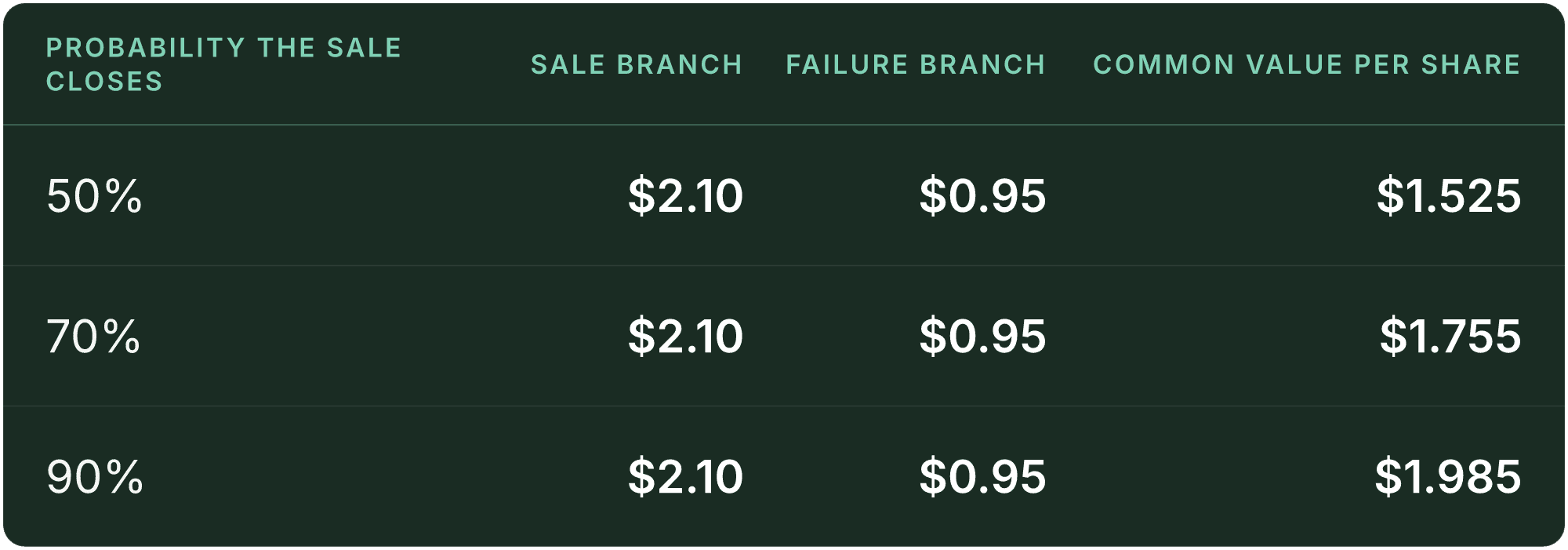
The weighted value is 70% x $2.10 plus 30% x $0.95, which is $1.47 plus $0.285, or $1.755 per share before any marketability discount. The weights are the whole story, so the next table shows how sensitive the answer is to them.
[](https://www.409.ai/uploads/hybrid_method_409a_pwerm_opm_exit_probability_signed_loi_table_1_f19a736f43.png)
Each ten points of probability moves the common value by $0.115, which is 10% times the $1.15 gap between the two branches. Moving from 70% to 90% lifts the strike price from $1.755 to $1.985, about 13%. The probability is the input an employee, an auditor or an IRS examiner will ask about first, because it is a judgment and the arithmetic is not.
The two inputs the hybrid method adds
Exit probability. The report should say what supports the number: the stage of the process, whether the LOI is binding on price, what diligence is still open, any financing condition, and the buyer's track record on similar deals. A signed LOI is evidence, but LOIs are routinely renegotiated. A report that moves from a low probability to near certainty between two valuations should name the event that justified it.
Exit timing. The sale branch is discounted from the expected closing date, so a later close lowers the value. The failure branch also depends on timing, since the OPM's time-to-liquidity input sets how much option value common retains. A six-month close and a twelve-month close produce different numbers, and the board should ask which date the report used and why.
How a board should test the inputs
Before approving grants on a hybrid-based report, a board or CFO can ask a short list of questions.
- Does the probability match what the deal team tells you in private? If the CEO would say "60-40" in the hallway, a 90% in the report needs a documented reason.
- Is the exit price the same number the board has seen in the LOI, and does the waterfall reflect every preference, participation right, escrow and management carve-out that would take value ahead of common?
- Do the timing assumptions agree with the closing timeline in the deal documents?
- Does the failure branch assume something realistic, a company that lost a quarter and still needs financing, or a business as usual that flatters common?
- Has anything changed since the valuation date? A price cut or a new bidder is a material event, and our post on [when to update a 409A](https://www.409.ai/articles/409a-valuation-frequency-how-often-should-you-get-one) explains why the report may need to be refreshed.
Keep the answers with the report. Treasury Regulation 1.409A-1(b)(5)(iv)(B), which you can read at [Cornell's Legal Information Institute](https://www.law.cornell.edu/cfr/text/26/1.409A-1), says a valuation is not reasonable if it fails to reflect information available after the valuation date that may materially affect value. Our post on [what actually earns the safe harbor](https://www.409.ai/articles/409a-safe-harbor-price-vs-qualified-appraiser) goes through how that presumption works in practice.
What it means for your next grant
If you have a signed LOI, a letter from a banker or an IPO filing in motion, ask your appraiser one direct question before the report is final: which method does it use, and what exit probability and date did it assume? A hybrid with a documented 70% and a stated closing date is something the board can approve with a clear record. If the report still uses a plain OPM because the last round was nine months ago, ask why the visible exit is left out. Our post on [a letter of intent and a stale 409A](https://www.409.ai/articles/letter-of-intent-409a-stale-option-grants-before-acquisition-closes) covers that first step.
If you want a report that shows its hybrid inputs on one page, see [409.AI's 409A valuation](https://www.409.ai/products/409a).