Equity
Bridge Round Before Your Next 409A: When a Flat Extension Resets the Strike Price
A bridge round can make a recent 409A stale before 12 months pass. A five-question test for founders and finance leads deciding whether to grant options now.
By 409.AI Team - 2026-10-19
# Bridge Round Before Your Next 409A: When a Flat Extension Resets the Strike Price
A founder closes a $1.5M bridge in October. The last 409A is eight months old, comfortably inside the 12-month window, and a new hire is waiting on an offer letter with an option grant. The finance lead checks the date, sees it's fresh, and moves ahead. Three weeks later the board is reading a term sheet for a Series A.
This post is for the founder or startup finance lead who has to decide whether a bridge round counts as the kind of new information that makes a recent 409A stale. The 12-month clock is only half of the rule. The other half is about what you know, and a bridge usually teaches you something about value.
The rule has two tests, not one
For stock that isn't publicly traded, the regulation under Section 409A asks for a value determined by "the reasonable application of a reasonable valuation method." The text sits in [Treas. Reg. §1.409A-1(b)(5)(iv)(B)](https://www.law.cornell.edu/cfr/text/26/1.409A-1). It lists the factors a method has to weigh, including the company's assets, its anticipated cash flows and the values of comparable businesses.
It then gives two ways a value you already hold stops being usable. The first is age: a value calculated with respect to a date more than 12 months earlier is not reasonable. The second is information: a previous value isn't reasonable if it fails to reflect information that became available after the calculation and may materially affect the company's value. The regulation's own examples are the resolution of material litigation and the issuance of a patent.
A good independent appraisal gets a presumption of reasonableness if it is dated no more than 12 months before the grant. The presumption helps with the first test. It doesn't repair a report that ignored something material. Our guide to [how often you should get a 409A](https://www.409.ai/articles/409a-valuation-frequency-how-often-should-you-get-one) walks through the calendar side, and the [safe harbor comparison](https://www.409.ai/articles/409a-safe-harbor-price-vs-qualified-appraiser) explains what the presumption does and doesn't protect.
Why a bridge is information about value
A bridge round is rarely just cash. Three features carry information the last report didn't have.
The price or cap. If the bridge is priced above the last round's valuation, the report's market evidence is out of date upward. If it's a flat or down extension, the report may be too generous, and the strike price is higher than it needs to be. Either way the number moved.
The terms. Notes and SAFEs add instruments that sit ahead of common stock. A discount, a valuation cap, interest and a maturity date change what common holders can expect to receive in an exit. We cover the mechanics in [how SAFEs affect your 409A](https://www.409.ai/articles/how-safes-affect-your-409a-valuation).
The signal about timing. A bridge says the next priced round is coming. A bridge from insiders to extend runway says something different from a bridge led by a new investor who wanted in early. Valuation providers read that difference, and a plain "eight months old" doesn't.
None of this means every bridge forces a new report. A small insider extension on the same terms as the last note, with no change in the plan, may leave the old conclusion standing. The point is that you have to decide, and write the decision down.
A worked example
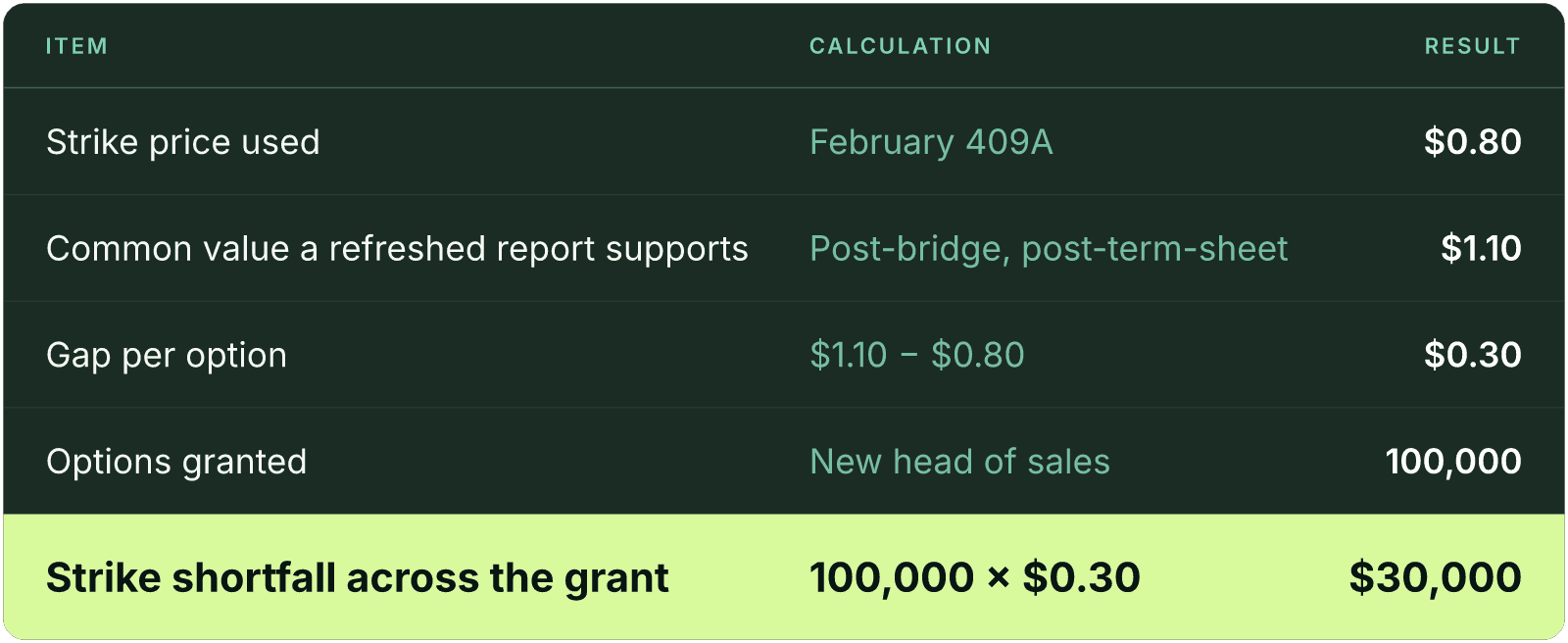
Illustrative numbers. A company has a 409A dated February 20 that put common stock at $0.80 a share. In October it closes a $1.5M bridge on SAFEs with a $15M cap, above the $12M post-money of the seed round the February report relied on. Four weeks later it signs a Series A term sheet. Meanwhile it grants 100,000 options to a new head of sales at the February strike price.
Suppose a refreshed report, run after the bridge and the term sheet, would have put common at $1.10.
[](https://www.409.ai/uploads/bridge_round_409a_material_event_option_grant_timing_table_1_bddf657cfe.png)
The shortfall looks small beside a seven-figure bridge. It matters because of what a below-market strike does to the holder. An option granted at a discount to fair market value is, for tax purposes, deferred compensation that doesn't meet the exemption in the Section 409A regulations. The holder can owe income tax on the spread as it vests, plus an additional 20% federal tax, and the company has reporting and withholding duties it didn't plan for. If the grant was meant to be an incentive stock option, a strike set below fair market value also stops it from qualifying as one, unless the company made a good-faith attempt to price it correctly.
This is why the $30,000 is the wrong number to focus on. The cost lands on a single employee, spread over vesting years, and the problem usually surfaces at the worst moment: in diligence for the Series A, or when an acquirer's counsel reads the grant history. Our post on the [IRS correction notice for discounted options](https://www.409.ai/articles/discounted-stock-option-correction-notice-2008-113) covers how a below-market strike gets fixed, and why the timing of the fix matters.
The table also assumes the refreshed report says what the example says. It might not. The bridge could have landed at a $15M cap and the provider could still conclude that common is worth $0.85. Nobody knows until the work is done, which is the case for doing the work before the grant.
A five-question test before you grant after a bridge
Run these before the board approves any option grant in the weeks after new financing.
1. Did the bridge change the price, the cap or the terms compared with what the last report assumed? If the report used the prior round as its main market evidence, any new priced or capped instrument is new evidence. 2. Is a priced round, a sale process or a tender now likely? A signed term sheet or letter of intent is the strongest signal. The [letter of intent post](https://www.409.ai/articles/letter-of-intent-409a-stale-option-grants-before-acquisition-closes) shows how it plays out when the event is an acquisition. 3. Did the plan, the revenue or the burn change since the valuation date? A bridge often comes with a reset. Slower growth lowers value; a signed enterprise customer raises it. 4. Is the grant large enough to matter? Count the shares, but also check the effect on the $100,000 yearly limit for incentive stock options, which is measured on grant-date value. The [ISO limit guide](https://www.409.ai/articles/iso-100k-limit-409a-grant-date-fair-market-value) has the arithmetic. 5. Can the grant wait? Often it can. Holding an offer's grant until the board meeting after a refreshed report costs a few weeks. A rushed grant on a stale strike can cost the employee real money.
Answer yes to the first, second or third question and the safe move is a refresh before the grant. A refresh doesn't have to mean a full new engagement every time; ask your provider whether a bring-down of the existing analysis for the bridge facts is enough. That's a judgment for the provider and the board to make together, on the facts.
Put the decision in the board file
Whatever you decide, the paper trail is what protects the grant later. For each grant meeting after a financing, the minutes should record the date of the valuation relied on, the bridge terms the board reviewed, and the reason the board concluded the report still reflected fair market value, or the reason it waited for a new one. The [board approval and grant date post](https://www.409.ai/articles/option-grant-date-board-approval-409a-strike-price) explains why the grant date and the approval date have to line up with the valuation you cite.
If you find after the fact that a grant went out on a stale strike, don't wait for diligence to find it for you. The earlier the correction, the cheaper it is.
The takeaway
Treat every financing as a prompt to ask one question before the next grant: does the report on file know about this? If the bridge changed the price, the terms or the likely timing of the next round, the answer is no, however recent the report looks. Date the question, answer it in the board minutes, and hold grants for a refreshed report when the answer is no. If you're sitting on a bridge and have grants queued, [get a 409A valuation](https://www.409.ai/products/409a) that reflects it before the offer letters go out.