Equity
The $100,000 ISO Limit: Why a Higher 409A Turns More of Your Grant Into an NSO
The $100,000 ISO limit is measured in grant-date 409A value, not shares. How refresh grants, cliffs, and acceleration turn incentive options into NSOs.
By 409.AI Team - 2026-09-11
# The $100,000 ISO Limit: Why a Higher 409A Turns More of Your Grant Into an NSO
An engineer at a Series B company exercises 5,000 vested options in March, expecting the usual incentive stock option treatment: no paycheck withholding, an AMT calculation to worry about in April, and a capital gains clock that starts ticking. Instead, payroll withholds federal and state income tax on the spread, takes Social Security and Medicare out too, and the amount lands on her W-2 as ordinary wages.
Nobody made a mistake. Her grant agreement says "Incentive Stock Option" on the cover page, and part of it still is one. The rest quietly stopped being an ISO before she ever clicked exercise, because of a dollar cap that the Tax Reform Act of 1986 put on how many ISOs can come due in a single year. The cap has never been indexed for inflation.
The rule in one sentence
[IRC Section 422(d)](https://www.law.cornell.edu/uscode/text/26/422) says that to the extent the aggregate fair market value of stock with respect to which incentive stock options are exercisable for the first time by an individual during any calendar year exceeds $100,000, those options are treated as options that are not incentive stock options. The limit applies across all plans of the employer and its parent and subsidiary corporations, so an employee cannot reset it by holding grants from two entities in the same group.
Three words in that sentence do most of the damage, and each one trips up a different company.
"Fair market value." Not the strike price, not the spread, not the exercise proceeds. The measurement is the value of the underlying stock, and [Section 422(d)(3)](https://www.law.cornell.edu/uscode/text/26/422) fixes that value as of the date the option is granted. For a private company, that number is the 409A valuation in effect when the board approved the grant. It never moves again for this test, no matter what the company is worth later.
"Exercisable for the first time." Not granted, not exercised. [Treas. Reg. Section 1.422-4(b)(4)](https://www.law.cornell.edu/cfr/text/26/1.422-4) treats an option as first exercisable in a calendar year if it will become exercisable at any time during that year, assuming the service condition is met. In practice that means the vesting year. A four-year grant spreads its grant-date value across four calendar years for this purpose, which is exactly why most early grants never run into trouble.
"Aggregate." Every ISO an employee holds counts toward the same $100,000 in a given year. Refresh grants, promotion grants, and the original new-hire grant all stack.
Why the cap bites later, not earlier
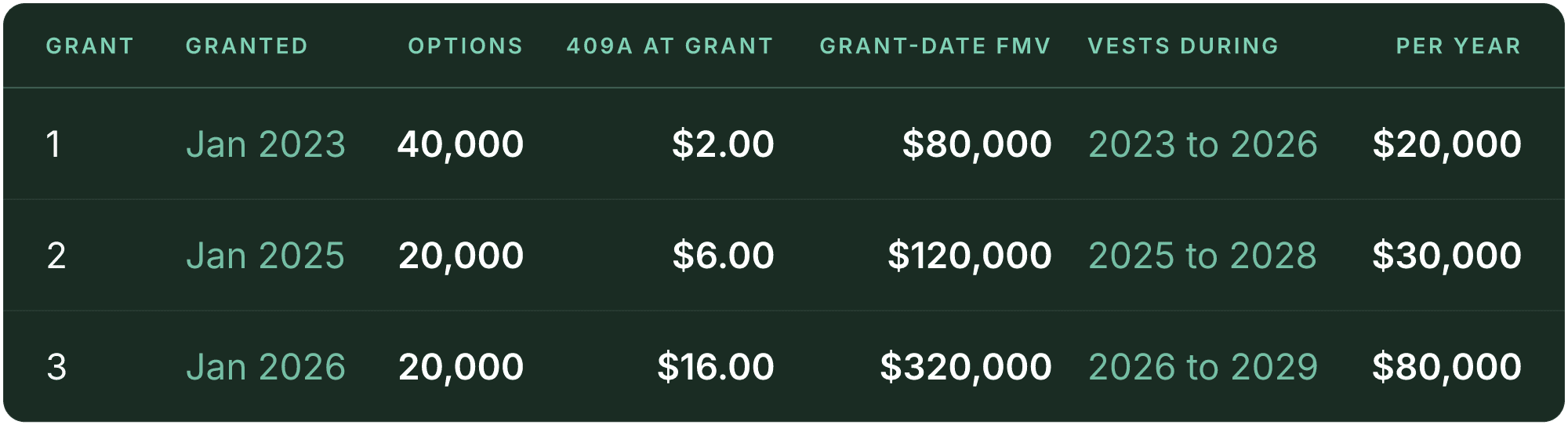
The limit is denominated in dollars of grant-date value, not in shares. So the same option grant consumes more of the $100,000 as your 409A climbs. Consider one employee's grant history at a company whose common stock value keeps rising. Assume each grant is made in January and vests monthly over four years with no cliff, so each calendar year carries a quarter of the grant:
[](https://www.409.ai/uploads/iso_100k_limit_409a_grant_date_fair_market_value_table_1_0b85eb6845.png)
Each grant on its own is fine. Grant 3 is the largest by value but still only puts $80,000 into any single year. The problem shows up in 2026, the one year all three are vesting at once: $20,000 plus $30,000 plus $80,000 is $130,000, which is $30,000 over the cap.
Now the ordering rule decides who takes the hit. [Section 422(d)(2)](https://www.law.cornell.edu/uscode/text/26/422) applies the limit by taking options into account in the order in which they were granted, not the order in which they vest. Grant 1's $20,000 stays an ISO. Grant 2's $30,000 stays an ISO, bringing the running total to $50,000. Grant 3 then gets split: $50,000 of its 2026 vesting fits under the cap and keeps ISO treatment, and the remaining $30,000 is treated as a nonstatutory option. Reg. Section 1.422-4(c)(1) expressly allows a single option to be part ISO and part NSO.
In shares, Grant 3 vests 5,000 shares in 2026 at a $16.00 grant-date value. Of those, 3,125 are ISO shares and 1,875 are NSO shares. The newest and most valuable grant is the one that gets clipped, every time. And 2026 is not a one-off: in 2027, with Grant 1 finished, Grant 2 and Grant 3 still stack to $110,000.
There is a mirror image of this that surprises people after a down round. Because the test uses grant-date value, an option granted at a $16.00 409A still counts $16.00 per share against the cap even if the company's common stock is now worth $7.00. The employee is burning ISO capacity at a price the stock no longer supports. Repricing can fix the economics, but it does not quietly fix this: under [Section 424(h)(1)](https://www.law.cornell.edu/uscode/text/26/424), modifying an option is treated as granting a new one, so a repriced option comes back into the test with a new grant date and a new grant-date value. We walk through the broader mechanics in our guide to [down rounds, underwater options, and repricing the right way](https://409.ai/articles/down-round-409a-underwater-options-repricing).
Acceleration compresses four years into one
Most plans accelerate vesting on a change of control. Reg. Section 1.422-4(b)(4) says an acceleration provision is ignored until it is triggered, and once triggered, the accelerated options are treated as first exercisable in the year of the trigger.
Take the same employee, and assume a January 2027 acquisition accelerates everything unvested. Grant 1 finished vesting in 2026, so it is out of the picture. Grant 2 has $60,000 left and Grant 3 has $240,000 left, and all $300,000 becomes first exercisable in 2027. Applying the ordering rule, Grant 2 stays an ISO in full, $40,000 of Grant 3 squeaks under the cap, and $200,000 of grant-date value, or 12,500 shares, converts to NSO treatment on the spot.
That conversion arrives at the worst possible moment, because a change of control is usually when the spread is largest and everyone exercises at once. The one piece of good news in the regulation: exercises that happen before the acceleration is triggered are protected. Reg. Section 1.422-4(b)(4), illustrated by Example 4 in paragraph (d), confirms that an option exercised earlier in the year keeps its ISO character even if a later acceleration blows past the cap.
Worth noting that acceleration itself is not a "modification" under [Section 424(h)(3)](https://www.law.cornell.edu/uscode/text/26/424), so it does not create a new grant date. It only changes which year the option lands in. If your exit is close enough that the excise tax rules are in play, read that alongside [Section 280G and the shareholder vote that prevents the 20% excise tax](https://409.ai/articles/section-280g-golden-parachute-startup-exit-shareholder-vote).
Two plan design choices that cost ISO capacity
Early exercise. If a grant is exercisable immediately at grant, it is first exercisable in the grant year in its entirety, even though the shares remain subject to repurchase. Examples 1 and 2 in Reg. Section 1.422-4(d) both assume immediately exercisable options and count their full grant-date value in the year granted. Structure Grant 3 above as early exercisable and all $320,000 lands in 2026, stacked on top of the $20,000 and $30,000 still vesting from the two earlier grants. Under the ordering rule, only $50,000 of Grant 3 stays an ISO and $270,000 becomes an NSO. Early exercise is still often the right call for the capital gains clock and the [83(b) election](https://409.ai/articles/the-83b-election-explained-for-founders), but it is not free.
Cliffs. The standard one-year cliff releases 25% of a grant in one lump, and everything that vests monthly after it lands in the same calendar year. Take a July 2026 grant worth $400,000 at grant. With monthly vesting and no cliff, 2026 picks up six months of value, or $50,000, and the peak year carries $100,000. Put a one-year cliff on it and 2026 picks up nothing, while the July 2027 cliff releases $100,000 and the five monthly tranches after it add another $41,667. That single year carries $141,667 before any other grant is counted, which is $41,667 of ISO treatment lost to a vesting start date.
What the NSO portion actually costs
For the ISO portion, exercise creates no regular income tax, and [Section 3121(a)(22)](https://www.law.cornell.edu/uscode/text/26/3121) keeps the transfer out of FICA wages entirely. The spread is an AMT preference item, which matters more in 2026 than it did last year. [Rev. Proc. 2025-32](https://www.irs.gov/pub/irs-drop/rp-25-32.pdf) sets the 2026 AMT exemption at $90,100 for single filers and $140,200 for joint filers. The exemption now begins phasing out at $500,000 and $1,000,000 of alternative minimum taxable income, down from $626,350 and $1,252,700 in 2025, and the One Big Beautiful Bill Act doubled the phase-out rate to 50 cents per dollar. Senior employees at a company with a real 409A reach AMT sooner than they used to.
For the NSO portion, exercise is ordinary compensation income equal to the spread, subject to income tax withholding and payroll taxes, with the employer owing its share and taking a corresponding deduction. For a finance team, that is a cash and payroll problem, not just an employee tax problem, and it is one you want to know about before a tender offer or an exit triggers a wave of exercises. Our comparison of [how ISOs and NSOs are each taxed](https://409.ai/articles/iso-vs-nso-how-stock-options-are-taxed) covers the downstream treatment in detail.
What finance teams should actually do
Track the cap by grant-date value per calendar year, per employee, across every entity in the group. A cap table that only stores share counts and strike prices cannot compute this, because the grant-date 409A is the input and the strike price is only a proxy for it when the option was struck exactly at fair market value.
Designate the ISO and NSO shares in your records. Reg. Section 1.422-4(c)(2) lets a company issue a separate certificate or mark the designation in its transfer or plan records, and doing so is not treated as a modification. Skip it and the default applies: shares are treated as ISO shares up to the $100,000 limit and the excess as NSO shares, which may not be the allocation you wanted.
File [Form 3921](https://www.irs.gov/instructions/i3921) for the ISO portion of each exercise, furnished to the employee by January 31 and filed with the IRS by February 28 on paper or March 31 electronically. The NSO portion goes on the W-2 instead.
And keep the grant-date number defensible. The entire calculation runs on the 409A value in effect when the board approved each grant, which means a stale or unsupported valuation does not just risk the strike price, it corrupts the ISO math for every grant issued against it. If you are unsure whether your current report still carries safe harbor protection, start with [what actually earns 409A safe harbor](https://409.ai/articles/409a-safe-harbor-price-vs-qualified-appraiser) and [when a valuation needs refreshing](https://409.ai/articles/409a-valuation-frequency-how-often-should-you-get-one).
The $100,000 figure has not moved since 1986, while the common stock values it measures against have. Nothing about that is a compliance failure. It is arithmetic, and the companies that handle it well run the numbers at grant approval, when they can still adjust grant sizes, vesting starts, or the split between ISO and NSO grants, rather than discovering them in a payroll run three years later. The input that decides all of it is the grant-date fair market value on your [409A valuation](https://409.ai/products/409a), which is one more reason the report you rely on should be one you can defend.