Financial Reporting
ILPA's Continuation Vehicle Guidance: Your Last Four Quarterly Marks Are the Benchmark
For fund CFOs running a continuation vehicle: ILPA's October 2026 guidance sets the price against your last four quarterly marks. What the file must show.
By 409.AI Team - 2026-11-28
# ILPA's Continuation Vehicle Guidance: Your Last Four Quarterly Marks Are the Benchmark
If you're the CFO or controller of a private equity fund moving an asset into a continuation vehicle around year end, the first thing your LPs will hold the price against is your own reporting. ILPA's final guidance, Continuation Vehicles: Advancing Alignment through Best Practices, published in October 2026, says the election pack should give "details on valuations (at least compared to most recent four quarterly reported valuations or similar)" and "fully justified explanations for deviations from existing valuation(s)."
That sentence turns a year of quarterly Level 3 marks into an exhibit. Every LP deciding whether to sell or roll will read the price next to the four numbers you already sent them, and the LPAC will read it before they do. The valuation file has to be ready for that reading before the pack goes out, because after it goes out the file can only be explained, not improved.
What the guidance asks for, in the fund CFO's terms
The document builds on ILPA's 2023 guidance and calls itself principles-based: its practices "are designed to guide, not dictate." A deal that departs from them isn't a flawed deal by definition, but the departure "should prompt greater transparency, engagement, and disclosure." It isn't a regulation. It's the checklist your largest LPs will bring to the call.
Five of its expectations land on the valuation function:
- The four-quarter comparison. The confidential information memorandum should set the price and multiple against at least the four most recent quarterly reported valuations, with the modeling assumptions used.
- Deviations explained early. Material deviations from the fund's valuation policy, or values inconsistent with an independent valuation or third-party pricing, should reach the LPAC "as early as possible" and every LP no later than the sell-or-roll decision.
- Independent price validation. Evidence of a competitive auction or other third-party validation, "supported by an independent fairness opinion or similar." A strong competitive process may be enough without an opinion, if the GP explains why.
- An opinion wide enough to use. Where there is one, it "should value the totality of the CV asset(s), not simply the lead investor's (often non-controlling) stake." The valuer's scope, prior relationships with the GP, limits the GP imposed and any success-based fee are disclosed to the LPAC.
- The pricing mechanism. The reference date, the adjustments for cash flows after it, and any mechanism that brings the value down to closing.
Then the clock. The election period should run at least 20 clear business days from receipt of the final pack, and the LPAC should get at least 10 business days' notice before the conflicts waiver meeting. Hold on to those two numbers. They matter for the mark later.
Put the four marks and the price on one page
Start with the table ILPA is describing. The figures below are illustrative: a buyout fund moving its whole position in one portfolio company into a single-asset vehicle, with a September 30, 2026 reference date and a negotiated price of $184.0 million.
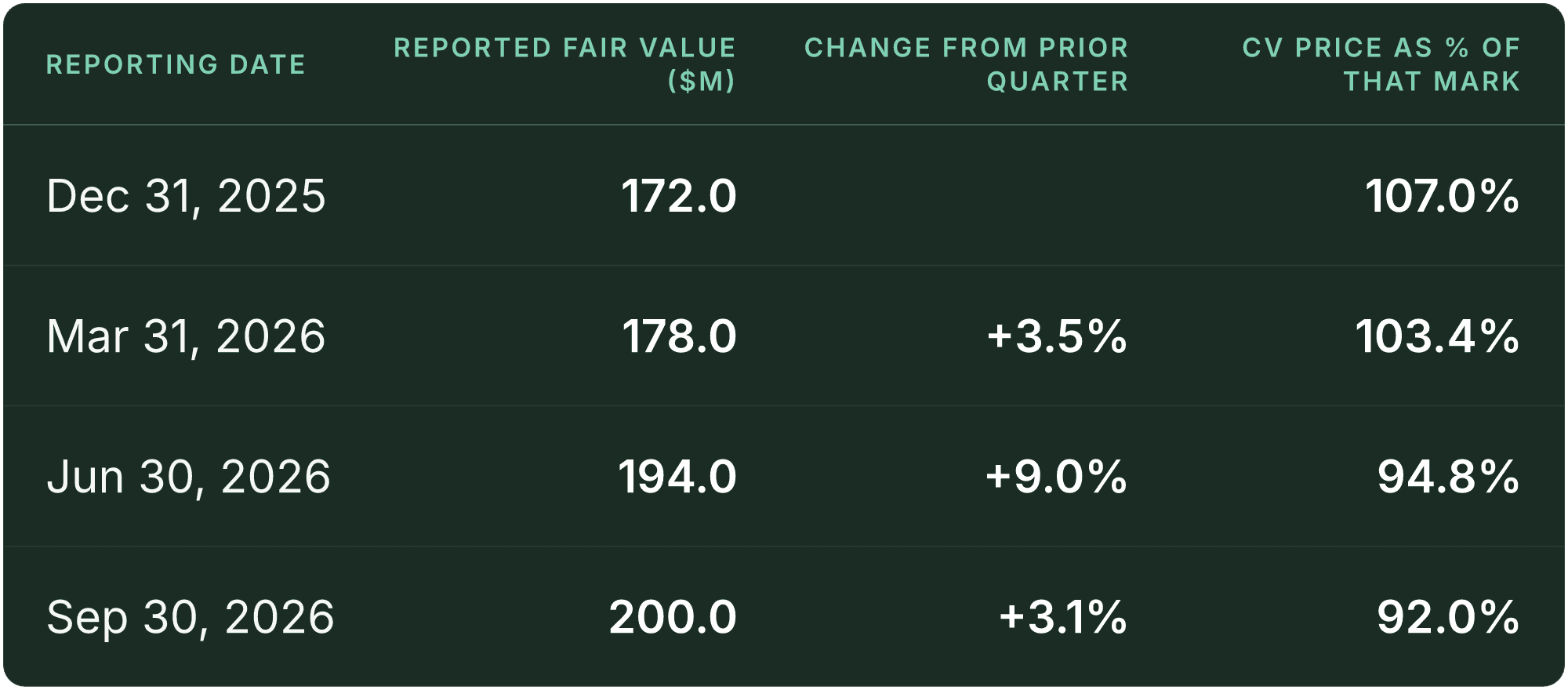

Read it the way an LP's investment committee will. The price is 8% below the latest mark, which invites the first question: is the buyer getting a bargain from a GP that sits on both sides? It is also 7% above the mark of nine months ago, which invites the second: what happened in the June quarter, when the value rose 9% in ninety days, shortly before a sale process began?
Both questions come from the guidance. It tells LPs to assess whether a valuation "reflects recent performance" over those four quarters, and that they "should be able to challenge valuations that seem opportunistic or inconsistent with performance, market conditions, or past reporting." A mark that climbs just before a process sets a higher anchor for the price, and for the carry paid on it. A mark that sags makes a low entry price look fair for a vehicle the GP will keep managing. The four-quarter view exists to expose either pattern.
So the June step needs its own paragraph in the file: which input moved (EBITDA, the multiple, net debt), by how much, and the evidence behind it at the time. If the quarterly memo already says that, you copy it into the pack. If the memo says "updated for performance," you're about to write the explanation under scrutiny, six months late. That is the practical argument for a valuation policy that is followed quarter by quarter and for a calibrated buyout mark whose inputs are named each quarter.
Bridge the September 30 mark to the price, asset by asset
The table shows a gap. The pack has to explain it, and a single sentence about secondary market discounts won't do that. Build a bridge for each asset, sorted by the kind of difference:
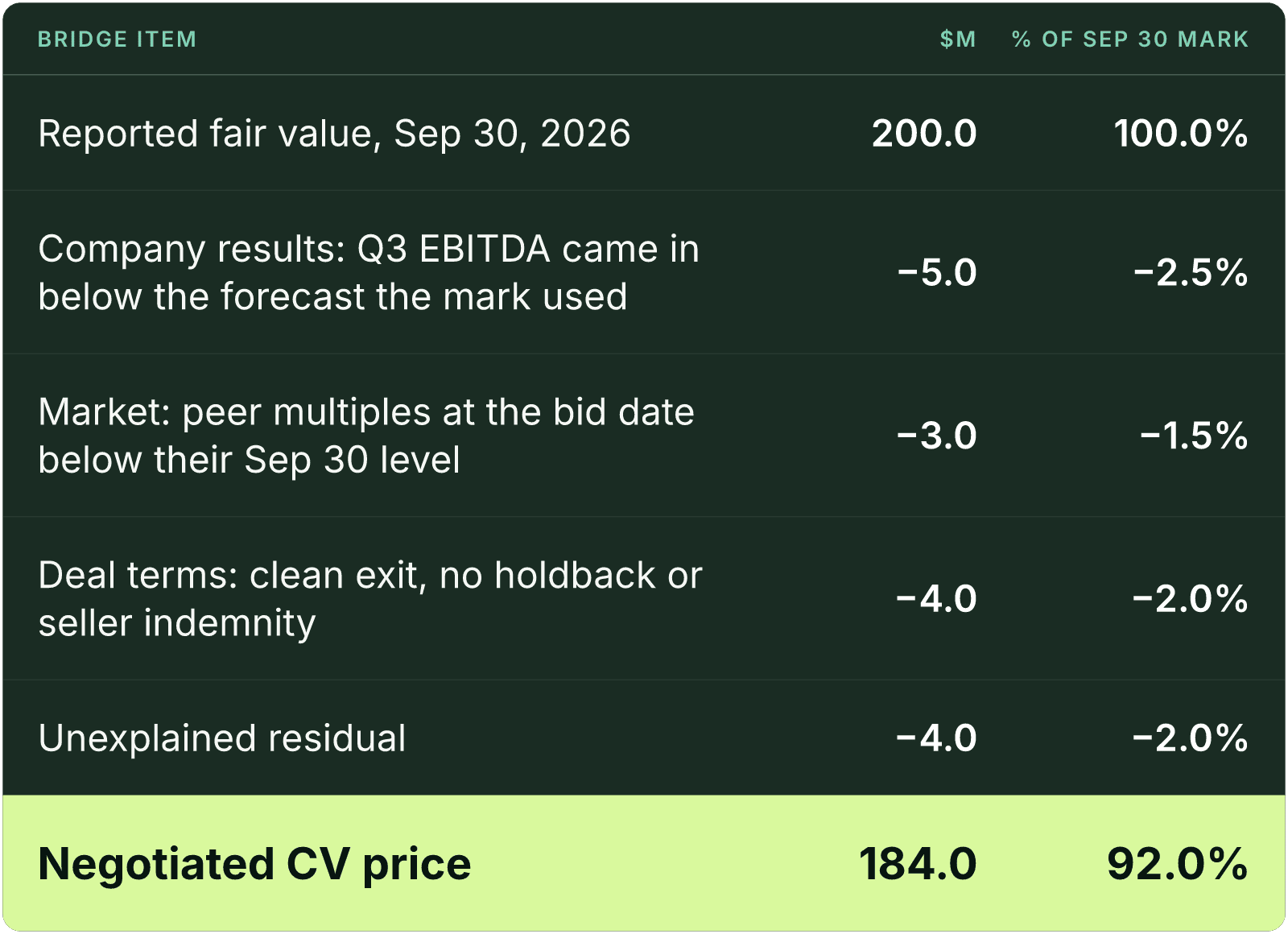

The three explained lines are different in nature, and that's the point of separating them.
Company results and market moves are information about the asset. They're what the guidance means when it asks for "modeling assumptions used," and they carry forward: whatever part of that $8.0 million still holds at December 31 belongs in the legacy fund's year-end mark, whether or not the deal has closed.
Deal terms are information about the transaction. ILPA asks the GP to explain "how the allocation of post-closing risks and liabilities impacts the negotiated price relative to the relevant valuation," and, where a discount is agreed, the "trade-offs between price, liquidity, transaction certainty, and the allocation of risk." A buyer that accepts no holdback pays less than one that keeps recourse. That $4.0 million says something about the contract and little about what the company is worth.
Then the residual. Two percent of the mark with no name on it is the line the LPAC, the fairness opinion provider and your auditor will each ask about. Either you find its cause, or it is evidence that the September 30 mark was high. ASC 820 defines fair value as the price in an orderly transaction between market participants at the measurement date, and a negotiated price for the same position is hard to set aside. We covered that test in detail in what happens to the mark when a continuation fund prices below carrying NAV. The bridge is how you find out before the pack goes out which of the two you're facing.
What the fairness opinion has to cover
A fairness opinion addresses the price. Your marks are a fair value measurement. They overlap without being the same document, and the guidance narrows the room between them in three ways a CFO should check against the engagement letter.
First, scope. An opinion limited to the stake the lead investor is buying doesn't meet the expectation that it value everything transferring to the vehicle.
Second, independence, shown rather than asserted. Scope limits set by the GP, existing relationships and a fee that depends on closing all go to the LPAC, and the GP should make the valuer available to the committee where possible.
Third, dates. LPs are told to look at the "reference date and any mechanism to 'bring down'" the value for changes between that date and closing, and at "post-reference date cash flows or other adjustments." If the opinion is dated in October on September 30 data and the deal closes in January, somebody owns the gap. Decide who before an LP asks.
If your quarterly marks already carry outside support, say so in the pack and show that the opinion provider had that work. The guidance flags values "inconsistent with an independent valuation," and two outside views of one asset that nobody has reconciled read badly. The auditor will look at the same people from another side, as we described in what the auditor tests about an outside valuation specialist.
Twenty clear business days and the December 31 mark
Now the clock. "Clear" business days, in ILPA's footnote, count only complete business days and exclude the day the period begins. Send the final pack on Monday, November 30, 2026, treat December 25 as a holiday, and the twentieth clear business day is Tuesday, December 29. Your fund documents may define business days differently, so count against them. Elections can't close earlier than that, and the closing follows.
By then the September 30 reference valuation is three months old. The guidance names the consequence: longer periods "can make the reference date valuation stale," which leads buyers to ask for material adverse change clauses, price adjustments and holdbacks. Each of those is a deal term that belongs on the bridge.
And two days later you owe a December 31 mark on an asset that is signed but may not be closed. The price is the best evidence you hold, adjusted for whatever changed in the quarter and for the risk that the deal doesn't complete. What arrives in January, including the closing itself, gets sorted by the rule for information that arrives after the measurement date. The year-end mark also resets the carried interest accrual for LPs who haven't yet been paid out.
The file to finish before the pack leaves
Four things, in this order. The four-quarter table for every asset in the vehicle, with the input that drove each quarterly change. The bridge from the reference-date mark to the price, with deal terms separated from value and the residual named or closed. The opinion's scope, date and fee basis, checked against what ILPA tells LPs to ask. A dated chronology of bids, LPAC notices and the pack, because the December 31 mark will be judged on what you knew and when.
None of this changes what the asset is worth. It changes how quickly you can show that the price and your last four reports describe the same asset. For funds that want independent support behind those quarterly marks before a process starts, 409.AI's ASC 820 portfolio valuation is expert-reviewed and scoped per portfolio.
About the author
409.AI Team
Startup valuation and equity workflow specialists
The 409.AI team writes practical valuation content for founders and finance teams preparing 409A reports, equity documentation, and related startup finance workflows.
Related valuation reports
- ASC 820 valuation report: 409.AI helps funds and companies prepare expert-reviewed ASC 820 valuation reports with fair value analysis and Level 3 documentation support for US GAAP reporting.
- 409A valuation report: 409.AI helps private companies prepare expert-reviewed 409A valuation reports for equity compensation and option strike price support.
- Pricing for every report type
- 409A valuation calculator
- Sample 409A report