Financial Reporting
Your Fund's Valuation Firm and the Audit: What the Auditor Tests About an Outside Specialist
Fund CFOs and controllers: your auditor tests the valuation firm, not just its report. See the five SAS 143 checks and the specialist file to hand over.
By 409.AI Team - 2026-10-19
# Your Fund's Valuation Firm and the Audit: What the Auditor Tests About an Outside Specialist
If you are the CFO or controller of a VC or PE fund that pays an outside firm to value its Level 3 positions, you probably think the valuation report is the audit answer. It is not. The auditor reads it as evidence that management still has to stand behind, and year-end audit planning, which usually starts in November, is when the requests for the supporting file arrive.
This article walks through what the auditor evaluates about an outside specialist under the AICPA's current estimates standard, and lists the file a fund should have ready before planning starts.
Why the report is not the end of the conversation
When a fund hires a valuation firm to help measure its portfolio, the firm is a management's specialist: an individual or organization with expertise outside accounting and auditing whose work management uses to prepare the financial statements. The marks remain the fund's. Management signs the financial statements, and the auditor tests whether the estimate behind each mark is reasonable.
SAS No. 143, Auditing Accounting Estimates and Related Disclosures, sits in the codification as AU-C 540. It applies to audits of financial statements for periods ending on or after December 15, 2023, so it is now several audit cycles old. [CBIZ's summary of the standard's effect on private fund audits](https://www.cbiz.com/insights/article/auditing-standards-impact-on-private-fund-audit) notes that auditors ask for more persuasive evidence where management can significantly alter or override a specialist's judgments. That sentence is worth reading twice if your own team edits the firm's draft.
The standard does not ask whether you hired a famous firm. It asks five questions, and each one maps to a document you can prepare in advance.
The five things the auditor evaluates
Per the summaries of the standard from [TXCPA](https://www.tx.cpa/resources/txcpa-magazine/may-june-2024/2024/05/10/cpe--sas-143---new-guidance-on-auditor-s-responsibilities-relating-to-accounting-estimates) and the practitioner guidance cited above, the auditor works through the specialist in this order.
1. Competence and capabilities
Does the firm have the qualifications for this asset class? A firm that values public equities well may not have valued pre-revenue biotech or a structured preferred round. The auditor looks at credentials, experience with comparable positions and the firm's resources. Hand over a short qualification summary and the engagement letter, not a marketing deck.
2. Objectivity and relationship
The auditor asks about the relationship between the specialist and the fund: fees, other services, ownership ties and any pressure over the conclusion. A fee that depends on the value reached is the obvious red flag. A firm that also advises the GP on fundraising materials raises the question too. Document who engaged the firm, who reviews its work and whether any fee depends on the outcome.
3. The method
The auditor checks that the method suits the framework and the asset, is applied consistently from period to period and that the calculations follow the method and are mathematically accurate. A switch from a recent-round calibration to a market approach is not wrong. It does need a written reason, because a change in method is something the auditor evaluates for management bias.
4. The significant assumptions
Discount rates, marketability discounts, volatility, exit timing and probabilities are where the judgment lives. The auditor assesses whether those judgments point to possible management bias and may trace assumptions back to supporting documents. Our article on the [SEC staff's statement on private asset fair value](https://www.409.ai/articles/sec-staff-statement-private-asset-fair-value-calibration-nav) covers calibration and NAV, two places where these assumptions get tested.
5. The data
Was the data the fund gave the firm relevant and reliable? Portfolio company financials, cap tables, the latest round terms and board materials are the usual inputs. If a position was valued on a stale cap table, the best method in the world does not rescue the mark. The auditor looks at where the data came from and whether it matches what the fund used in prior periods.
Management bias, the point estimate and the retrospective review
Three further procedures sit on top of the specialist evaluation.
The auditor evaluates whether indicators of possible management bias exist, such as a pattern of consistently favorable outcomes. If they do, the auditor assesses what follows from that, including questioning management's judgments more closely.
The auditor may develop an independent point estimate or range to compare with yours. Where management has not taken appropriate steps to address estimation uncertainty, the standard says the auditor develops one to the extent practicable. If your mark falls outside the auditor's range, the misstatement is the distance to the nearest point in the range.
The auditor also reviews the outcomes of prior estimates. For a fund, that means exits, secondary trades and follow-on rounds compared with the marks that came before them. Our [back-testing method for fund marks](https://www.409.ai/articles/back-testing-fund-marks-exit-prices-asc-820-disposition-analysis) shows how to run that comparison yourself, before the auditor does.
What the audit team will ask for
The CBIZ summary lists the requests that follow from those procedures. They are specific:
- Everything management provided to the specialist.
- The specialist's findings and conclusions used in the financial statements.
- Evidence of the specialist's qualifications and its relationship with management.
- Evidence of the controls management applies over the use of the specialist's work.
- Support for the estimate, including method, assumptions, data sources and the rationale for changes from the prior period.
- Back-testing of prior-period valuations.
Notice what is on the list besides the report: the fund's own review. The auditor wants proof that someone at the fund read the work, challenged it and approved it. That is the part funds most often leave undocumented.
The specialist file, built for planning
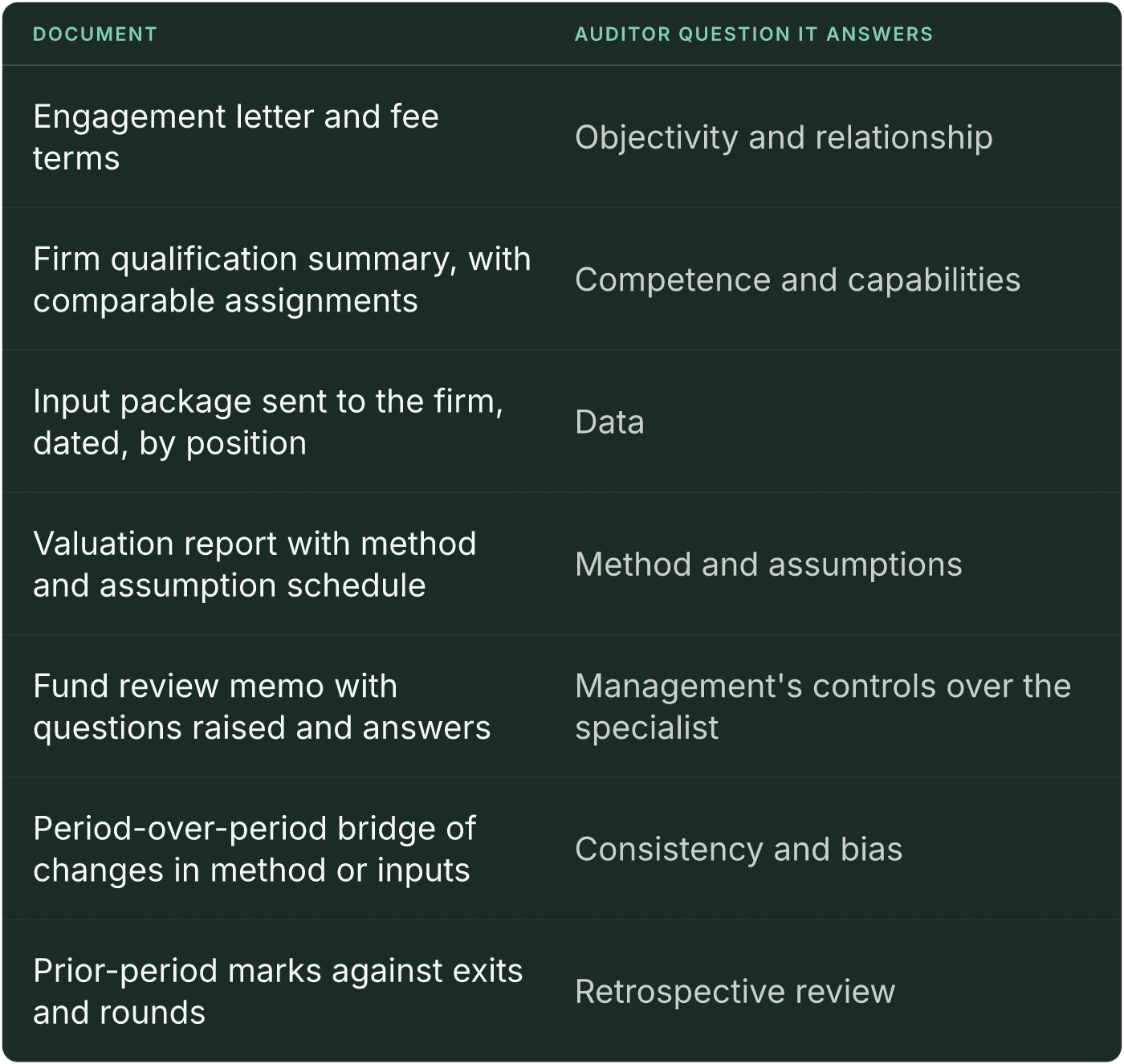
Here is a way to organize it. The column on the right is the question each document answers.
[](https://www.409.ai/uploads/fund_valuation_firm_sas_143_auditor_tests_management_specialist_file_table_1_f43dde48df.png)
An example shows why the review memo matters. Take an illustrative fund with 14 Level 3 positions and a valuation firm that used a 25% discount rate on a Series B position, up from 22% last quarter. If the report says so and nothing at the fund records why, the auditor has to ask, and the answer will be given from memory in a planning meeting. If the review memo records that a lower revenue forecast and a missed milestone drove the move, the question closes in one email. The figures are illustrative; the pattern is not.
Where the valuation policy fits
The specialist file works best when it follows a written process. A valuation policy that names who engages the firm, who reviews the output and who approves the final mark gives the auditor a control to test instead of a story to hear. We cover what auditors and the SEC read in that document in [Nobody Makes You Disclose Your Valuation Policy](https://www.409.ai/articles/fund-valuation-policy-asc-820-audit-sec-exam).
A note on timing
Audit work on year-end marks is bounded by deadlines. If your fund is subject to the custody rule's audited financial statements deadline, the calendar leaves little room to assemble this file in January. Our walkthrough of [back-planning year-end marks](https://www.409.ai/articles/custody-rule-120-day-audit-deadline-fund-year-end-marks) shows how to lay the schedule out. Building the specialist file in November costs a few hours. Building it during fieldwork costs the audit its schedule.
What to do this month
Pull last year's audit request list and compare it with the table above. For each row, write down whether you have the document, who owns it and when it was last updated. Where the row is empty, the gap is cheaper to close now than during fieldwork.
Then check the review memo. If a reviewer cannot show what they challenged and what they accepted, the fund's own control over the specialist is missing, and the auditor will see it.
If your fund needs an outside valuation, [409.AI's ASC 820 valuation](https://www.409.ai/products/asc-820) is reviewed by a valuation expert and starts from $2,999 for one to five assets. Whichever firm you use, the file above is yours to build, and it is what the auditor will test. For the underlying framework, start with our guide to [ASC 820 and the Level 3 problem](https://www.409.ai/articles/asc-820-level-3-fair-value-fund-portfolio-valuation).