Financial Reporting
Equity Refresh Grants: Top-Up, Boxcar or Wait, and What Each One Costs Under ASC 718
For startup CFOs planning refresh grants: how a top-up, a boxcar or a later grant sets the strike and lands in ASC 718 expense, with a worked six-year schedule.
By 409.AI Team - 2026-11-24
# Equity Refresh Grants: Top-Up, Boxcar or Wait, and What Each One Costs Under ASC 718
You're the CFO or controller of a venture-backed startup, and the first wave of hires is two years into a four-year vest. The founders want to keep them, someone has suggested a refresh grant, and the board will be asked to approve one at the next meeting. Before it does, three questions belong on the page: what strike the new options carry, when the expense starts, and what happens to that expense if the person leaves anyway.
A top-up granted now, a boxcar granted now that starts vesting later, and a grant made when the first one runs out look similar in a board deck. They land very differently in the 409A, the tax rules and the ASC 718 schedule your auditor will test.
The two dates that decide everything
Every option has a grant date and a vesting schedule, and a refresh is the one place where companies deliberately pull the two apart.
The grant date fixes the price. For an incentive stock option, IRC Section 422(b)(4) requires an option price not less than the fair market value of the stock at the time the option is granted. For any option that wants to stay outside Section 409A, Treas. Reg. Section 1.409A-1(b)(5) says the exercise price may never be less than the fair market value of the underlying stock on the date of grant. For a private company that number is the 409A valuation in effect the day the board approves the grant, which is why the board approval, not the offer letter, sets the strike. Telling an employee at the halfway mark that "more equity is coming" fixes nothing: there is no strike and no grant-date fair value until the board approves the terms.
The grant date also fixes the accounting. Under ASC 718, the fair value of an equity-classified award is measured at the grant date and never remeasured, and ASC 718-10-35-2 has the cost recognized over the requisite service period, "the period during which an employee is required to provide service in exchange for an award, which often is the vesting period." The FASB glossary defines the service inception date, when that period begins, as usually the grant date. A boxcar puts two years between its grant date and its first vesting day, and the service period starts at the first of them.
Three ways to refresh the same employee
Take an illustrative engineer hired on January 1, 2024 with 48,000 options at a $1.20 strike, vesting monthly over four years after a one-year cliff, fully vested at the end of 2027. In January 2026, halfway through, the company's latest 409A puts common stock at $3.00. The board wants to grant 12,000 more options, a quarter of the original grant. It has three choices:
- Top-up now. Grant 12,000 options in January 2026 at $3.00, vesting monthly over four years, through the end of 2029.
- Boxcar now. Grant 12,000 options in January 2026 at $3.00, with vesting that starts in January 2028, the day the first grant is done, and runs monthly through the end of 2031.
- Wait. Grant 12,000 options in January 2028, when the first grant ends, at whatever the 409A says then. Assume a Series B in between and a $6.00 common value.
To put a fair value on each, we use Black-Scholes with illustrative inputs: 60% volatility, a 4.0% risk-free rate, no dividends, a 10-year contractual term. For the expected term, many private companies use the practical expedient in ASC 718-10-30-20A, added by ASU 2016-09: for an award that vests on service alone, the expected term is the midpoint between the requisite service period and the contractual term. We cover where each input comes from in our guide to Black-Scholes inputs for private companies.
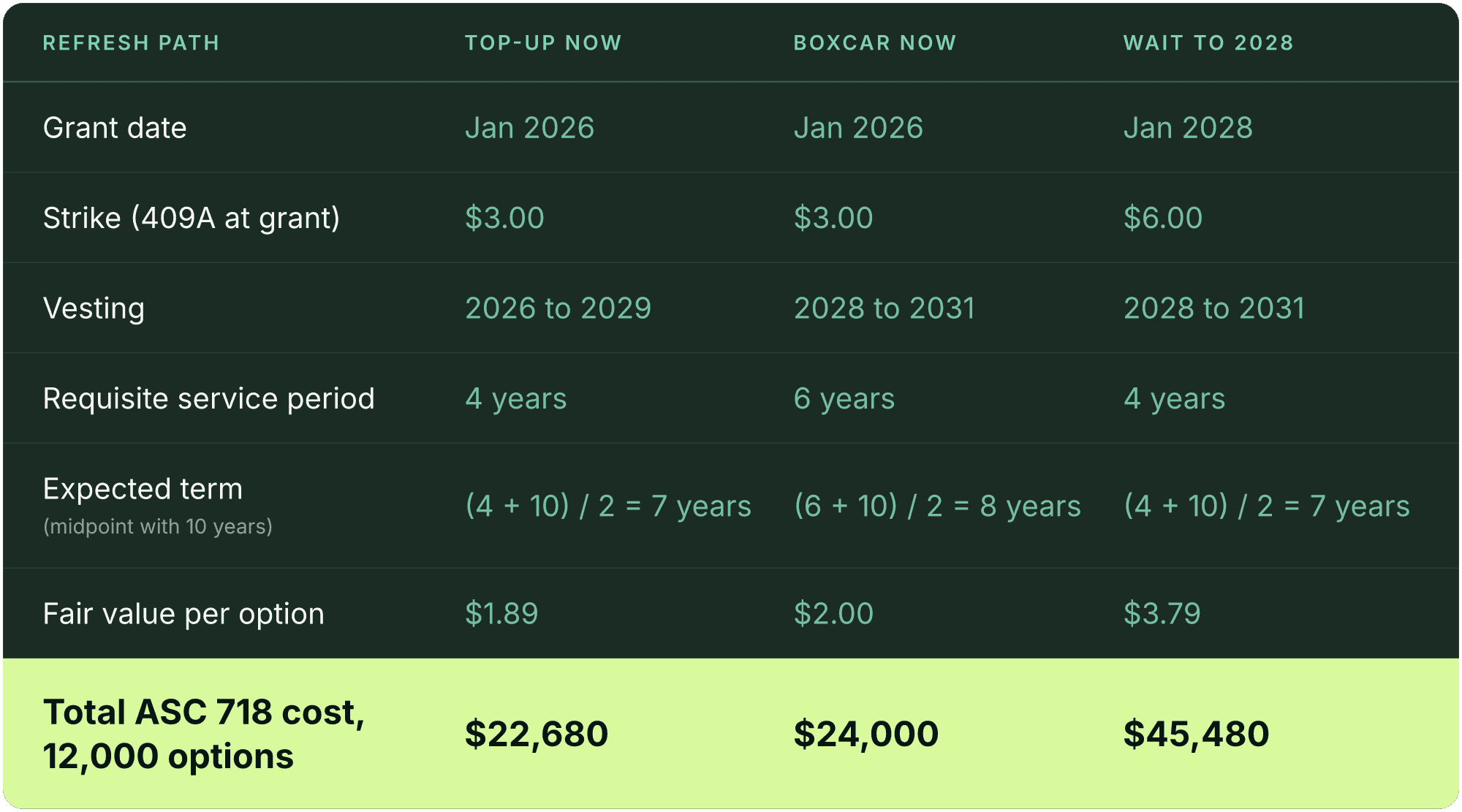

The boxcar and the top-up carry the same strike, because they're granted the same day off the same 409A. The boxcar is worth slightly more per option because its requisite service period runs two years longer, which pushes the expected term out by a year, and a longer-dated option is worth more. Waiting is the expensive path twice over: the employee faces a $72,000 exercise cost instead of $36,000, and the company books roughly twice the expense for the same 12,000 options, because the fair value of an at-the-money option scales with the stock price.
When the expense shows up
The total is half of what your controller needs. The other half is the year-by-year schedule.
Many startups elect, under ASC 718-10-35-8, to recognize a graded-vesting award on a straight-line basis over the requisite service period of the last tranche, rather than treating each monthly tranche as its own award. The paragraph adds a floor: the cost recognized at any date must at least equal the grant-date value of the portion already vested. Here is the engineer's schedule under that election, with the original grant's $36,480 (48,000 options at an illustrative $0.76 fair value) alongside:
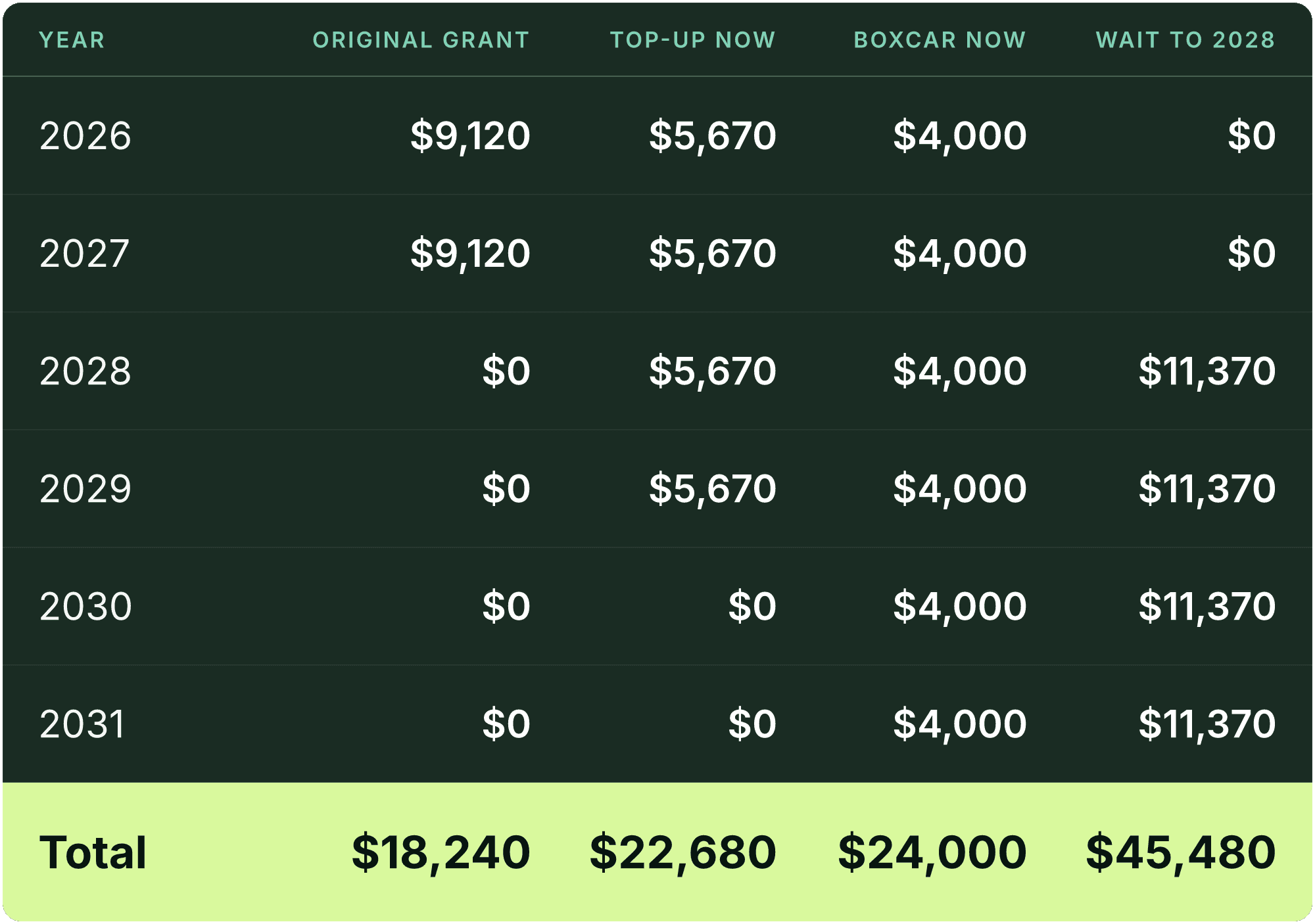

Look at the boxcar column in 2026 and 2027. Nothing vests in those two years, yet the company books $8,000 of expense, because the service period starts at the grant date and the employee has to stay through 2026 and 2027 to earn any of it. The floor never binds: by the end of 2028 the company has recognized half the cost against a quarter vested, and the two lines meet at the end of 2031.
The top-up stacks on the original grant, so 2026 and 2027 carry $14,790 a year for this one person. Refresh a cohort of thirty early hires in the same quarter and that becomes a visible step in operating expense. A boxcar spreads the same cohort's cost across six years instead of four.
Under the graded election of 35-8(a), each monthly tranche gets its own service period from the grant date, and the boxcar's front-loading is heavier than this schedule shows.
What a departure does to each path
Some refreshed employees leave anyway. Under ASC 718-10-35-3, a company either estimates forfeitures up front or recognizes them when they happen, an entity-wide election. Many startups take the second option, and the rule then is blunt: "Previously recognized compensation cost for an award shall be reversed in the period that the award is forfeited."
Suppose the engineer leaves on December 31, 2027, the day the original grant finishes vesting.
- Top-up. Half of it, 6,000 options, has vested, and the $11,340 booked for them stays. The other 6,000 are forfeited before any cost was booked for them under the straight-line schedule.
- Boxcar. None of it has vested. The $8,000 recognized in 2026 and 2027 is reversed in 2027, and the employee walks away with nothing from the refresh.
- Wait. No grant was ever made, so there's nothing to reverse.
The reversal is a credit to expense in the year of departure, which flatters that year's operating loss. It also says something about retention design: a boxcar only rewards staying past the end of the first grant, while a top-up starts paying out immediately.
The same departure triggers the employee's own clock. To keep ISO treatment, Section 422(a)(2) requires the employee to have been employed until three months before exercise, so vested ISOs from the original grant and any top-up have to be exercised within that window or lose their status. Extending the window has its own accounting and tax consequences, covered in what extending the post-termination exercise window really costs.
Three details that trip up a boxcar
The term clock starts at grant. An ISO cannot be exercisable after ten years from the date it was granted, under Section 422(b)(3). A boxcar granted in January 2026 and fully vested at the end of 2031 has about four years of life left after its last tranche vests, against six for the top-up.
The strike is only as good as the 409A behind it. The boxcar's appeal is locking today's price. Under Treas. Reg. Section 1.409A-1(b)(5)(iv)(B), an independent appraisal earns the presumption of reasonableness only as of a date no more than 12 months before the grant, and a value stops being reasonable when it fails to reflect later information that may materially affect the company. A boxcar granted on a 409A that's eleven months old, a few weeks before a term sheet closes, locks in a price an examiner can challenge. The same 409A also feeds the ASC 718 measurement, which is the subject of our ASU 2021-07 current price checklist.
The expected-term shortcut has conditions. ASC 718-10-30-20B allows the practical expedient only for an option granted at the money, with a limited time to exercise after termination (typically 30 to 90 days), that the employee cannot sell or hedge, and with no market condition. A refresh that carries an extended exercise window, or one priced at a premium, needs its expected term estimated the long way.
The ISO limit matters too. The $100,000 cap under Section 422(d) counts options by the calendar year they first become exercisable, at grant-date value (Treas. Reg. Section 1.422-4). A boxcar adds less to any one year than a top-up, but its first tranche still shares a calendar year with the original grant's last one if the two meet mid-year. Our article on the $100,000 ISO limit works through the ordering rule.
What to bring to the board
Before the refresh resolution goes out, put four things in the board pack: the 409A date and whether anything material has happened since, the fair value per option under each structure, the year-by-year expense for the cohort, and the reversal exposure if a share of the cohort leaves before vesting starts. Then the board sees the real trade: earlier vesting and higher near-term expense, or a longer hook with the cost at risk of reversal.
If your auditor will want a grant-date fair value report for the refresh cycle, our ASC 718 valuation measures each grant from the same 409A that prices it. For what that report contains and what auditors test in it, see what an ASC 718 valuation is, and for the full expense mechanics, our ASC 718 guide for startups.
The practical takeaway: a boxcar is not a cheaper refresh. It costs slightly more in total and starts expensing on the day it's granted, two years before the employee sees a single vested share. What it buys is a lower strike than waiting, a smoother expense line than a top-up, and a reason to stay past the end of the first grant, which is the whole point of granting it.
About the author
409.AI Team
Startup valuation and equity workflow specialists
The 409.AI team writes practical valuation content for founders and finance teams preparing 409A reports, equity documentation, and related startup finance workflows.
Related valuation reports
- ASC 718 valuation report: 409.AI helps startups prepare expert-reviewed ASC 718 valuation reports with grant-date fair value analysis to support stock-based compensation expense and audit requests.
- 409A valuation report: 409.AI helps private companies prepare expert-reviewed 409A valuation reports for equity compensation and option strike price support.
- Pricing for every report type
- 409A valuation calculator
- Sample 409A report