Financial Reporting
What Is an ASC 718 Valuation? The Report Your Auditor Asks For After the 409A
Finance leads facing a first audit: what an ASC 718 valuation is, how Black-Scholes inputs become expense, how it relates to your 409A, and what it costs.
By 409.AI Team - 2026-11-04
# What Is an ASC 718 Valuation? The Report Your Auditor Asks For After the 409A
Your auditor sends a request list for the first audited statements, and one line reads "stock-based compensation: grant-date fair value support for all awards." Your 409A report is in the folder. It sets the common stock price, so you assume that line is covered. Sometimes it is, and sometimes the auditor wants a document you have never seen. That document is an ASC 718 valuation, and this primer is for the CFO, controller or finance lead who has just heard the name.
What an ASC 718 valuation is
ASC 718 is the US GAAP standard for share-based payment. It says a company that pays people in options, restricted stock or RSUs has a cost, and the cost belongs in the income statement. The amount is the award's fair value on the grant date, recognized over the period the person has to work to earn it. The standard is Topic 718 of the FASB Accounting Standards Codification.
An ASC 718 valuation is the written support for that grant-date number. It takes each award, or each batch of awards granted on the same terms, and documents how the fair value per award was built, so the expense schedule in your financial statements can be traced to something an auditor can test.
It is not a tax document. A [409A valuation](https://www.409.ai/articles/what-is-a-409a-valuation-a-comprehensive-guide) answers a tax question: is the strike price at least the fair market value of the common stock? An ASC 718 valuation answers an accounting question: what is each option worth, and how much expense does that create each period? The first feeds the second, which is why the two are so often ordered together.
The moment you need one
Nobody needs an ASC 718 valuation because they hold options. They need one because someone is about to read the financial statements:
- **The first audit.** Statements prepared under US GAAP and audited carry the expense. The auditor tests the inputs. The [first-audit checklist for 409A assumptions](https://www.409.ai/articles/first-audit-409a-valuation-au-c-540-assumptions) shows what that testing looks like.
- **An institutional round.** Investors diligence the cap table and the financials, and a missing or unsupported expense schedule slows a close.
- **IPO preparation.** Years of grants have to be measured and supported at once, under a securities regulator's eyes.
- **A change to an award.** A repricing after a down round, or any other modification, creates a new measurement. The [post on underwater options and repricing](https://www.409.ai/articles/down-round-409a-underwater-options-repricing) covers why that surprises teams.
If you only prepare tax-basis books and nobody audits you, the pressure is lower. The expense still exists, but nobody is asking for the schedule yet.
What goes into the number
For a stock option, the fair value comes from an option-pricing model. Most private companies use Black-Scholes, which needs six inputs: the current price of the underlying share, the exercise price, the expected term, the expected volatility, the risk-free interest rate and the expected dividend yield. Awards with market conditions, such as a vesting hurdle tied to a share price, usually need a lattice or Monte Carlo model instead.
Three of those inputs have no direct source in a private company:
- **Current share price.** This is the 409A common stock value, or a value built on the same principles. FASB's [ASU 2021-07](https://storage.fasb.org/ASU_2021-07.pdf) gave nonpublic entities a practical expedient for equity-classified awards: the price can come from a reasonable application of a reasonable valuation method, and a valuation done under the Treasury regulations for Section 409A is an example. Our [ASU 2021-07 checklist](https://www.409.ai/articles/asu-2021-07-409a-asc-718-current-price-checklist) tests a report against that.
- **Expected term.** With no exercise history, many companies use the simplified method in the SEC's [Staff Accounting Bulletin Topic 14](https://www.sec.gov/interps/account/sabcodet14.htm): the average of the vesting term and the contractual term, for plain vanilla options. A 10-year option vesting over four years in graded steps gives 6.25 years in the bulletin's own example. The staff does not expect it when better information exists, and the company discloses that it used it.
- **Expected volatility.** Without a trading history, the same bulletin says a company may look to the volatility of similar public entities, judged on industry, life-cycle stage, size and financial leverage. It warns against substituting an industry index's volatility for the volatilities of the individual companies. How a valuation team builds that peer set is in the [guide to Black-Scholes inputs for private companies](https://www.409.ai/articles/black-scholes-inputs-private-company-stock-options).
The risk-free rate and the dividend yield are the easy ones. The rate is a US Treasury yield matched to the expected term, and a company that has never paid a dividend and does not plan to uses zero.
An RSU is simpler. It has no strike price, so its grant-date fair value is the value of the underlying share on the grant date, and no pricing model is needed.
A worked example
A company grants 100,000 options on one day. The 409A common value is $4.00, so the strike is $4.00. The options vest over four years and expire in ten. The valuation uses a 6.25-year expected term, 60% volatility from a peer set, a 4% risk-free rate and no dividends. Those inputs are illustrative, not a benchmark for any company.
Black-Scholes gives roughly $2.41 per option. The table shows what happens next.
[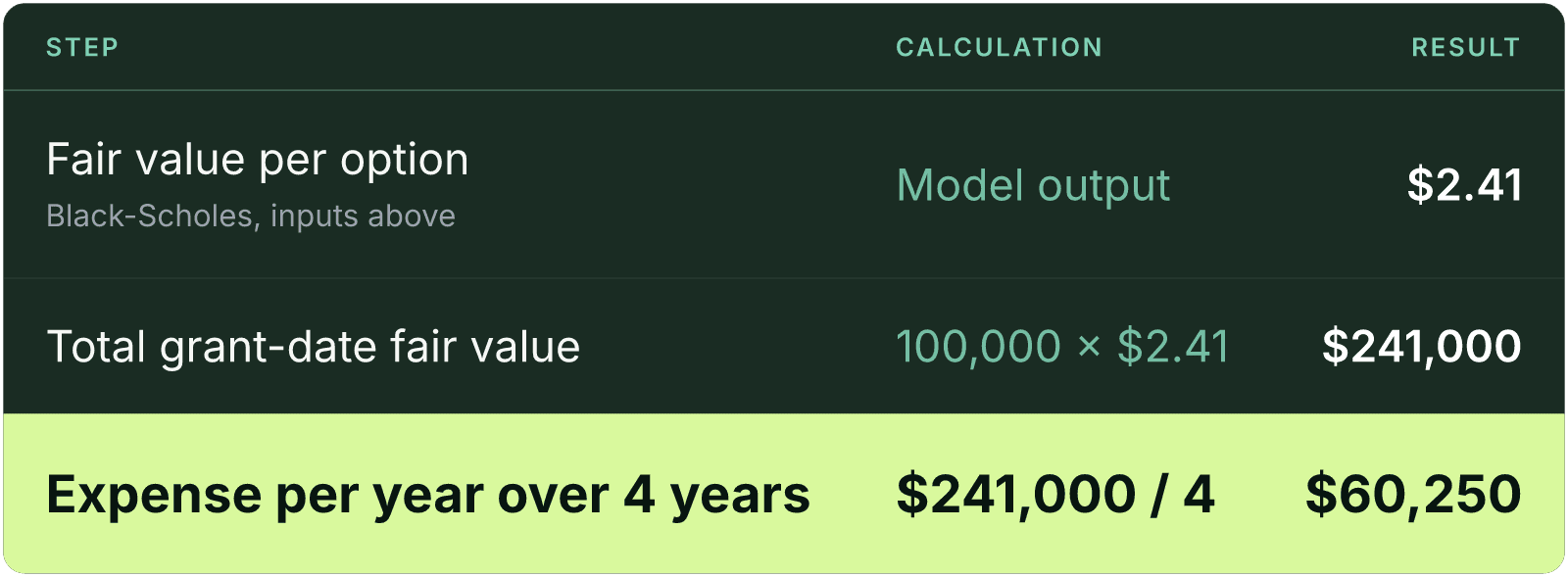](https://www.409.ai/uploads/what_is_an_asc_718_valuation_grant_date_fair_value_report_auditor_asks_for_table_1_5a3d932eb8.png)
The expense does not move if the share price triples next year. Grant-date fair value is measured once. What can move it is the forfeiture policy: ASC 718 lets a company estimate forfeitures up front or account for them as they happen, and the choice is an accounting policy the valuation support should state. Companies with many grants and many leavers often feel the difference.
Notice how much the volatility input matters. Raise it from 60% to 80% and the per-option value rises substantially, because an option's downside is capped at zero while its upside is not. That is why auditors ask where the volatility came from before they ask almost anything else.
What the report contains
An ASC 718 valuation report typically has the grant data you supplied (dates, number of awards, strikes, vesting), the share price used and its source, each model input with the reason for it, the fair value per award, and a schedule that turns fair value into expense by period. The 409.AI [ASC 718 valuation](https://www.409.ai/products/asc-718) follows that structure and ends in an expert-reviewed report your auditor can read.
The report supports the expense. It does not replace the accounting judgments around it, such as the forfeiture policy, the classification of an award or the disclosure in the notes. Those stay with management and the auditor.
Cost and timing
The price of a 409.AI ASC 718 valuation starts from $1,499, as shown on the product page. The page does not publish a turnaround time for this report, so ask for the date when you order, and order before the audit fieldwork starts rather than during it.
When the 409A is enough, and when it is not
The expedient helps with the price input only. It does not produce the option value, the expected term, the volatility or the expense schedule. If your auditor accepts the 409A as the share price, you still need the rest of the measurement from somewhere. The expedient also covers equity-classified awards, so a phantom stock or SAR plan that settles in cash falls outside it; see the [post on phantom stock and SARs](https://www.409.ai/articles/phantom-stock-sars-private-company-409a-asc-718).
Companies that report under IFRS rather than US GAAP follow a different standard with a different attribution rule; the [comparison of IFRS 2 and ASC 718](https://www.409.ai/articles/ifrs-2-vs-asc-718-share-based-payment) lists where they part.
Questions finance teams ask
Does a 409A replace an ASC 718 valuation? It can supply the share price when it meets the conditions of ASU 2021-07. It does not value the option or build the expense.
Do RSUs need a valuation? They need the underlying share value on the grant date. They do not need an option-pricing model.
How often is it done? The measurement is done at grant. A new valuation is needed for each grant date with a new share price, and again for a modification.
Who signs it? Management owns the financial statements. The valuation is support for management's number, and the auditor decides whether it is enough.
The takeaway
Before the auditor's request list lands, take your grant list and ask one question of each batch: can I show where the share price, the term and the volatility came from? If the answer for any batch is "the valuation firm typed it in," get that support written down now, while the person who knows is still reachable. If your 409A already meets the ASU 2021-07 conditions, you have solved one input of six, and the remaining five are what an ASC 718 valuation documents.