Compliance
Letter of Intent Signed? Why Your 409A May Be Stale Before Closing
A signed LOI can make a months-old 409A unreliable. Founders and finance leads: the 12-month and 90-day tests, a worked strike price example, and what to do.
By 409.AI Team - 2026-10-18
# Letter of Intent Signed? Why Your 409A May Be Stale Before Closing
If you are a founder or startup finance lead and a buyer just signed a letter of intent, the 409A valuation sitting in your files may already be unusable for the next option grant. The date on the report says it is good for 12 months. The regulation says something narrower, and a pending deal is the situation where the gap between the two costs real money.
This article walks through what the rule actually says, why an acquisition offer can break a valuation that is only four months old, and how to handle grants while a deal is in motion.
The 12-month rule is a ceiling, not a guarantee
Most teams remember one number from 409A: a valuation lasts 12 months. That number comes from [Treasury Regulation 1.409A-1(b)(5)(iv)(B)](https://www.law.cornell.edu/cfr/text/26/1.409A-1), and the sentence that contains it has two halves. A previously calculated value is not reasonable as of a later date if either of these is true:
- The value was calculated as of a date more than 12 months before the date it is being used.
- The calculation fails to reflect information available after its date that may materially affect the value of the company. The regulation's own examples are the resolution of material litigation and the issuance of a patent.
So the 12 months is the outer limit. The second half can end a valuation in month three. We cover the full list of events that do this in [the trigger events that beat the calendar](https://www.409.ai/articles/409a-valuation-frequency-how-often-should-you-get-one), and a company-run tender is one of the clearest, as [tender offers and secondary sales](https://www.409.ai/articles/tender-offers-secondary-sales-409a-valuation) explains.
A signed letter of intent (LOI) sits in the same family. The regulation does not name it. That is the point: the test is facts and circumstances, and an offer from a real buyer at a stated price is about as material as information about a private company gets.
Why an offer moves the common stock value
A 409A valuation estimates what the common stock is worth on the valuation date. The regulation lists the factors a reasonable method takes into account, including the value of the business's assets, the present value of its expected cash flows, the values of similar companies, and recent arm's length transactions in the stock. It also says a method that ignores "all available information material to the value of the corporation" is not reasonable.
Take a company whose March report used a financing-based method and landed at a $2.10 common share price. In October a buyer signs an LOI at a price that implies a much higher equity value. Two things have changed that the March report could not have known:
1. There is now a priced, third-party indication of what the whole company might fetch. 2. The odds of a sale in the next year, and so the weight on a sale outcome in the allocation, are higher than they were.
Both feed the allocation step. The report we cover in [OPM vs. PWERM](https://www.409.ai/articles/409a-allocation-methods-opm-pwerm-backsolve) assigns probabilities to exit scenarios. A scenario-weighted method that gave a sale a 10% weight in March has a different answer when a signed LOI exists.
A non-binding LOI is not a closed deal. Buyers walk, diligence reprices, and a headline number can shrink by closing. An appraiser will weigh that. But weighing a document is different from never having seen it, and the second one is what makes a valuation unreasonable.
The 90-day line inside the startup presumption
Many private companies rely on the presumption of reasonableness for a written valuation of illiquid start-up stock. It is in [the same section of the regulation](https://www.law.cornell.edu/cfr/text/26/1.409A-1) and it has a limit that matters here. The presumption does not apply if the company or the service provider "may reasonably anticipate, as of the time the valuation is applied," either of these:
- a change in control event within the 90 days following the action to which the valuation is applied, or
- a public offering of securities within the 180 days following that action.
Read that as a question you must answer on the day of every grant: is a sale reasonably expected within 90 days of this grant? With a signed LOI, an exclusivity period and a diligence calendar that closes in 60 days, the honest answer may be yes. If so, the safer reading is that the startup presumption is not available for that grant, whatever the report on file says. The company would then need to defend the strike price on the merits, with a valuation that reflects the deal. [Safe harbor depends on what you can show](https://www.409.ai/articles/409a-safe-harbor-price-vs-qualified-appraiser), not on how recent the report is.
What a wrong strike price costs
If an option is granted below the fair market value on the grant date, it stops being exempt from Section 409A. Under [IRC 409A(a)(1)(B)](https://www.law.cornell.edu/uscode/text/26/409A), the person holding it includes the deferred amount in income, pays interest at the underpayment rate plus 1 percentage point, and owes an additional tax of 20% of the amount included. The tax falls on the option holder, which is why a bad strike price becomes an employee relations problem for the founder.
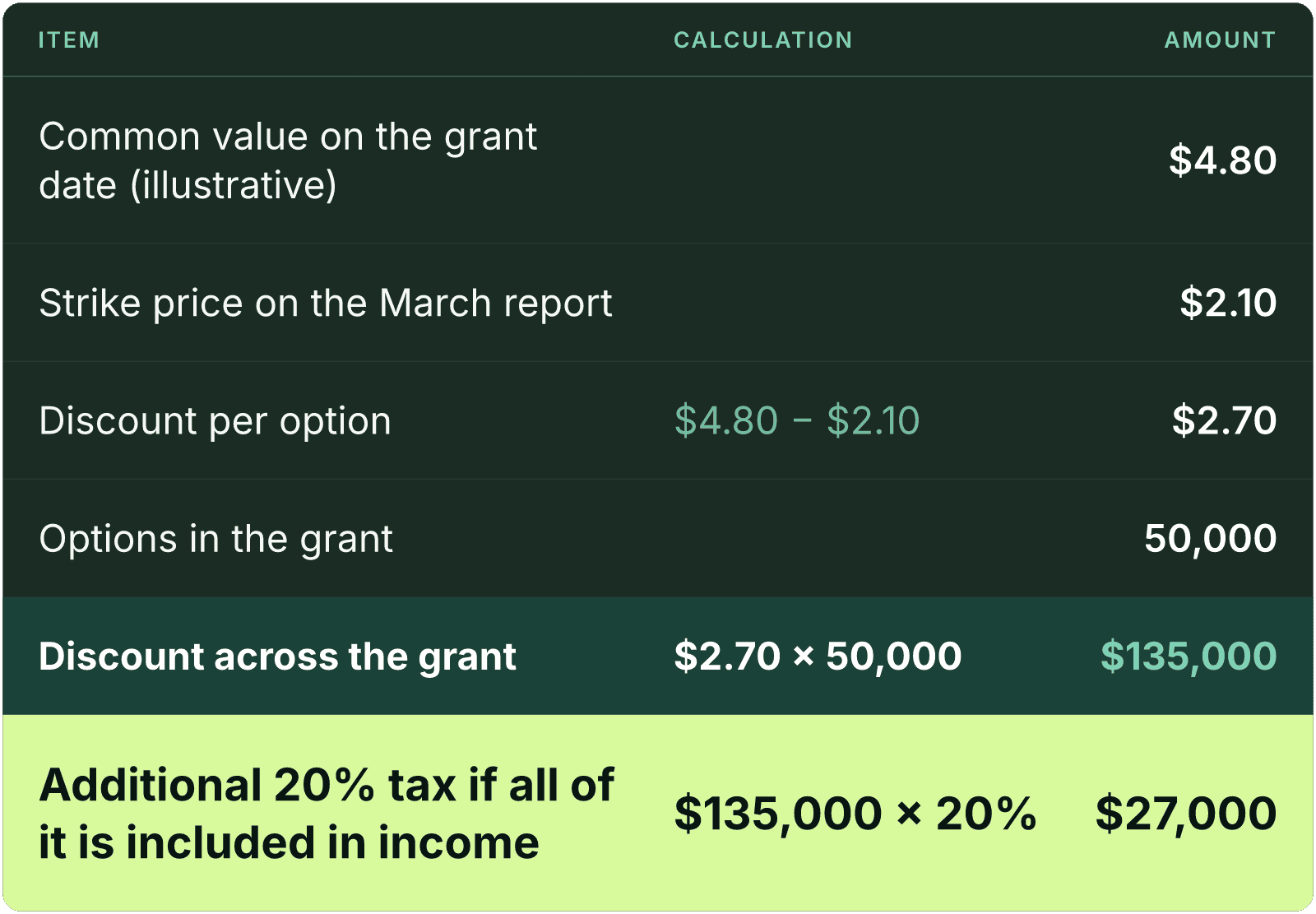
Here is an illustrative case. The company grants 50,000 options at the March strike of $2.10 in October. A later valuation shows the common stock was worth $4.80 on the grant date.
[](https://www.409.ai/uploads/letter_of_intent_409a_stale_option_grants_before_acquisition_closes_table_1_c8b6371943.png)
The $27,000 sits on top of ordinary income tax on the same $135,000 and the premium interest. The numbers are simplified. The amount included in a given year depends on vesting and on the spread at year end, so treat the table as an order of magnitude, not a calculation for any one person. The company, with the employee's help, can sometimes correct a strike price in time; [dealing with incorrect 409A valuations](https://www.409.ai/articles/dealing-with-incorrect-409a-valuations) lays out those windows.
There is a second cost for employees who were promised ISOs. The strike price also sets how much of a grant fits under the annual limit, as [the $100,000 ISO limit](https://www.409.ai/articles/iso-100k-limit-409a-grant-date-fair-market-value) explains, so a strike that is later found too low shifts the numbers there as well.
What to do while a deal is pending
None of this means you freeze every grant the day an email arrives from a buyer. It means you build a short, dated record. In order:
1. Decide whether the offer is real. A signed LOI, an indication of interest with a price in writing, or an exclusivity agreement is information. A casual coffee does not make a valuation stale. 2. Put the document in front of the board and the appraiser. The board should note the offer in its minutes. The appraiser should see the LOI, the implied price and the expected timeline, because the question is how much weight to give it, and only the appraiser can make that call. 3. Ask for an update, not just a reaffirmation. A short letter that says "no material change" is the wrong output when something did change. Ask for a refreshed value or a written explanation of why the LOI does not move the common stock value, with the reasoning. 4. Hold the grants until you have it. Option grants for new hires can wait a week or two. [The grant date is the date the board completes its action](https://www.409.ai/articles/option-grant-date-board-approval-409a-strike-price), so holding the board vote is the clean way to wait. 5. Test the 90-day question every time. Before each grant, write down whether a change in control is reasonably expected in the next 90 days, and why or why not. 6. Keep everything you used. If the IRS examines the grant, it will ask for the same material it asks for in any 409A review, as [what the IRS asks for](https://www.409.ai/articles/irs-audit-409a-valuation-document-request) details.
What option holders should expect at closing
Options still outstanding when the deal closes are treated according to the merger agreement: assumed, substituted, cashed out, or cancelled. That is a separate topic, a topic of its own. For this article the narrow point is that the strike prices of grants made in the months before closing will be read against the deal price by the buyer's lawyers and, later, by the tax authorities. A grant at $2.10 six weeks before a $9 per share closing looks very different from the same grant a year earlier.
The takeaway
When a letter of intent is signed, the date on your 409A stops being the test. The test is whether the report reflects what you now know, and whether a sale is reasonably expected within 90 days. Put the LOI in the board record, send it to the appraiser the same week, and make no grant on the old strike until you hold a written answer. If you need a refreshed valuation fast, [409.AI's 409A valuation](https://www.409.ai/products/409a) starts from $899 and can turn a draft within 24 hours.