Tax
Selling Your Startup for Buyer Stock? Your QSBS Exclusion Stops at the Closing-Day Gain
For founders selling a startup for buyer or holdco stock: Section 1202(h)(4) keeps QSBS on the new shares but caps the exclusion at the gain on closing day.
By 409.AI Team - 2026-11-27
# Selling Your Startup for Buyer Stock? Your QSBS Exclusion Stops at the Closing-Day Gain
If you hold qualified small business stock in a C corporation and part of your sale price is stock of the buyer, or of a new holding company the buyer sets up, this one is for you and for the tax advisor reading the term sheet beside you. The tax-free exchange keeps your QSBS status alive on the new shares. It does not keep the exclusion open-ended. Everything the new shares gain after closing day is taxed, unless the issuer of those shares is itself a qualified small business at the exchange.
That rule sits in one paragraph of the Internal Revenue Code, Section 1202(h)(4), and it turns the value of your shares on closing day into the number that decides how much of your eventual gain is excluded. Here's how it works, what the 351 route adds, and what your file should hold before the deal closes.
Why the new shares need a special rule at all
QSBS has to be acquired at original issue "in exchange for money or other property (not including stock)", under Section 1202(c)(1)(B). Shares you receive from an acquirer in exchange for your startup shares fail that test on their face: you paid for them with stock. And the acquirer is often far past the $75 million gross assets limit of Section 1202(d), so its stock could never be QSBS in your hands anyway.
Section 1202(h)(4)(A) fixes the first problem. In a transaction described in Section 351, or a reorganization described in Section 368, when QSBS is exchanged for other stock that would not qualify on its own, the new stock "shall be treated as qualified small business stock acquired on the date on which the exchanged stock was acquired."
Two things follow. Your holding period does not restart: the clock that began when your founder shares were issued keeps running on the buyer's stock. And the date-based rules of Section 1202 follow the original date too, so stock acquired on or before July 4, 2025 keeps the five-year holding period and the $10 million per-issuer cap of that regime, rather than the tiered 3, 4 and 5 year exclusion and the $15 million cap that apply to stock acquired after it. If you want the two regimes side by side, our summary of the 2025 Section 1202 changes sets them out.
The limit: gain built in on closing day, and nothing after
Section 1202(h)(4)(B) is where founders get surprised. The exclusion applies to gain on the new stock "only to the extent of the gain which would have been recognized at the time of the transfer" if Section 351 or 368 had not applied. In plain words: imagine you had sold your startup shares for their fair market value on closing day. The gain you would have had then is the most the exclusion can cover, ever.
Appreciation after the close is ordinary long-term capital gain. If the buyer's stock doubles in the two years after the deal, that doubling is taxed when you sell, however long you have held.
A worked example makes the stakes concrete. All figures are illustrative.
A founder received 4,000,000 common shares at incorporation in 2019 for $10,000. In 2026 the company is acquired in an all-stock reorganization by a buyer with gross assets far above $75 million. The founder's shares are exchanged for buyer stock worth $8,000,000 at closing, so $7,990,000 of gain is built in on closing day. In 2028 the founder sells the buyer stock for $14,000,000. The original shares were issued after September 2010 and have been held more than five years by the sale, so the excluded portion is 100% under Section 1202(a)(4). We assume the top federal long-term capital gains rate of 20% plus the 3.8% net investment income tax.
The table below runs that sale twice: once with the closing-day value documented at $2.00 a share, and once at $1.50 a share, the figure a lower valuation of the same shares would give.
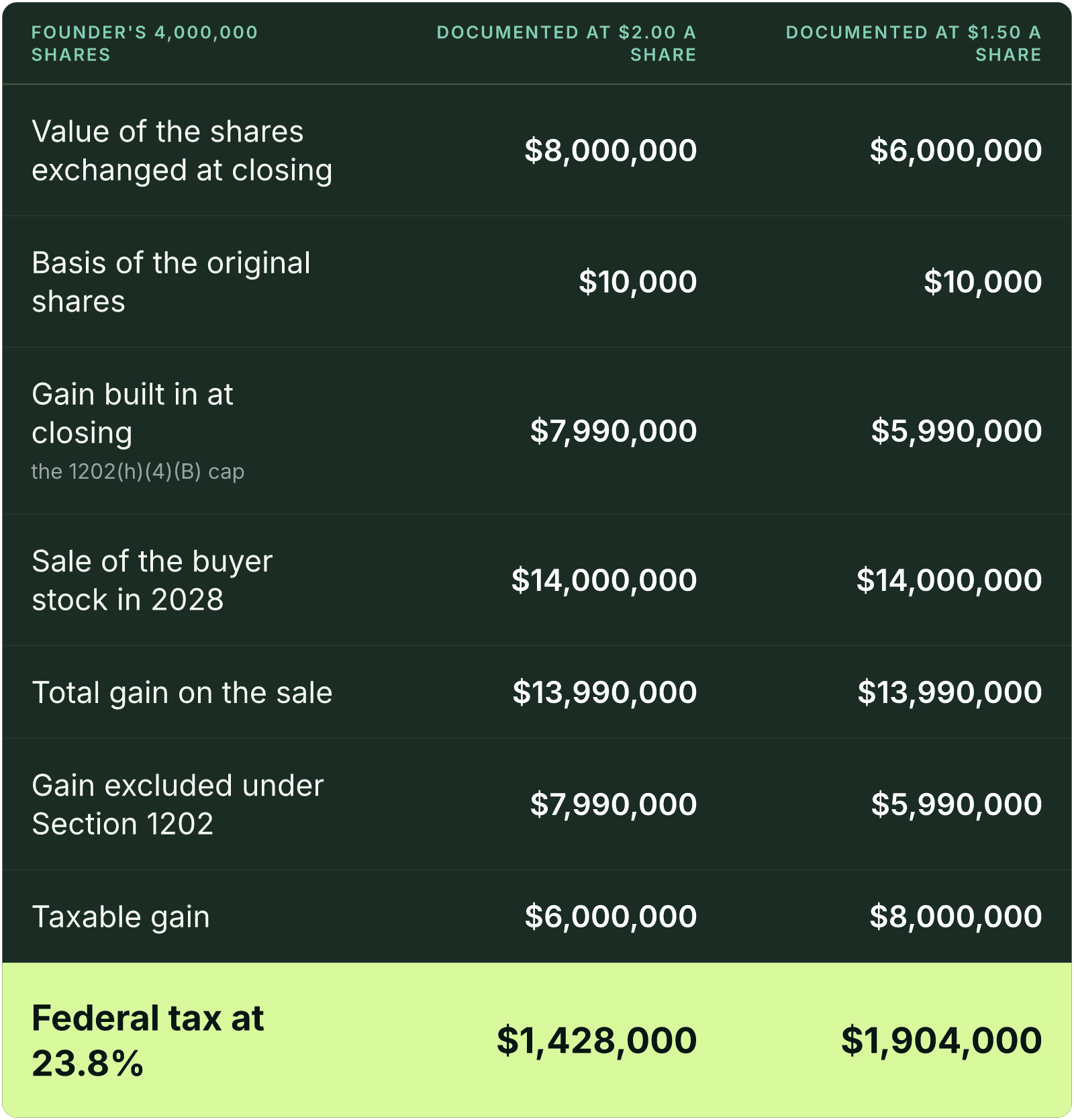

The total gain is the same in both columns. What moves is the line between the excluded part and the taxed part, and it moves dollar for dollar with the value assigned to the shares on the day of the exchange. Half a dollar a share on 4,000,000 shares is $476,000 of federal tax. The closing-day value is not a formality to fill in later. It is the cap.
Notice also that the cap here sits under the $10 million per-issuer limit of Section 1202(b). When the built-in gain is larger than the per-issuer limit, the smaller of the two binds. How Section 1202(b) counts gain on the buyer's stock that started life as gain on your company's stock is a question to settle with your tax advisor; the statute does not spell it out.
The exception: when the new issuer is a qualified small business
The second sentence of Section 1202(h)(4)(B) switches the limit off when the corporation issuing the new stock is itself a qualified small business at the time of the exchange. That is rare when a large company buys a startup. It is less rare when two venture-backed companies merge, or when a small acquirer pays in its own stock.
Whether the issuer passes is its own calculation under Section 1202(d): aggregate gross assets of $75 million or less before and immediately after the issuance, with every corporation in the same parent-subsidiary group counted as one. It is measured as of the transfer, so it has to be checked against the issuer's balance sheet at closing, not its last audited year-end. The gross assets test has traps of its own, capitalized research costs among them.
If the issuer passes, post-closing appreciation can be excluded too, subject to the usual caps. That is worth knowing before the structure is fixed, not after.
The 351 route: a holdco rollover needs 80% control
Many private equity deals use a new holding company. The buyer funds a holdco with cash, the founder contributes part of their startup shares to the same holdco for holdco stock, and the holdco ends up owning the startup. That contribution is a Section 351 exchange, and Section 1202(h)(4) can carry QSBS onto the holdco shares, with one more condition.
Section 1202(h)(4)(D) applies the rule to a 351 exchange "only if, immediately after the transaction, the corporation issuing the stock owns directly or indirectly stock representing control" of the company whose stock was exchanged. Control is the Section 368(c) definition: at least 80% of the total combined voting power and at least 80% of the shares of every other class.
So a holdco that ends up with 100% of the startup passes. A holdco that buys 60% and leaves the rest of the shareholders where they were does not, and the founder's holdco shares lose the Section 1202 treatment entirely, not just the post-closing gain. The ownership table at closing, every class included, is the evidence.
Two structures sit outside the rule altogether. A rollover into units of a buyer that is a partnership or an LLC taxed as one is a Section 721 contribution, not a 351 exchange, and partnership units are not stock in a C corporation, so Section 1202 does not reach them. And the cash part of a mixed deal is not deferred at all. In a reorganization, gain is recognized up to the cash and other property received, under Section 356(a). That recognized gain is gain on your original QSBS, so the exclusion can cover it when the holding period is met, and it uses part of your per-issuer cap.
Successive deals keep the first cap
Section 1202(h)(4)(C) answers the next question before it comes up. If the buyer is later acquired itself in another tax-free exchange, the new-new shares stay QSBS, but the limit is measured "as of the time of the first transfer". The closing-day value of the first deal stays the cap for as long as you hold any shares that descend from your original stock.
That is the strongest reason to document the first value properly. Ten years and two mergers later, nobody will rebuild it from memory.
What the closing-day value file should hold
The IRS will look at the value of the shares you gave up, not at the headline price in the press release. In a clean all-stock deal with a listed acquirer, that value often comes straight from the exchange ratio and the acquirer's trading price on closing day. It gets harder in the cases founders actually face:
- The consideration is private stock. A holdco or a private acquirer has no trading price, so the value of what you received has to be supported by a valuation of its own.
- Your shares are common and the investors hold preferred. The deal value runs through the liquidation preferences before it reaches your class, so the value per common share is not the purchase price divided by the share count.
- Part of the price is contingent. Escrows, holdbacks and earnouts change what was received on closing day and how it is measured.
The file your advisor will want holds the merger agreement and the exchange ratio, the value of the consideration at closing and how it was reached, the allocation of the deal value to your class through the waterfall, the basis and issue date of each lot of your original shares, the evidence that the original shares were QSBS (the facts an attestation letter documents), the issuer's gross assets at the transfer if you are claiming the exception, and for a 351 rollover the capitalization table showing 80% control immediately after.
If your options are being rolled into buyer options rather than exchanged as shares, that is a different set of rules; what happens to stock options in an acquisition covers them. And if you are short of five years and the deal is for cash, Section 1045 is the provision to read instead. State tax is separate again: some states do not follow the federal exclusion at all, as our state conformity overview shows.
The takeaway
Before you sign a stock-for-stock deal, ask two questions. Is the corporation issuing your new shares a qualified small business at closing? If not, every dollar of growth after closing day is taxed, and the closing-day value of your shares is the ceiling on your exclusion for good. If the deal runs through a holdco, will it own at least 80% of your company immediately after? If not, the new shares are not QSBS at all.
Then get the closing-day value of your class documented while the deal documents are still on the table. A 409.AI QSBS attestation letter organizes the Section 1202 facts of your original shares for your advisor and the buyer's diligence team, and the closing-day value belongs in the same file, so the number that caps your exclusion is on record before anyone asks for it.
About the author
409.AI Team
Startup valuation and equity workflow specialists
The 409.AI team writes practical valuation content for founders and finance teams preparing 409A reports, equity documentation, and related startup finance workflows.
Related valuation reports
- QSBS attestation letter: 409.AI helps companies prepare Section 1202 QSBS attestation letters for diligence, shareholder requests, and advisor review.
- 409A valuation report: 409.AI helps private companies prepare expert-reviewed 409A valuation reports for equity compensation and option strike price support.
- Pricing for every report type
- 409A valuation calculator
- Sample 409A report