Tax
What Is a QSBS Attestation Letter? What It Documents and When You Need One
A QSBS attestation letter records the Section 1202 facts: original issue, the $75M gross assets test, active business, redemptions. For founders and their CPAs.
By 409.AI Team - 2026-11-02
# What Is a QSBS Attestation Letter? What It Documents and When You Need One
A founder, an early employee or a seed investor holds shares in a Delaware C corporation and hopes to exclude the gain under Section 1202 one day. The question that arrives first is rarely about the tax code. It is a request from an investor, an acquirer or a CPA: "Can you show us this stock qualifies?" A QSBS attestation letter is the document that answers it.
This primer explains what the letter is, which facts it records, when people ask for it and what it can and cannot do. It is written for founders, finance leads, and the CPAs and attorneys beside them.
What a QSBS attestation letter is
Qualified small business stock (QSBS) is stock that meets the tests of [Section 1202 of the Internal Revenue Code](https://www.law.cornell.edu/uscode/text/26/1202). When it does, a holder can exclude part or all of the gain on a sale. The Code does not ask anyone to file a certificate to claim that treatment. You report the sale, and the exclusion goes on the return.
That is why the attestation letter exists at all. It is not a government form and it is not a ruling. It is a written record, prepared from the company's own documents, of the facts the Section 1202 tests turn on, stated as of the dates that matter. The company, a shareholder, an acquirer's counsel or a CPA can read it and see the same set of facts in one place.
The letter also does not decide the question for the IRS. The holder claims the exclusion on a return, and the facts behind it must hold up if the return is examined. The letter's job is to make those facts easy to find, check and keep. [409.AI's QSBS attestation letter](https://www.409.ai/products/qsbs) organizes company-provided facts for investors, shareholders and advisors, and it is not tax or legal advice.
The facts the letter records
Section 1202 sets several tests, and each one needs a fact from a different corner of the company's files.
A domestic C corporation. The stock must be in a C corporation, and Section 1202(e)(4) requires a domestic one. An LLC taxed as a partnership does not qualify until it converts, and the clock starts at conversion. We cover that case in [the LLC to C corporation conversion article](https://www.409.ai/articles/llc-to-c-corp-conversion-qsbs-valuation-section-1202).
Original issue. Under Section 1202(c)(1)(B), the holder must acquire the stock at its original issue, directly or through an underwriter, for money, for property other than stock, or as pay for services. Stock bought from another shareholder on the secondary market does not qualify, which is why the issuance records matter: board approvals, stock purchase agreements, the ledger.
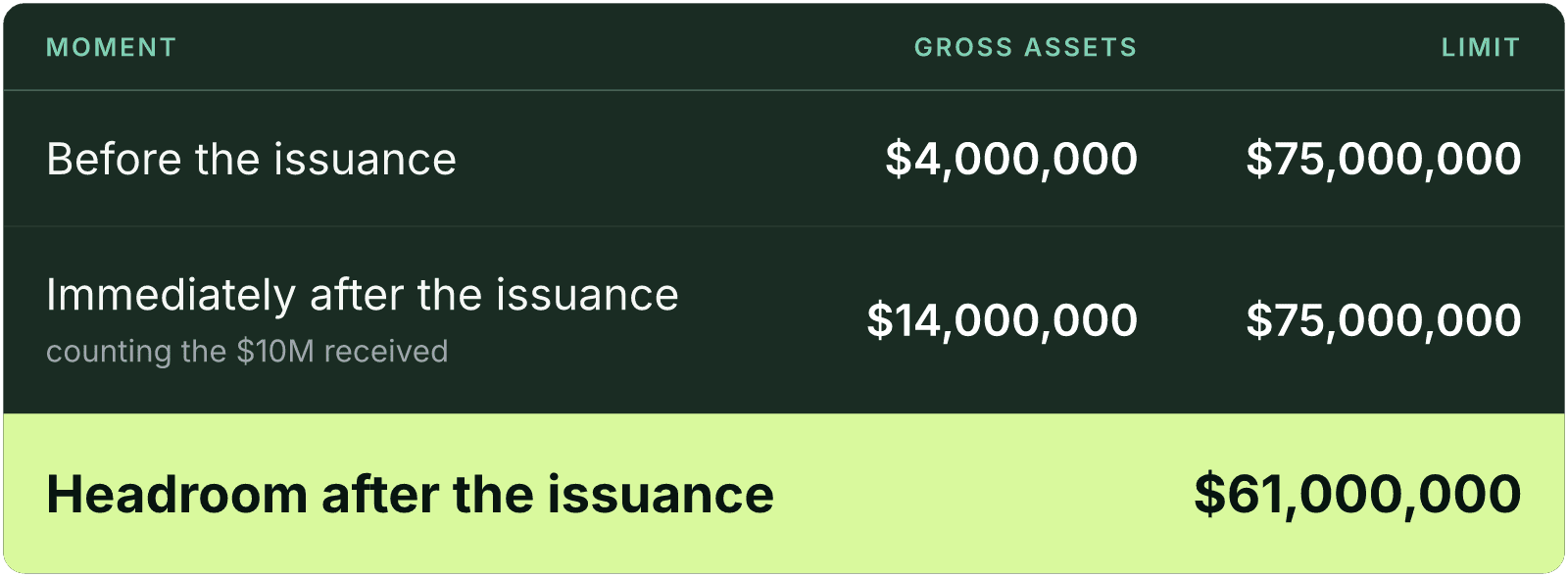
The $75 million gross assets test. Section 1202(d) looks at the corporation's aggregate gross assets twice. They must not have exceeded $75,000,000 at any time before the issuance, and not immediately after it, counting the cash received in the issuance. For this test, gross assets are cash plus the adjusted bases of other property, and property contributed to the company is counted at its fair market value when contributed. Parents and subsidiaries in a controlled group are added together. The detail on what counts as an asset is in [our gross assets test article](https://www.409.ai/articles/qsbs-gross-assets-test-section-174a-capitalized-rd).
The active business test. At least 80 percent of the corporation's assets, by value, must be used in the active conduct of one or more qualified trades or businesses (Section 1202(e)(1)), during substantially all of the holder's holding period. Banking, insurance, financing, leasing and investing businesses are excluded, as are certain service fields. [The consulting test](https://www.409.ai/articles/qsbs-qualified-trade-or-business-consulting-test-section-1202) is the one that catches software and services companies by surprise.
No disqualifying redemptions. Section 1202(c)(3) disqualifies stock if the company bought back stock from the holder or a related person in the window from two years before to two years after the issuance, and in a separate two-year window it disqualifies stock when buybacks exceed 5 percent of the value of all stock. [One buyback can taint a whole year of issuances](https://www.409.ai/articles/qsbs-redemption-rules-stock-buybacks-section-1202), and a letter is the natural place to confirm that none happened.
The dates. The holding period begins when the stock is acquired. For stock issued for services subject to vesting, that date depends on the 83(b) election, which is why the letter and the election are often discussed together. Our article on [early exercise and the 83(b) election](https://www.409.ai/articles/early-exercise-stock-options-83b-election-iso-nso-qsbs) shows how the dates line up.
A worked example of the gross assets test
Take a company with $4 million of cash and property at adjusted basis before a seed round, which raises $10 million. The test is a comparison with $75 million at two moments.
[](https://www.409.ai/uploads/what_is_a_qsbs_attestation_letter_section_1202_facts_gross_assets_original_issue_table_1_4bb695c8f8.png)
The company passes with room to spare, and the letter records both numbers with the date of each. The test gets harder later. A Series C that pushes the balance sheet past $75 million closes the door on that round's shares, though it does not retroactively disqualify the earlier rounds. Each issuance is tested on its own date.
Note that the test uses adjusted tax basis for property, not what the company is worth. A company valued at $300 million can still pass if its assets are mostly low-basis intangibles and its cash is modest. That is the point of the article on [why your post-money does not count](https://www.409.ai/articles/qsbs-gross-assets-test-section-174a-capitalized-rd).
What the exclusion is worth, and why people ask for proof
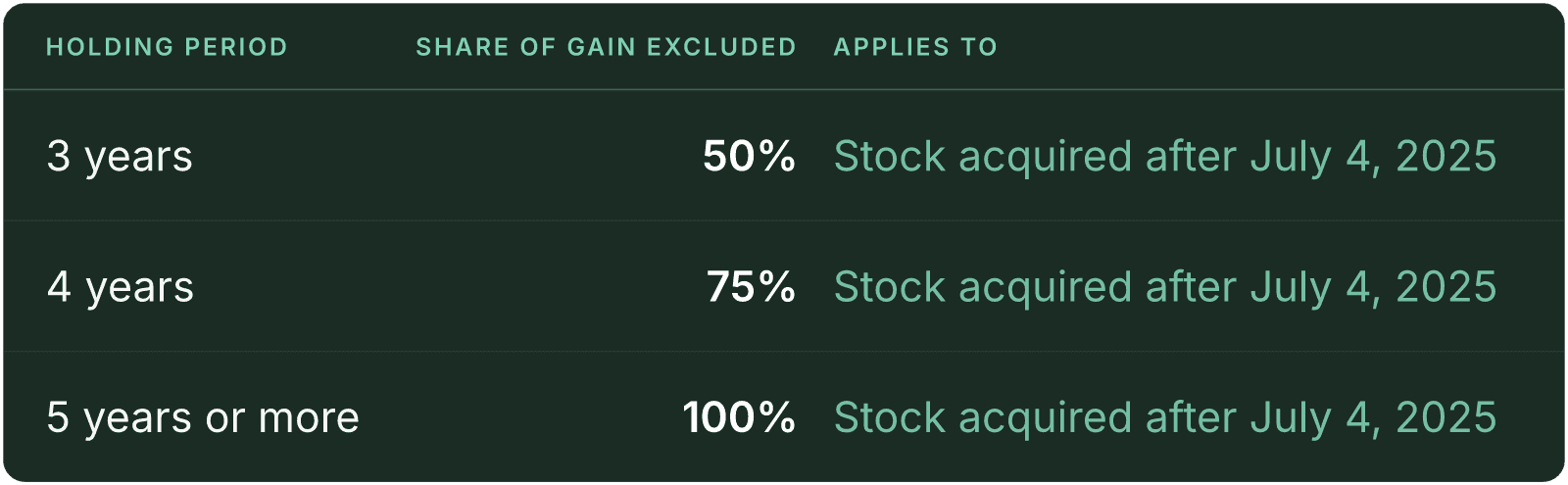
The rules differ by when the stock was issued. For stock acquired after July 4, 2025, Section 1202(a)(5) excludes 50 percent of the gain after three years, 75 percent after four and 100 percent after five or more. The per-issuer limit under Section 1202(b) is the greater of $15,000,000 or ten times the aggregate adjusted basis of the stock sold, and the $15 million amount is indexed for inflation for tax years beginning after 2026. [Our article on the 2025 changes](https://www.409.ai/articles/qsbs-one-big-beautiful-bill-act-section-1202-changes) compares them with the older rules.
[](https://www.409.ai/uploads/what_is_a_qsbs_attestation_letter_section_1202_facts_gross_assets_original_issue_table_2_ed2024aabd.png)
Stock issued earlier follows the earlier schedule. The letter states the issue date, so the right column applies.
At those amounts, a holder with a large gain has a six- or seven-figure reason to want the file in order before anyone asks. When the buyer's counsel reads the purchase agreement, the holder's CPA prepares the return and the company's records are five years old, a single document that ties each fact to a source is far cheaper to produce today than to rebuild later.
When people ask for one
Several moments recur:
- **A financing or diligence request.** Investors and acquirers want to know whether shareholders will carry tax benefits into the exit, and whether the company's own actions could disturb them.
- **A secondary sale or exit.** The holder needs the facts when preparing the return. We walk through [the secondary sale case](https://www.409.ai/articles/secondary-sale-startup-shares-qsbs-tax-treatment) separately.
- **Shareholder tax preparation.** Founders and employees ask the company for a statement their CPA can use.
- **A priced round or a grant.** The 409A valuation and the QSBS facts both turn on the cap table and the issuance dates. A company that is already commissioning a 409A can add the QSBS letter, which the site lists as a $500 add-on, and the same cap table serves both.
- **Internal recordkeeping.** Companies that expect many holders to ask later prefer to document each issuance once.
What it costs and what it needs from you
The site lists the QSBS attestation letter from $999. The helpful inputs are the incorporation documents, stock issuance records, financing history, cap table context and a description of the business activity. The letter is built from what the company provides, so incomplete records produce a letter that says what could not be confirmed.
What a letter does not do
It does not give the holder a right to the exclusion. The statute is not satisfied by a document, and Section 1202 has requirements that depend on the holder's own situation, such as how the stock was acquired and whether short positions exist. It is not legally required to claim QSBS, and it does not replace a tax advisor. It does not predict a future event either: a redemption or a change in the business after the letter's date can still affect the stock.
When the exclusion is claimed, the sale is reported on Form 8949 with code Q in column (f), and the excluded amount is entered as a negative number in column (g), as the [IRS instructions for Form 8949](https://www.irs.gov/instructions/i8949) explain. The letter is what the preparer has beside that return.
Questions people search
Does the IRS require a QSBS letter? No. The Code sets the tests, and the holder claims the exclusion on the return.
Does a SAFE count as stock? Not until it converts, and the holding period begins at conversion. See [the SAFE and Section 1202 article](https://www.409.ai/articles/safes-qsbs-holding-period-conversion-section-1202).
Who asks the company for the letter? Usually a holder, a holder's CPA, or a buyer's counsel at diligence.
Is it the same as a 409A? No. A 409A sets the fair market value of common stock for option pricing. The two share a cap table and a set of dates, and many companies order them together.
The takeaway
Write down the issuance date, the gross assets before and after, the nature of the business and any buyback the day each round closes. That is five facts per issuance, and the letter is their summary. If your company has issued stock, check the record against the tests above now, while the people who signed the documents still remember them. When you want it prepared, the [QSBS attestation letter](https://www.409.ai/products/qsbs) starts from $999.