Education
The Working Capital Peg: Why the Price for Your Business Moves at Closing
Selling your business? The working capital peg decides whether you collect the price in the letter of intent. Here is how it is set and how it moves at closing.
By 409.AI Team - 2026-10-29
# The Working Capital Peg: Why the Price for Your Business Moves at Closing
You signed a letter of intent at $5,000,000. Ninety days later, the buyer's closing statement says you are owed $4,780,000. Nothing went wrong with the business. The price moved because of a number most owners have never heard of: the working capital peg.
This article is for the owner of a small private company who is about to sell, and for the business broker or CPA who is helping write the letter of intent. It explains what the peg is, how it is set, and how the closing adjustment turns it into dollars.
What working capital means in a sale
Working capital is the money a business needs to run from one day to the next. In a deal, the term used is net working capital: current assets minus current liabilities, with cash and debt taken out.
For a typical small company, the items look like this:
- **Counted as assets:** customer invoices not yet paid (accounts receivable), inventory, and prepaid expenses.
- **Counted as liabilities:** bills owed to suppliers (accounts payable), accrued payroll and bonuses, and customer deposits or prepayments.
- **Left out:** cash and bank balances, loans and the line of credit, and accrued interest on them.
Cash and debt are left out because most small-business sales are priced "cash-free, debt-free." You keep the cash and pay off the loans from the proceeds, and the buyer gets the business with what it needs to operate. The buyer is paying for a business that can keep filling orders and paying staff on day one. The peg is the agreed level of working capital that makes that possible.
What the peg is
The peg is a target amount of net working capital that the buyer and seller agree on before closing. It is written into the purchase agreement. If the business is delivered with more working capital than the peg, the price goes up. If it is delivered with less, the price goes down.
BDO's transaction advisory team describes the usual method in its [guide to net working capital in M&A](https://www.bdo.com/insights/advisory/importance-of-net-working-capital-nwc-in-m-a): the peg is typically the average of normalized net working capital over the latest trailing twelve months. The parties can agree on a shorter period, such as six or three months, when it better reflects where the business is now.
The two sides want opposite things. A buyer prefers a high peg, because it means more working capital handed over. A seller prefers a low one, because it is easier to meet. The workable middle is the amount the business really needs to operate normally.
Setting the peg: a worked example
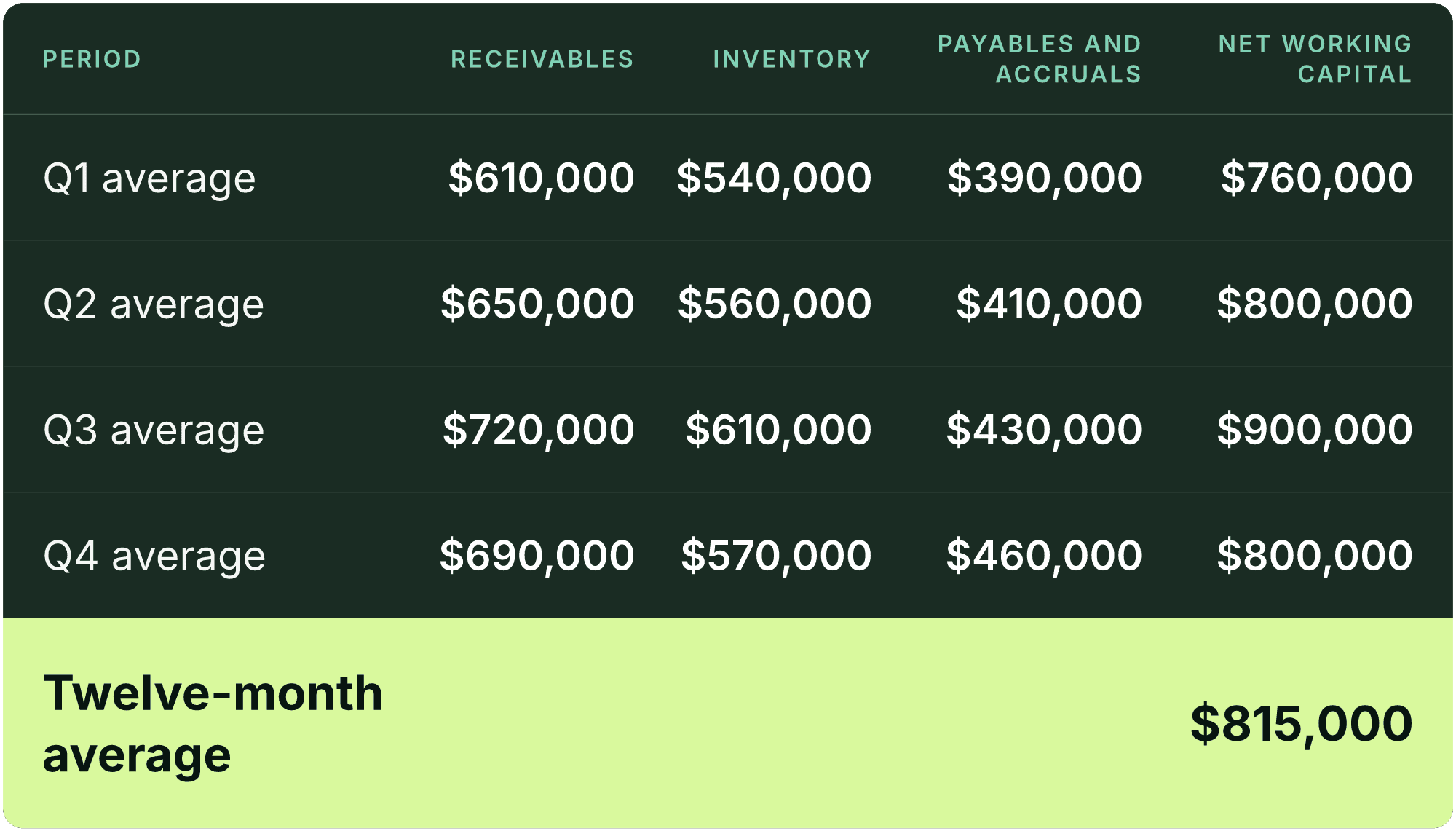
Take a small distribution company with these figures, averaged by quarter from its month-end balance sheets. All numbers are illustrative.
[](https://www.409.ai/uploads/working_capital_peg_small_business_sale_closing_price_adjustment_table_1_1d99c45e14.png)
The twelve-month average is $815,000. That would be the starting point for the peg, before adjustments.
Two things can change it. The first is seasonality: if the sale closes in March, when this business normally sits near its low, a flat twelve-month average asks the seller to deliver more than the business carries that time of year. The parties may agree to a seasonal peg or to a shorter averaging period. The second is normalization. A one-time year-end accrual, a customer deposit that is not typical, or a personal expense run through the books can push a single month up or down. Those items get adjusted out so the average reflects normal operations.
The peg is a negotiated number. Neither side should accept the other's first calculation without seeing the monthly balance sheets behind it.
The closing true-up
At closing, the actual net working capital delivered is compared with the peg. The difference moves the price dollar for dollar.
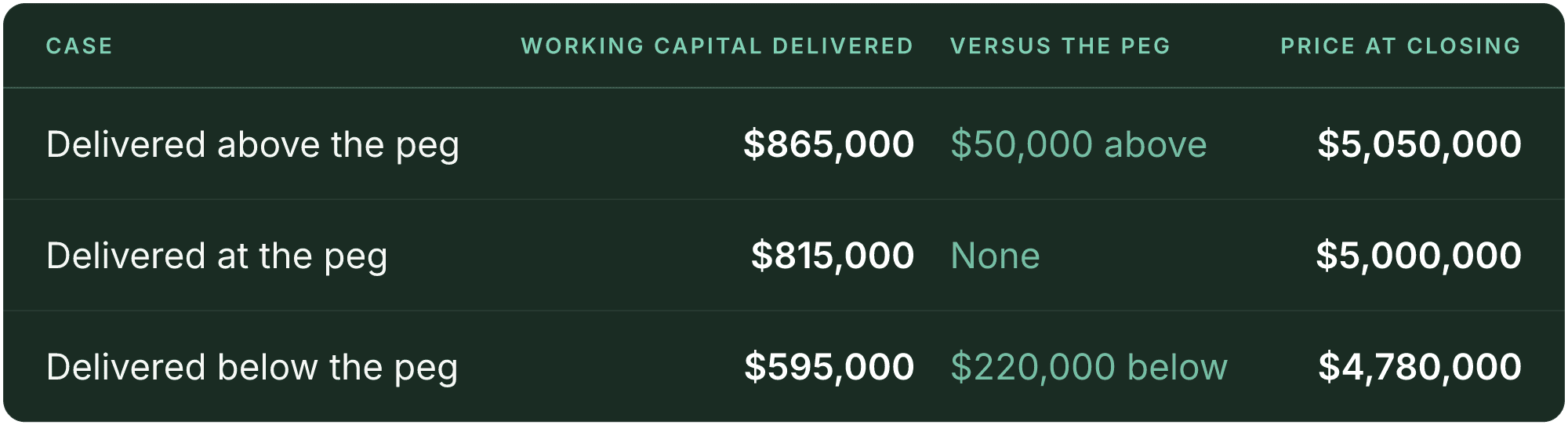
Suppose the peg is $815,000 and your headline price is $5,000,000.
[](https://www.409.ai/uploads/working_capital_peg_small_business_sale_closing_price_adjustment_table_2_d4079583f8.png)
The last row is the scenario from the opening. A business that delivers $220,000 less than the peg gets a price that is $220,000 lower. Most agreements estimate the number at closing, then true it up against the final closing balance sheet in the weeks that follow. That means money can change hands twice.
Nothing about this is a penalty. The buyer paid for a business with a normal level of receivables, inventory and payables. If it arrives with less, the buyer has to put in cash to bring it back to normal.
Why pulling cash out before closing does not pay
Some owners hear "cash-free" and conclude that anything they can move out of the business before closing is theirs. Part of that is true. Cash in the bank is yours.
The trouble starts when the effort to produce cash touches working capital:
- **Collecting receivables early** by offering discounts converts working capital into cash. The cash is yours, but net working capital falls, and so does the price.
- **Stretching payables** by paying suppliers late raises cash for a while, but the unpaid invoices are liabilities. Higher payables lower net working capital, and the buyer will count them in the closing statement.
- **Letting inventory run down** to harvest cash reduces what the buyer receives. If the business cannot fill orders in the first month, the buyer will say so.
In each case, what you gain in cash you lose in price, usually with friction in between. Run the business normally through closing and the peg takes care of the rest.
Where owners and buyers disagree
Most peg disputes come from definitions rather than arithmetic. The items below deserve a line in the purchase agreement.
Cash versus accrual books. Many small companies keep books on a cash basis for taxes. Working capital on that basis leaves out receivables and payables entirely, so it has to be recalculated on an accrual basis before a peg means anything. Our piece on [cash-basis books in a small business valuation](https://www.409.ai/articles/cash-basis-vs-accrual-small-business-valuation-tax-return-earnings) shows how the same restatement changes earnings.
Old receivables and the allowance. A receivable that is 150 days past due is not worth its face value. If the seller's allowance for bad debts is lighter than the buyer's, the buyer will restate working capital downward after closing. BDO's guide gives this exact example and recommends that the agreement spell out how the allowance is calculated.
Customer deposits. Money a customer paid in advance sits as a liability, because the buyer now owes the work. The seller keeps the cash in a cash-free deal, so the buyer will want the liability counted.
Related-party balances. Amounts owed to or by the owner or a family company rarely look like normal trade balances and are usually removed.
Non-operating items. Things unrelated to running the business, such as an owner's personal loan or a deposit on a building, are not part of working capital. Our article on [excess cash and non-operating assets](https://www.409.ai/articles/excess-cash-non-operating-assets-small-business-valuation-owner-balance-sheet) covers how an appraiser separates them.
The best protection is a sample calculation attached to the agreement as an exhibit. If both sides have signed a worked example using the actual accounts, there is less to argue about after closing.
How the peg sits beside the price
The peg is easy to confuse with the price itself, and the two come from different places. The price reflects what the business earns: [owner pay and add-backs](https://www.409.ai/articles/owner-compensation-add-backs-small-business-valuation-sde-ebitda), which years of earnings count, and the multiple a buyer will pay. The question of why small companies sell for [three or four times earnings](https://www.409.ai/articles/capitalization-rate-vs-discount-rate-small-business-valuation-earnings-multiple) is a valuation question. The peg answers a different one: how much operating capital stays in the business when the price is paid.
A rule-of-thumb price based on a multiple of earnings, like those covered in our article on [rule-of-thumb multiples versus an appraisal](https://www.409.ai/articles/rule-of-thumb-multiples-vs-appraisal-small-business-valuation-sde), says nothing about the peg. The same $5,000,000 headline can end up at $4,780,000 or $5,050,000. That spread is part of what you are negotiating, so it belongs in the conversation as early as the multiple.
The tax side matters too. How the final price is divided among assets drives your tax result, and a post-closing adjustment changes that split. [Form 8594 and the allocation of a small business sale](https://www.409.ai/articles/form-8594-asset-allocation-small-business-sale) explains why your CPA should see the adjustment mechanics before you sign.
What to do before you sign the letter of intent
Three steps cost little and can protect a large number.
1. Build your own peg first. Pull twelve monthly balance sheets, remove cash and debt, and compute the monthly net working capital. Look at the low and high months and the reason for each. 2. Ask the LOI to name the method. A line stating the averaging period, the treatment of cash and debt, and that the calculation follows the same accounting method as your historical statements saves a renegotiation later. 3. Plan the last 60 days. Keep collections, inventory and payables on their usual rhythm, and tell your broker or CPA before any unusual item hits the books.
The peg is a number you can see coming, which makes it one of the few surprises in a sale you can remove yourself. If you want an independent view of what your business earns and what it is worth before negotiating the headline price, our [small business valuation](https://www.409.ai/products/smb-valuation) starts at $899.