Education
The typical 409A buyer is a team of one to three people that raised within the last year
Founders planning a first option grant: 409.AI Data shows who orders a 409A by headcount, declared revenue status, AICPA stage and time since the last round.
By 409.AI Team - 2026-10-28
# The typical 409A buyer is a team of one to three people that raised within the last year
If you are a founder with two co-founders, a fresh round and your first option grants on the calendar, you probably assume you are early to the 409A. The data says you are the middle of the pack. We looked at 412 of the 409A valuations 409.AI published over the four quarters from October 2025 to September 30, 2026, and the picture of who orders one is sharper than most advice about it suggests: very small teams, mostly pre-revenue or still losing money, and most of them close to a financing.
This is a 409.AI Data story. Every figure comes from our own published valuations, in aggregate. Nothing here identifies a company, a founder or a round.
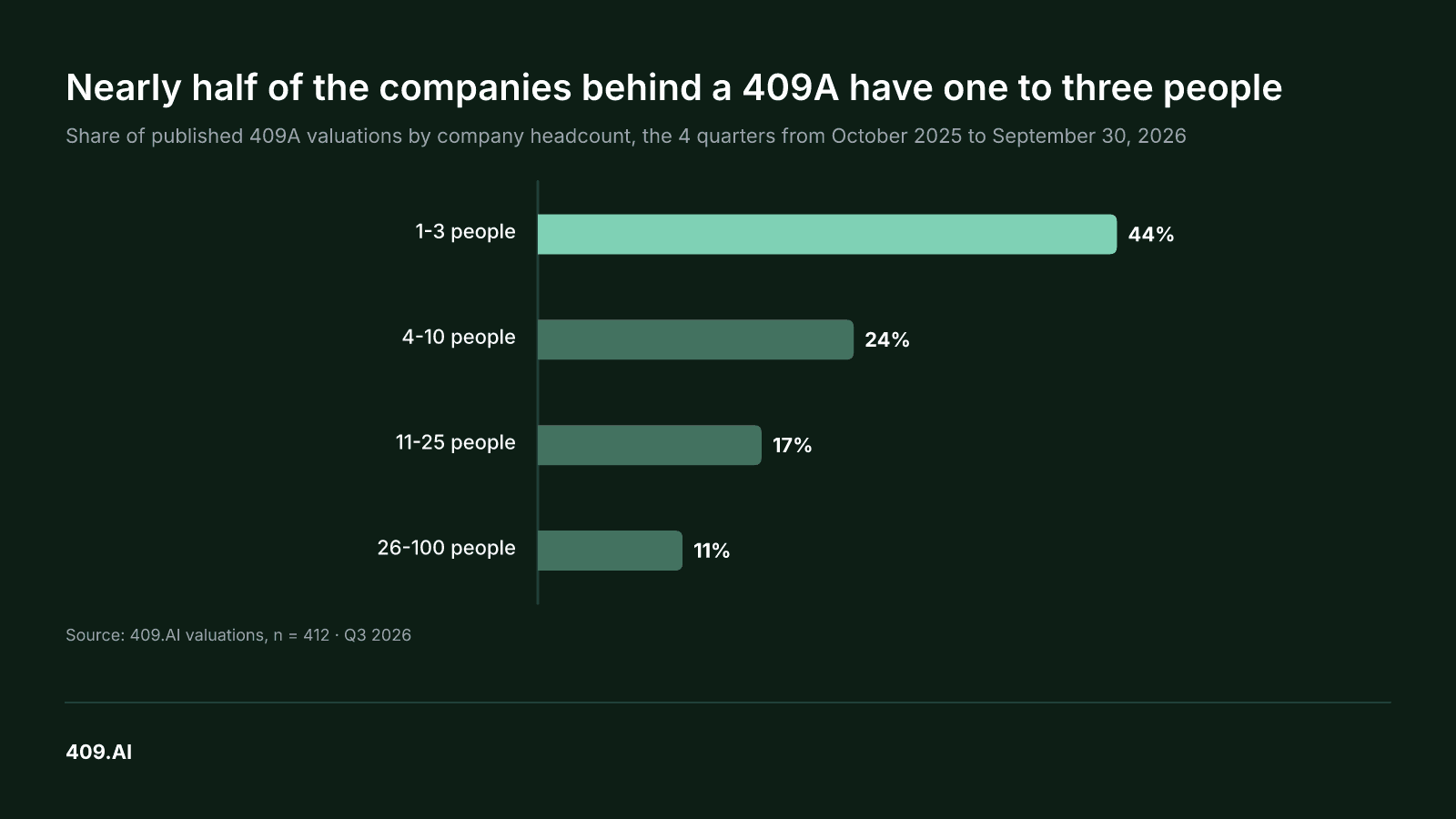
Nearly half of the companies have one to three people
[](https://www.409.ai/uploads/who_orders_a_409a_headcount_revenue_status_last_round_409ai_data_q3_2026_chart_1_b21e6bde6c.png)
Forty-four percent of the valuations belong to companies with one to three people, and another 24% to companies with four to ten. Together that is the bulk of the work. Companies with 26 to 100 people account for 11%, and the two largest size bands in our data, 101 to 250 and 250 or more, had too few valuations to show.
The reason is simple. A 409A exists to support an option strike price, and the first strike price is needed at the moment a company wants to grant options to anyone who is not a founder. That moment arrives when the team is still tiny: the first engineer, an advisor, an early designer. The headcount is small because the company is early, not because it is unusual.
For a one-person or three-person company, this changes the question worth asking. It is less "are we big enough to need a valuation?" and more "have we granted, or are we about to grant, anything at all?" We cover that threshold in [what to do before the first option grant](https://www.409.ai/articles/first-409a-valuation-pre-revenue-startup-before-first-option-grant), and why the board approval date matters in [the grant date and strike price piece](https://www.409.ai/articles/option-grant-date-board-approval-409a-strike-price).
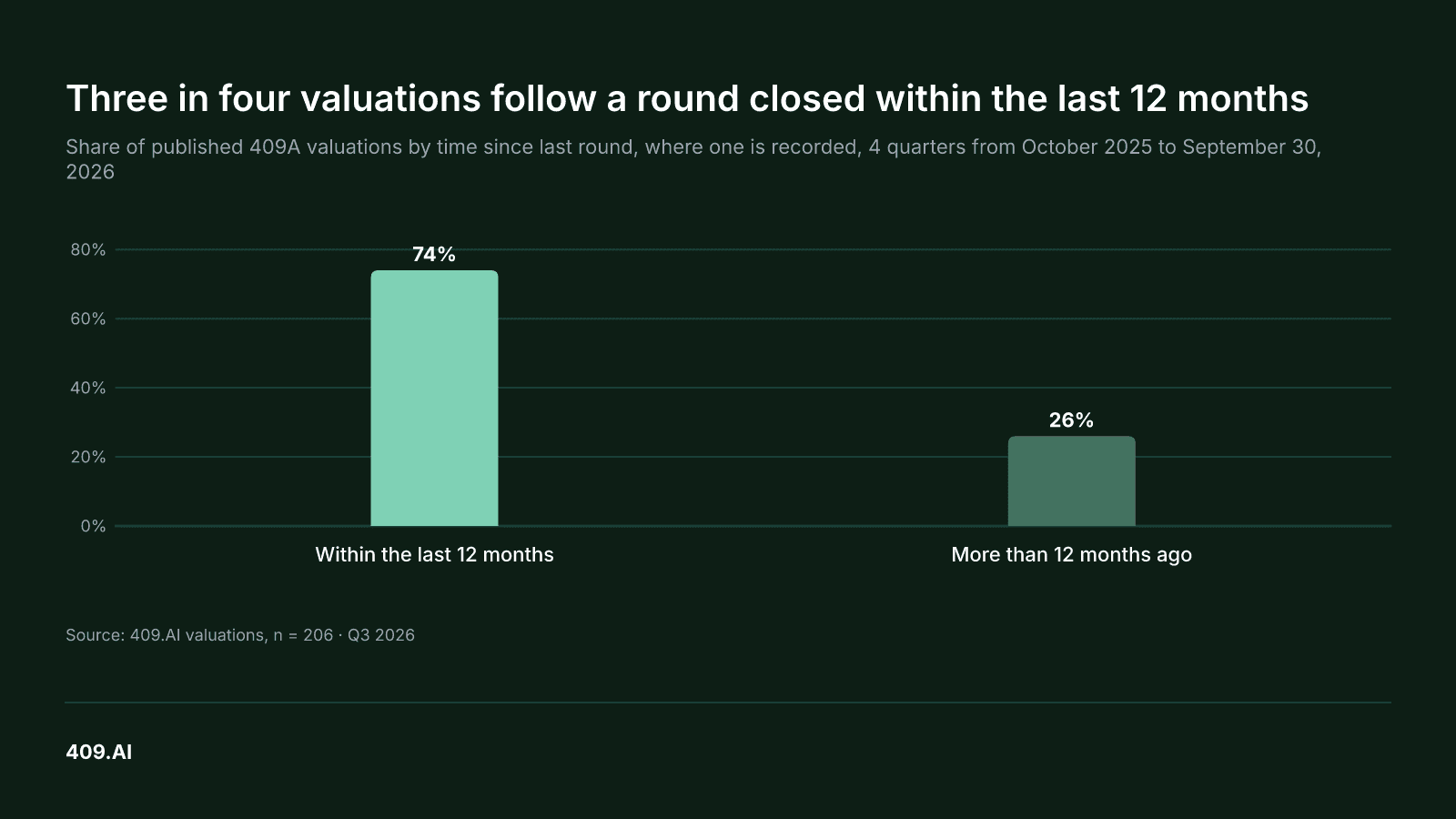
Three in four had a round in the past year
[](https://www.409.ai/uploads/who_orders_a_409a_headcount_revenue_status_last_round_409ai_data_q3_2026_chart_2_5c0b4752f1.png)
This chart covers the valuations where a last round is on record, 206 of the 412. Of those, 74% followed a round closed within the previous 12 months, and 26% came more than a year after the last one.
Read that against the rule most founders know. The familiar guidance is that a 409A lasts twelve months. The data suggests the round, not the calendar, is what actually brings people in. A new financing is the event that changes what the common stock is worth and the event that usually comes with new hires and new grants, so the valuation follows it.
That is also the correct instinct under the rules. A financing is a material event, and a valuation that predates it can stop supporting a strike price long before its twelve months are up. [Our piece on bridge rounds](https://www.409.ai/articles/bridge-round-409a-material-event-option-grant-timing) goes through why even a small bridge counts, and [the one on valuation frequency](https://www.409.ai/articles/409a-valuation-frequency-how-often-should-you-get-one) covers the twelve-month clock. If you closed a round in the past year and your last 409A is older than that round, you are in the majority of our customers, and you are probably due.
The 26% who came more than twelve months after their last round are worth a sentence too. Those are companies that kept operating between financings and still needed a current valuation, whether for a new hire, a refresh or a reporting need. A quiet fundraising calendar does not mean a quiet equity calendar.
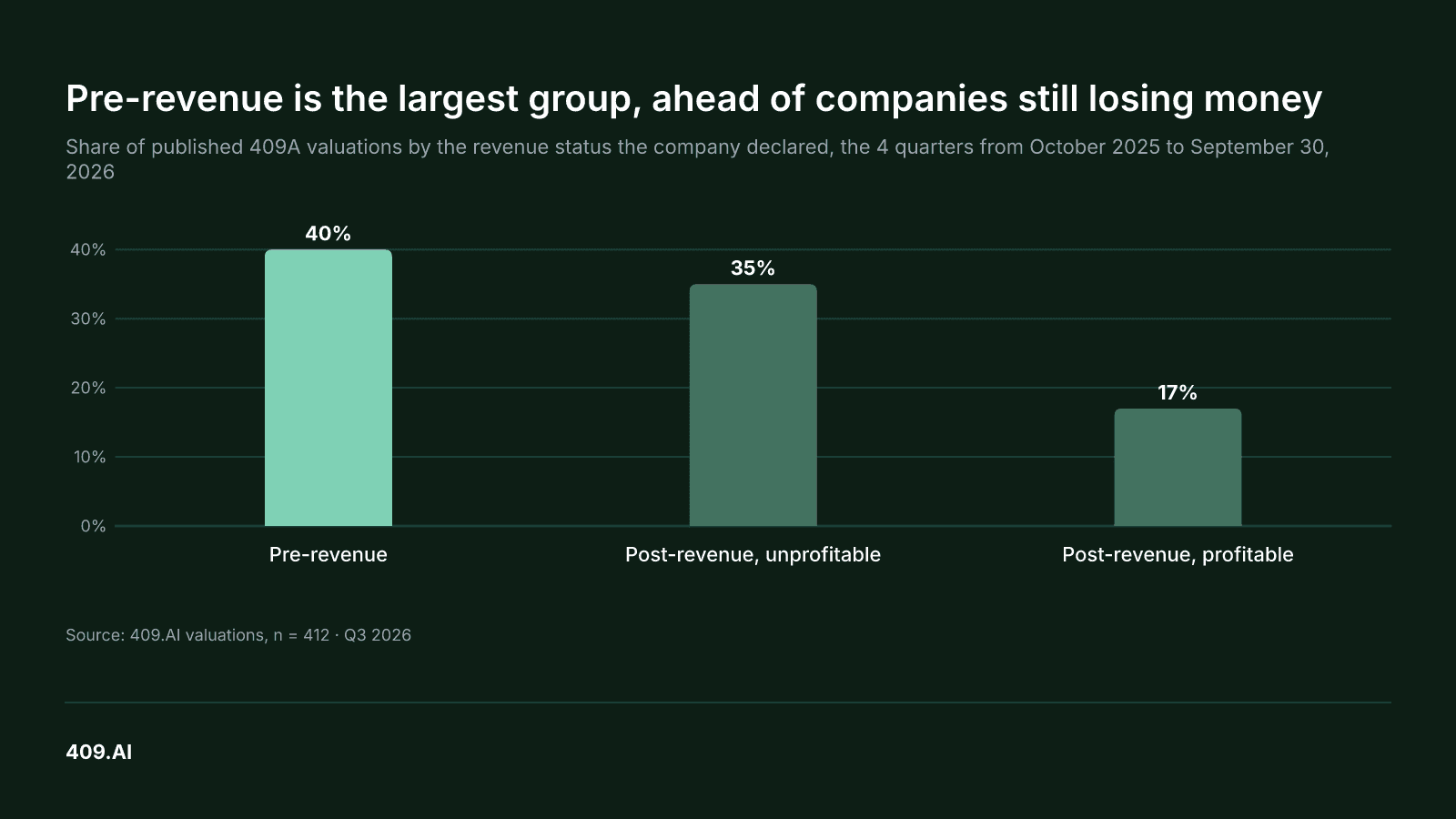
Most are pre-revenue or still losing money
[](https://www.409.ai/uploads/who_orders_a_409a_headcount_revenue_status_last_round_409ai_data_q3_2026_chart_3_fe65b663b5.png)
When a company orders a valuation it tells us where it stands: pre-revenue, post-revenue but unprofitable, or post-revenue and profitable. Forty percent say pre-revenue, 35% say post-revenue and unprofitable, and 17% say profitable. A small group that described itself as breakeven was too small to show.
Pre-revenue is the largest single group, and it matters for what a valuation can lean on. Without revenue or earnings there is little for an income approach to work with, so the report tends to rest on the most recent financing and on how the preferred and common stock split the value. If that describes your company, the useful preparation is the financing documents and an honest picture of runway, not a revenue forecast. [How SAFEs affect a 409A](https://www.409.ai/articles/how-safes-affect-your-409a-valuation) is worth reading if your last round was one.
One caution about this chart. It shows what companies declare, which is a self-description. It is not the same thing as the stage the valuation assigns, and the next chart shows how the two differ.
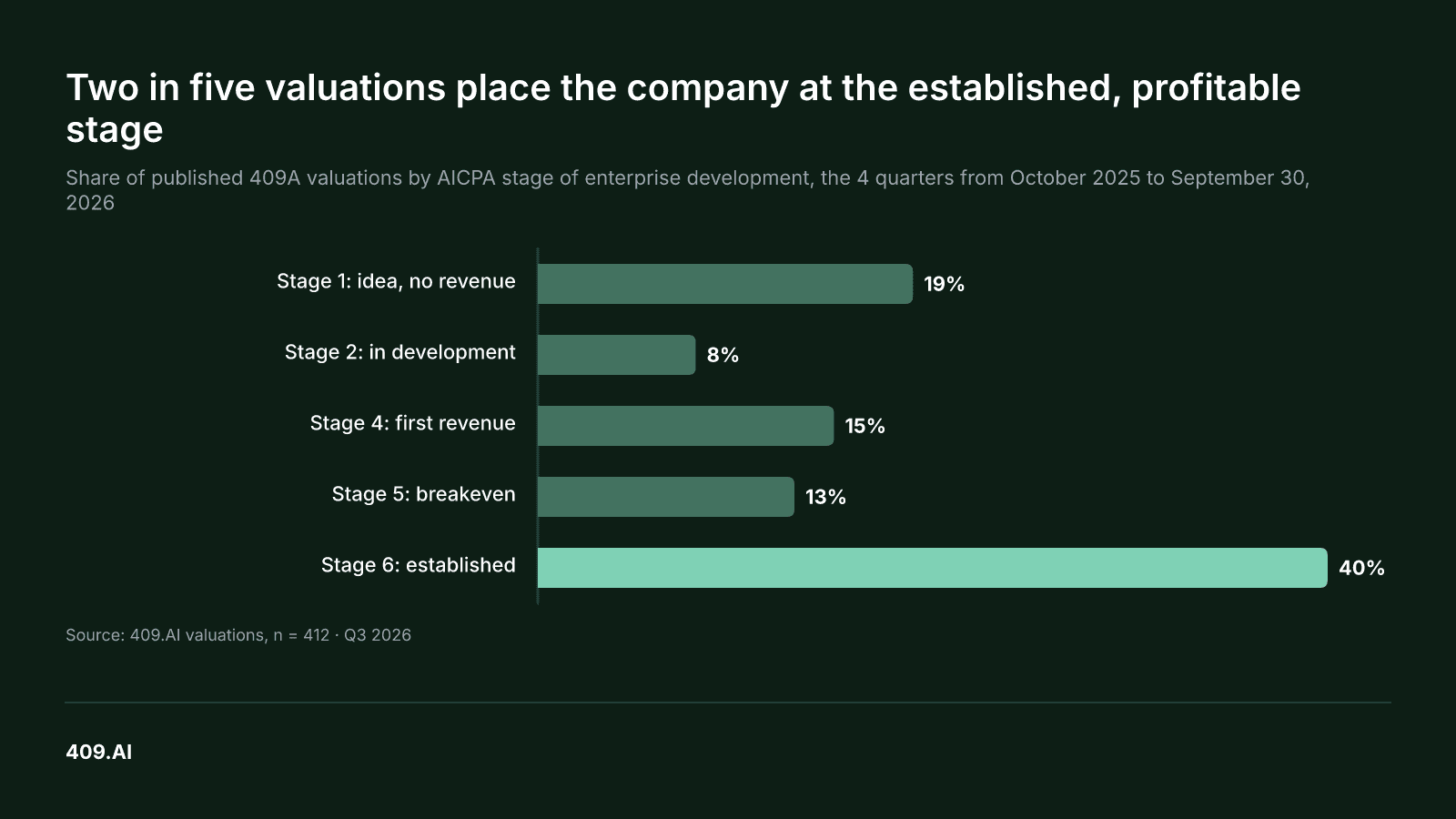
The stage the valuation assigns is a different measure
[](https://www.409.ai/uploads/who_orders_a_409a_headcount_revenue_status_last_round_409ai_data_q3_2026_chart_4_fed284eafd.png)
Here is the part that surprises people. Forty percent of the valuations land at stage 6, the AICPA's established, profitable stage, while only 17% of companies declared themselves profitable. Stage 1, the idea stage, holds 19%, and the stages in between hold the rest. Stage 3, near-complete product with no revenue, had too few valuations to show.
The two charts measure different things. The declared status is a simple statement about revenue and profit. The AICPA stages of enterprise development, which the valuation uses to place the company in its life cycle, take in more than revenue: the maturity of the product, the team, the funding history and the likelihood of an exit in the form the valuation assumes. A venture-backed company with a real team and a Series A can sit at a late stage in the valuation while still telling us, accurately, that it loses money.
For a founder reading a draft report, the practical point is not to be alarmed by a stage that sounds more advanced than your income statement. The stage describes where the company sits in its development, and it feeds the allocation and the discount the report applies. If the stage in your draft looks wrong given your facts, that is a fair question to ask the provider, and the answer should be in the report's reasoning. [The difference between a safe-harbor price and a qualified appraisal](https://www.409.ai/articles/409a-safe-harbor-price-vs-qualified-appraiser) explains why those reasoning pages are worth reading, not skimming.
What this means if you are about to order one
Put the four charts together and the typical valuation looks like this: a team of one to three, pre-revenue or losing money, a round closed in the last twelve months, and a first or second set of option grants waiting on the strike price. If that is you, you are neither early nor unusual.
So the planning is concrete. Order the valuation when the round closes, not when the twelve-month mark approaches. Have the financing documents ready before you ask, because they carry most of the weight for a company without revenue. And read the stage and discount pages of the report with the declared-versus-assigned difference in mind. When you are ready, [409.AI's 409A valuation](https://www.409.ai/products/409a) starts from exactly these inputs. For the marketability discount and volatility behind the strike price, see the earlier [409.AI Data story on the discount by stage and quarter](https://www.409.ai/articles/409a-dlom-by-stage-and-quarter-409ai-data-q3-2026).
How we measured
The population is every 409A valuation 409.AI published through September 30, 2026. The shares by headcount, declared revenue status and AICPA stage cover the 412 valuations published in the four quarters from October 2025 to September 30, 2026. The time since the last round is recorded for 206 of those 412, and its shares are of those 206 only. Every group shown has at least 30 valuations; groups with fewer are left out, which is why some size bands, one declared status and one stage do not appear. Shares are rounded to the nearest whole percent, so a chart may not add to exactly 100. The data was read on October 22, 2026, and contains no company names, people or individual valuations.